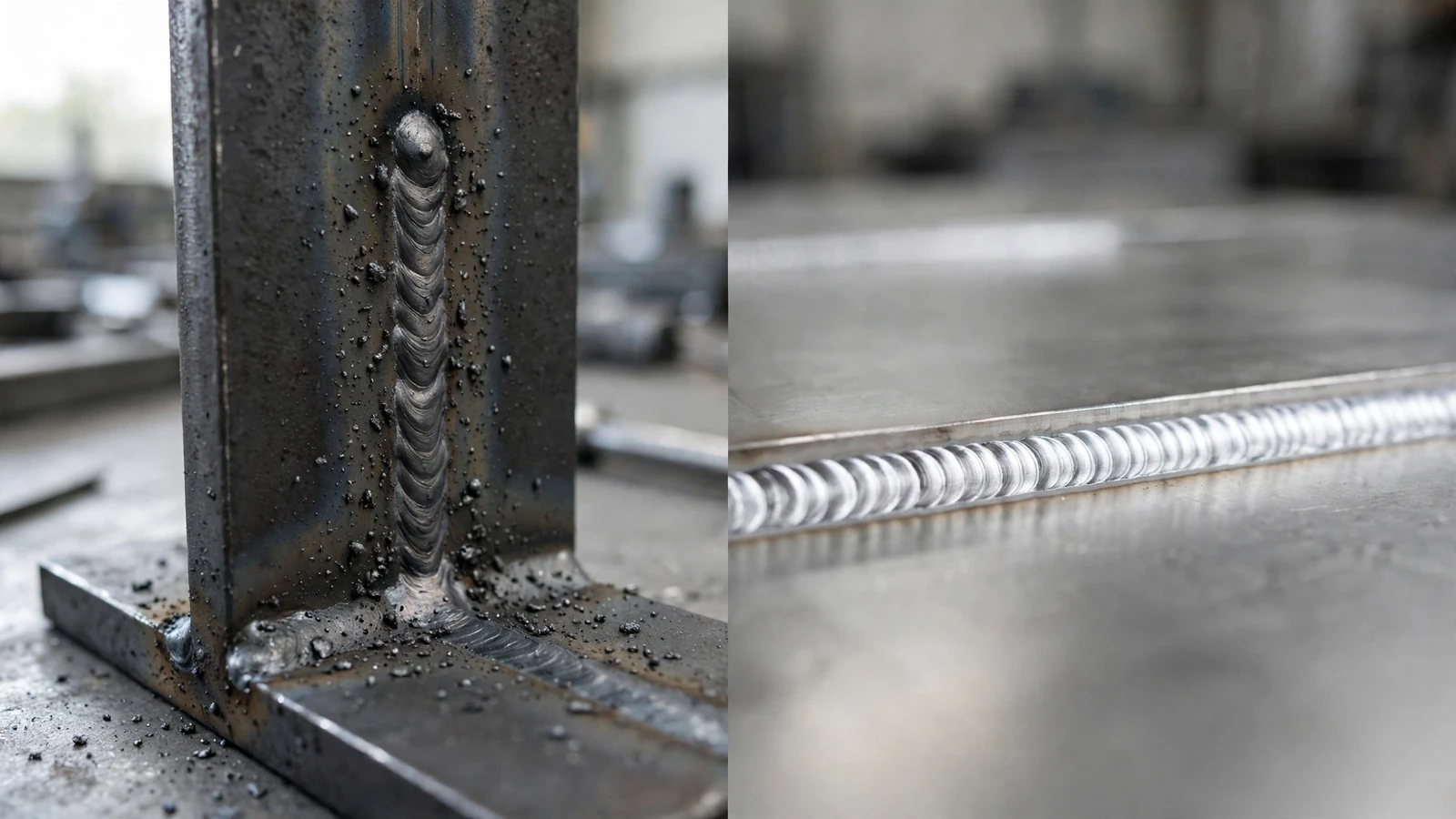
The core of MIG vs TIG welding is how filler metal is added. MIG feeds a consumable wire through the gun, so it is fast and easy to learn. TIG uses a non-consumable tungsten electrode and a separate filler rod, so it is slower but gives far more control, cleaner welds and better results on thin or visible parts.
Quick answer: Choose MIG for speed, thicker material and lower cost per part. Choose TIG for thin sheet, stainless steel, aluminum, and welds that must look clean or be leak-tight. Both can produce welds as strong as the base metal when the procedure is right; the difference is speed and control, not inherent strength.
Whether you search for TIG and MIG welding or the other way round, the question is the same, so this guide compares the MIG and TIG processes from a fabricator’s point of view: what each does well, how to choose by material and thickness, what drives cost, and the mistakes that cause rework.
MIG and TIG welding are both arc welding processes protected by shielding gas. The difference between MIG and TIG welding comes down to the electrode.
MIG welding, short for metal inert gas and also known as gas metal arc welding (GMAW), feeds a solid wire electrode from a spool through the welding gun. The wire is both the electrode and the filler metal, and it melts into the joint continuously while you pull the trigger.
TIG welding, short for tungsten inert gas and formally called gas tungsten arc welding (GTAW), strikes the arc from a tungsten electrode that does not melt. The welder adds filler by hand from a separate rod, or welds without filler on suitable thin joints, and usually controls the current with a foot pedal or fingertip control.
That one design choice drives everything else: speed, skill required, cleanliness, cost, and which jobs each process suits.
Understanding the differences, along with the similarities and differences in setup, makes it easier to judge either process for a welding project. MIG welding is often the default in production shops, while TIG welding is often reserved for parts where the weld will be seen or must seal.
| Factor | MIG (GMAW) | TIG (GTAW) |
|---|---|---|
| Electrode | Consumable wire, also the filler | Non-consumable tungsten |
| Filler metal | Fed automatically | Added by hand (or none) |
| Shielding gas | Argon/CO₂ mix for steel; argon for aluminum | Pure argon (sometimes argon/helium) |
| Speed | Fast, high deposition | Slow |
| Skill to learn | Low to moderate | High |
| Control and precision | Moderate | Excellent |
| Appearance | Good, some spatter | Very clean, no spatter |
| Best thickness range | Medium to thick | Thin to medium |
| Aluminum | Possible with spool gun or push-pull | Excellent with AC |
| Outdoor use | Poor (gas blows away) | Poor (gas blows away) |
| Cost per meter of weld | Lower | Higher |
| Typical uses | Frames, brackets, structural parts, production runs | Stainless enclosures, aluminum parts, tubing, visible welds |
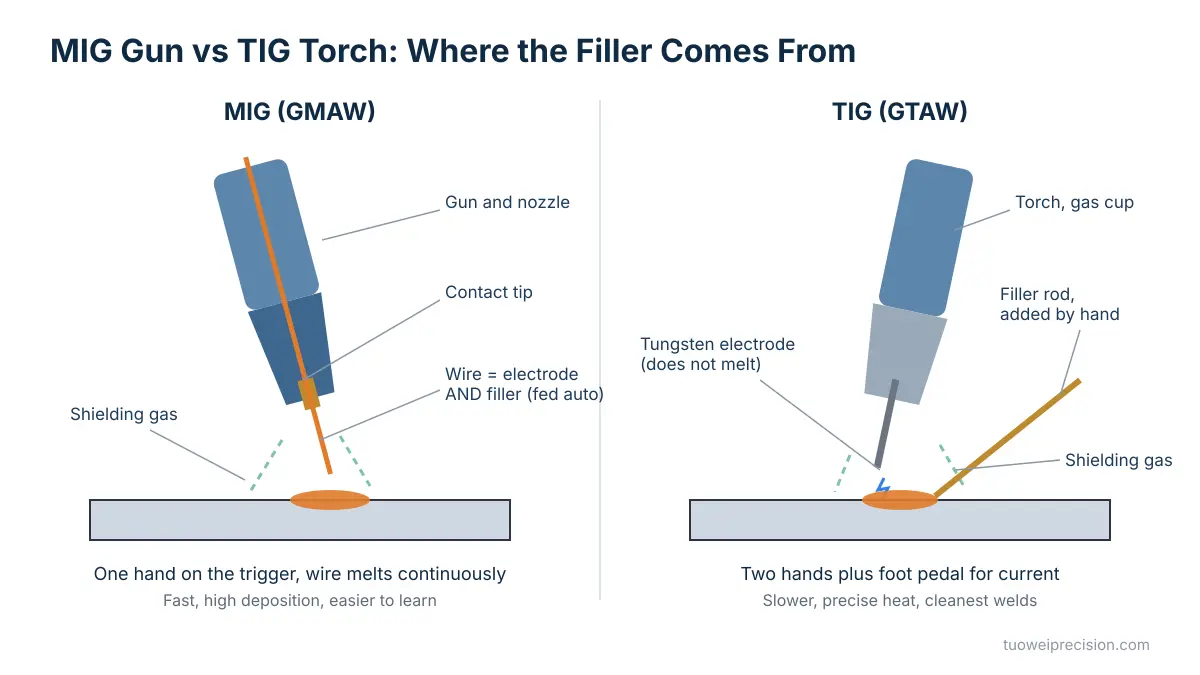
If the table had to be reduced to one line: MIG is the production process, TIG is the precision process. Everything else in choosing the right welding process follows from that.
A MIG welder pushes wire through a liner to the contact tip, where current transfers into it and an arc forms with the workpiece. Shielding gas flows around the arc to keep oxygen and nitrogen out of the molten pool. For mild steel, a 75% argon and 25% CO₂ mix is the most common shop choice.
MIG welding equipment is simple: a power source, wire feeder, gun and gas bottle. The MIG process is generally forgiving, and MIG welding is faster on long seams thanks to faster welding speeds and continuous wire feed.
Advantages of MIG welding:
Limitations:
A TIG welding torch holds a sharpened tungsten electrode inside a gas cup. The welder strikes an arc, forms a small molten pool, and dips filler rod into it as needed. Direct current is used for steel and stainless; alternating current is used for aluminum because it breaks up the tough oxide layer on the surface.
TIG welding equipment adds a foot pedal and, on heavier work, a water-cooled torch. TIG welding requires steady hands, and the TIG process is slower than MIG welding, but TIG welding produces the cleanest bead of the common arc processes. A skilled TIG welder can control heat finely enough for foil-thin parts, so TIG welding offers control where MIG offers speed.
TIG welding advantages:
Limitations:
Neither process is automatically stronger, which surprises many people reading TIG vs MIG welding comparisons. A properly made weld from either process can match or exceed the strength of the base metal, because strength depends on fusion, filler choice and the welding procedure.
Where TIG earns its reputation is consistency. Its precise control makes it easier to get full fusion and fewer defects on thin material and critical joints, so TIG welds are less likely to hide flaws. MIG, used with correct settings, is fully capable of strong structural welds on thicker steel and is the standard process for much of that work.
Our view is simple: specify the process the joint needs, then specify inspection if strength is critical. A good procedure matters more than the letters on the machine.
On the learning curve the two are not close: MIG welding is easier to learn, especially for beginners. The machine feeds the wire, the welder controls gun angle and travel speed, and acceptable welds on mild steel come within a few practice sessions for most people.
Welding technique matters far more with TIG, because the welder manages arc length, torch angle, filler rod and amperage at the same time. Many welders learn MIG first, then move to TIG once they understand how a weld pool behaves. For people choosing what to learn for fabrication work, TIG skills are often in higher demand, precisely because they take longer to master.
This is where the welding method, and the whole TIG vs MIG welding question, usually gets settled in a fabrication shop. The table reflects common practice; procedure qualification and customer specifications override it.
| Material and thickness | Usual choice | Why |
|---|---|---|
| Mild steel, thicker sections and frames | MIG | Speed and deposition |
| Mild steel sheet, thin gauge | TIG, or MIG with care | TIG avoids burn-through; MIG is faster if fit-up is good |
| Stainless steel, visible or sanitary | TIG | Clean welds, low distortion, less finishing |
| Stainless steel, structural brackets | MIG | Faster where appearance matters less |
| Aluminum sheet and small parts | TIG (AC) | Best control and appearance |
| Thick aluminum, production | MIG with spool gun or push-pull | Higher deposition |
| Chromoly and thin-wall tubing | TIG | Control on thin walls |
| Copper alloys, titanium | TIG | Precise heat and gas coverage |
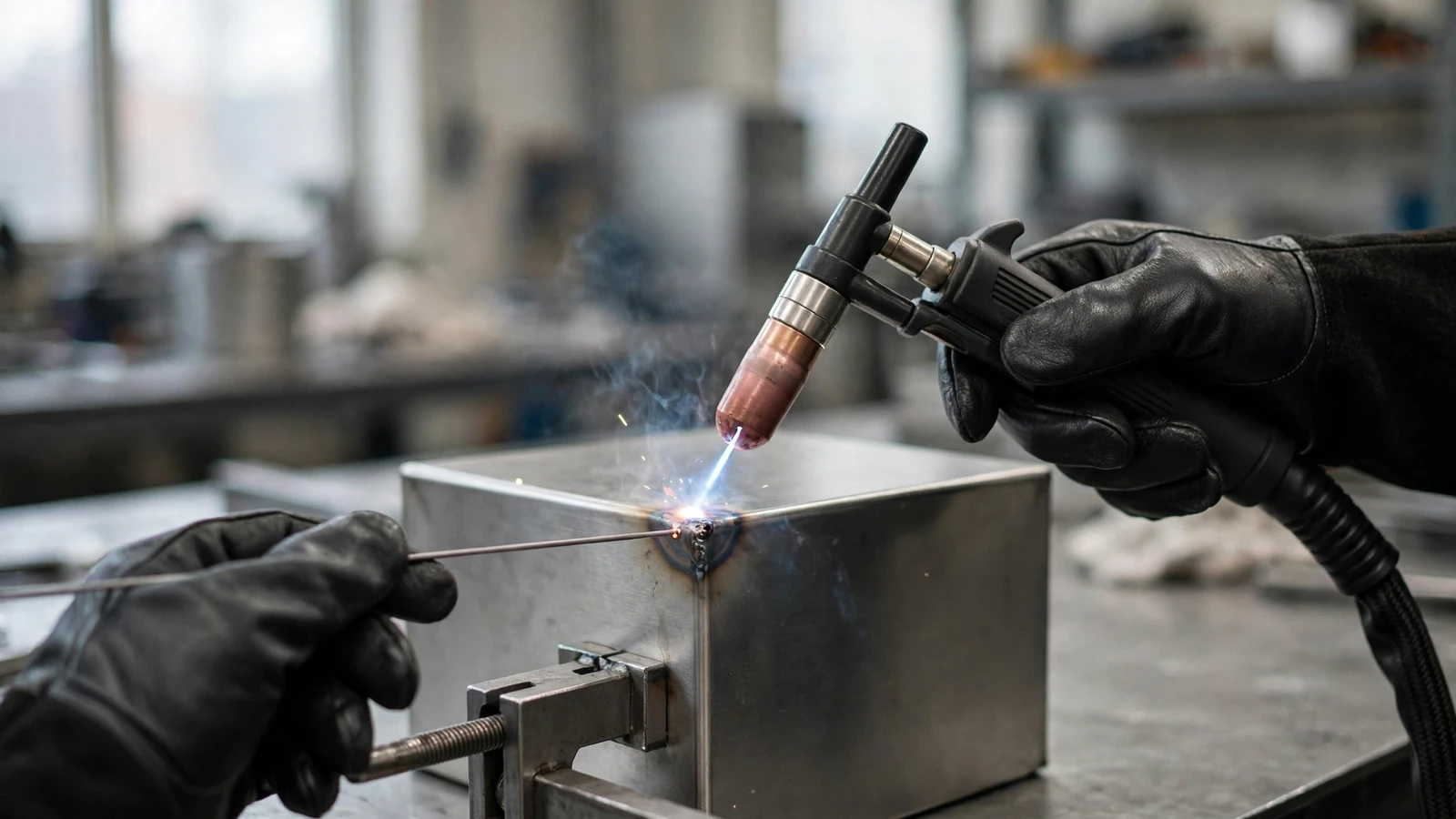
Thin stainless enclosures show why the choice between MIG and TIG processes matters. MIG can weld them, but the extra heat and spatter often mean more distortion and finishing. TIG takes longer at the torch but frequently saves time overall because the part needs little straightening or grinding afterward.
If you only need a fast answer about which type of welding process to use, run through these questions in order and stop at the first “yes”:
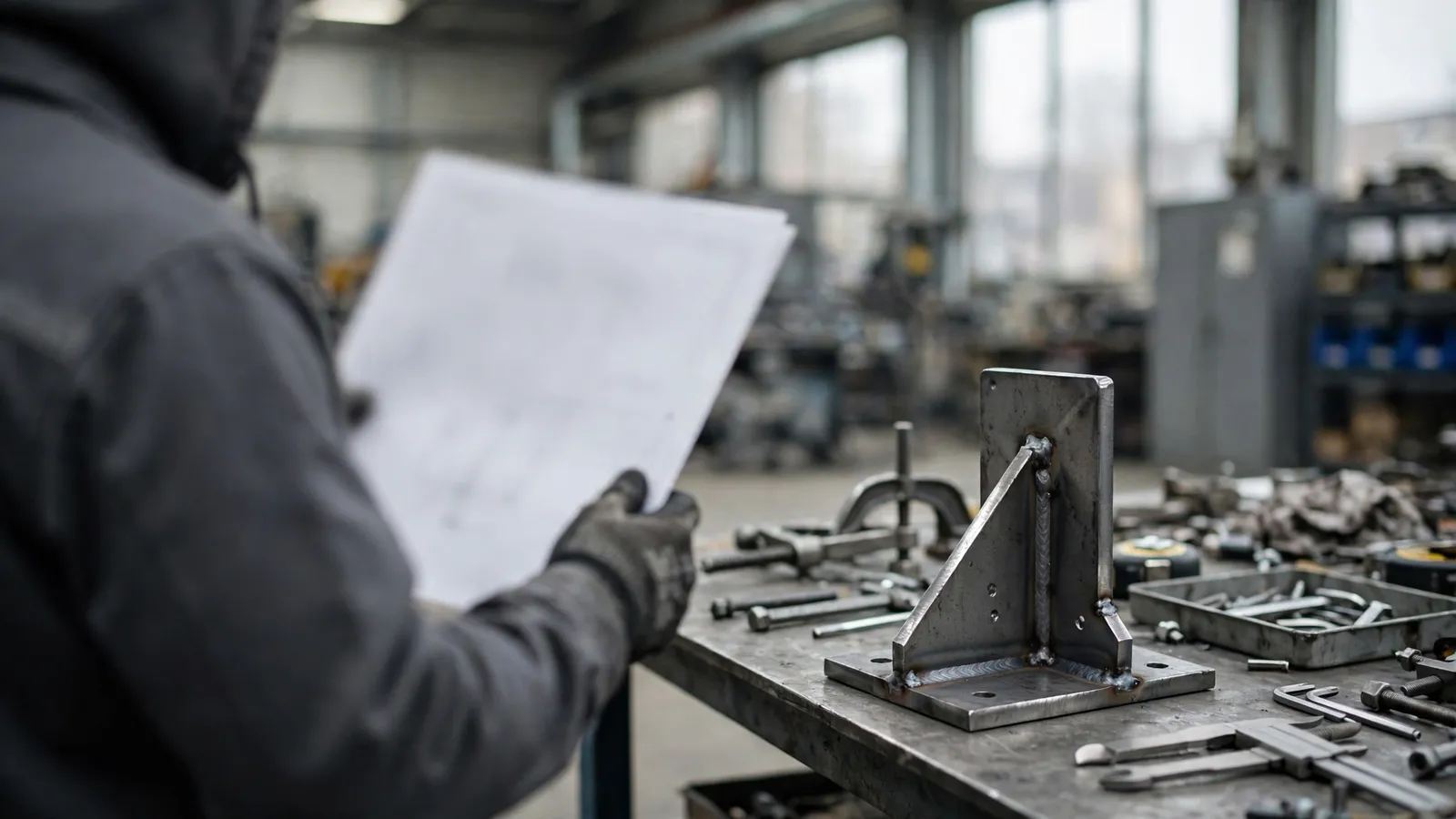
The right type of welding changes from one joint to the next, even on the same assembly. Many of the frames we build use MIG on the structure and TIG on visible or thin features.
Two other processes often come up alongside MIG and TIG welding. Stick welding is also the cheapest setup to buy, which keeps it popular for repairs.
| Process | Shielding | Best for | Main drawback |
|---|---|---|---|
| MIG (GMAW) | External gas | Fast shop welding on clean metal | Gas blows away outdoors |
| TIG (GTAW) | External gas | Precision, thin and visible welds | Slow, high skill |
| Stick (SMAW) | Flux coating on the rod | Outdoor, dirty or rusty steel, repairs | Slag removal, less clean |
| Flux core (FCAW) | Flux inside the wire, optional gas | Outdoor and thick steel, high deposition | Slag, more fumes |
In the mig vs tig vs stick debate, stick wins outdoors and on site, MIG wins on productivity in the shop, and TIG wins on quality and appearance. Flux core sits between MIG and stick, offering MIG-like speed with better tolerance for wind.
Equipment price is the cost most comparisons mention, but for production parts it is rarely the deciding factor. What usually decides cost per part:
When we compare MIG and TIG welding on a quote, the question is total time, not torch time. A TIG-welded stainless panel that ships without finishing can cost less than a MIG version that needs grinding and straightening.
These are the defects we see most often on welded parts, and their usual causes.
Most of these are procedure problems that affect MIG and TIG welding alike, not process problems. Choosing TIG will not fix poor gas coverage, and choosing MIG will not fix poor fit-up.
If the process matters to you, say so on the drawing. Under AWS A2.4, the process designation goes in the tail of the welding symbol: GMAW for MIG and GTAW for TIG. Our guide to reading welding symbols explains where it sits and what the rest of the symbol means.
If you do not specify a process, the fabricator will choose. That is often fine, but for visible stainless welds, leak-tight joints, or thin aluminum, naming GTAW avoids a surprise.
Not overall; it is better for certain jobs. TIG gives more control, cleaner welds and better results on thin material, stainless steel and aluminum. MIG is faster, easier to learn and cheaper per part on thicker steel. Most fabrication shops use both and pick the process to suit each joint.
Not inherently. Both can produce welds as strong as the base metal when the procedure, filler and fusion are correct. TIG is more consistent on thin and critical joints because its precise control reduces defects. MIG is fully capable of strong structural welds on thicker material with proper settings and inspection.
MIG. The machine feeds the wire automatically, so a beginner only manages gun angle and travel speed, and can make sound welds on mild steel quickly. TIG requires coordinating a torch, filler rod and amperage control at once. Many welders start with MIG and learn TIG once they understand weld pool behavior.
Yes. Aluminum MIG welding uses pure argon gas and usually a spool gun or push-pull system, because soft aluminum wire tangles in a standard liner. MIG is fast and practical for thicker aluminum in production. For thin aluminum sheet or welds where appearance matters, AC TIG welding usually gives better control and a cleaner finish.
Yes. TIG always needs an inert shielding gas, usually pure argon, to protect the tungsten electrode and the weld pool. Without it, the tungsten burns away and the weld becomes porous. MIG also normally uses gas, although flux-cored wire allows gasless welding, which is why flux core is popular outdoors.
The best answer to MIG vs TIG welding depends on the part, not the process. Use MIG for speed on thicker steel and production assemblies. Use TIG for thin sheet, stainless steel, aluminum, and any weld that must look clean or hold pressure. When you are unsure, describe the joint, material and finish you need, and let the fabricator propose the process.
At Tuowei, we use both processes inside our sheet metal fabrication service, alongside laser cutting and precision metal bending, so welded assemblies are planned from cutting through finishing. For background, see our overview of what sheet metal fabrication involves.
Request a quote for your welded parts or visit Tuowei Precision to explore our full capabilities.
Sources and further reading
Process recommendations reflect common fabrication practice. Qualified welding procedures and customer specifications always take priority.