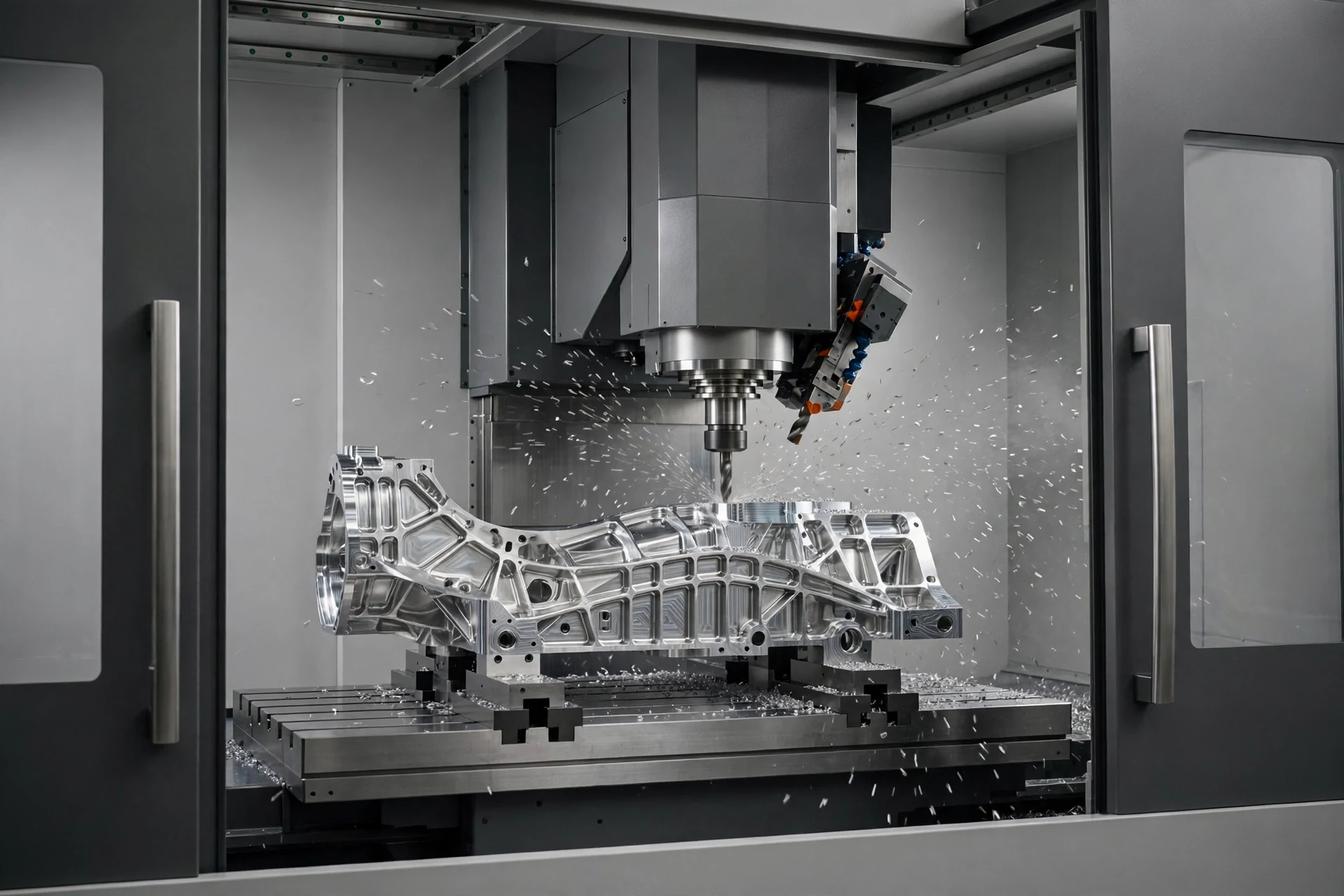
A 5 axis CNC machine is a computer-controlled mill that moves a cutting tool in five different directions at once. Three are linear and two are rotary, so the tool can reach almost any face of a part without a new setup. If you are new to the basics, start with our guide on what CNC machining is and how it works, then come back here for the 5-axis detail.
So what is a 5 axis cnc machine? It is a CNC machine tool, a milling machine and a type of CNC machining center, with five axes of motion instead of three. A 3-axis machine moves the cutting tool left and right, forward and back, up and down. A 5-axis machine adds two rotary axes, which tilt and rotate the workpiece or the spindle, so the tool can approach the part from any angle.
That extra motion is the whole point of precision machining. A 5-axis CNC machine can mill complex geometries, angled holes, and contoured surfaces in a single setup, where a 3-axis machine would need the part repositioned several times. Each move adds time and a small chance of error, so cutting that out improves speed and precision.
The five axes are three linear axes and two rotary axes. The linear axes move the cutting tool in straight lines. The rotational axes turn the workpiece or the tool head, which changes the angle of the cut. Together, the five axes let the machine reach five sides of a part without unclamping it.
Most 5-axis machines use the A axis with the C axis, or the B axis with the C axis. The exact pair matters less than the result: the tool can tilt and the workpiece can turn, so the machine can cut angled faces, undercuts, and curved surfaces that a 3-axis mill cannot reach.
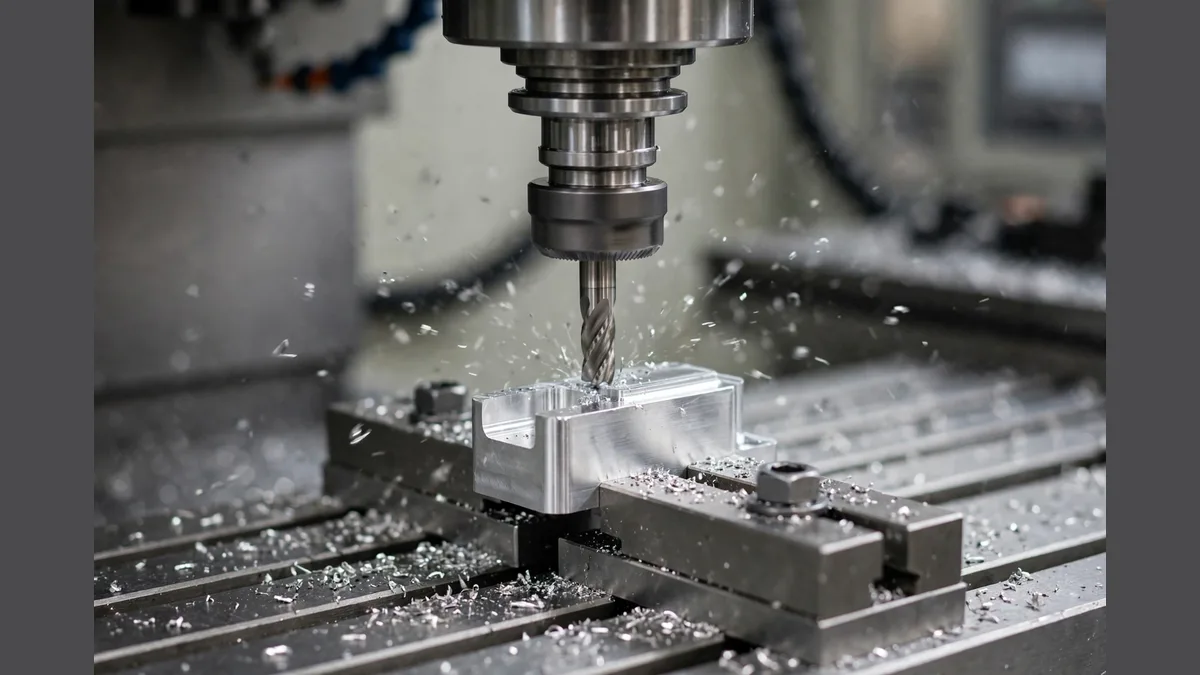
The CNC machining process starts with a CAM program that controls all five axes at once or in sequence. The CNC setup is simple: the operator loads the workpiece, and the program drives the tool while the rotary axes hold or move the part. The cutting tool stays short and rigid because it can tilt toward the surface instead of reaching around the part. An automatic tool changer swaps cutters without stopping the machine.
In 3+2 machining, the two rotary axes position the workpiece at a fixed angle and then lock. The cut itself uses only the X, Y, and Z axes. This simpler form of multi-axis CNC machining already removes most of the repositioning a 3-axis job needs. It works well for angled holes and faces that can be reached from one fixed tilt.
In simultaneous 5-axis machining, all five different axes simultaneously move together while the tool is cutting. The tool stays perpendicular to a curved surface as it follows the contour, which gives a smoother surface finish and a more even chip load. This is the method used for turbine blades, impellers, and other complex parts with flowing curves.
True simultaneous work needs RTCP, rotation tool center point control, a feature of modern CNC technology. RTCP keeps the cutting tool tip on the programmed path while the rotary axes move, so the operator does not recalculate the tool position by hand, and it helps avoid tool interference on steep walls. Without RTCP, simultaneous 5-axis work is far harder to program on modern machine tools and far easier to get wrong.
There are several machine types, and each machine configuration delivers rotary motion in its own way. The right machine capability depends on the size and shape of the parts, and the cutting result is similar across all of them.
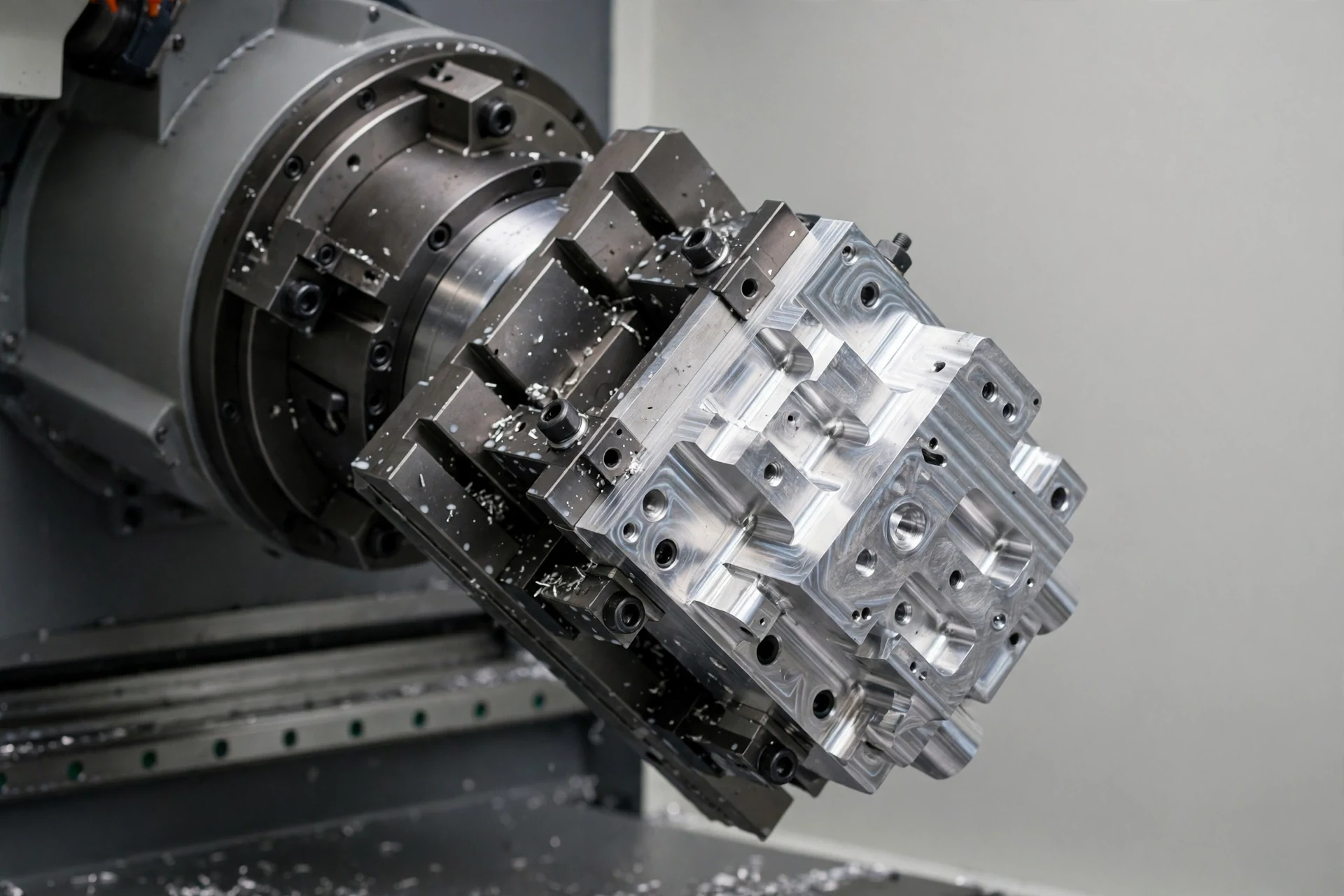
A trunnion machine tilts and rotates the workpiece on a machine table while the spindle stays fixed. The A axis moves first, tilting the table, and the C axis rotates it. Trunnion machines are common for smaller parts, and they keep the spindle simple, which helps rigidity and precision.
A tilting head machine swings the spindle while the table rotates the workpiece. Tilting-head machines allow larger or heavier parts that are hard to tilt on a table. The head carries the extra rotary axes, so the machine can reach deep cavities and tall walls without a long tool.
Gantry 5-axis CNC systems move a bridge over a large fixed table, which suits long parts such as aerospace spars and large molds. Mill-turn machines combine milling with a lathe spindle, so a round part can be turned and milled in one setup, unlike traditional CNC machines that need two setups. Some mill-turn machines add even more axes, see the FAQ below.
3-axis machines are simpler and cheaper, and they are the right choice for flat parts with features on one or two faces. A 5-axis machine earns its place when a part has angled faces, curves, or features on several sides.
| 3-Axis CNC Machine | 5-Axis CNC Machine | |
|---|---|---|
| Axes of motion | X, Y, Z only | X, Y, Z plus two rotary axes |
| Setups per part | Often several | Usually one, sometimes two |
| Complex geometries | Limited | Curves, undercuts, angled faces |
| Surface finish on curves | Stepped, needs more handwork | Smoother, tool stays normal to the surface |
| Best for | Flat parts, simple brackets | Complex parts, multi-sided parts |
The main benefit is fewer setups. A part that needs five setups on a 3-axis machine often needs just one on a 5-axis machine. Each setup you remove saves clamping time and removes the small alignment error that comes with moving a part. Features cut in a single setup stay consistent, which matters for tight tolerance work. It also means less handling between setups, and it changes the manufacturing process itself.
A second benefit is tool reach. Because the tool can tilt, it can stay short and stiff during long machining operations while it reaches into a pocket or over a curved surface. A short tool vibrates less, cuts faster, and leaves a better surface finish. The machine can also use the side of the tool more effectively, which improves the finish on contoured shapes.
Five-axis machines are used where the shape is too complex for a 3-axis mill, or where the part needs several faces machined in one setup. They are a staple of modern manufacturing and precision manufacturing alike, used most in aerospace, medical, automotive, and mold making.
If the part is flat, with holes on one face, a 3-axis machine will usually do the job faster and cheaper. Five-axis machining earns its keep on parts where the shape itself is the challenge.
Five-axis CNC machining is worth it when the part has features on several sides, angled holes, or curved surfaces, or when one setup instead of five saves more time than the higher machine rate costs. It is also worth it when consistency between features matters, because CNC systems cut everything without moving the part.
For most simple parts, a 3-axis or 4-axis machine is the practical choice. A 4-axis machine adds one rotary axis, which is often enough for parts that need machining around a cylinder or on four sides.
For aluminum parts, the cost question is common enough that we covered it separately: see our guide on when 5-axis CNC machining is worth the cost for aluminum parts. Understanding 5-axis CNC starts with good CAD files, so see our notes on CAD files for 5-axis CNC machining before you send a request.
There is no single price for a 5 axis machine, and the machine itself is only part of the cost. A used CNC machine costs less than a new one, but the controller and CAM software matter just as much. A shop also pays for CAM software, tooling, workholding, training, and maintenance. The total depends on size, brand, and options, so any number you see online is only a rough guide.
For a buyer, the part price matters more than the machine price. Five-axis work usually costs more per hour than 3-axis work, but fewer setups and less handling can make the finished part cheaper. If you want a number for your part, send the CAD file and the drawing to a shop for a quote. Our 5-axis CNC machining services page explains what we make and how to request a quote.
A 5-axis CNC machine can mill complex parts with angled faces, curved surfaces, and undercuts in a single setup. It can make aerospace brackets, medical implants, impellers, turbine blades, and mold cavities. It can also drill angled holes and cut features on five sides of a part without repositioning it.
Yes, 7-axis CNC machines exist, mostly as mill-turn machines that add rotary axes to a lathe. The extra axes let the machine turn, mill, and drill a round part in one place. For most milled parts, five axes are enough, and the extra axes mainly help turned parts that conventional machining cannot finish.
A 5-axis CNC machine costs more than a 3-axis machine, and the price varies with size, brand, and options. The machine price is only part of the total, since CAM software, tooling, workholding, training, and maintenance add to it. For part pricing, request a quote, since part shape and quantity drive the price.
Yes, 6-axis CNC machines exist, usually as mill-turn machines that combine a lathe with milling axes. The sixth axis adds extra motion for complex turned parts, such as parts that need milling on a rotating workpiece. For most milled parts, a 5-axis machine is enough, and the sixth axis only pays off for turned work.
A 5-axis CNC machine works from a CAM program that controls three linear axes and two rotary axes. In 3+2 machining, the rotary axes position the part and lock, and the cut uses X, Y, and Z. In simultaneous machining, all five axes move together, which keeps the tool square to curved surfaces.