By Owen Lin, Engineer, Tuowei Precision · November 2026
Sheet metal fabrication is the process of turning flat metal sheets into finished parts by cutting, bending, joining and finishing them. A laser or punch cuts the flat shape, a press brake folds it into three dimensions, and welding, rivets or inserted hardware hold the pieces together.
Enclosures, brackets, chassis and panels are all made this way. So what is sheet metal fabrication best at? Strong, light parts with mostly uniform walls, made quickly and without expensive tooling.
Short answer: Sheet metal fabrication is a group of manufacturing processes that shape thin metal sheet, usually under about 6 mm thick, into parts. The four main stages are cutting the flat blank, forming it with bends, joining or assembling the pieces, and finishing the surface. It suits prototypes and production runs alike, in steel, stainless steel, aluminum and copper alloys.
This guide walks through each stage of the process, the materials and tolerances to expect, what the work costs, and the design mistakes that slow most projects down.
The word fabrication means building something by working and assembling material, as opposed to casting it from liquid or machining it from a solid block. In sheet metal fabrication, every part starts as a flat sheet of constant thickness. Its shape comes from removing material around the outline and folding what is left.
That constant thickness is the defining feature. A sheet metal part has the same wall thickness everywhere, apart from small local changes at bends. Ribs, bosses and thick sections are not possible the way they are on a machined or cast part. Stiffness comes from flanges, bends and formed features instead.
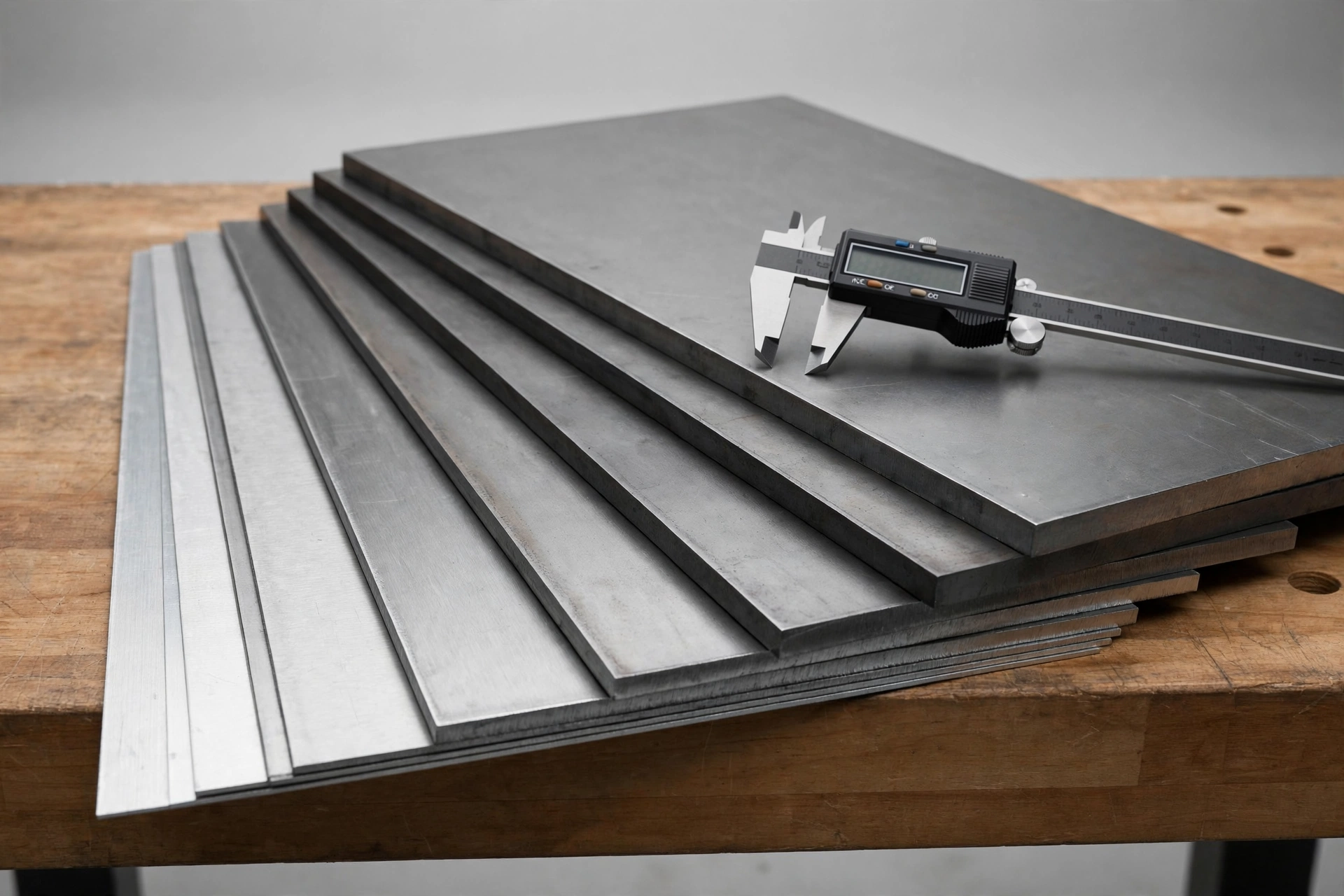
Most shops treat sheet as material up to roughly 6 mm (0.25 in) thick. Anything heavier is usually called plate and is handled with bigger cutting and forming equipment. Thickness is often given as a gauge number, but gauges mean different things for steel and aluminum, so our sheet metal gauge chart is worth checking before you fix a design.
When people ask about the three types of metal fabrication, they usually mean the three basic operations every fabricated part goes through:
Finishing is often added as a fourth stage. Some sources group the work differently, for example by industry (structural, commercial and industrial fabrication), so the answer depends on who is asking. For parts design, the cutting, bending and joining split is the useful one.
A typical custom part moves through the sheet metal fabrication process in this order:
For a simple bracket, steps 3 to 8 can take a few days. A welded and powder coated enclosure takes longer, because welding, grinding and coating each add their own queue. Most delays we see come before cutting starts, when a drawing has to go back to the customer to fix a bend that cannot be formed.
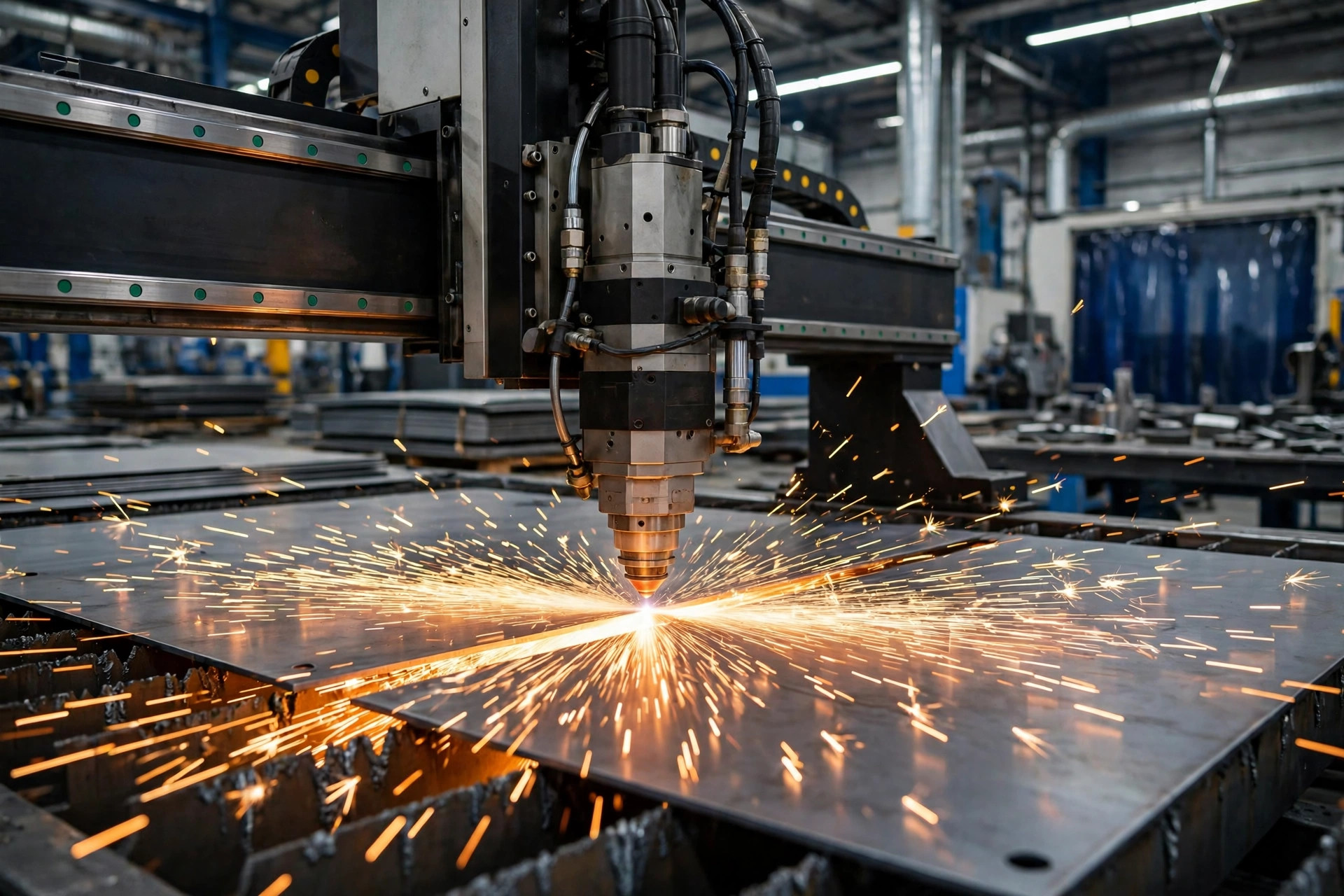
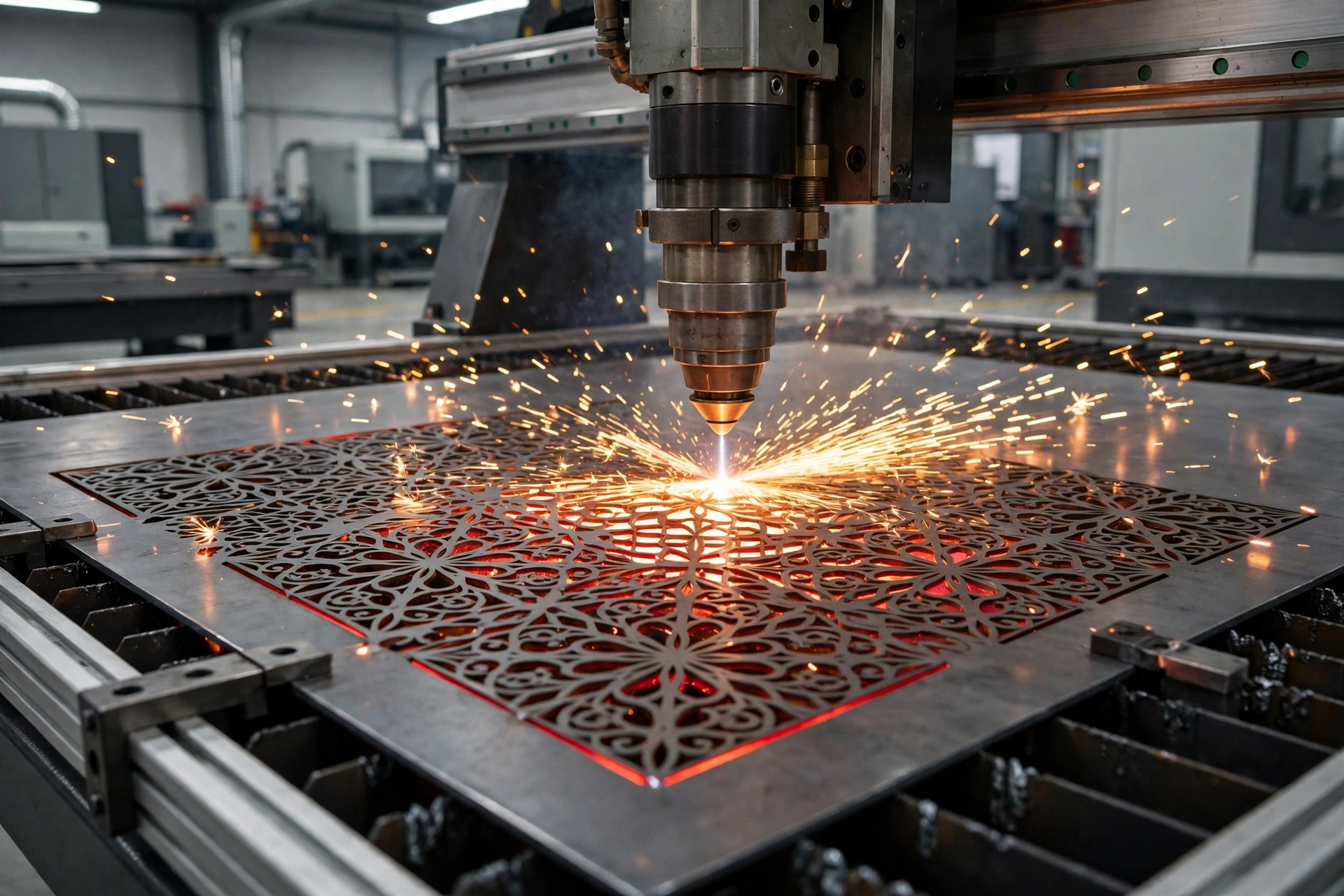
Cutting creates the flat blank, and it is usually the first machine step in sheet metal fabrication. The main options are:
Our view: for custom parts up to medium thickness, laser cutting is the right default, because it changes design to design with no tooling cost. Punching pays off when a part has dozens of identical holes or formed features and runs in high volumes.
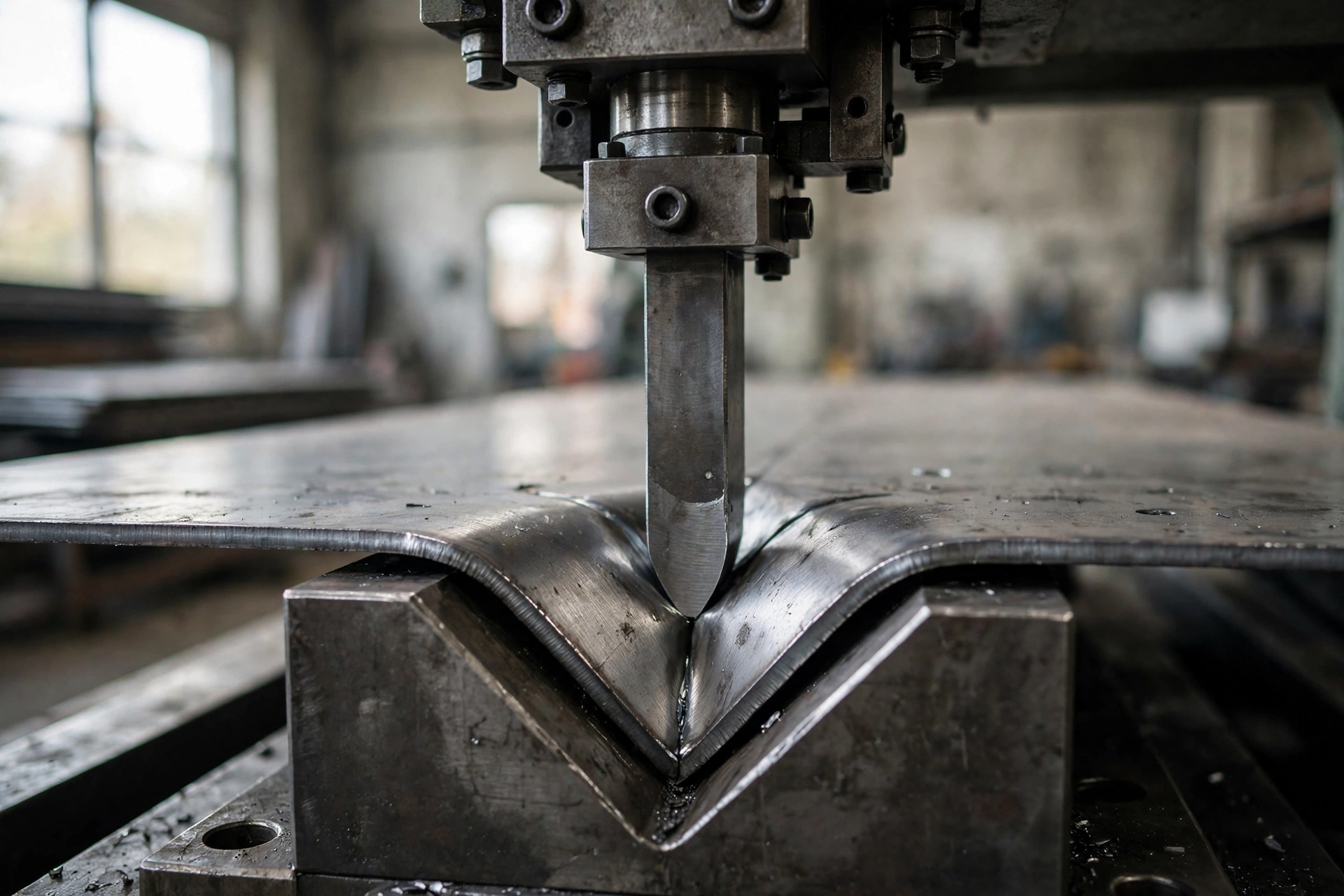
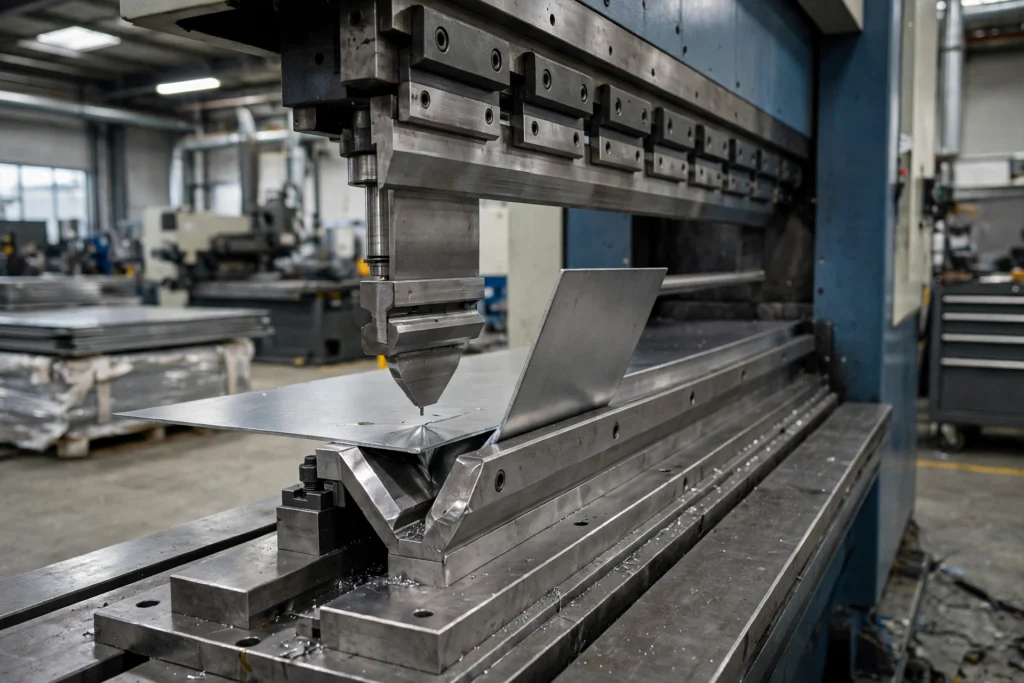
Forming gives the flat blank its shape. In custom sheet metal fabrication, bending on a press brake is by far the most common operation. A punch pushes the sheet into a V-shaped die until it reaches the target angle.
Every bend has an inside radius, and the metal springs back slightly after the punch lifts. Good shops compensate for both. Our metal bending services page lists the radii and angle tolerances we work to. Our guide to how to bend sheet metal covers the K-factor, bend allowance and springback in detail.
Once parts are formed, they are joined into assemblies. The common methods are:
| Method | How it works | Best for |
|---|---|---|
| MIG (GMAW) welding | Wire-fed arc weld | Fast welds on steel and thicker sections |
| TIG (GTAW) welding | Tungsten arc with separate filler | Clean, precise welds on stainless and aluminum |
| Spot welding | Resistance weld at points between overlapping sheets | High-volume sheet assemblies |
| Riveting | Mechanical fastener set through both sheets | Joining dissimilar metals, no heat |
| Self-clinching hardware | Nuts, studs and standoffs pressed into the sheet | Threads in thin sheet |
| Fasteners | Screws and bolts | Parts that must come apart for service |
Welding is strong, but it adds heat, distortion and cleanup time. Welding fumes and arc radiation also need proper control, and OSHA covers welding, cutting and brazing hazards for general industry. Where a design allows it, a bend or a pressed-in insert is often cheaper and more consistent than a weld.
Raw sheet metal rarely ships as-is, and finishing is often the longest stage of a sheet metal fabrication job. Common finishes include:
Finishing usually happens after forming and welding, so the coating is not cracked at bends. It also adds thickness, which matters for tight slots and press-fit hardware.
Most sheet metal fabrication uses a handful of standard alloys:
| Material | Strengths | Watch-outs |
|---|---|---|
| Cold-rolled steel | Low cost, strong, easy to form and weld | Needs coating or plating to resist rust |
| Galvanized steel | Zinc coating protects against corrosion | Welding burns off zinc and gives off fumes |
| Stainless steel 304 / 316 | Corrosion resistant, clean finish | Harder to form, more springback, higher cost |
| Aluminum 5052 | Light, forms well, good corrosion resistance | Softer, scratches easily |
| Aluminum 6061 | Stronger than 5052 | Can crack on tight bends, needs larger radii |
| Copper and brass | Excellent conductivity | Expensive, soft, marks easily |
For bent aluminum parts we usually recommend 5052 over 6061, because 5052 takes tight bends without cracking. Choose 6061 only when the part truly needs the extra strength, and give it larger bend radii.
Sheet metal parts hold good accuracy, but tolerances stack up with each bend, so they are looser than on machined parts. These are the general tolerances on our sheet metal fabrication services:
| Feature | Typical tolerance |
|---|---|
| General tolerances (metals) | ISO 2768-c |
| Cut features | ±0.2 mm (±0.008 in) |
| Bend angle | ±1.0° |
| Bend to edge | ±0.254 mm (±0.010 in) |
| Bend to hole | ±0.2 mm (±0.008 in) |
ISO 2768-1 defines general tolerance classes for dimensions without an individual tolerance on the drawing. Stating a class lets you tolerance only the features that really matter. Dimensions that cross several bends will vary more than this table suggests, so dimension critical features from the same flange where you can.
A sheet metal fabricator turns drawings into parts. On a typical day that means reading drawings and 3D models, programming laser cutters and press brakes, setting up tooling, bending and welding parts, and inspecting them. In a contract manufacturing shop, fabricators and engineers also review customer designs, suggest changes that make a part easier to build and plan the order of operations.
It is skilled work. Sheet metal fabrication machines are largely CNC today, but getting a multi-bend part right depends on bend sequence, tooling choice and springback compensation, and those come from experience as much as from software.
| Advantages | Limitations |
|---|---|
| Little or no tooling for laser-cut and press-brake parts | Constant wall thickness limits part geometry |
| Fast turnaround from CAD file to part | Tolerances stack up across bends |
| Strong and light for the material used | Complex 3D shapes need welding or many bends |
| Scales from one prototype to thousands of parts | Welding adds distortion and labor |
| Wide choice of metals and finishes | Per-part cost stays higher than stamping at very high volume |
Sheet metal is usually cheaper than machining for enclosures and brackets, since far less material ends up as chips. For a closer comparison on electronics housings, read our guide to sheet metal vs CNC machining for aluminum enclosures.
Most problems in sheet metal fabrication start in CAD. These are the issues we flag most often:
It is the process of making parts from flat metal sheets. The sheet is cut to shape, bent into three dimensions, joined with welds or fasteners and then finished. Everyday examples include computer cases, electrical boxes, brackets, vents and appliance panels, all made from thin metal of one thickness.
The basic operations are simple to explain, but doing them accurately takes skill. Fabricators must plan bend sequences, compensate for springback, control weld distortion and hold tolerances across several bends. Modern CNC laser cutters and press brakes make results repeatable, but good setup still depends on experienced people.
The difference is thickness. Most fabricators call material sheet up to about 6 mm (0.25 in) thick, and plate above that. Plate needs heavier cutting and forming equipment, larger bend radii and more force, so it is used for structural parts rather than enclosures and brackets.
Cost depends on material, thickness, part size, number of bends, welding, hardware, finish and quantity. Laser cutting and press brake bending need no dedicated tooling, so prototypes stay affordable. Welding and cosmetic finishes usually add the most cost, so designing them out often saves more than changing material.
The sheet metal working process is another name for the same sequence: cutting the flat blank, forming it with bends or stamping, joining parts and finishing the surface. Shops add deburring, hardware insertion and inspection between those stages, depending on what the part needs.
At Tuowei Precision we keep laser cutting, press brake bending, welding, hardware insertion and finishing in one facility, with a network of more than 100 machines including laser cutters, bending machines and welders. We work with over 20 materials and more than 10 surface finishes, and simple parts can ship in as little as 3 days. Our quality system is certified to ISO 9001:2015 and ISO 13485.
Send a STEP file and drawing with the material, thickness, quantity and finish. Our engineers review every design before quoting and flag bends, holes and flanges that will cause trouble. You can start with our sheet metal fabrication service page.
About the author: Owen Lin is an engineer at Tuowei Precision. He plans tooling and production processes and works with the quality team to keep every batch consistent.