By Owen Lin, Engineer, Tuowei Precision · November 2026
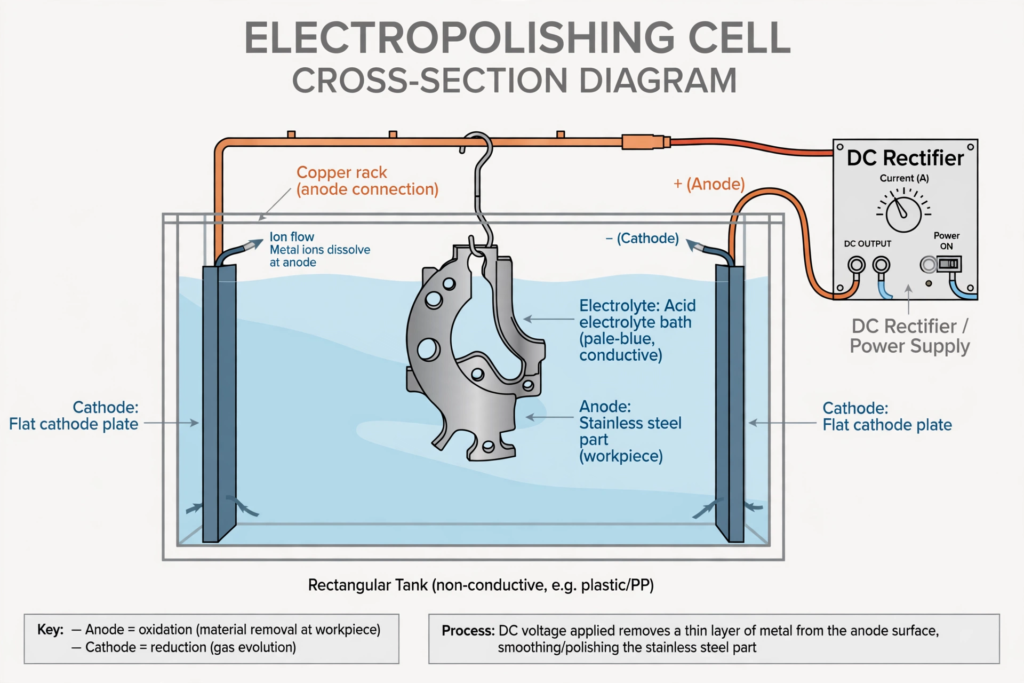
Electropolishing is an electrochemical finishing process that removes a very thin, controlled layer of metal from a part’s surface. How does electropolishing work? The part is wired to the positive terminal of a DC power supply and lowered into an acid electrolyte, where current dissolves metal from the surface, microscopic peaks first. It is one of the surface finishes offered alongside CNC machining at Tuowei Precision.
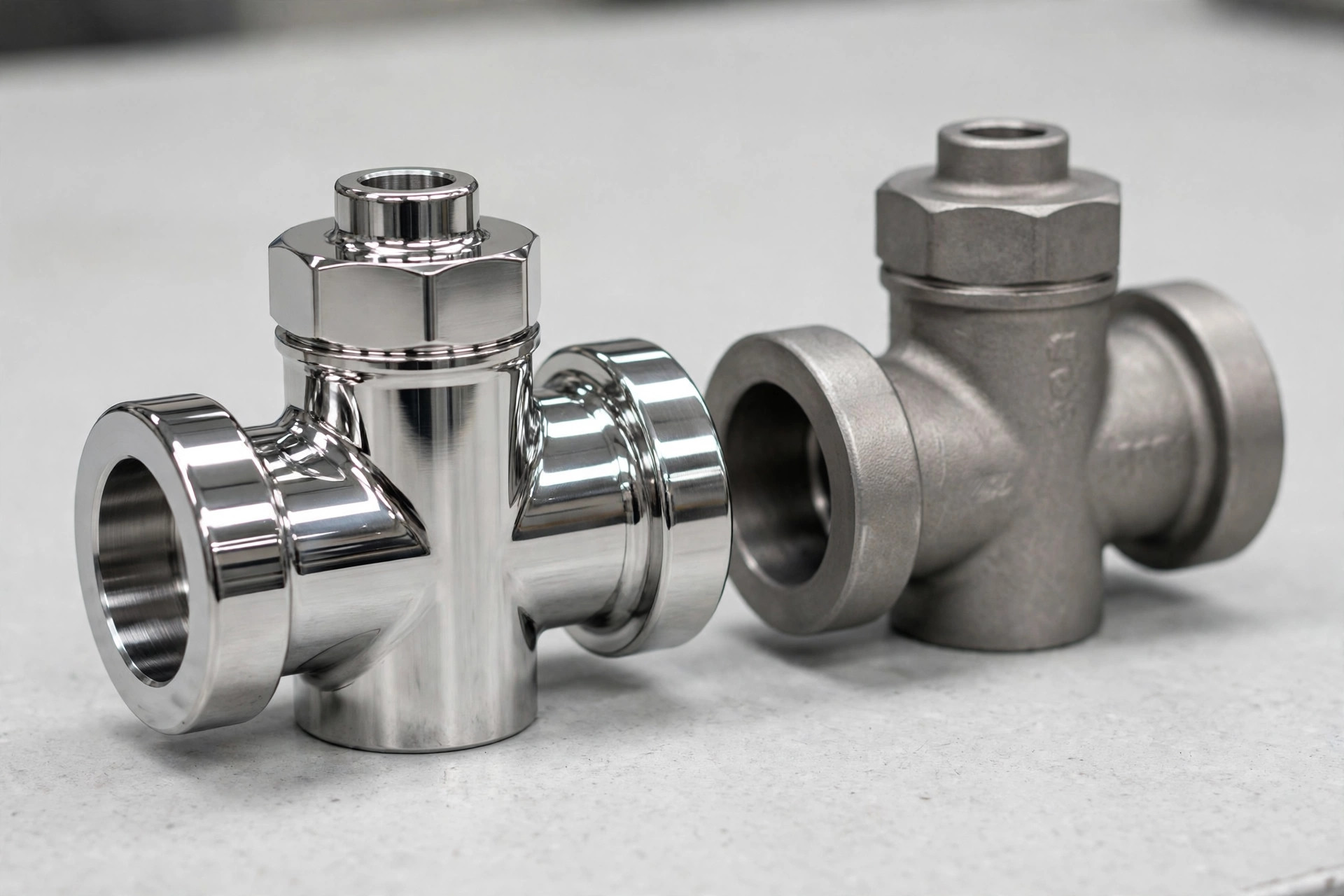
What remains is smoother, brighter and cleaner. On stainless steel the surface also resists corrosion better, which is why the finish is standard on medical, pharmaceutical, food and semiconductor equipment.
Short answer: Electropolishing works like electroplating in reverse. The metal part is the anode in a bath of mixed acids, usually phosphoric and sulfuric. A controlled DC current dissolves the surface atom by atom, removing peaks faster than valleys. It smooths and brightens the part, removes micro-burrs and embedded iron, and leaves stainless steel with a chromium-rich, passive surface.
This guide covers the electrochemistry step by step, what the treatment does to stainless steel, how much material comes off, which alloys respond well, how to specify it, and the problems it will not fix.
The process goes by several names, including electrochemical polishing and electrolytic polishing. It is a finishing step for metal parts that have already been machined, formed or welded. Because it removes metal rather than adding a coating, there is nothing to chip or peel later. It is often compared with two other finishes:
The two methods are often combined. A part may be mechanically polished to take out deep marks, then given the electrochemical treatment to clean, brighten and passivate it.
It all depends on one simple fact about current: it concentrates on high points. When the part becomes the anode, a thin, viscous film forms on its surface in the electrolyte. The film is thinner over the microscopic peaks and thicker in the valleys. Current density is therefore higher at the peaks, so metal dissolves there faster. Over a few minutes the peaks come down and the surface levels out.
Engineers call this anodic leveling at the larger scale of roughness and anodic brightening at the very fine scale. Together they produce the familiar mirror-like finish.
Stainless steel adds one more effect. Iron dissolves more readily than chromium, so the surface ends up richer in chromium, and that chromium forms a stronger passive oxide layer once the part is rinsed and exposed to air.
For stainless steel, ASTM B912 is the common US specification for passivation by this method. It covers 200, 300 and 400 series stainless and precipitation-hardened grades, and it groups the work into preparatory cleaning, the polishing step itself and post-treatment. Internationally, ISO 15730 covers the process as a means of smoothing and passivating stainless steel.
Five things change.
| Property | What changes |
|---|---|
| Surface roughness | Lower, because peaks are removed first |
| Appearance | Brighter and more reflective |
| Corrosion resistance | Better; the surface is chromium-rich and free of embedded iron |
| Cleanability | Better; fewer places for bacteria and residue to cling |
| Edges and burrs | Micro-burrs dissolve, and sharp edges round slightly |
The corrosion benefit has two sources. A smoother surface gives contaminants fewer places to settle. Removing the outer layer also takes away iron particles left by machining, grinding or handling. The treatment removes heat tint and oxide scale from welds too, which plain chemical passivation does not.
Both improve the corrosion resistance of stainless steel, but they work in different ways.
| Factor | Electrochemical polishing | Chemical passivation |
|---|---|---|
| How it works | Electrochemical removal of surface metal | Acid bath dissolves free iron |
| Material removal | A few microns, controllable | Essentially none |
| Surface finish | Smoother and brighter | Unchanged |
| Weld heat tint | Removed | Usually not removed |
| Cost | Higher | Lower |
Our view: if a stainless part needs a smooth, cleanable surface, choose the electrochemical route. If it only needs better corrosion resistance and the existing finish is acceptable, passivation is cheaper and enough.
Removal is controlled by current and time, so it can be set to suit the part. Only a thin surface layer comes off, and cosmetic and passivation jobs sit at the low end of the range. That sounds tiny. On a bearing fit it is not.
Current also concentrates on edges and corners, so they lose slightly more than flat faces, while deep holes and internal bores lose less. Tell the finisher which dimensions are critical. They can mask features, adjust the time or add internal cathodes.
Deep defects stay. The treatment reduces fine roughness well, but a deep scratch or tool mark will still be visible afterwards, just shinier. If the starting surface is rough, plan a mechanical polish first.
Many problems come from a vague note such as “polish all over.” A clear callout saves a round of questions and a week of delay. A good note covers:
Not every drawing needs every line. A cosmetic bracket may only need the alloy, the finish and a note on rack marks, while a fluid-handling part for a pharmaceutical plant may need all seven.
| Advantages | Disadvantages |
|---|---|
| Smooth, bright, easy-to-clean surface | Does not remove deep scratches or tool marks |
| Improves stainless corrosion resistance | Removes material, which can affect tight fits |
| Removes micro-burrs and weld heat tint | Uneven removal in deep recesses and holes |
| No coating to chip or peel | Leaves small rack contact marks |
| Reaches complex shapes that hand polishing cannot | Uses hazardous acids that need specialist handling |
| Consistent from batch to batch | Can expose inclusions in some alloys |
Time in the bath is short, and most of the job time goes on cleaning, racking, rinsing and inspection rather than on the tank itself. Complex parts with internal cathodes take longer to set up.
Other finishes suit other needs. Aluminum parts are more often anodized, and steel parts that only need a dark, low-cost finish may use black oxide.
It will not remove deep scratches, it takes off a little material that can affect tight fits, and recesses polish less than outside surfaces. It leaves small rack contact marks and can expose inclusions in some alloys such as 303 stainless. It also uses hazardous acids that require specialist equipment and handling.
It depends on the goal. Electrochemical polishing smooths and brightens the surface, removes weld heat tint and passivates stainless steel in one step, giving better cleanability and corrosion resistance. Chemical passivation costs less and leaves dimensions unchanged, which is enough when the existing surface finish is already acceptable.
Cost depends on part size, quantity, racking time, alloy, required finish and whether internal surfaces need special cathodes. Small parts in large batches are usually inexpensive per piece, while large or complex parts cost more. Send drawings with the required surface roughness to get an accurate quote from your finisher.
Yes, slightly. It removes a thin, controlled layer, typically a few microns, from every exposed surface. Edges and corners lose a little more than flat faces, and deep holes lose less. For tight tolerances, tell the finisher which dimensions are critical so they can adjust the time or mask features.
Yes. With a suitable electrolyte, aluminum takes a bright, reflective finish, often before anodizing for decorative trim and reflectors. It is less common than on stainless steel, because aluminum does not gain the same corrosion benefit from the treatment and is usually anodized for protection instead.
At Tuowei Precision, this finish is one of our more than 30 surface finish options, offered alongside CNC machining so one order covers machining, finishing and inspection. It is often specified for medical, aerospace and automation parts in 304, 316L and 17-4 PH. Our quality system is certified to ISO 9001:2015.
For an accurate quote, send a drawing with the alloy, quantity, required Ra, critical dimensions and any internal surfaces that must be polished. Our engineers flag fits that need masking and recommend a pre-polish where the starting surface is too rough. See our brushed and electropolishing finish page or the guide to surface finishes for CNC machined parts.
Owen Lin is an engineer at Tuowei Precision. He plans tooling and production processes and works with the quality team to keep every batch consistent.