By Owen Lin, Engineer, Tuowei Precision · November 2026
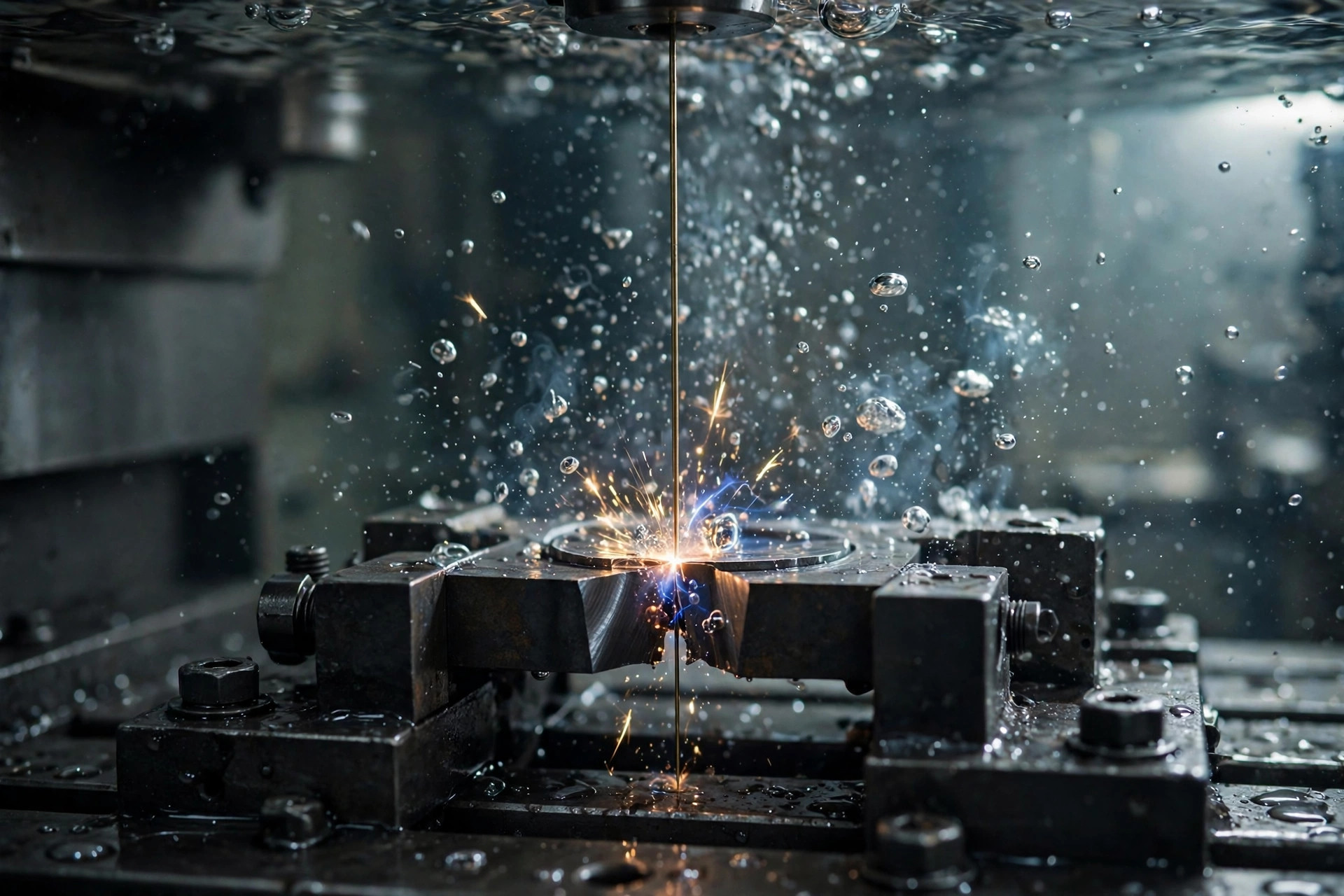
The answer to what is wire EDM sits in the name: wire electrical discharge machining cuts metal with electrical sparks instead of a cutting tool. A thin, electrically charged wire travels through the part while thousands of tiny sparks per second melt and vaporize the metal in its path. The wire never touches the workpiece.
That one fact explains the whole process. With no cutting force, hardness stops mattering and thin features do not bend. The wire cuts hardened tool steel as easily as soft steel, leaves sharp internal corners, and holds tolerances that would be very hard to reach with an end mill.
Short answer: Wire EDM is a non-contact machining process that cuts electrically conductive metals with a thin brass or coated wire, usually 0.1 to 0.3 mm in diameter. Controlled sparks jump between the wire and the part through deionized water, eroding a narrow slot along a CNC-programmed path. It suits hardened steels, carbide and titanium, punches, dies and precise 2D profiles.
This guide explains how the process works, what the machine and the wire are made of, what tolerances and finishes to expect, and where wire EDM is the right choice over milling or laser cutting.
EDM stands for electrical discharge machining. The “wire” refers to the electrode, which in this version of the process is a continuously fed wire rather than a shaped block. You will also hear it called wire cutting, wire erosion, spark erosion or simply “wire.”
EDM as a family has three main members:
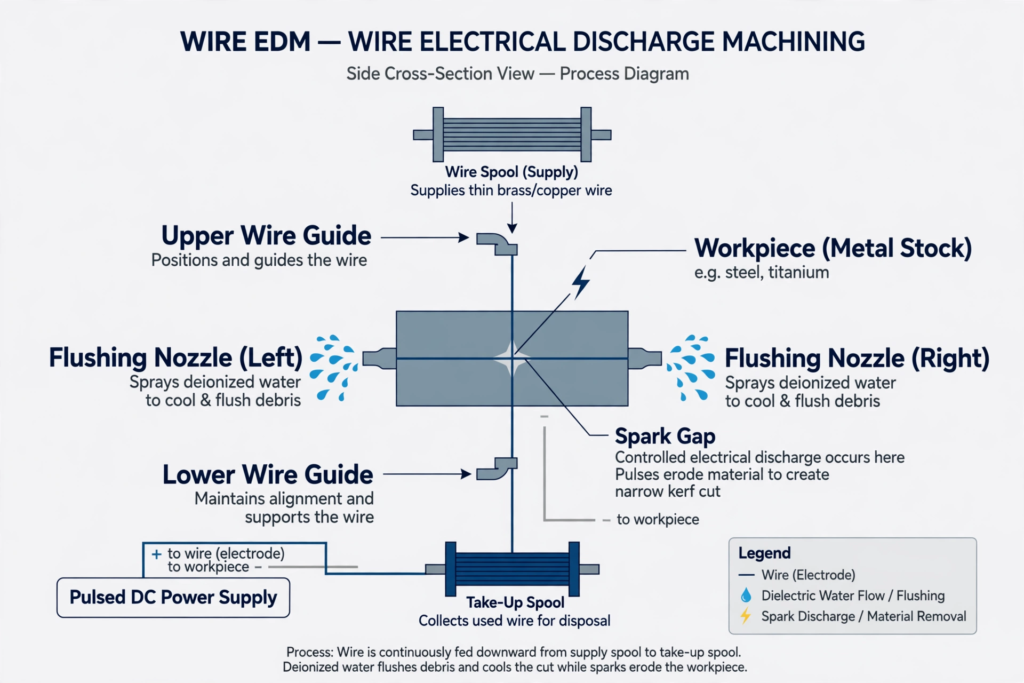
The physics are simple once you picture the gap. The wire and the workpiece are both connected to a power supply, but they never touch. Between them is a gap of a few hundredths of a millimeter, filled with deionized water that acts as an insulator, or dielectric.
When the voltage across that gap is high enough, the water breaks down and a spark jumps across. The spark is tiny, but its temperature is extreme, so it melts a microscopic crater in the metal. The surrounding water then flushes the molten particles away and cools the surface. The generator repeats this thousands of times per second while the CNC moves the wire along the programmed path.
Step by step, a typical job looks like this:
The rough cut is fast but leaves a rougher surface and a thin melted layer. Each skim cut removes a little more, at lower energy, so accuracy and finish improve with every pass. The trade-off is time. A part with one cut might be ready in an hour, while the same profile with three skims can take several times as long. Ask for skims only on the faces that need them.
A wire EDM machine has four main systems:
Many shops in China also run reciprocating “fast wire” machines, which move a molybdenum wire back and forth and reuse it many times. They cost less to run but are less accurate and leave a rougher finish than single-pass brass wire machines. When a supplier quotes the job, it is worth asking which type the part will run on.
The wire is the electrode, so its material decides cutting speed, accuracy and cost.
| Wire type | Material | Typical use |
|---|---|---|
| Plain brass | Copper-zinc alloy | General purpose; the most common choice |
| Coated wire | Brass or copper core with a zinc-rich coating | Faster cutting and better flushing on thick parts |
| Molybdenum | Moly | Reciprocating “fast wire” machines; reused many times |
| Tungsten | Tungsten | Very fine wires for micro features |
Common diameters run from about 0.1 mm to 0.3 mm, with 0.25 mm the everyday default. Thinner wire cuts smaller corner radii but breaks more easily and cuts more slowly. On single-pass machines the wire is used once and then recycled as scrap, because spark erosion damages its surface.
The process works on any material that conducts electricity. Hardness makes almost no difference, which is the main reason the process exists.
It cannot cut plastics, glass, most ceramics or other insulators. Conductive composites are possible but need testing first.
Wire cutting is one of the most accurate cutting processes in a typical machine shop. Accuracy depends on part size, thickness, the number of skim cuts, temperature control and the machine itself. These are the tolerances we work to on our wire cutting service:
| Wire EDM work | Typical tolerance |
|---|---|
| Standard wire cutting | ±0.005 in (±0.127 mm) |
| High-precision wire cutting | ±0.002 in (±0.051 mm) |
| Small parts | ±0.003 in (±0.076 mm) |
| Large parts | ±0.010 in (±0.254 mm) |
| Complex features | ±0.005 in (±0.127 mm) |
With several skim cuts, surfaces can reach about 16 µin Ra (0.4 µm). Tolerances on drawings should follow a recognized system, such as general tolerance classes under ISO 2768-1 or geometric tolerancing under ASME Y14.5, so supplier and buyer read the drawing the same way.
Our view: do not ask for the machine’s best tolerance on every edge. Hold the tightest values on punch and die clearances, fits and datum faces, and let the rest run at standard tolerance. Each extra skim cut adds machine time.
| Advantages | Limitations |
|---|---|
| Cuts hardened metals without tool wear on the part | Only works on electrically conductive materials |
| No cutting force, so thin walls and fine features stay true | Slow compared with milling or laser cutting |
| Sharp internal corners, limited only by wire radius | Through-cuts only; blind pockets need sinker EDM |
| Very tight tolerances and fine finishes with skim cuts | Leaves a thin recast layer on the cut surface |
| Burr-free edges | Internal shapes need a start hole first |
| Cutting after heat treatment avoids distortion | Cost per part rises quickly with thickness and skim passes |
Every spark melts metal, and some of that metal re-solidifies on the surface instead of flushing away. The result is a thin recast layer, sometimes called the white layer, with a heat-affected zone underneath. It is harder and more brittle than the base metal and can contain micro-cracks.
For most parts this does not matter. For fatigue-critical aerospace parts, medical implants or highly stressed punches, it can. Skim cuts reduce the layer, and polishing or light grinding can remove it. If your part sees cyclic loads, say so on the drawing so the supplier plans for it.
| Factor | Wire EDM | CNC milling | Laser cutting |
|---|---|---|---|
| Hard materials (over ~45 HRC) | Excellent | Difficult | Possible, with heat effects |
| Sharp internal corners | Yes, down to wire radius | No, limited by tool radius | Limited by kerf |
| Thick parts | Yes, slowly | Yes | Limited |
| Speed | Slow | Fast | Very fast on sheet |
| Typical accuracy | Very high | High | Moderate |
| 3D features | Through-cuts and tapers only | Full 3D | 2D profiles |
The rule of thumb is simple. Mill it if you can, laser cut it if it is sheet, and send it to the wire machine when hardness, sharp internal corners or tight profile tolerances rule the other two out. Many parts use both: CNC machining roughs the block before heat treatment, and the wire cuts the hardened profile afterwards. For sheet parts, our guide to how laser cutting works covers the faster alternative.
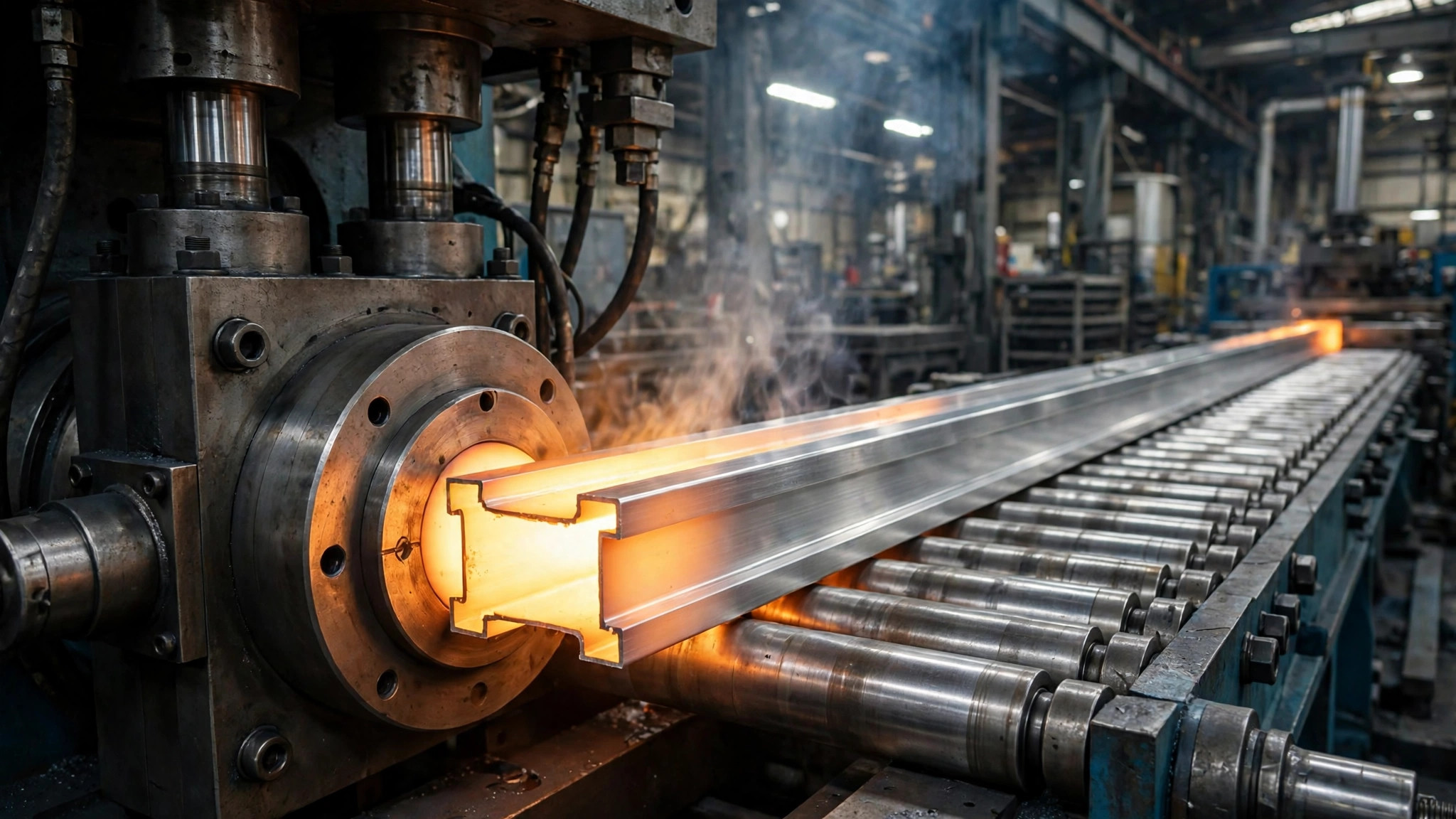
The process also plays a quiet role across the shop. It cuts the dies used in aluminum extrusion and many of the inserts in injection molds, so it sits behind a large share of mass-produced parts. It is one of the core processes in precision machining.
EDM is the general family of spark-erosion machining processes. Wire EDM is one type that uses a continuously fed thin wire as the electrode to cut through a part. Sinker EDM, another type, uses a shaped electrode to burn blind cavities, such as mold pockets, that do not pass through the material.
Usually not. Waterjet removes material much faster, especially on thick or soft materials, and it can cut non-conductive materials too. Wire EDM is slower but far more accurate, leaves no burrs and produces finer finishes, so it is chosen when precision matters more than speed or cost per part.
Machines can cut parts up to about 300 mm (12 in) thick, depending on the machine’s frame and the wire used. Cutting slows considerably as thickness increases, and tolerances usually need to loosen on very tall parts because flushing and wire deflection become harder to control.
Each spark erodes a little of the wire as well as the workpiece, leaving its surface pitted and its diameter uneven. Reusing it would reduce accuracy and cause wire breaks. Reciprocating fast-wire machines do reuse molybdenum wire, but they accept lower accuracy and rougher finishes in exchange.
It cuts precise two-dimensional and tapered profiles through conductive metal, using sparks instead of a cutting tool. Shops use it for punches, die plates, mold inserts, gears and fine slots, especially in hardened steel or carbide, where milling would struggle to hold sharp internal corners or tight tolerances.
At Tuowei Precision, wire cutting runs alongside CNC milling, turning and heat treatment, so a hardened part can be roughed, hardened and wire cut in one order. Our facilities are certified to ISO 9001:2015 and ISO 14001:2015.
For an accurate quote, send a DXF or STEP file with the material and hardness, part thickness, quantity, the faces that need skim cuts and any start-hole restrictions. Our engineers check corner radii, thickness and tolerances before quoting, and suggest where milling would save cost. Start on our wire cutting page.
Owen Lin is an engineer at Tuowei Precision. He plans tooling and production processes and works with the quality team to keep every batch consistent.