By Owen Lin, Engineer, Tuowei Precision · November 2026
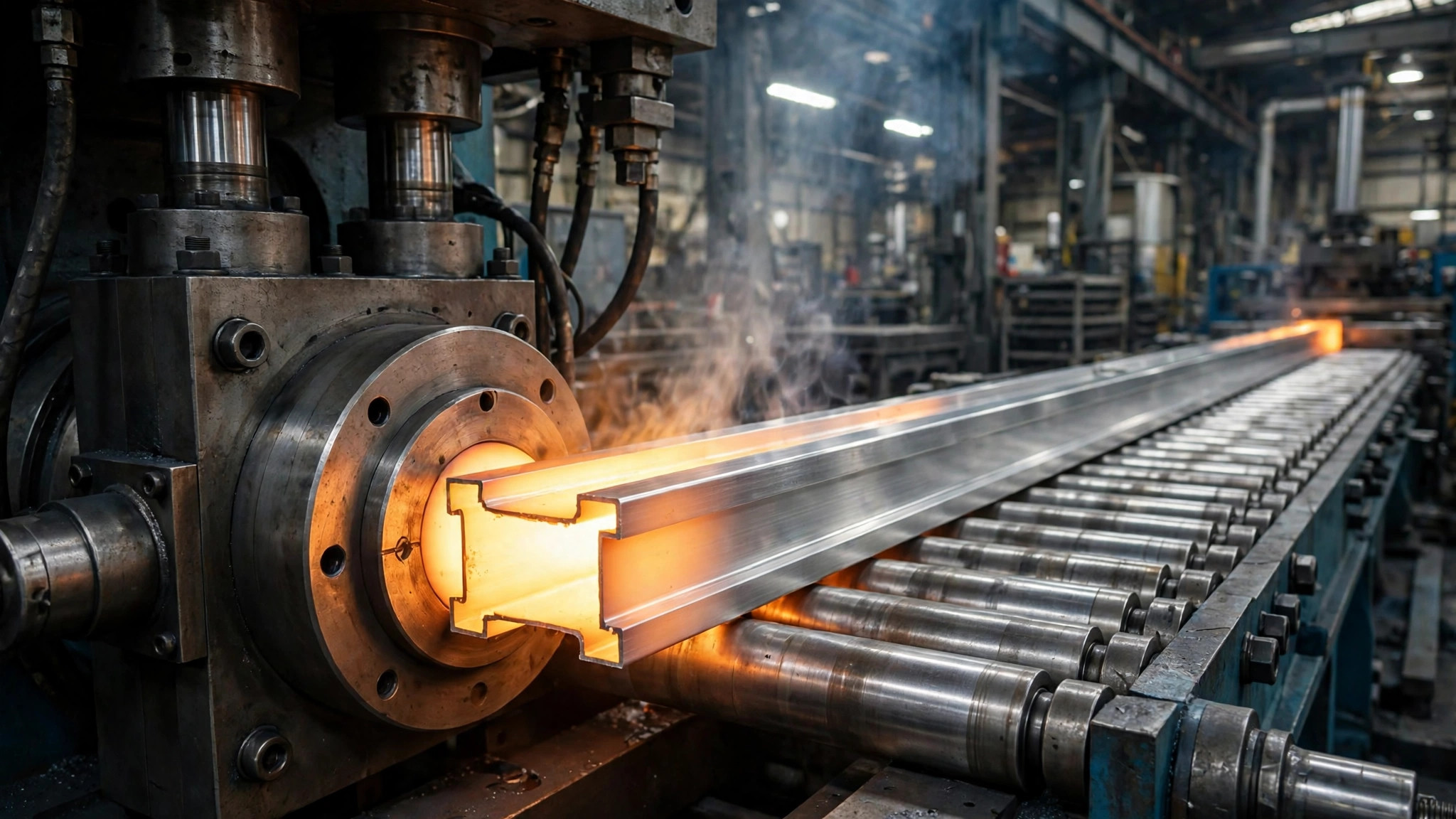
Extrusion means forcing a material through a shaped opening so that it comes out with the same cross-section along its whole length. So what is aluminum extrusion? It is that idea applied to a heated aluminum billet: a hydraulic ram pushes the soft but still solid metal through a steel die, and a long profile emerges in the shape of the die opening.
Window frames, heat sinks, T-slot framing, rails and enclosures are all made this way. The process is cheap to tool, fast to run and very good at one thing: long parts with a constant cross-section.
Short answer: Aluminum extrusion pushes a preheated aluminum billet, usually at 400 to 500 °C, through a steel die to form a continuous profile with a fixed cross-section. The profile is cooled, stretched straight, cut to length and often aged for strength. It suits frames, rails, heat sinks and housings in 6000-series alloys, from prototype runs to high volume.
This guide covers each step of the aluminum extrusion process, the alloys and tempers worth knowing, realistic tolerances, what drives cost, and the design mistakes that most often slow a new profile down.
An aluminum extrusion is the product of the process: a length of aluminum whose cross-section is identical from one end to the other. Engineers often call it a profile or a section. The process is commonly compared to squeezing toothpaste from a tube, and the comparison holds: the shape of the opening decides the shape of what comes out.
Profiles fall into three families, and the family decides which kind of die the shop needs:
The key limit is the one in the definition. Extrusion cannot make a feature that changes along the length. Holes, slots, tapers and pockets have to be added after extrusion by sawing, punching or CNC machining.
Every profile follows roughly the same route through the plant. Here is the sequence on a typical direct-extrusion line.
On a simple solid profile, the press cycle itself is quick. Most of the calendar time on a new part sits in die making and first-article approval, not in pressing metal.
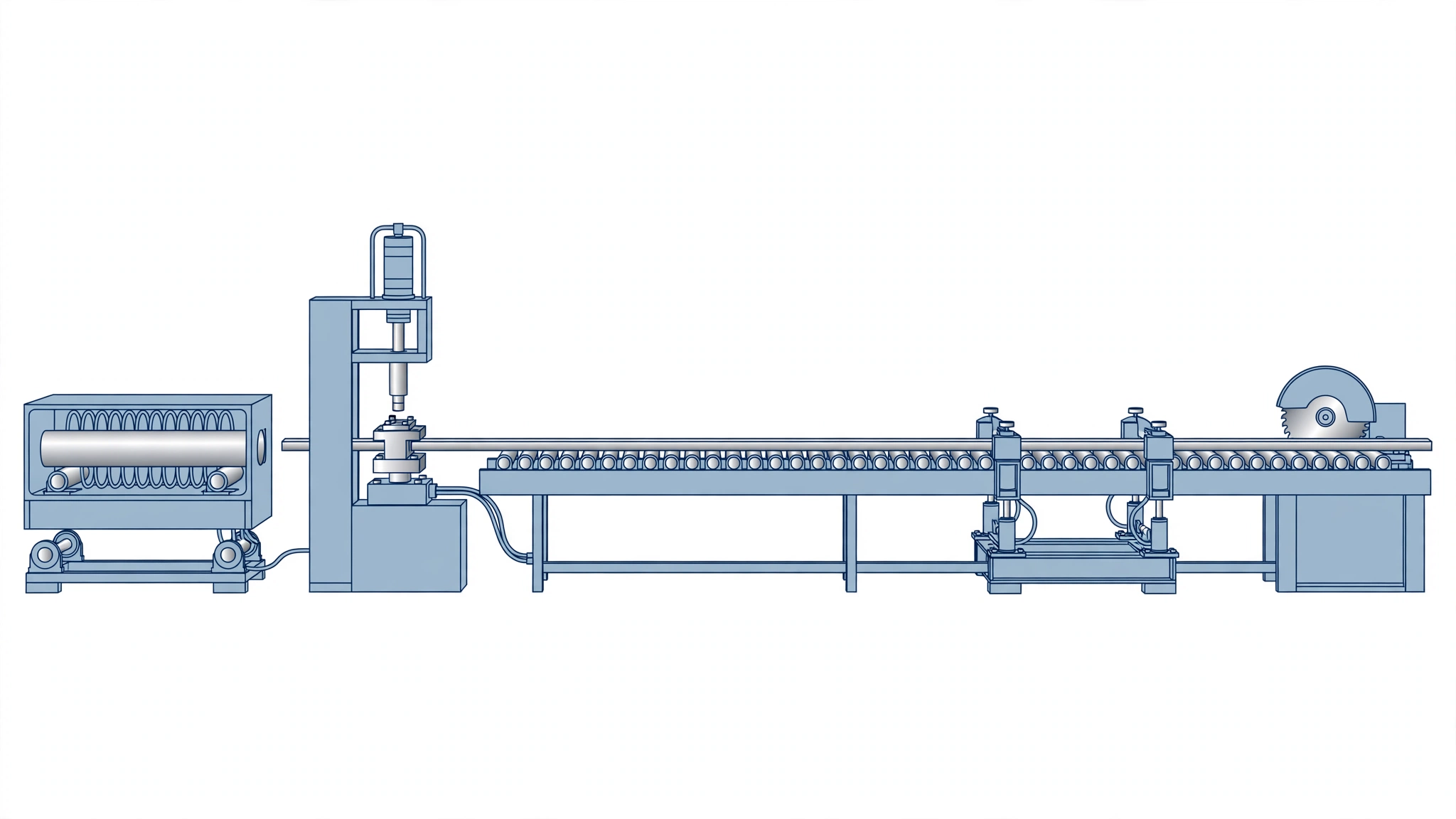
In direct extrusion, the die is fixed and the ram pushes the billet through it. The billet slides along the container wall, so friction is high, but the method is simple and handles most profiles. It is the standard choice.
In indirect extrusion, the die sits on a hollow ram that moves into a stationary billet. There is no sliding friction against the container, so the force is lower and the metal flows more evenly. The trade-off is that the hollow ram limits the size of profile the press can make.
Almost all commercial aluminum profiles are hot extruded, because heat lowers the force needed and lets the metal fill complex dies.
Cold extrusion, done at or near room temperature, is used for small, high-strength parts such as impact-extruded cans and cylinders. It gives a fine surface and tight dimensions but needs much more force.
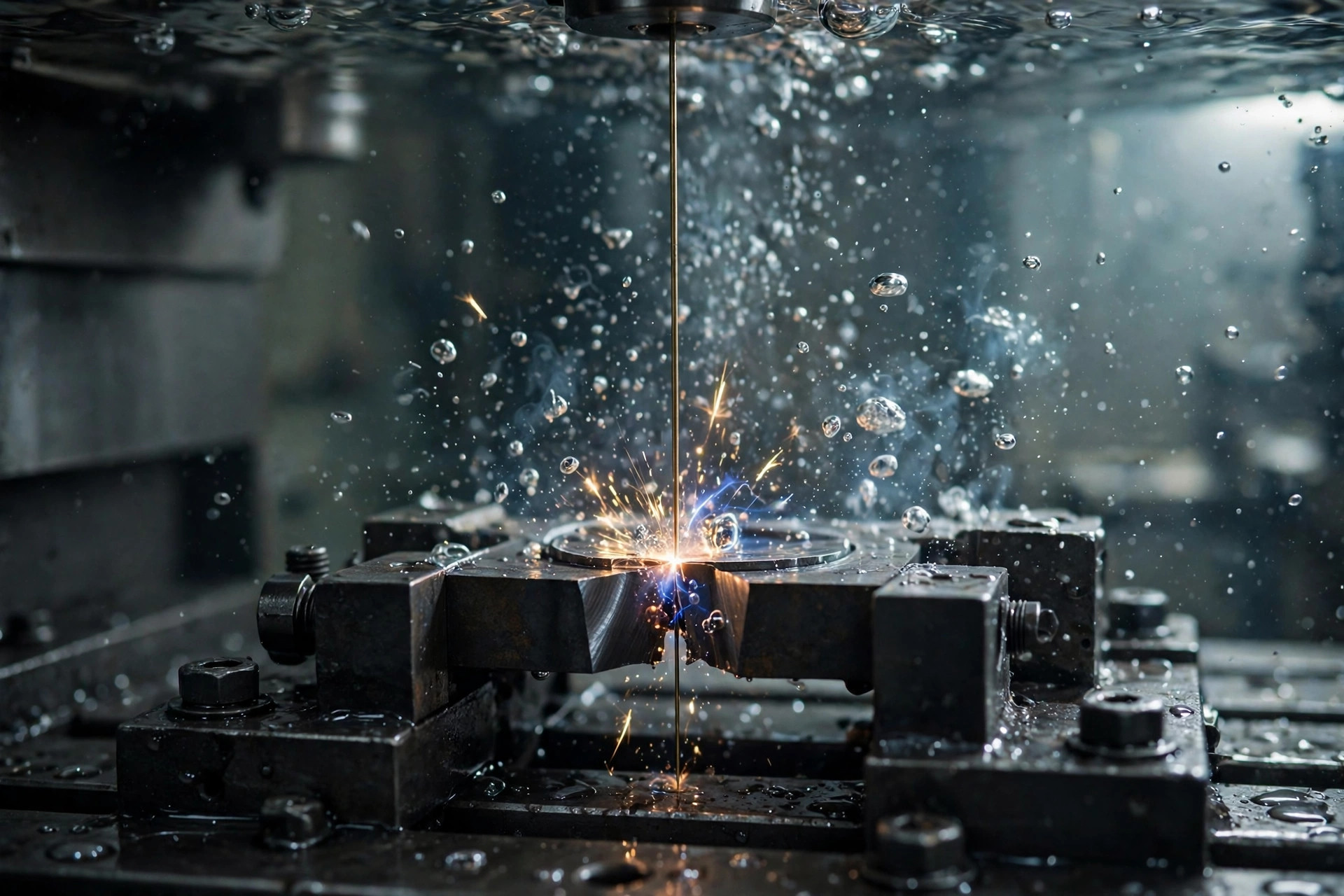
The die is a thick steel disc with the profile cut through it, usually by wire EDM. A solid die is the simplest and cheapest. Hollow profiles need a porthole die, in which the metal splits around a mandrel and welds back together inside the die before it exits. Those internal weld lines are normal, but they can show up as faint stripes after anodizing.
Compared with an injection mold or a die casting die, an extrusion die is inexpensive and fast to make. That is why custom profiles make sense at quantities where other tooled processes would not. Even so, a hollow die costs more than a solid one, and very thin walls, deep narrow channels or sharp internal corners shorten die life and raise the price.
Most extruded aluminum comes from the 6000 series, which combines good flow through the die with useful strength after aging.
| Alloy | Strength | Extrudability | Typical uses | Watch-outs |
|---|---|---|---|---|
| 6063 | Moderate | Excellent | Window frames, trim, heat sinks, cosmetic profiles | Not for high structural loads |
| 6061 | Good | Good | Structural frames, machine parts, brackets | Rougher surface than 6063 on complex shapes |
| 6005A / 6082 | Good to high | Good | Structural sections, transport frames | Availability varies by region |
| 7075 | Very high | Poor | Aerospace and high-load parts | Slow to extrude, costly, limited shapes |
| 1100 / 3003 | Low | Excellent | Tubing, electrical and decorative parts | Soft, low strength |
Our view: for most custom profiles, start with 6063 if appearance or fine detail matters, and with 6061 if the part carries a real structural load. Choose a 7000-series alloy only when the strength requirement leaves no alternative, because cost and lead time rise sharply.
Temper describes how the profile was heat treated. The designations come from the ANSI H35.1 temper system maintained by the Aluminum Association. Many 6000-series lines achieve near-T6 properties with a fast press quench, but check the mechanical properties on the material certificate rather than assuming them.
Aluminum extrusions hold good accuracy across the profile, but not machining accuracy. Dimensions depend on alloy, profile size, wall thickness and whether a feature spans an open gap. In North America, standard extrusion tolerances are set out in ANSI H35.2, the American National Standard for dimensional tolerances of aluminum mill products, maintained by the Aluminum Association. Typical tolerances on our custom extrusion work:
| Feature | Typical tolerance |
|---|---|
| Profile dimensions | ±0.10 mm to ±0.50 mm |
| Wall thickness (walls ≤ 3 mm) | ±0.10 mm |
| Wall thickness (thicker walls) | ±0.30 mm |
| Straightness | 1.0 mm per 1,000 mm |
| Twist | 1.0 mm per 300 mm |
| Flatness | ±0.15 mm per 25 mm width |
| Cut length | ±0.50 mm to ±1.0 mm |
| Angles | ±0.5° |
Tighter features, such as bearing bores, sealing faces or precise hole patterns, are machined after extrusion. That combination is common: the extrusion gives the cheap, consistent cross-section, and CNC machining adds the handful of precise features.
| Advantages | Limitations |
|---|---|
| Low tooling cost compared with casting or molding | Cross-section must stay constant along the length |
| Complex profiles with integrated features (slots, fins, snap fits) | Tolerances looser than machining |
| Good strength-to-weight ratio in 6000-series alloys | Very thin walls and deep channels are hard to fill |
| Long lengths with consistent dimensions | Hollow dies cost more and show weld lines |
| Takes anodizing and powder coating well | High-strength alloys extrude slowly |
| Aluminum can be recycled repeatedly without losing its properties | Minimum order is set by press runs, not single parts |
Buyers often weigh a custom profile against machining from plate or casting the part. The right answer depends on shape and volume.
The combination route deserves attention. An aluminum extrusion for a heat sink or rail, made close to shape and machined at a few points, is often far cheaper than machining the same part from solid plate, because most of the material never becomes chips.
Good aluminum extrusion design is mostly about helping metal flow evenly through the die.
Most problems with custom profiles start on the drawing, not at the press. These are the ones we see most often:
These mistakes cost time as much as money. A tolerance query on a new die usually sends the drawing back to the customer and adds days before cutting starts.
Extruded aluminum turns up in almost every industry, usually where a long, light, stiff part is needed.
Finishing usually follows. Anodizing is the most common choice for corrosion protection and color, while powder coating suits parts that need a thicker colored layer outdoors.
Extrusion is a way of shaping material by pushing it through a shaped opening, called a die. Whatever comes out has the same cross-section as the opening along its entire length. Aluminum, plastics and even food such as pasta are made this way, at very different temperatures and pressures.
The main limits are that the cross-section cannot change along the length, tolerances are looser than machining, and very thin walls or deep channels are hard to produce. Hollow profiles need more expensive dies, and features such as holes or pockets require secondary machining after the profile is cut to length.
Usually, yes. Extruded aluminum is wrought metal, so it has a denser structure and less porosity than a typical casting. A 6061-T6 extrusion generally outperforms common die casting alloys in strength and ductility, although exact values depend on alloy, temper and section, so always check the material certificate.
Lead time depends on profile complexity, die type and the press shop’s queue, so confirm it with your supplier. Solid dies are faster to make than hollow porthole dies. First samples are then checked against the drawing, and small die corrections are common before production is approved and the main run starts.
Yes. Extruded 6063 and 6061 anodize very well, which is why most architectural and consumer profiles are anodized. Expect slight color differences between batches and alloys, and possible faint lines on hollow profiles where the metal welded inside the die. Specify the alloy and anodizing type together on the drawing.
At Tuowei Precision, our extrusion partners run multiple press lines, and the network is certified to ISO 9001 and ISO 14001. We handle the full route in one order: die design, extrusion, cutting, CNC machining, anodizing or powder coating, and inspection.
To get a useful quote, send a profile drawing or STEP file with the alloy and temper, the finish, the cut length, your annual quantity and the dimensions that are truly critical. Our engineers review each profile for wall balance, tongue ratios and die cost before tooling starts. You can begin on our custom aluminum extrusion service page.
Owen Lin is an engineer at Tuowei Precision. He plans tooling and production processes and works with the quality team to keep every batch consistent.