Need expert machining solutions? Our team at Tuowei Precision is here to assist with all your manufacturing needs. Get in touch today for a quote on your ongoing or upcoming projects!
Swiss screw machining produces small, long and slender precision parts at high volume with tolerances conventional lathes struggle to hold. Originally developed for Swiss watchmaking, today’s CNC Swiss-type lathes make connector pins, medical components, shafts and fittings by the million. This guide explains how the sliding-headstock design actually works, what tolerances and sizes are realistic, which materials run best, when Swiss turning beats conventional turning — and when it doesn’t.
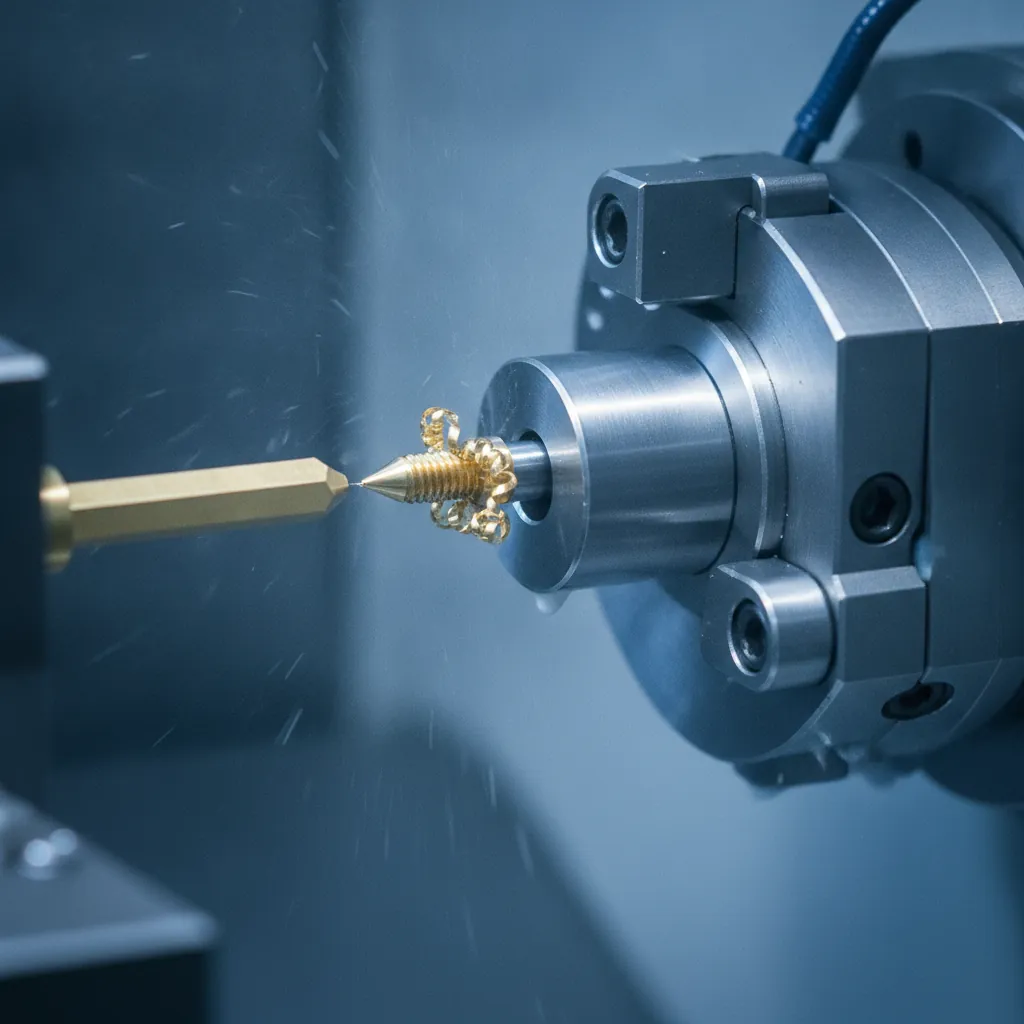
The defining feature of a Swiss-type (sliding headstock) lathe is the guide bushing. Bar stock is gripped by a collet in the headstock, which slides along the Z-axis and feeds the bar through a carbide-lined guide bushing. Cutting tools work on the material immediately next to the bushing — typically within 1–3 mm of support.
Because the workpiece is supported at the exact point of cutting, deflection is nearly eliminated. That is why a Swiss machine can turn a Ø2 mm shaft 40 mm long (L/D of 20:1) and still hold a few microns — geometry that would chatter or bend on a conventional lathe, where the tool may work far from the chuck.
Modern CNC Swiss machines add live tooling, sub-spindles and back-working stations, so a part is turned, milled, cross-drilled, threaded and cut off complete — no second operation.
| Parameter | Typical Capability |
|---|---|
| Bar diameter range | Ø0.5 – Ø38 mm (most Swiss machines) |
| Diameter tolerance | ±0.005 mm standard; ±0.002 mm on controlled features |
| Length tolerance | ±0.01 mm typical |
| Concentricity | 0.005 mm (single setup, bushing-supported) |
| Surface finish | Ra 0.4 – 0.8 µm turned; Ra 0.2 µm achievable |
| Length-to-diameter ratio | Up to 20:1 without steady rest |
| Economic quantities | ~500 to 1,000,000+ pieces |
| Factor | Swiss-type lathe | Conventional CNC lathe |
|---|---|---|
| Best part size | Ø0.5–38 mm, long/slender | Ø10–600 mm, short/stocky |
| Slender parts (L/D > 3) | Excellent — bushing support | Needs tailstock/steady rest |
| Cycle time (small parts) | Seconds — done-in-one | Longer; often 2 operations |
| Setup cost | Higher — justified by volume | Lower — fine for small lots |
| Ideal quantities | High volume | 1 – 5,000 |
For larger or lower-volume turned work, see our CNC turning service and CNC turned parts page.
Bar stock quality matters: Swiss machines feed ground or drawn bar through the guide bushing, so diameter consistency of the raw material directly affects the bushing fit and final tolerance.
A sliding-headstock lathe that feeds bar stock through a guide bushing, supporting the workpiece at the cutting point. It excels at small-diameter, long, high-precision parts in high volumes.
The design was developed in late-1800s Switzerland to mass-produce watch components — tiny shafts and screws needing watchmaker precision at industrial quantities.
±0.005 mm is routine on diameters; ±0.002 mm is achievable on controlled features with good bar stock and temperature control.
“Screw machining” historically covers all automatic bar-fed lathes (including cam-driven multi-spindles); Swiss screw machining specifically means the sliding-headstock, guide-bushing type — today usually CNC.
Tuowei Precision runs CNC Swiss-type lathes with live tooling and sub-spindles for small precision parts from Ø0.5 to Ø38 mm — connector pins to implant screws — with 100% critical-dimension gauging. Combine Swiss parts with our CNC machining services or a full contract machining program. Send your drawing for a quote within 24 hours.

Written by Andy, Manufacturing Engineer at TUOWEI Precision. Andy specializes in CNC machining, precision manufacturing, and production engineering, with hands-on experience supporting projects from rapid prototyping through full-scale production. He works closely with engineering and manufacturing teams to evaluate materials, tolerances, machining processes, and design manufacturability. His articles provide practical, technically informed insights to help engineers and buyers make better manufacturing decisions, optimize production efficiency, and achieve consistent part quality. Explore TUOWEI Precision’s CNC machining and custom manufacturing solutions for your next project.
From rapid prototypes to scalable production, Tuowei Precision delivers reliable CNC machining with accuracy and consistency at every step. Start your project today.
Read our latest guides on CNC machining, materials, finishing and industry trends to make better production decisions.