Vous avez besoin de solutions d'usinage spécialisées ? L'équipe de Tuowei Precision est là pour répondre à tous vos besoins en matière de fabrication. Contactez-nous dès aujourd'hui pour obtenir un devis concernant vos projets en cours ou à venir !
Swiss screw machining produces small, long and slender precision parts at high volume with tolerances conventional lathes struggle to hold. Originally developed for Swiss watchmaking, today’s CNC Swiss-type lathes make connector pins, medical components, shafts and fittings by the million. This guide explains how the sliding-headstock design actually works, what tolerances and sizes are realistic, which materials run best, when Swiss turning beats conventional turning — and when it doesn’t.
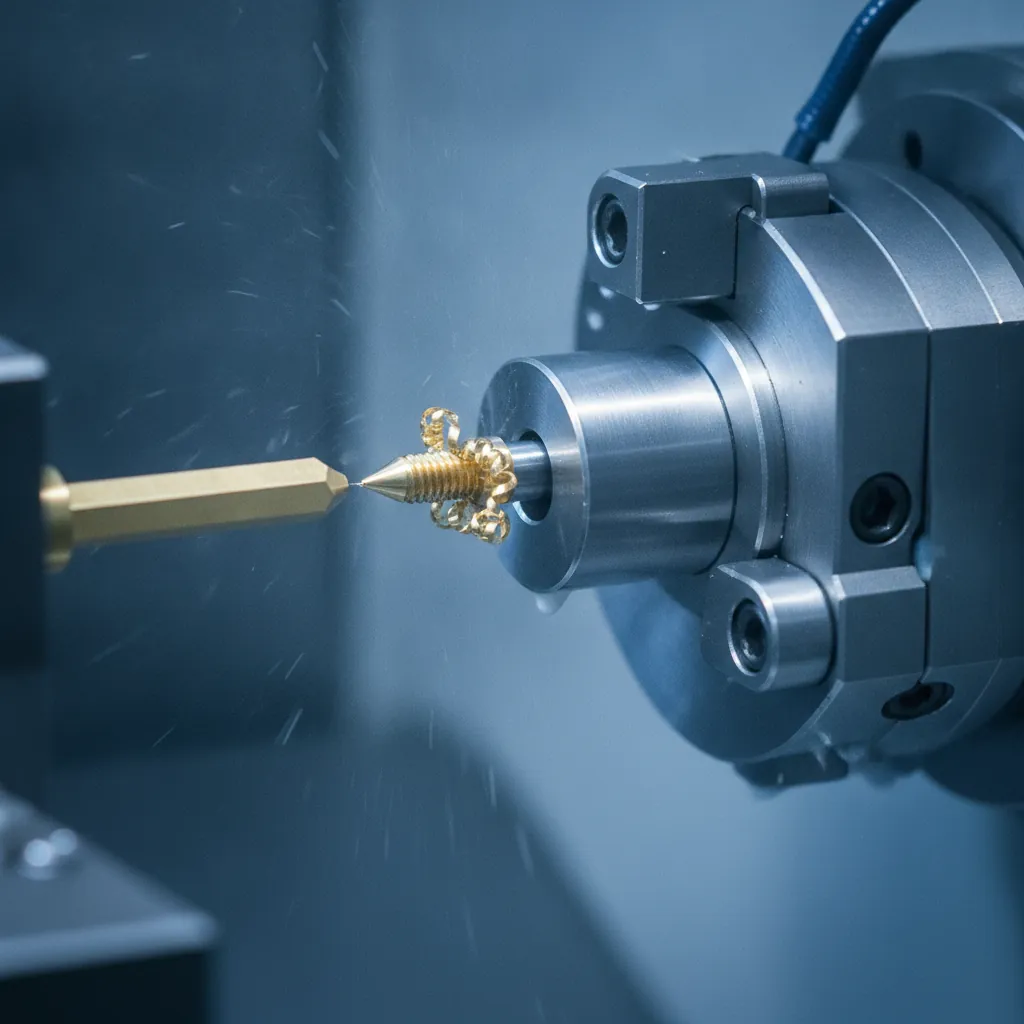
The defining feature of a Swiss-type (sliding headstock) lathe is the guide bushing. Bar stock is gripped by a collet in the headstock, which slides along the Z-axis and feeds the bar through a carbide-lined guide bushing. Cutting tools work on the material immediately next to the bushing — typically within 1–3 mm of support.
Because the workpiece is supported at the exact point of cutting, deflection is nearly eliminated. That is why a Swiss machine can turn a Ø2 mm shaft 40 mm long (L/D of 20:1) and still hold a few microns — geometry that would chatter or bend on a conventional lathe, where the tool may work far from the chuck.
Modern CNC Swiss machines add live tooling, sub-spindles and back-working stations, so a part is turned, milled, cross-drilled, threaded and cut off complete — no second operation.
| Parameter | Typical Capability |
|---|---|
| Bar diameter range | Ø0.5 – Ø38 mm (most Swiss machines) |
| Diameter tolerance | ±0.005 mm standard; ±0.002 mm on controlled features |
| Length tolerance | ±0.01 mm typical |
| Concentricity | 0.005 mm (single setup, bushing-supported) |
| Finition de surface | Ra 0.4 – 0.8 µm turned; Ra 0.2 µm achievable |
| Length-to-diameter ratio | Up to 20:1 without steady rest |
| Economic quantities | ~500 to 1,000,000+ pieces |
| Facteur | Swiss-type lathe | Conventional CNC lathe |
|---|---|---|
| Best part size | Ø0.5–38 mm, long/slender | Ø10–600 mm, short/stocky |
| Slender parts (L/D > 3) | Excellent — bushing support | Needs tailstock/steady rest |
| Cycle time (small parts) | Seconds — done-in-one | Longer; often 2 operations |
| Setup cost | Higher — justified by volume | Lower — fine for small lots |
| Ideal quantities | Volume élevé | 1 – 5,000 |
For larger or lower-volume turned work, see our CNC turning service et CNC turned parts page.
Bar stock quality matters: Swiss machines feed ground or drawn bar through the guide bushing, so diameter consistency of the raw material directly affects the bushing fit and final tolerance.
A sliding-headstock lathe that feeds bar stock through a guide bushing, supporting the workpiece at the cutting point. It excels at small-diameter, long, high-precision parts in high volumes.
The design was developed in late-1800s Switzerland to mass-produce watch components — tiny shafts and screws needing watchmaker precision at industrial quantities.
±0.005 mm is routine on diameters; ±0.002 mm is achievable on controlled features with good bar stock and temperature control.
“Screw machining” historically covers all automatic bar-fed lathes (including cam-driven multi-spindles); Swiss screw machining specifically means the sliding-headstock, guide-bushing type — today usually CNC.
Tuowei Precision runs CNC Swiss-type lathes with live tooling and sub-spindles for small precision parts from Ø0.5 to Ø38 mm — connector pins to implant screws — with 100% critical-dimension gauging. Combine Swiss parts with our Services d'usinage CNC or a full contract machining program. Send your drawing for a quote within 24 hours.

Rédigé par Andy, ingénieur de production chez TUOWEI Precision. Andy est spécialisé dans l'usinage CNC, la fabrication de précision et l'ingénierie de production. Il possède une expérience pratique dans l'accompagnement de projets, du prototypage rapide à la production à grande échelle. Il travaille en étroite collaboration avec les équipes d'ingénierie et de fabrication pour évaluer les matériaux, les tolérances, les procédés d'usinage et la fabricabilité des conceptions. Ses articles offrent des conseils pratiques et techniquement fondés pour aider les ingénieurs et les acheteurs à prendre de meilleures décisions en matière de fabrication, à optimiser l’efficacité de la production et à garantir une qualité constante des pièces. Découvrez les solutions d’usinage CNC et de fabrication sur mesure de TUOWEI Precision pour votre prochain projet.
Du prototypage rapide à la production à grande échelle, Tuowei Precision propose des services d'usinage CNC fiables, alliant précision et régularité à chaque étape. Lancez votre projet dès aujourd'hui.
Consultez nos derniers guides sur l'usinage CNC, les matériaux, les finitions et les tendances du secteur pour prendre de meilleures décisions en matière de production.