¿Necesitas soluciones de mecanizado especializadas? El equipo de Tuowei Precision está a tu disposición para ayudarte con todas tus necesidades de fabricación. ¡Ponte en contacto con nosotros hoy mismo para solicitar un presupuesto para tus proyectos actuales o futuros!
Swiss screw machining produces small, long and slender precision parts at high volume with tolerances conventional lathes struggle to hold. Originally developed for Swiss watchmaking, today’s CNC Swiss-type lathes make connector pins, medical components, shafts and fittings by the million. This guide explains how the sliding-headstock design actually works, what tolerances and sizes are realistic, which materials run best, when Swiss turning beats conventional turning — and when it doesn’t.
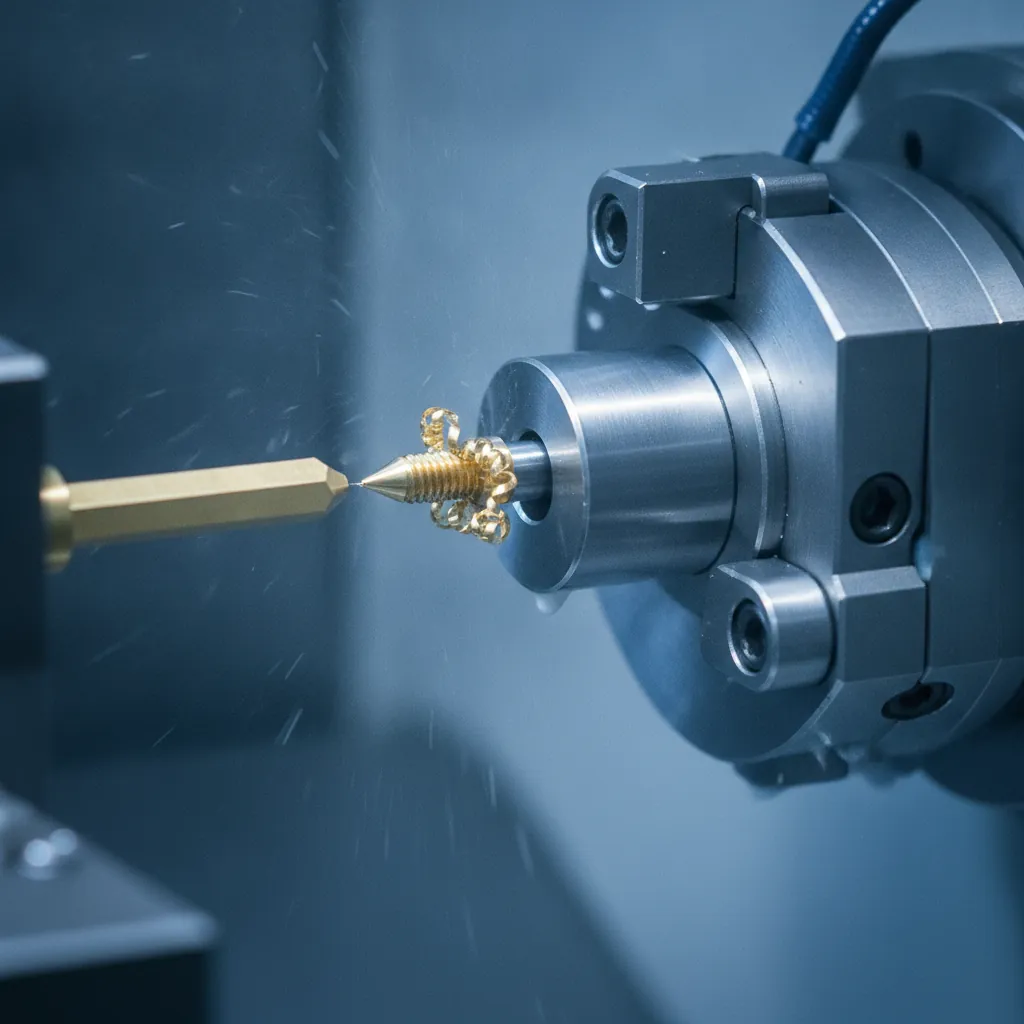
The defining feature of a Swiss-type (sliding headstock) lathe is the guide bushing. Bar stock is gripped by a collet in the headstock, which slides along the Z-axis and feeds the bar through a carbide-lined guide bushing. Cutting tools work on the material immediately next to the bushing — typically within 1–3 mm of support.
Because the workpiece is supported at the exact point of cutting, deflection is nearly eliminated. That is why a Swiss machine can turn a Ø2 mm shaft 40 mm long (L/D of 20:1) and still hold a few microns — geometry that would chatter or bend on a conventional lathe, where the tool may work far from the chuck.
Modern CNC Swiss machines add live tooling, sub-spindles and back-working stations, so a part is turned, milled, cross-drilled, threaded and cut off complete — no second operation.
| Parameter | Typical Capability |
|---|---|
| Bar diameter range | Ø0.5 – Ø38 mm (most Swiss machines) |
| Diameter tolerance | ±0.005 mm standard; ±0.002 mm on controlled features |
| Length tolerance | ±0.01 mm typical |
| Concentricity | 0.005 mm (single setup, bushing-supported) |
| Acabado de la superficie | Ra 0.4 – 0.8 µm turned; Ra 0.2 µm achievable |
| Length-to-diameter ratio | Up to 20:1 without steady rest |
| Economic quantities | ~500 to 1,000,000+ pieces |
| Factor | Swiss-type lathe | Conventional CNC lathe |
|---|---|---|
| Best part size | Ø0.5–38 mm, long/slender | Ø10–600 mm, short/stocky |
| Slender parts (L/D > 3) | Excellent — bushing support | Needs tailstock/steady rest |
| Cycle time (small parts) | Seconds — done-in-one | Longer; often 2 operations |
| Setup cost | Higher — justified by volume | Lower — fine for small lots |
| Ideal quantities | Gran volumen | 1 – 5,000 |
For larger or lower-volume turned work, see our CNC turning service y CNC turned parts página.
Bar stock quality matters: Swiss machines feed ground or drawn bar through the guide bushing, so diameter consistency of the raw material directly affects the bushing fit and final tolerance.
A sliding-headstock lathe that feeds bar stock through a guide bushing, supporting the workpiece at the cutting point. It excels at small-diameter, long, high-precision parts in high volumes.
The design was developed in late-1800s Switzerland to mass-produce watch components — tiny shafts and screws needing watchmaker precision at industrial quantities.
±0.005 mm is routine on diameters; ±0.002 mm is achievable on controlled features with good bar stock and temperature control.
“Screw machining” historically covers all automatic bar-fed lathes (including cam-driven multi-spindles); Swiss screw machining specifically means the sliding-headstock, guide-bushing type — today usually CNC.
Tuowei Precision runs CNC Swiss-type lathes with live tooling and sub-spindles for small precision parts from Ø0.5 to Ø38 mm — connector pins to implant screws — with 100% critical-dimension gauging. Combine Swiss parts with our Servicios de mecanizado CNC or a full contract machining program. Send your drawing for a quote within 24 hours.

Escrito por Andy, ingeniero de fabricación en TUOWEI Precision. Andy está especializado en mecanizado CNC, fabricación de precisión e ingeniería de producción, y cuenta con experiencia práctica en el apoyo a proyectos que abarcan desde la creación rápida de prototipos hasta la producción a gran escala. Trabaja en estrecha colaboración con los equipos de ingeniería y fabricación para evaluar materiales, tolerancias, procesos de mecanizado y la facilidad de fabricación de los diseños. Sus artículos ofrecen información práctica y con base técnica para ayudar a ingenieros y compradores a tomar mejores decisiones de fabricación, optimizar la eficiencia de la producción y lograr una calidad constante de las piezas. Descubre las soluciones de mecanizado CNC y fabricación a medida de TUOWEI Precision para tu próximo proyecto.
Desde prototipos rápidos hasta la producción a gran escala, Tuowei Precision ofrece un mecanizado CNC fiable, con precisión y uniformidad en cada paso. Empieza tu proyecto hoy mismo.
Lee nuestras últimas guías sobre mecanizado CNC, materiales, acabados y tendencias del sector para tomar mejores decisiones de producción.