
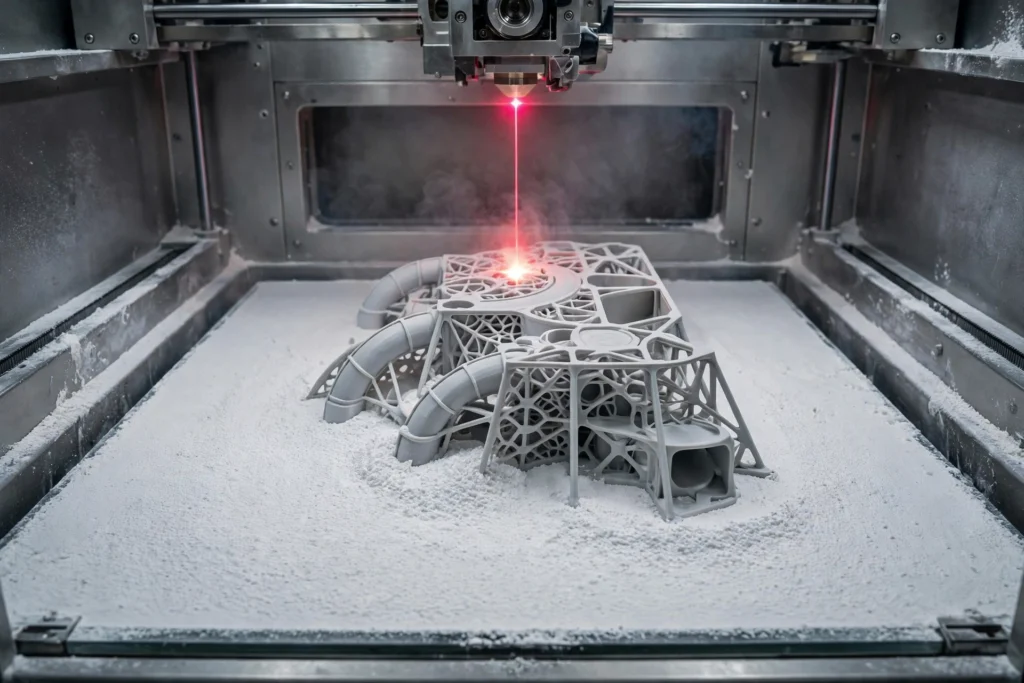
SLS 3D printing builds strong, functional plastic parts straight from a digital model, with no molds, tooling, or support structures. It is one of the core methods behind rapid prototyping, because a team can print complex nylon parts in days and test them under real loads.
This guide explains what selective laser sintering is, how the process works, which materials it runs, what accuracy to expect, and how it compares with SLA, MJF, and FDM. It also covers practical design tips, so you can judge whether SLS suits your part before you commit to a build.
What Is SLS 3D Printing? #
SLS stands for selective laser sintering. It is an additive manufacturing process: a high-power laser, usually a CO2 laser, scans across a bed of fine polymer powder and fuses the particles into a solid layer. The build platform drops, a recoater spreads a fresh layer of powder, and the laser fuses the next cross-section until the part is complete.
Under the ISO/ASTM 52900 standard, selective laser sintering belongs to the powder bed fusion category. The key difference from MJF, its closest relative, is the heat source: SLS traces each layer with a laser, point by point, while MJF fuses a whole layer at once with fusing agents and an infrared lamp.
How SLS Works, Step by Step #
Selective laser sintering was one of the first additive manufacturing techniques, developed in the mid-1980s by Carl Deckard and Joe Beaman at the University of Texas at Austin (Formlabs). Every SLS build follows the same sequence, and the unfused powder does the job that support structures do in other processes.
- Model: The part is designed in CAD and exported as a mesh file, usually STL or 3MF.
- Slice: Slicing software cuts the model into thin horizontal layers, about 0.1 mm thick, and plans the laser path for each one.
- Preheat: The build chamber is heated to just below the powder’s melting point, so the laser only needs a small extra push to fuse each layer.
- Print: The laser traces the part’s cross-section, fusing the powder into a solid layer. The platform drops, the recoater spreads fresh powder, and the cycle repeats.
- Cool: The finished parts cool slowly inside the powder bed, which limits warping before they are removed.
- Recover: The parts are dug out of the powder and brushed clean. Unused powder is mixed with fresh powder and reused, and the parts are media-blasted to remove loose powder fully.
Common SLS Materials #
SLS runs on polymer powder, and nylon is the workhorse. The four materials below cover most SLS work, with Nylon 12 the default choice for functional parts. All figures in the table are Formlabs’ published values for its Fuse Series powders.
| Material | Tensile strength | Elongation at break | Heat deflection @ 0.45 MPa |
|---|---|---|---|
| Nylon 12 | 50 MPa | 11% | 171°C |
| Nylon 11 | 49 MPa | 40% | 182°C |
| Nylon 12 GF | 38 MPa | 4% | 170°C |
| TPU | Varies by grade | Varies by grade | — |
Table sources: tensile strength, elongation, and heat deflection figures from Formlabs’ Nylon 12 Powder technical data sheet, its Nylon 11 comparison, and its Nylon 12 GF material page. Figures are typical published values and vary by printer, grade, and build orientation. TPU figures are omitted because no single comparable set is published — check the powder maker’s datasheet for exact values.
Nylon 12 #
Nylon 12 is the default SLS material and the one most parts are printed in. Formlabs lists an ultimate tensile strength of 50 MPa, a tensile modulus of 1,850 MPa, and elongation at break of 11 percent, with a heat deflection temperature of 171°C at 0.45 MPa. It absorbs very little moisture, resists light, heat, and chemicals, and is biocompatible, which suits orthotics, prosthetics, and other skin-contact parts.
Nylon 11 #
Nylon 11 is the more ductile nylon, with elongation at break of 40 percent against Nylon 12’s 11 percent, at nearly the same tensile strength of 49 MPa (Formlabs). Its heat deflection temperature reaches 182°C at 0.45 MPa, and it absorbs impacts better, which suits clips, living hinges, and parts that must flex without snapping.
Nylon 12 GF #
Nylon 12 GF adds glass filler to Nylon 12 for stiffness and thermal stability under load. Its tensile modulus of 2,800 MPa is far above standard Nylon 12, but tensile strength drops to 38 MPa and elongation to 4 percent, so it suits stiff brackets and housings rather than parts that must bend (Formlabs).
TPU #
TPU is a flexible thermoplastic polyurethane powder for parts that must bend, stretch, or absorb shock, such as seals, gaskets, and protective covers. It prints more slowly than rigid nylons, and its properties vary widely by Shore hardness grade, so no single tensile or heat figure applies.
Strengths and Limits #
Strengths #
SLS needs no support structures, because the unfused powder cradles the part as it builds. That frees complex geometries, internal channels, undercuts, and nested parts in a single build, and whole build volumes can be packed with dozens of parts at once. SLS parts are also strong and functional straight off the printer, with near-isotropic strength that FDM cannot match.
Limits #
SLS parts come out with a grainy, sandy surface that needs media blasting or further finishing for a smooth look. Large, flat parts can warp as they cool, and the process shrinks 3 to 3.5 percent (Xometry), so dimensions must be planned around shrinkage. Powder handling also adds cost and cleanup, and the material range is narrower than FDM, with nylon dominating.
Isotropy: Why SLS Parts Are Strong in Every Direction #
SLS parts are far more isotropic than FDM parts, because each layer fuses into the powder bed rather than being laid down as strands. Xometry notes SLS reaches roughly 85 to 90 percent isotropy, against 97 to 98 percent for MJF. That makes SLS a safer choice than FDM for parts loaded in more than one direction, though machined metal still beats any printed plastic for critical loads.
Tolerances and Surface Finish #
Xometry lists SLS tolerances at about ±0.3 percent with a lower limit of ±0.3 mm for a 100 mm part, with a typical layer thickness near 0.1 mm and a minimum feature size of 0.5 mm (0.75 mm recommended). For tighter tolerances, Xometry recommends PA 12 glass-filled. These are planning values, not guarantees: material, part size, and geometry all shift real results, and large flat surfaces are the most prone to warping.
Surface finish is the other limit to plan for. As-printed SLS parts have a grainy, sandy texture, and Formlabs recommends media blasting to clean off loose powder fully. Polishing, dyeing, and coatings can smooth and color the surface, but each adds time and can change dimensions slightly, so critical fits should be checked after finishing, not before.
SLS vs SLA vs MJF vs FDM #
SLS, SLA, MJF, and FDM all build parts layer by layer, but they use different materials and suit different jobs. SLS fuses nylon powder with a laser, SLA cures liquid resin with UV light, MJF fuses powder with fusing agents and an infrared lamp, and FDM melts filament. The table below sums up the practical differences.
| Method | How it works | Typical tolerance* | Best for |
|---|---|---|---|
| SLS | CO2 laser fuses nylon powder | ±0.3% (±0.3 mm) | Strong parts, no supports needed |
| SLA | UV-cured liquid resin | ±0.5% (±0.2 mm) | Fine detail, smooth surfaces |
| MJF | Fusing agent + infrared lamp | ±0.3% (±0.3 mm) | Fast batches, smooth nylon parts |
| FDM | Melted filament, layer by layer | ±0.5% (±0.5 mm) desktop | Strong, large, low-cost parts |
| DMLS / SLM | Laser fuses metal powder | ±0.1% (±0.1 mm) | Metal end-use parts |
*Tolerance figures are Xometry’s indicative values and vary with material, size, and geometry. MJF is the closest relative: both print nylon powder without supports, but MJF fuses whole layers at once, so it runs faster on batches, while SLS offers more machine and powder choices. If your part needs tight tolerances, smooth surfaces, or production materials, CNC machining services may be the better route, since machined parts hold far tighter tolerances than printed ones.
Design Tips for SLS Parts #
Good SLS design works with the powder process instead of against it. Small choices at the design stage decide whether a part prints cleanly and holds its fit.
- Keep walls above the minimum: Formlabs recommends vertical walls of at least 0.6 mm and horizontal walls of at least 0.3 mm for Fuse Series printers.
- Size features above 0.5 mm: Smaller details may not resolve; Xometry recommends 0.75 mm as the safe minimum feature size.
- Add escape holes: Trapped powder must have a way out of hollow sections and internal channels, or it stays inside the part.
- Keep walls even: Even wall thickness cools evenly and warps less than sections that jump between thick and thin.
- Allow for shrinkage: SLS shrinks 3 to 3.5 percent, so leave extra clearance on mating features and check critical fits after printing.
- Nest parts in the build: Pack multiple parts into one build to cut per-part cost, since no supports are needed and the powder bed holds them all.
Frequently Asked Questions #
What is SLS in 3D printing? #
SLS is a 3D printing method that uses a high-power laser to fuse small particles of polymer powder, usually nylon, into a solid part, layer by layer. The unfused powder supports the part during printing, so no dedicated support structures are needed, and complex geometries print in a single build.
What does SLS stand for in 3D printing? #
SLS stands for selective laser sintering. Selective means the laser fuses only the powder inside the part’s cross-section, laser is the heat source, and sintering is the fusing of powder particles into a solid without fully melting them.
How does SLS 3D printing work? #
A recoater spreads a thin layer of nylon powder across the build platform, and a CO2 laser traces the part’s cross-section, fusing the powder into a solid layer. The platform drops, a fresh layer is spread, and the process repeats until the part is complete. The part then cools in the powder, is dug out, and is media-blasted clean.
Which is better, SLA or SLS? #
It depends on the part. SLA gives finer detail and smoother surfaces, so it suits small, cosmetic, or highly detailed parts. SLS gives stronger, functional nylon parts with no supports, so it suits parts that must take load or have complex shapes. For functional prototypes and end-use parts, SLS is usually the better choice.
Is SLS or FDM faster? #
It depends on the job. FDM builds one part at a time and is often quicker for a single simple part. SLS builds many parts at once, nested in one powder bed, so its per-part time falls sharply on batches. For one small prototype, FDM is usually faster; for dozens of parts, SLS usually wins.


