Need expert machining solutions? Our team at Tuowei Precision is here to assist with all your manufacturing needs. Get in touch today for a quote on your ongoing or upcoming projects!
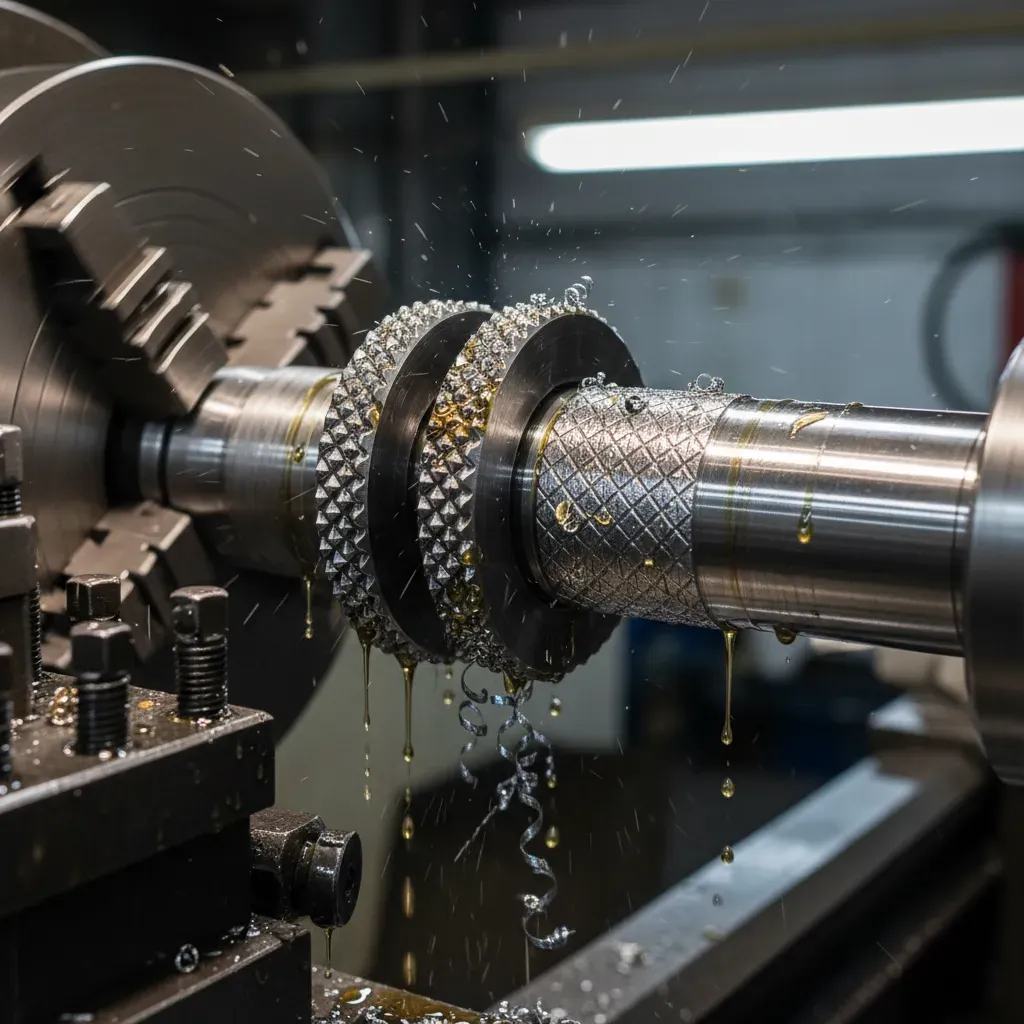
Knurling is the process of forming a textured pattern — diamond, straight or helical ridges — onto a cylindrical surface, almost always on a lathe. It turns a slippery machined surface into a grip: thumb screws, tool handles, electrical connector shells and press-fit inserts all rely on it. This guide covers the two fundamentally different knurling tools, pattern and pitch selection, exactly how much the outside diameter grows, and how to call knurls out on a drawing so your machine shop produces what you expect.
| Pattern | Geometry | Primary use |
|---|---|---|
| Diamond (criss-cross) | Two opposed helical ridge sets forming raised diamonds | Hand grip in any direction — knobs, handles, fasteners |
| Straight | Ridges parallel to the axis | Rotational grip and press-fit retention in plastic/light alloys |
| Helical (single direction) | One helix direction (LH or RH) | Decorative, special assembly functions |
| Factor | Form (roll) knurling | Cut knurling |
|---|---|---|
| Principle | Hardened wheels press and displace material | Angled cutting wheels shave the pattern |
| Chips | None | Yes |
| OD change | Grows above blank diameter | Stays at or below blank diameter |
| Radial force on part | High — can bend slender work | Low — suits thin/long parts |
| Best materials | Ductile: steel, brass, aluminum | Stainless, hard alloys, thin walls |
| Speed | Very fast — production standard | Slower, cleaner pattern |
Form knurling displaces metal outward: the finished OD is larger than the turned blank. The practical rule:
OD growth ≈ 0.5 × pitch (e.g., 0.8 mm pitch → ~0.4 mm growth)
| Knurl pitch | Typical blank undercut below finished OD |
|---|---|
| 0.5 mm (fine) | 0.2–0.3 mm |
| 0.8 mm (medium) | 0.3–0.45 mm |
| 1.0 mm (coarse) | 0.4–0.55 mm |
Two drawing consequences: specify the finished OD over knurl (with a workable tolerance like ±0.1 mm), and keep the knurl clear of any bearing or sealing diameters.
| Pitch class | Approx. pitch | Suits diameters | Feel |
|---|---|---|---|
| Fine | 0.5 mm / 33 TPI | Ø3–12 mm | Smooth, precise adjustment knobs |
| Medium | 0.8 mm / 21 TPI | Ø8–30 mm | General-purpose grip |
| Coarse | 1.0–1.6 mm | Ø20 mm+ | Aggressive grip, gloved hands |
A coarse pitch on a small diameter gives too few diamonds — the pattern tears and looks ragged. When in doubt, medium.
Straight or diamond knurls are the standard anti-rotation feature on metal inserts molded or pressed into plastic. Design notes: knurl OD typically 0.2–0.4 mm over the hole, length ≥1× diameter for torque, and a plain pilot diameter to start alignment. Brass C360 is the classic insert material — see our brass CNC machining service.
| Problem | Cause | Fix |
|---|---|---|
| Double-tracked / ghost pattern | Wheel circumference not dividing evenly into part OD | Adjust blank OD slightly; use self-centering head |
| Flattened diamond tops | Over-penetration | Reduce infeed; check growth formula |
| Bent part | Form-knurling force on slender work | Support with tailstock, or switch to cut knurling |
| Ragged pattern in stainless | Work hardening under rolling | Cut knurling, sharp wheels, positive feed |
Mainly grip: hand-operated knobs, screws and handles. Second, retention: knurled surfaces anchor press-fits and molded-in inserts against rotation and pull-out. Third, appearance on consumer hardware.
A knurling tool held in the lathe turret — either forming wheels that press the pattern (form knurling) or angled cutting wheels that machine it (cut knurling). Scissor-type holders clamp the part between two wheels to cancel radial force.
Form knurling does — by roughly half the pitch. Cut knurling does not; it machines the pattern into the existing diameter.
The most common pattern: two crossed helical ridge sets creating raised diamond points, giving grip in both rotation and axial pull directions.
We produce knurled knobs, shafts and inserts on CNC lathes and Swiss machines — pattern, pitch and finished OD held to your callout. See our CNC turned parts capabilities and Swiss screw machining services, or send your drawing for a 24-hour quote.

Written by Andy, Manufacturing Engineer at TUOWEI Precision. Andy specializes in CNC machining, precision manufacturing, and production engineering, with hands-on experience supporting projects from rapid prototyping through full-scale production. He works closely with engineering and manufacturing teams to evaluate materials, tolerances, machining processes, and design manufacturability. His articles provide practical, technically informed insights to help engineers and buyers make better manufacturing decisions, optimize production efficiency, and achieve consistent part quality. Explore TUOWEI Precision’s CNC machining and custom manufacturing solutions for your next project.
From rapid prototypes to scalable production, Tuowei Precision delivers reliable CNC machining with accuracy and consistency at every step. Start your project today.
Read our latest guides on CNC machining, materials, finishing and industry trends to make better production decisions.