Need expert machining solutions? Our team at Tuowei Proto is here to assist with all your manufacturing needs. Get in touch today for a quote on your ongoing or upcoming projects!
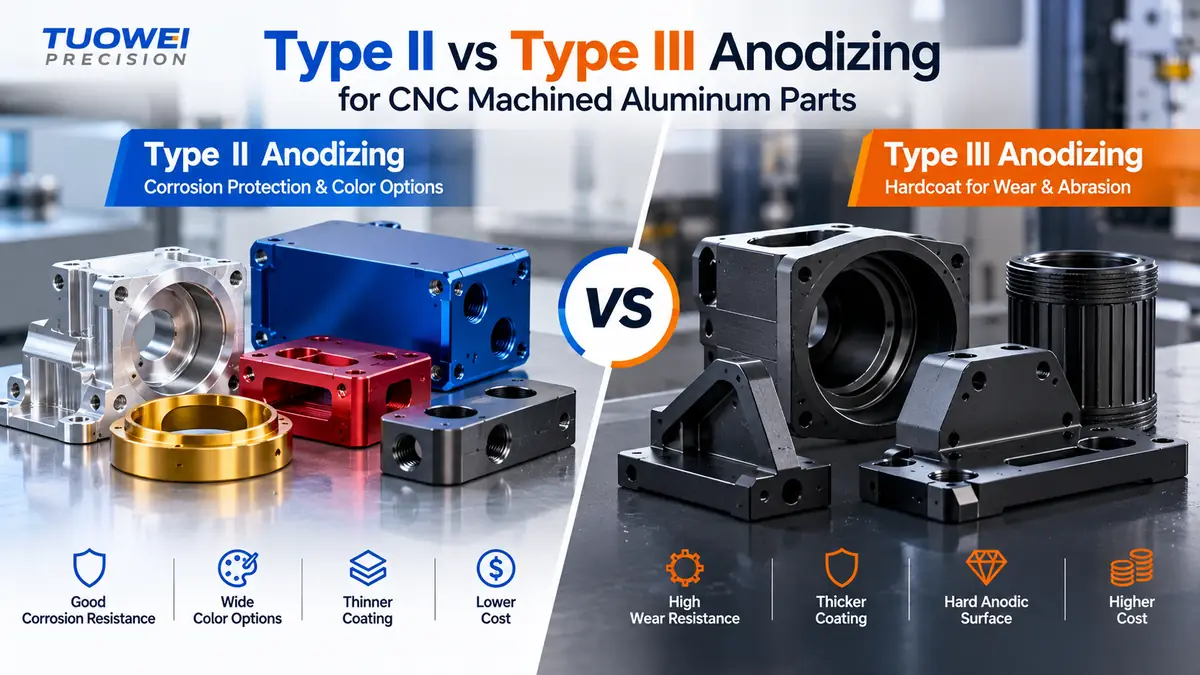
Type II vs Type III anodizing is really a question about what the surface has to survive. Type II is a thinner sulfuric acid coating that takes dye well and protects against corrosion, so it suits housings, brackets and cosmetic parts. Type III, also called hard anodizing, builds a much thicker, denser layer for sliding wear and abrasion. It costs more, changes dimensions more and narrows your color choices.
Short answer: Pick Type II when a machined aluminum part needs corrosion protection, color or a clean cosmetic finish. Pick Type III when a surface slides, rubs or takes abrasion. Type III builds a much thicker coating, so bores, threads and fits need allowances before machining, and it usually costs more per part.
Below, both finishes are compared against the requirements in the specification itself. You will also see how much each one changes your dimensions and how to call them out so the part you receive is the part you designed.
Type II is sulfuric acid anodizing. The part becomes the anode in a sulfuric acid bath, and electric current converts the aluminum surface into aluminum oxide. That oxide is porous enough to absorb dye, and it is then sealed to close the pores.
It is not paint or plating sitting on top of the metal; the coating grows out of the aluminum itself, which is why it does not peel.
In the US, the governing specification is MIL-PRF-8625, still written on many drawings as MIL-A-8625. It sorts coatings by Type (the process) and Class. Class 1 is non-dyed and Class 2 is dyed. For Type II, the spec sets a minimum coating weight of 1,000 mg per square foot and requires the coating to be sealed unless the drawing says otherwise. Sealed Type II must then pass 336 hours of salt spray testing under ASTM B117.
That mix of corrosion protection, color and modest thickness makes Type II the everyday finish for anodized aluminum parts: electronics enclosures, camera and optics housings, robot brackets, consumer products and fixtures. The spec also includes Type IIB, a thinner sulfuric acid coating meant as a non-chromate alternative to Type I chromic acid anodizing.
Type III is what MIL-PRF-8625 calls a hard anodic coating. Most shops call it hardcoat. The bath runs much colder and at a higher current density than Type II, which grows a denser and far thicker oxide.
Unless the drawing states otherwise, the spec sets Type III at a nominal 0.002 in. (2 mils), with a tolerance of ±20% for coatings up to that thickness. Thicker coatings can be ordered. Above 0.002 in., the thickness is held to ±0.0004 in.
What the spec does not give Type III is a hardness number. It tests abrasion instead, using a Taber abrasion test under ASTM D4060 with CS-17 wheels, a 1,000 g load and 10,000 cycles. The maximum wear index is 1.5 mg per 1,000 cycles for most alloys and 3.5 mg for alloys with 2% or more copper. Rockwell C figures quoted for hard coat anodizing online are approximations, not a requirement your supplier has to meet.
One more difference that buyers often miss: Type III is left unsealed by default when wear resistance is the reason for using it. Sealing closes the pores and helps corrosion resistance, but it lowers abrasion resistance. If you need hardcoat on an outdoor part, the purchase order has to ask for sealing.
| Property | Type II | Type III |
| Process | Sulfuric acid anodizing | Hard anodic coating in a cold bath at higher current density |
| Coating requirement in MIL-PRF-8625 | Minimum coating weight of 1,000 mg/ft² | Nominal 0.002 in. unless specified; ±20% up to 0.002 in. |
| Sealing by default | Sealed | Unsealed when wear is the main purpose |
| Corrosion test | 336 hours salt spray (ASTM B117) | 336 hours only when sealing is specified |
| Wear test | None required | Taber abrasion: 1.5 or 3.5 mg per 1,000 cycles max |
| Growth per coated surface | About half of a thin coating | About 0.001 in. at the nominal 0.002 in. coating |
| Color | Wide range of dyes (Class 2) | Naturally gray to dark bronze; dyes limited to dark shades |
| Fatigue impact | Can reduce fatigue strength | Larger reduction, since thicker coatings cut fatigue strength more |
| Relative cost | Lower | Higher |
| Typical parts | Housings, enclosures, brackets, cosmetic parts | Pistons, slides, valve bodies, guide rails, wear pads |
Anodizing thickness matters because the coating does not simply sit on top of the part. MIL-PRF-8625 gives a working rule: expect each coated surface to grow by about half the coating thickness. The rest forms below the original surface as aluminum converts to oxide.
On a flat face that sounds small. On a diameter the effect doubles, because two opposite surfaces grow at once:
Threads are where this hurts most. On a 60° thread, outward growth on the flanks changes the pitch diameter (the effective diameter that sets how a thread fits) by about four times the growth per surface. At 0.001 in. per surface, that is roughly 0.004 in. on pitch diameter, more than many Class 2A and 2B thread tolerances allow. Threads on Type III parts are usually masked, or cut oversize and gauged after coating.
Type II is thinner, so the change is smaller, but it is not zero. Precision bores and fine threads still need a decision.
Our view: dimension every critical feature as “after coating” and let the manufacturer size the part to suit. That puts the allowance with the people who control both the machining and the finish, instead of splitting responsibility between two suppliers.
Alloy choice changes the look of the coating, its quality and, for Type III, whether the part can be hard anodized at all.
| Alloy | Type II result | Type III result |
| 6061-T6 | Clear, even color; the usual choice for cosmetic parts | Good hardcoat; the easiest alloy to specify |
| 6063 | Very even cosmetic finish on extrusions | Good |
| 7075-T6 / T651 | Anodizes well; clear coats can look slightly yellow or gray | Good wear coating on a high-strength alloy |
| 2024-T3 | Duller and less even color | Softer coating; falls under the higher 3.5 mg wear limit |
| High-silicon cast alloys | Gray and blotchy | Not permitted above 8.0% silicon without buyer approval |
MIL-PRF-8625 bars Type III on alloys with a nominal copper content above 5.0% or nominal silicon above 8.0%, unless the buyer approves. Most wrought machining alloys sit well inside those limits. The rule mostly catches certain casting alloys.
For strength-critical parts, 7075-T651 aluminum takes both finishes well, though its color can differ from 6061 in the same tank. That leads to a common mistake. A 6061 cover and a 7075 frame anodized black in the same lot will rarely match exactly. If color match matters across an assembly, keep the parts in one alloy and one anodizing lot.
Choose Type III anodizing when a surface does mechanical work: pistons and cylinder bores, slides and guide rails, valve bodies, wear pads, and parts that see repeated abrasion from grit or fasteners. In those uses the thicker oxide earns its cost.
Choose Type II for almost everything else. Our position: if nothing rubs on the surface, Type II Class 2 with a proper seal gives most parts the corrosion protection, color and price they need, and it keeps dimensional change small.
A few cases need more thought:
Most anodizing problems are built in at the machining stage. These are the ones that come up most often in RFQs (requests for quote):
Our CNC milling services team reviews edge breaks, thread sizes and masking features with the finish in mind, because changing them after the first article is slower and more expensive.
The costliest failure is also the most common. A drawing says “anodize” with no type, class or color, the parts come back in clear Type II, and the customer wanted black hardcoat on the running surfaces. Stripping and recoating removes more base metal and moves the dimensions again, so the fix is often a new part.
A clear callout names the spec, type, class, color, thickness where it matters, sealing and masking. For example:
Many drawings still reference MIL-A-8625. The current revision, MIL-PRF-8625F with Amendment 2, superseded MIL-A-8625F, and you can check the latest status in the DoD ASSIST specification database. For international supply chains, ISO 10074 covers hard anodic coatings and can be referenced for Type III work.
Parts for defense and military programs are often certified to the exact spec revision named on the contract. Revisions do change, so confirm which one applies before the order ships.
In the RFQ, send the callout together with the part size or surface area, lot quantity and any certification you need. The finishing price depends on all four.
Hard coat anodizing costs more than Type II anodizing for four practical reasons:
Both types run in batches with a lot charge, so small orders pay more per part either way. Grouping parts with the same type, class and color into one lot is the simplest saving. On small parts with many masked features, masking labor can be a large share of the finishing price.
The exact gap between the two depends on part size, anodizing thickness, color and lot size, so compare quotes on the same callout rather than on the word “anodize.” If you are also pricing the machining, our CNC machining services quote the part and the finish together, which keeps the coating allowance and the finish price in one place.
Treat Type II vs Type III anodizing as a surface-by-surface decision rather than a whole-part one. Ask which faces wear, which must conduct, which need to match in color and which carry tight fits. The answers usually point to Type II for most anodized aluminum parts, with hardcoat saved for the surfaces that earn it.
When you are ready, send your drawing and finish callout to Tuowei Precision. Our engineers will confirm the type, coating thickness and masking plan with your quote, before any material is cut.
Q: What is the main difference between Type II and Type III anodizing?
A: Type II is a thinner sulfuric acid coating used for corrosion protection and color. Type III is a thick, dense hard anodic coating built for wear and abrasion. Type III changes dimensions more, costs more, offers fewer colors and is left unsealed by default when wear resistance is the goal.
Q: How thick is Type III hard anodizing?
A: MIL-PRF-8625 sets Type III at a nominal 0.002 in. (2 mils) unless the drawing specifies otherwise, with a ±20% tolerance up to that thickness. Thicker coatings can be ordered. Expect each coated surface to grow outward by about half the coating thickness, so plan machining allowances around it.
Q: Can Type III anodizing be dyed?
A: Yes, but the choice is narrow. Hardcoat is naturally gray to dark bronze depending on the alloy and thickness, so dyes mostly give black or dark shades. Bright colors and close color matching across parts are much easier to achieve with Type II Class 2.
Q: Does anodizing affect threads and tolerances?
A: Yes. Each surface grows by about half the coating thickness, and on a 60° thread that changes pitch diameter by about four times the growth per surface. Threads on hardcoat parts are usually masked or cut oversize, and critical dimensions should state that they apply after coating.
Q: Is Type III anodizing better for corrosion resistance?
A: Not automatically. Sealed Type II must pass 336 hours of ASTM B117 salt spray. Type III is often left unsealed for wear resistance and only carries that salt spray requirement when sealing is specified. For outdoor hardcoat parts, ask for sealing on the purchase order.

Written by Andy, Manufacturing Engineer at TUOWEI Precision. Andy specializes in CNC machining, precision manufacturing, and production engineering, with hands-on experience supporting projects from rapid prototyping through full-scale production. He works closely with engineering and manufacturing teams to evaluate materials, tolerances, machining processes, and design manufacturability. His articles provide practical, technically informed insights to help engineers and buyers make better manufacturing decisions, optimize production efficiency, and achieve consistent part quality. Explore TUOWEI Precision’s CNC machining and custom manufacturing solutions for your next project.
From rapid prototypes to scalable production, Tuowei Precision delivers reliable CNC machining with accuracy and consistency at every step. Start your project today.
Keep updated on the real CNC machining, industry trends, and production insights in Tuowei Precision, but is installed to enable you to make better production decisions.