Need expert machining solutions? Our team at Tuowei Proto is here to assist with all your manufacturing needs. Get in touch today for a quote on your ongoing or upcoming projects!
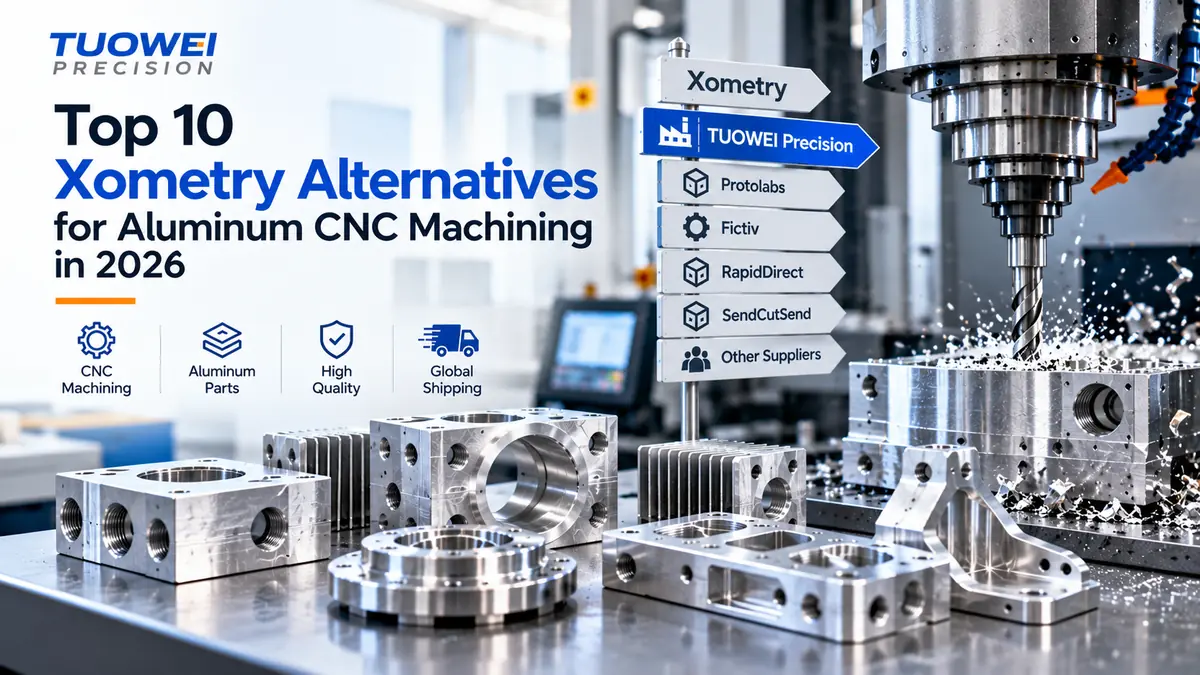
The best Xometry alternatives for aluminum parts in 2026 are Tuowei Precision, Protolabs, Fictiv, Protolabs Network (Hubs), RapidDirect, SendCutSend, Fathom, Jiga, Geomiq, and Star Rapid. Pick an in-house factory when you want one team accountable for your parts. A managed network fits better when you need a wide process range, sourcing in several regions, or someone else to run the program.
Quick answer: Xometry is an AI-quoting marketplace that routes your order to a supplier in its network. The strongest alternatives either make parts in their own factories (Protolabs, Tuowei, RapidDirect, Star Rapid), manage a curated network (Fictiv, Protolabs Network, Geomiq), or let you talk directly to vetted shops (Jiga). For production runs of aluminum parts, factory-direct suppliers usually quote lower.
Disclosure: Tuowei Precision is a CNC machining manufacturer and appears in this list. Details about other companies come from their own websites and public filings as of September 2026. Check each supplier before you order, because capabilities and certifications change.
Xometry works well for a lot of people. You upload a CAD file, get a price in minutes, and the order ships. The question is what happens between those two steps.
According to Xometry’s 2024 annual report filed with the SEC, the company prices a job before sourcing it, then routes it to a seller in a network it described as 4,375 active suppliers. Xometry is the merchant of record. You pay Xometry, and a shop you did not choose makes the part.
That model has real strengths. It also creates three problems that show up often on aluminum work:
To be fair, Xometry earns its customers. The instant quote is genuinely fast, the process list runs from CNC and sheet metal to 3D printing and molding, and its about page lists ISO 9001:2015, AS9100D, ISO 13485:2016, IATF 16949:2016, and ITAR. For a buyer who needs six different processes on one purchase order, that breadth is hard to match.
So the case for a Xometry alternative is not that Xometry fails. It is that no single sourcing model fits every aluminum part. The right option depends on your part, your quantity, and how much of the supplier relationship you want to manage yourself.
We looked at each supplier through the lens of an engineer buying machined aluminum, not a general 3D printing customer. Every company was checked against its own website or public filings in September 2026.
The criteria:
We did not use review-site scores, because they swing with a handful of reviews and mix 3D printing complaints with machining ones. Where a company did not publish a figure, we left it out rather than guess.
| Supplier | Business model | Headquarters | Best for | Aluminum detail from the supplier’s site |
| Tuowei Precision | Own factory plus partner network | Shenzhen, China | Factory-direct aluminum production | 6061-T651, 7075-T651, 7050, 6082, 5052, 2024-T351, MIC6 |
| Protolabs | Own factories plus Protolabs Network | Maple Plain, Minnesota, USA | Fastest prototypes | Aluminum alloys and anodizing offered |
| Fictiv | Managed partner network | San Francisco, California, USA | Multi-region supply chains | Aluminum machining across 4 regions |
| Protolabs Network (Hubs) | Distributed partner network | Operated by Protolabs | Broad alloy and finish choice | 6061-T6, 7075-T6, 6082; Type II and Type III anodizing |
| RapidDirect | Own factory plus 80+ suppliers | Shenzhen, China | Budget prototypes and bridge runs | Common aluminum grades |
| SendCutSend | In-house, USA | Nevada, Kentucky, Texas, USA | Small 6061 billet parts made in the USA | 6061-T6 only, Class II anodize colors |
| Fathom | In-house plus global sourcing | Hartland, Wisconsin, USA | ITAR and regulated programs | Aluminum across 8 US locations |
| Jiga | Direct-to-supplier platform | Not stated on site | Talking directly to vetted shops | Depends on the matched supplier |
| Geomiq | Managed partner network | United Kingdom | UK and European buyers | 120+ CNC materials |
| Star Rapid | Own factory | Zhongshan, China | Prototypes that may move to tooling | Multi-axis CNC in aluminum |
Each entry below covers how the company works, what it offers for aluminum, and where it falls short. The order reflects fit for aluminum CNC work, not a paid ranking.
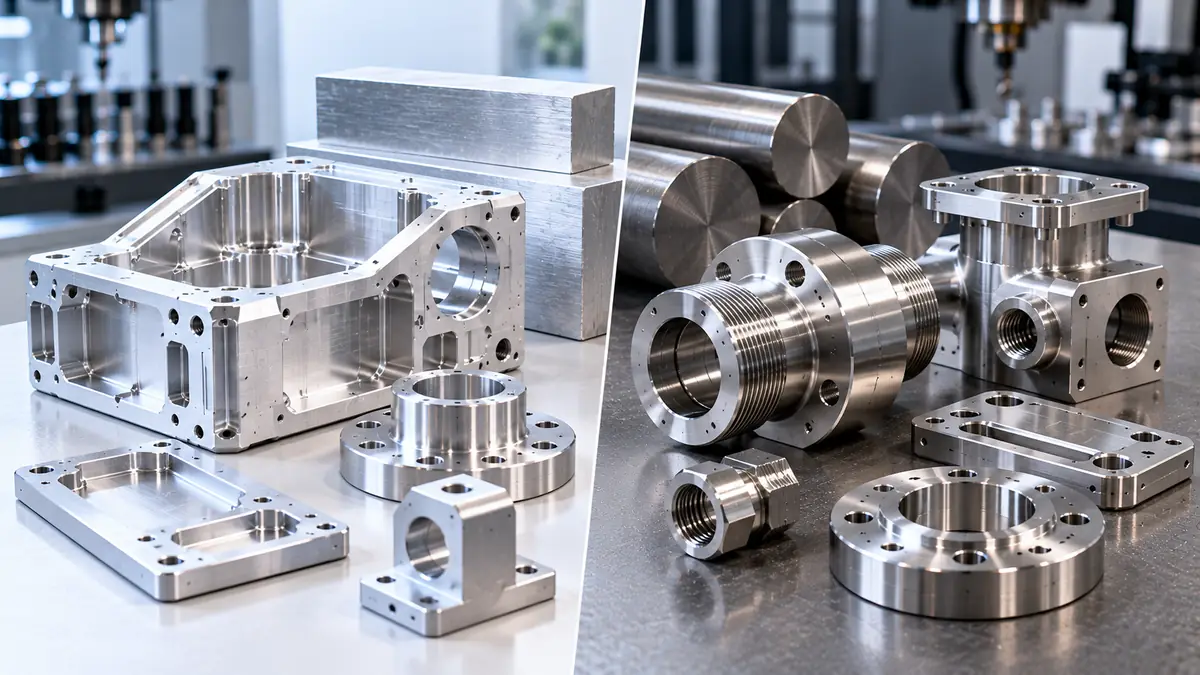
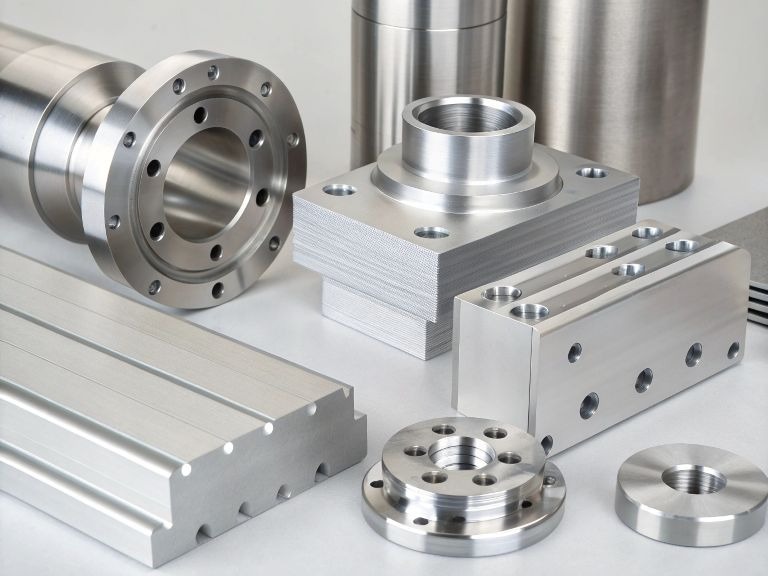
Tuowei Precision is a CNC machining manufacturer in Shenzhen with a 7,000 m² factory in Bao’an District, near Shenzhen Airport. It runs 3-axis, 4-axis, 5-axis, and right-angle milling alongside CNC turning, so most aluminum housings, brackets, and manifolds can be machined complete in one factory.
The aluminum range is wide. Tuowei stocks and publishes data for 6061-T651 aluminum, 7075-T651, 7075-T7351, 7050, 6082, 5052, 2024-T351, 2017A, 2014, and MIC6 cast plate. Finishing covers Type II and other aluminum anodizing services, plus chromate conversion coating and bead blasting.
Tuowei is built for the stage when a part outgrows sites like Xometry: the design is stable and quantities are growing. As a Xometry alternative, the difference is who you talk to. Your drawing goes to the engineers who program and machine the part, and DFM (design for manufacturing) feedback comes before cutting starts. [VERIFY with client: certifications ISO 9001:2015, AS9100D, ISO 13485; tolerance claim of ±0.0005″; statement that international quotes include tariffs.]
Watch out for: ocean or air freight from China adds transit time, and US tariffs on Chinese goods change. Ask for a landed-cost quote, not just a unit price.
Protolabs, founded in 1999 in Maple Plain, Minnesota, runs its own digital factories and pairs them with Protolabs Network. Its site says parts can ship “in as fast as a day,” and it lists ISO 9001, ISO 13485, and AS9100D certifications.
Among Xometry competitors, Protolabs is the one to call when speed is the main reason to switch. When a prototype has to be on a test bench by Friday, in-house automation beats routing to an outside shop.
The trade-off is price at volume. Protolabs designs its process around quick turns, so production runs of a few hundred aluminum parts often cost more than at a production-focused shop.
Fictiv was founded in 2013 in San Francisco and now operates as part of MISUMI [VERIFY acquisition wording]. It does not own factories. It manages a partner network across the United States, Mexico, India, and China, holds ISO 9001:2015, and states it can deliver custom parts in as little as 24 hours.
This is the Xometry competitor for teams that want someone else to run the program. Compared with Xometry, Fictiv adds project management, quality documentation, and the option to move production between regions if tariffs or capacity shift.
Expect premium pricing for that service. A small team ordering a handful of aluminum prototypes may not need it, and would get more value from a simpler Xometry alternative.
Formerly 3D Hubs, Protolabs Network gives access to more than 1,000 milling centers and 300 turning centers. Its CNC page lists 6061-T6, 7075-T6, and 6082 aluminum, with Type II and Type III anodizing in cosmetic and non-cosmetic grades. Lead times start at 5 business days.
For a buyer comparing sites like Xometry, this is the closest model: a network, instant pricing, and standardized inspection. The difference is Protolabs’ own quality standard applied across the network.
As with Xometry itself, the shop that machines your part can change between orders. If repeatability matters, ask whether you can lock a supplier for reorders.
RapidDirect was founded in 2009 in Shenzhen. It runs an in-house factory and adds more than 80 regular suppliers, holds ISO 9001:2015 and ISO 13485:2016, and reports shipping to more than 120 countries.
As an alternative to Xometry, it competes on price and a clean online quoting tool. For simple aluminum parts in 6061 or 7075, it is a practical option when budget matters more than a named machinist.
The same caution applies as with any hybrid model. Ask whether your part is made in-house or sent to a supplier.
SendCutSend is known for laser-cut sheet parts, but it now mills billet on 3-axis, 3+2, and 5-axis machines. The catch is scope. The only CNC material listed is 6061-T6 aluminum, parts must fit between 1 × 1 × 1 in and 7 × 7 × 12 in, and the stated tolerance is ±0.005 in.
Inside those limits, it is one of the fastest US-made options on this list. Production takes 2 to 5 days in Nevada, Kentucky, or Texas, with media blasting and five Class II anodize colors available.
If your part needs 7075, a tight bore fit, or anything larger than a shoebox, look elsewhere.
Fathom started in Oakland in 2008 and is now headquartered in Hartland, Wisconsin, with 8 US locations. It lists ISO 9001:2015, ISO 13485:2016, AS9100D, ITAR registration, and NIST 800-171 compliance.
That makes Fathom a strong alternative to Xometry for defense and aerospace aluminum work where the part cannot leave the country. Engineering support is hands-on, and in-house CNC sits next to additive, molding, and assembly.
Pricing reflects US labor costs and the overhead of running compliant facilities. For non-controlled commercial parts, offshore suppliers are usually cheaper.
Jiga takes the opposite approach to a black-box marketplace. Quotes are human-reviewed, and you communicate directly with pre-qualified suppliers in the US and allied countries that must hold certifications such as AS9100, ISO 9001, or ITAR.
It suits engineers who want to know exactly which shop makes their aluminum parts and build a relationship with it. Of all the Xometry competitors here, Jiga is the most transparent about who does the work. There is no instant price, so expect a short wait for quotes.
Geomiq is a UK-based platform with more than 300 European and 1,100 worldwide manufacturing partners. It holds ISO 9001:2015 and ISO 13485 and lists over 120 metals and plastics for CNC.
For US buyers, Geomiq is a Xometry alternative that makes the most sense when parts are delivered to a European site. Otherwise, a supplier closer to your assembly line saves freight time.
Star Rapid runs its own climate-controlled factory in Zhongshan, China, about 90 minutes from Hong Kong by ferry. It lists ISO 9001 and ISO 14001 and combines multi-axis CNC machining with rapid tooling and injection molding.
That combination makes it a useful alternative to Xometry when a machined aluminum prototype will later become a die-cast or molded part. The same team can advise on both stages. Expect project-based quotes here rather than a fully automated instant price.
Most online CNC machining service platforms, Xometry competitors included, default to 6061. That is fine for a lot of parts, but it is not the only answer, and not every supplier on this list stocks the others. Before you shortlist, check that the alloy you actually need is in stock.
| Alloy and temper | Why engineers pick it | What to watch |
| 6061-T651 | Good strength, easy to machine, anodizes evenly | The default choice, but not the strongest |
| 7075-T651 | Among the strongest common alloys, used in aircraft structures | Costs more, poor weldability, less even cosmetic anodize |
| 7050 | High strength in thick sections | Limited stock at smaller shops |
| 6082 | European structural equivalent to 6061 | Less common in US supply |
| 5052 | Excellent corrosion resistance, forms well | Gummy to machine, better for sheet than billet |
| 2024-T351 | High fatigue strength | Poor corrosion resistance without coating |
| MIC6 cast plate | Very flat and stable after machining | Lower strength, used for plates and fixtures |
The 6xxx series gets its properties from magnesium and silicon, while the 7xxx series relies on zinc. That difference explains most of the behavior in the table above.
If your part is a simple bracket, stay with 6061-T651. Move to 7075 only when a load calculation says you need it, not because it sounds better on a drawing.
Switching from Xometry to any new supplier is where most quality problems start. Not because the new shop is worse, but because details the old shop assumed never made it onto the drawing.
Put these on every RFQ for custom aluminum parts:
A realistic first order with a new factory follows a predictable path. The supplier reviews your drawing and sends DFM questions. You answer them and approve a sample. The sample ships with an inspection report, you check it against the drawing, and only then does the full batch start. Skipping any of those steps to save a few days is the most common reason a switch goes badly.
Our guide on how to choose a CNC machining manufacturer covers supplier vetting in more depth.
Unit price is only half the comparison when you weigh a China-based Xometry alternative against a US shop. For US buyers, CNC machining in China carries freight, customs brokerage, and duties.
Machined aluminum parts from China can fall under the tariff lists that the US Trade Representative publishes on its Section 301 tariff actions page. Rates and exclusions have changed several times, and they can change again with little notice. Check the current rate for your HTS (Harmonized Tariff Schedule) code with a licensed customs broker before comparing quotes.
A fair comparison looks like this:
| Cost line | US in-house supplier | China factory-direct supplier |
| Unit price | Higher | Lower |
| Freight | Ground, low | Air or ocean, higher per kg |
| Duties | None | Section 301 and base duty, verify current rate |
| Transit time | Short, domestic shipping | Longer; air is faster than ocean |
| Rework risk | Local return trip | International return trip |
The factory-direct route tends to win most clearly on repeat production orders, where setup cost is spread across the batch and freight is shipped by consolidated cartons. For a single urgent prototype, a US in-house shop is usually the better call.
Match the supplier to the job, not the brand. Here is how we would choose an alternative to Xometry for common aluminum scenarios.
If we had to pick one rule, it would be this. Use a platform while the design is still changing, then move to a factory you can talk to once the part is stable. That is the point where supplier consistency starts saving money.
Most failed first orders trace back to a handful of avoidable errors. Whether you use a platform, a network, or an online CNC machining service run by a single factory, the same five come up again and again.
Sending STEP files without a drawing. A 3D model carries geometry but not intent. Without a 2D drawing, the shop has no tolerances, thread callouts, or finish notes, so it applies defaults.
Specifying 7075 when 6061 would do. 7075 is stronger but costs more, and it does not anodize to the same even cosmetic color. If the part is not highly loaded, 6061-T651 is usually cheaper and easier to finish.
Skipping the first article. On a new supplier, approve one to five sample parts before releasing the full batch. It costs a few days. A rejected batch of 1,000 parts costs weeks.
Ignoring flatness on thin plates. Large, thin aluminum plates can move after heavy material removal. Tell the supplier which faces must stay flat so they can plan roughing, stress relief, and finish passes around it.
Leaving edge breaks undefined. A drawing with no note on sharp edges invites two bad outcomes: parts that cut fingers on the assembly line, or parts where an operator hand-files a chamfer that was never meant to be there. A single general note, such as breaking all sharp edges to a small specified size, removes the guesswork.
Comparing quotes with different finishes. One quote includes Type II black anodize, the other assumes as-machined. Normalize the spec before you compare prices.
The main Xometry competitors are Protolabs, Fictiv, Protolabs Network (Hubs), RapidDirect, Fathom, and Jiga. Factory-direct manufacturers such as Tuowei Precision and Star Rapid also compete for production orders. They differ mainly in whether they own factories, manage a partner network, or let buyers work directly with vetted machine shops.
Protolabs is usually better for fast aluminum prototypes because it machines many parts in its own factories. Xometry offers broader process choice through its supplier network. For production quantities, neither is always cheapest, and a factory-direct manufacturer often quotes lower once setup costs are spread across a larger batch.
Among Xometry competitors, factory-direct suppliers in China, such as Tuowei Precision, RapidDirect, and Star Rapid, usually offer the lowest unit prices for aluminum parts. The final number depends on quantity, finish, freight, and current US tariffs. Always compare landed cost, not unit price, before deciding which supplier is actually cheaper.
Generally, no. Xometry prices your order first and then routes it to a supplier in its network, acting as the merchant of record. If you want to know exactly which shop machines your aluminum parts, use a direct-to-supplier platform like Jiga or order from a manufacturer with its own factory.
Yes, when you vet the supplier properly. Ask for a current ISO 9001 certificate, a first article inspection report, and clear finishing specifications on your drawing. Start with a small sample order. Parts under ITAR or other export controls should stay with a registered US supplier instead.
There is no single winner among these Xometry alternatives. Protolabs is the speed pick among sites like Xometry. Fathom handles controlled work. Fictiv and Protolabs Network suit teams that want managed breadth, and Jiga suits engineers who want to pick their shop.
For stable aluminum designs ordered in real quantities, a factory-direct manufacturer is usually the most cost-effective route. Tuowei Precision machines custom aluminum parts in its own Shenzhen factory using CNC milling and 5-axis machining, with finishing and inspection coordinated by one team.
Send your drawing to the Tuowei CNC machining services team for a DFM review and quote, or visit the Tuowei Precision homepage to see the full range of capabilities.
Written by Andy, Manufacturing Engineer at TUOWEI Precision. Andy specializes in CNC machining, precision manufacturing, and production engineering, with hands-on experience supporting projects from rapid prototyping through full-scale production. He works closely with engineering and manufacturing teams to evaluate materials, tolerances, machining processes, and design manufacturability. His articles provide practical, technically informed insights to help engineers and buyers make better manufacturing decisions, optimize production efficiency, and achieve consistent part quality. Explore TUOWEI Precision’s CNC machining and custom manufacturing solutions for your next project.
From rapid prototypes to scalable production, Tuowei Precision delivers reliable CNC machining with accuracy and consistency at every step. Start your project today.
Keep updated on the real CNC machining, industry trends, and production insights in Tuowei Precision, but is installed to enable you to make better production decisions.