¿Necesitas soluciones de mecanizado especializadas? El equipo de Tuowei Precision está a tu disposición para ayudarte con todas tus necesidades de fabricación. ¡Ponte en contacto con nosotros hoy mismo para solicitar un presupuesto para tus proyectos actuales o futuros!
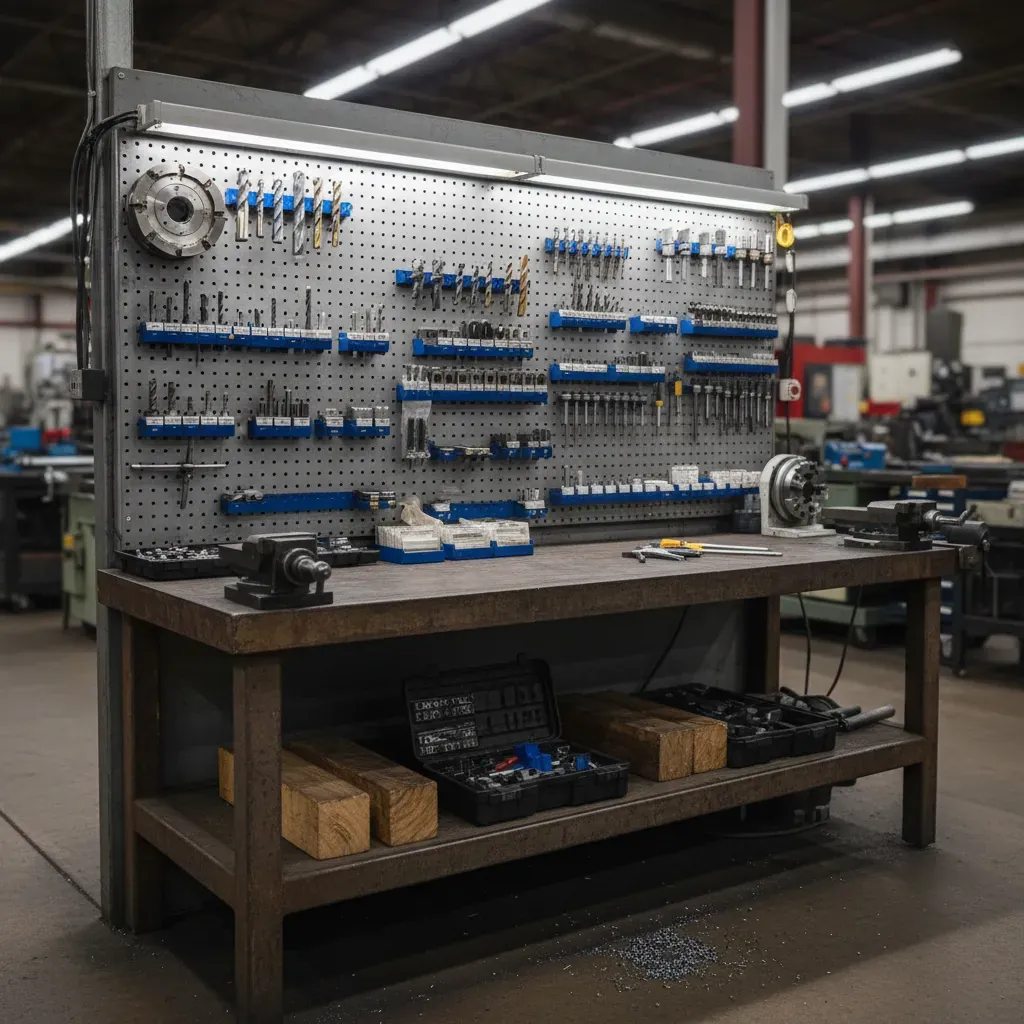
Every machined part is the sum of the tools that cut it. A machinist’s tool cabinet is organized around what each tool does: turning tools shape rotating stock, milling cutters carve prismatic features, drills and reamers make and size holes, taps cut threads, and finishing tools refine edges and surfaces. This guide walks through all the major types of machining tools — manual and CNC — with the selection logic competitor articles usually skip: which tool material for which workpiece, what the geometry angles actually do, and the parameters that keep tools alive.
| Category | Máquina | Typical tools | What they make |
|---|---|---|---|
| Turning tools | Lathe | Roughing, finishing, parting, grooving, threading, boring bars, knurling | Shafts, pins, bushings, any rotational part |
| Milling cutters | Milling machine / machining center | End mills, face mills, ball nose, slab mills, T-slot, dovetail, fly cutters | Flats, pockets, slots, 3D contours |
| Holemaking tools | Drill press, lathe, mill | Twist drills, center drills, reamers, boring tools, countersinks, counterbores | Holes from rough to H7 precision |
| Threading tools | Lathe, mill, by hand | Taps, dies, thread mills, single-point threading inserts | Internal and external threads |
| Abrasive / finishing | Grinder, hone, lap | Grinding wheels, honing stones, lapping plates, deburring tools | Fine finishes, tight tolerances, edge breaks |
| Gear cutting | Hobbing / shaping machine | Hobs, gear shapers, broaches | Gears, splines, keyways |
Lathe turning tools are single-point: one cutting edge, fed against rotating stock. The essential set:
Most CNC lathes run indexable carbide inserts (CNMG, DNMG, VNMG for turning; CCMT/DCMT for boring) clamped in standardized holders — a worn edge is indexed or swapped in seconds instead of reground. For a deeper dive see our lathe cutting tools guide y el CNC turning overview.
| Herramienta | Accuracy | Role |
|---|---|---|
| Center / spot drill | - | Starts the hole on location; prevents wander |
| Twist drill | ±0.05–0.1 mm | Makes the hole; 118° point general purpose, 135° split point for harder metals |
| Reamer | IT6–IT8 (H7 fits) | Sizes and finishes a drilled hole — see our reaming guide |
| Boring tool | IT6–IT9 | Corrects hole position and size single-point |
| Countersink / counterbore | - | Seats for flat-head and socket-head screws — see counterbore vs countersink |
| Tool material | Hot hardness | Ideal para | Coste relativo |
|---|---|---|---|
| High-speed steel (HSS) | to ~600 °C | Low-speed work, taps, drills, interrupted cuts; tough and regrindable | $ |
| Cobalt HSS (M35/M42) | higher | Stainless and harder steels where carbide is too brittle | $$ |
| Cemented carbide | to ~900 °C | The CNC default: 3–5× HSS speeds in steel, aluminum, cast iron | $$$ |
| Cermet | high | Fine finishing of steels; excellent surface finish | $$$ |
| Ceramic | to ~1200 °C | Hard turning, superalloys (Inconel) at very high speed | $$$$ |
| CBN | extreme | Hardened steel (HRC 45+), replacing grinding | $$$$$ |
| PCD (polycrystalline diamond) | - | Aluminum, copper, composites, plastics; never ferrous metals | $$$$$ |
Coatings multiply tool life: TiN (general, gold), TiCN (abrasive materials), TiAlN/AlTiN (high-heat dry machining — the modern default for steel), DLC and ZrN (non-stick for aluminum), diamond coating (graphite, composites).
| Pieza de trabajo | Tool choice | Key parameter notes |
|---|---|---|
| Aluminio | 2–3 flute carbide, polished or ZrN/DLC coated, PCD for volume | High speed, generous chip room, sharp positive rake |
| Mild / alloy steel | TiAlN-coated carbide, 4+ flutes | Moderate speed, climb milling, flood or air blast |
| Stainless (304/316) | Sharp coated carbide or cobalt HSS | Low speed, constant feed — never dwell (work hardening) |
| Titanio | Sharp carbide, high-pressure coolant | Low speed, high feed, maximum rigidity |
| Hardened steel HRC 45+ | CBN inserts, ceramic | Hard turning replaces grinding where geometry allows |
| Plásticos técnicos | Razor-sharp uncoated carbide, single/2 flute | High speed, low heat — see plastic machining services |
The classic seven are the lathe, milling machine, drill press, grinder, shaper, planer and saw. Modern CNC machining centers combine milling, drilling, tapping and boring in one machine, and turning centers add live tooling to the lathe.
Cutting tools (end mills, drills, turning inserts, taps, reamers), measuring tools (micrometers, calipers, indicators, gauge pins), workholding (vises, chucks, clamps, fixtures), and hand finishing tools (files, deburring scrapers, stones).
On machining centers: end mills, face mills, spot drills, twist drills, taps or thread mills, reamers and chamfer tools. On turning centers: indexable roughing and finishing inserts, grooving and threading inserts, and boring bars.
Coated cemented carbide. It covers aluminum through alloy steel at production speeds. Step up to CBN or ceramic only for hardened materials, and down to HSS for low-speed, interrupted, or hand-tapping work.
Tool selection, geometry and parameters are half the quality of a machined part. At Tuowei Precision our Servicios de mecanizado CNC run TiAlN carbide, PCD and CBN tooling matched to each alloy — from Torneado CNC of one-off shafts to million-piece turned parts production. Send your drawing for a 24-hour quote.

Escrito por Andy, ingeniero de fabricación en TUOWEI Precision. Andy está especializado en mecanizado CNC, fabricación de precisión e ingeniería de producción, y cuenta con experiencia práctica en el apoyo a proyectos que abarcan desde la creación rápida de prototipos hasta la producción a gran escala. Trabaja en estrecha colaboración con los equipos de ingeniería y fabricación para evaluar materiales, tolerancias, procesos de mecanizado y la facilidad de fabricación de los diseños. Sus artículos ofrecen información práctica y con base técnica para ayudar a ingenieros y compradores a tomar mejores decisiones de fabricación, optimizar la eficiencia de la producción y lograr una calidad constante de las piezas. Descubre las soluciones de mecanizado CNC y fabricación a medida de TUOWEI Precision para tu próximo proyecto.
Desde prototipos rápidos hasta la producción a gran escala, Tuowei Precision ofrece un mecanizado CNC fiable, con precisión y uniformidad en cada paso. Empieza tu proyecto hoy mismo.
Lee nuestras últimas guías sobre mecanizado CNC, materiales, acabados y tendencias del sector para tomar mejores decisiones de producción.