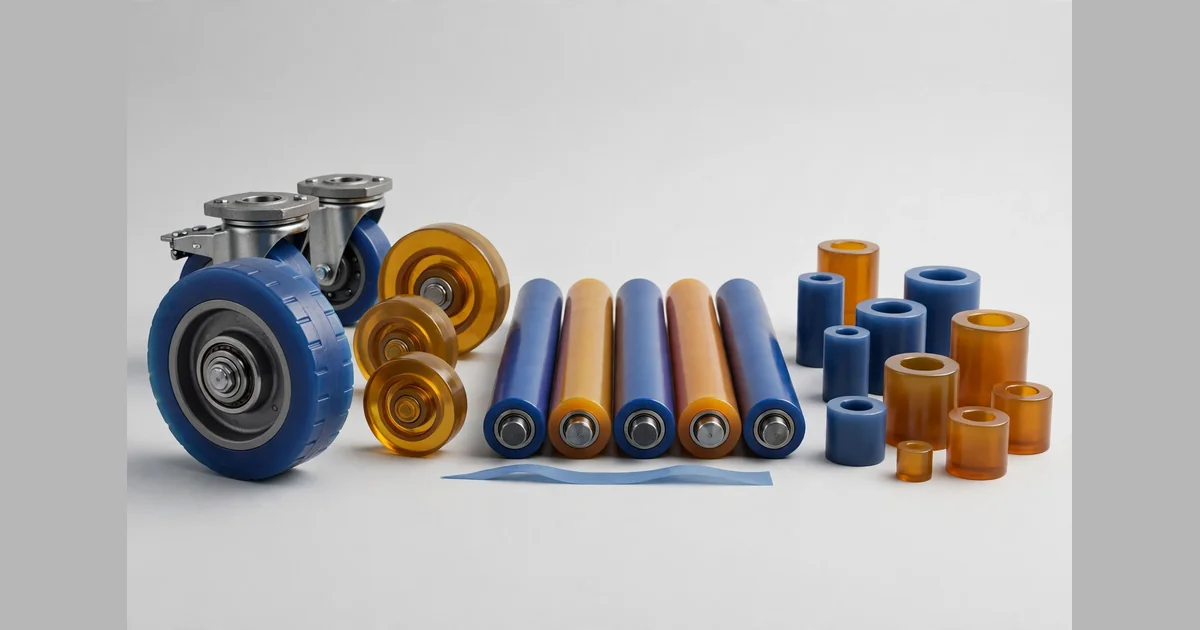
Urethane is the everyday name for polyurethane (PU), a tough plastic made by reacting an isocyanate with a polyol. It can be made as hard as a skateboard wheel or as soft as a gel, as a rubber-like elastomer, a foam, a varnish or a paint. In manufacturing, “urethane” usually means cast polyurethane elastomer: a rubbery material with much better abrasion and tear resistance than natural rubber.
This guide explains what urethane is made of, its properties and hardness range, where it is used, how it compares with rubber and other plastics, and when urethane casting beats injection molding for your parts.
Strictly speaking, “urethane” is a small chemical called ethyl carbamate. Polyurethane is a polymer whose chains are joined by many urethane (carbamate) links, and that is why people shorten polyurethane to urethane. When an engineer, a painter or a parts supplier says urethane, they mean polyurethane.
Polyurethane is made from two liquid parts that react when mixed:
Changing the ratio of hard and soft segments is what lets one chemistry cover everything from soft foam to hard rollers. Most cast urethanes are thermosets: once cured, they cannot be remelted. A separate family, thermoplastic polyurethane (TPU), can be injection molded and remelted like other plastics.
| Tipo | Puntos fuertes | Weak points | Uso habitual |
|---|---|---|---|
| Polyether | Resists water and hydrolysis, good rebound, stays flexible in cold | Lower oil and cut resistance than polyester | Wet environments, wheels, outdoor parts |
| Polyester | Better abrasion, cut, oil and solvent resistance, higher strength | Breaks down in hot water and steam over time | Scrapers, gears, oily industrial parts |
Urethane is popular because it combines the flexibility of rubber with the toughness of plastic.

| Shore hardness | Feels like | Example urethane part |
|---|---|---|
| 20A to 40A | Gel insole, soft grip | Cushions, soft pads |
| 50A to 70A | Rubber band, tire tread | Seals, gaskets, grips |
| 80A to 95A | Shoe heel, skateboard wheel | Wheels, rollers, scrapers |
| 50D to 75D | Hard hat, bowling ball shell | Gears, wear strips, bushings |
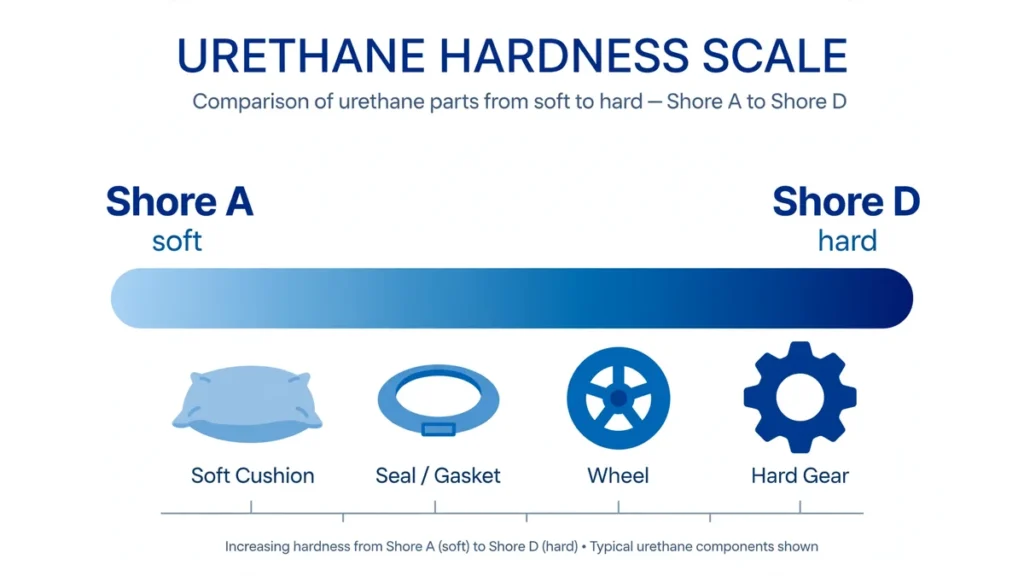
Shore A is used for soft materials and Shore D for hard ones. The scales overlap around 90A to 95A (about 40D to 45D).
Urethane shows up in four main forms:
| Form | What it is | Usos habituales |
|---|---|---|
| Cast elastomer | Solid rubber-like parts | Wheels, rollers, bushings, bumpers, seals, conveyor scrapers, mining screens |
| Espuma | Flexible or rigid cellular urethane | Mattresses, seat cushions, steering wheels, insulation panels |
| Coating and paint | Thin urethane film | Car paint, floor finishes, wood varnish, spar urethane |
| Adhesive and sealant | Reactive glue or caulk | Windshield bonding, construction sealants |
You will also find urethane in skateboard and roller skate wheels, reactive urethane bowling ball coverstocks, shoe soles, phone cases (often TPU) and medical tubing.
Urethane paint is a two-part (2K) coating in which a urethane resin is cured with an isocyanate hardener. It gives a hard, glossy, chemical resistant finish and is standard for automotive refinishing, aircraft and industrial equipment. Because the hardener contains isocyanates, spraying it needs proper ventilation and an approved respirator or supplied air.
Spar urethane is an oil-modified urethane varnish made for wood that lives outdoors or near water. It stays slightly flexible as the wood moves and contains UV absorbers. It is a wood finish, not the same material as cast urethane parts.
| Propiedad | Uretano | Natural / synthetic rubber | Rigid plastic (ABS, nylon) |
|---|---|---|---|
| Hardness range | Shore 20A to 75D | Shore 30A to 90A | Shore 70D and up |
| Abrasion resistance | Excelente | De aceptable a bueno | Bien |
| Tear and cut resistance | Excelente | Feria | Bien |
| Load bearing | Alta | Medio | High but brittle on impact |
| Oil resistance | Bien | Poor to good (by type) | Bien |
| Max continuous heat | About 80 to 90 °C | Up to 150 °C+ (silicone, EPDM) | 80 to 120 °C |
| Ideal para | Wear parts, wheels, rollers | Seals, high heat, low cost | Rigid housings and structures |
If you need a soft, rubbery part that is molded like a plastic, also look at TPE material, a thermoplastic elastomer used in grips and sobremoldeo.
People use urethane and polyurethane as interchangeable terms, and in most industries that is correct. The terminology only splits in chemistry. A “urethane” is a single molecule (ethyl carbamate), while a “polyurethane” is a polymer in which many urethane linkages join the chains. Polyurethane is formed when the isocyanate and polyol react at room temperature or with heat, so every cast part, foam or coating sold as urethane material is really a polyurethane.
Where the key differences matter is in coatings. Paint shops often say urethane for a tough, two-part, solvent-borne topcoat and polyurethane for a clear wood finish. Polyurethane coatings come in two main types: oil-based, which is amber, glossy and very durable, and water-based, which dries fast, stays clear and is easy to clean. Both polyurethane and urethane coatings protect the surface from scratches, stain and moisture, but a high-performance 2K urethane will withstand fuel, chemicals and impact far better than a one-part polyurethane varnish.
| Polyurethane vs urethane | Urethane (as used in industry) | Polyurethane (as used in coatings) |
|---|---|---|
| Typical meaning | Cast elastomer parts or 2K automotive paint | Clear wood finish or foam |
| Advantage | Durability, load-bearing capacity, chemical resistance | Easy to apply, low cost, wide range of sheens |
| Disadvantage | Needs isocyanate safety controls | Softer film, can crack outdoors without UV additives |
| Commonly used in | Industrial applications, automotive, mining | Furniture, floors, cabinets |
The versatility of polyurethane products is why they are commonly used in many industries. By changing the formulation, manufacturers can make a softer, elastic part for seals, an impact resistant wheel that is resistant to abrasion, or a rigid part with strong mechanical properties. That makes it easy to match the end product to specific requirements, and to specific applications where longevity matters. In manufacturing processes such as casting and molding, the right grade often gives a superior product to rubber or nylon at a similar cost.
Fully cured urethane parts are generally considered inert and are used in food contact, medical and consumer products when made from compliant grades. The hazard is in processing. Liquid isocyanates are respiratory sensitizers, so mixing, pouring and especially spraying need good ventilation, gloves and eye protection, and a respirator or supplied air for spraying. The pure chemical urethane (ethyl carbamate) is a different substance and is classified as a probable human carcinogen, which is one reason the two names cause confusion.
When you need plastic or rubber-like parts in small numbers, urethane casting (also called vacuum casting or polyurethane casting) is often the fastest and cheapest route. Injection molding wins once volumes climb.

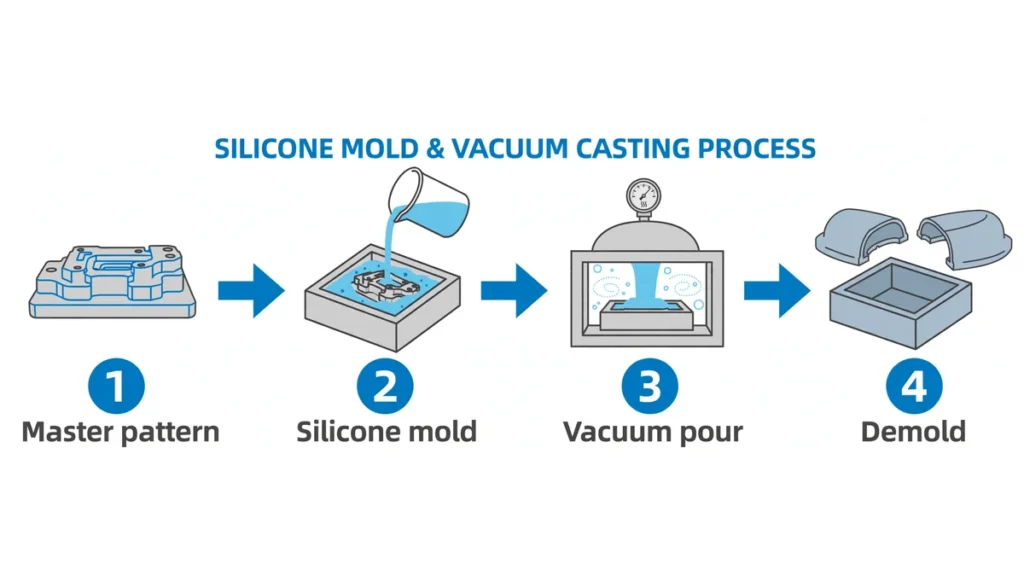
A silicone mold usually gives about 20 to 25 castings before it wears, so larger runs use several molds.
| Factor | Urethane casting (vacuum casting) | Moldeo por inyección |
|---|---|---|
| La mejor cantidad | About 10 to 200 parts | De cientos a millones |
| Herramientas | Silicone mold, low cost, built in days | Steel or aluminum mold, high cost, often 4 to 8 weeks |
| Lead time for first parts | About 5 to 10 business days | Weeks, plus tool trials |
| Materiales | PU resins that mimic ABS, PP, PC, rubber and clear plastics, Shore 20A to 85D | Real production thermoplastics (ABS, PC, PP, nylon, TPU, PEEK) |
| Coste de la pieza | Higher per part, low total for small runs | Very low per part at volume |
| Tolerancia | Roughly ±0.15 to 0.3 mm per 100 mm | Tighter and more repeatable |
| Cambios de diseño | Easy, make a new master | Costly tool changes |
| Uso recomendado | Prototypes, pilot runs, marketing samples, bridge production | Producción en serie |
The break-even point is usually a few hundred parts. Below it, the low tooling cost of urethane casting wins. Above it, the low part price of injection molding pays back the mold. For larger or thicker urethane parts, such as enclosures and bumpers, reaction injection molding (RIM) is a third option that injects liquid PU into a closed mold.
Tuowei Precision makes urethane cast parts with its vacuum casting services, using polyurethane resins in rigid, flexible, rubber-like, heat-tolerant and clear grades for runs of about 20 to 200 parts, with typical lead times of 5 to 10 business days. When your design is ready for volume, the same team can move it to moldeo por inyección de plástico. Explore prototipado rápido options, compare rapid prototyping materials, or upload your CAD for an presupuesto al instante.
Urethane (polyurethane) is made by reacting an isocyanate such as MDI or TDI with a polyol, plus curatives and additives. The urethane links formed in that reaction give the material its name.
Both, depending on the formula. Soft urethanes behave like rubber, hard urethanes behave like plastic, and the same chemistry covers the range in between.
In manufacturing and coatings, yes. Urethane is the short name for polyurethane. Only in chemistry does urethane mean the separate compound ethyl carbamate.
Wheels, rollers, bushings, seals, scrapers, foam cushions, insulation, car paint, wood varnish, adhesives and shoe soles are some of the most common uses.
In wear applications, cast urethane often outlasts rubber several times over. Life drops with heat above about 80 °C, hot water on polyester grades, and strong UV on aromatic grades.
Yes. Urethane casting, polyurethane casting and vacuum casting all describe pouring PU resin into a silicone mold under vacuum.