
There are many different types of RF connectors, and picking the wrong one can cost signal, space or money. This guide explains the common coaxial connector types, from SMA and N-type to BNC and 2.92 mm, with a chart of frequency range, impedance and coupling style, plus a simple way to choose the right connector for your application.
An RF connector is an electrical connector designed to carry radio frequency signals on a coaxial cable or between a cable and a circuit board, antenna or piece of test equipment. Unlike a power or data connector, an RF coaxial connector must keep the cable's characteristic impedance constant through the joint. If it does not, part of the RF signals reflect back, which shows up as high VSWR and signal loss in RF systems.
Every coaxial connector has the same basic parts: a center pin (or socket) that carries the signal, an insulator, usually PTFE, that holds the pin in place, and an outer body that carries the ground and couples the two halves together. The size of these parts sets the frequency limit a connector can handle: small connectors reach high frequencies, while larger ones carry more power.
Most RF systems use 50 Ω connectors, which balance power handling and low loss. 75 ohm connectors are used for video signals, cable television and broadcast. The two can look almost identical, especially BNC and F-type, but mating a 50 ohm plug with a 75 ohm jack can damage the center contact and adds reflection, so check the impedance before you mix them.
Connector gender refers to the center contact: male RF connectors (plugs) have a pin, and a female connector (jack) has a socket. The coupling thread does not decide gender. Reverse polarity connectors, such as RP-SMA, swap the pin and socket while keeping the same body, so a reverse polarity plug will not mate with a standard jack. You will see them on wireless routers and antennas.
Use this chart to compare each common connector at a glance. Frequency values are typical upper limits in GHz for standard versions; precision versions of some connectors go higher.
| Connector | Coupling | Impedance (ohm) | Typical max frequency (GHz) | Size | Common uses |
|---|---|---|---|---|---|
| SMA | Threaded (1/4-36) | 50 | 18 (precision to 26.5) | Small | Lab instruments, antennas, microwave modules |
| RP-SMA | Threaded | 50 | 18 | Small | Wi-Fi routers, wireless antennas |
| N-type | Threaded (5/8-24) | 50 / 75 | 11 (precision to 18) | Large | Base stations, outdoor antennas, high power |
| BNC | Bayonet | 50 / 75 | 4 | Medium | Oscilloscopes, video |
| TNC | Threaded | 50 | 11 | Medium | GPS, aerospace, vibration-prone sites |
| SMB | Snap-on | 50 / 75 | 4 | Small | Board connections, telecom modules |
| MCX | Snap-on | 50 / 75 | 6 | Small | GPS receivers, compact devices |
| MMCX | Snap-on | 50 | 6 | Very small | Wireless modules, wearables |
| SMP | Push-on | 50 | 40 | Very small | High-density boards, 5G modules |
| 2.92 mm (K) | Threaded | 50 | 40 | Small | Millimeter-wave labs |
| 2.4 mm | Threaded | 50 | 50 | Small | High-frequency instruments |
| 1.85 mm | Threaded | 50 | 67 | Small | Lab instruments |
| 7/16 DIN | Threaded | 50 | 7.5 | Very large | Cellular base stations, high power |
| 4.3-10 | Threaded or push-pull | 50 | 6 | Large | Compact base station radios |
| QMA | Snap-lock | 50 | 6 | Small | Quick-connect telecom gear |
| F-type | Threaded or push-on | 75 | About 1 | Medium | Cable TV, satellite TV |
| UHF (PL-259) | Threaded | Non-constant | 0.3 | Large | Amateur radio, CB radio |
| U.FL / IPEX | Snap-on | 50 | 6 | Micro | Laptops, IoT modules, Wi-Fi cards |
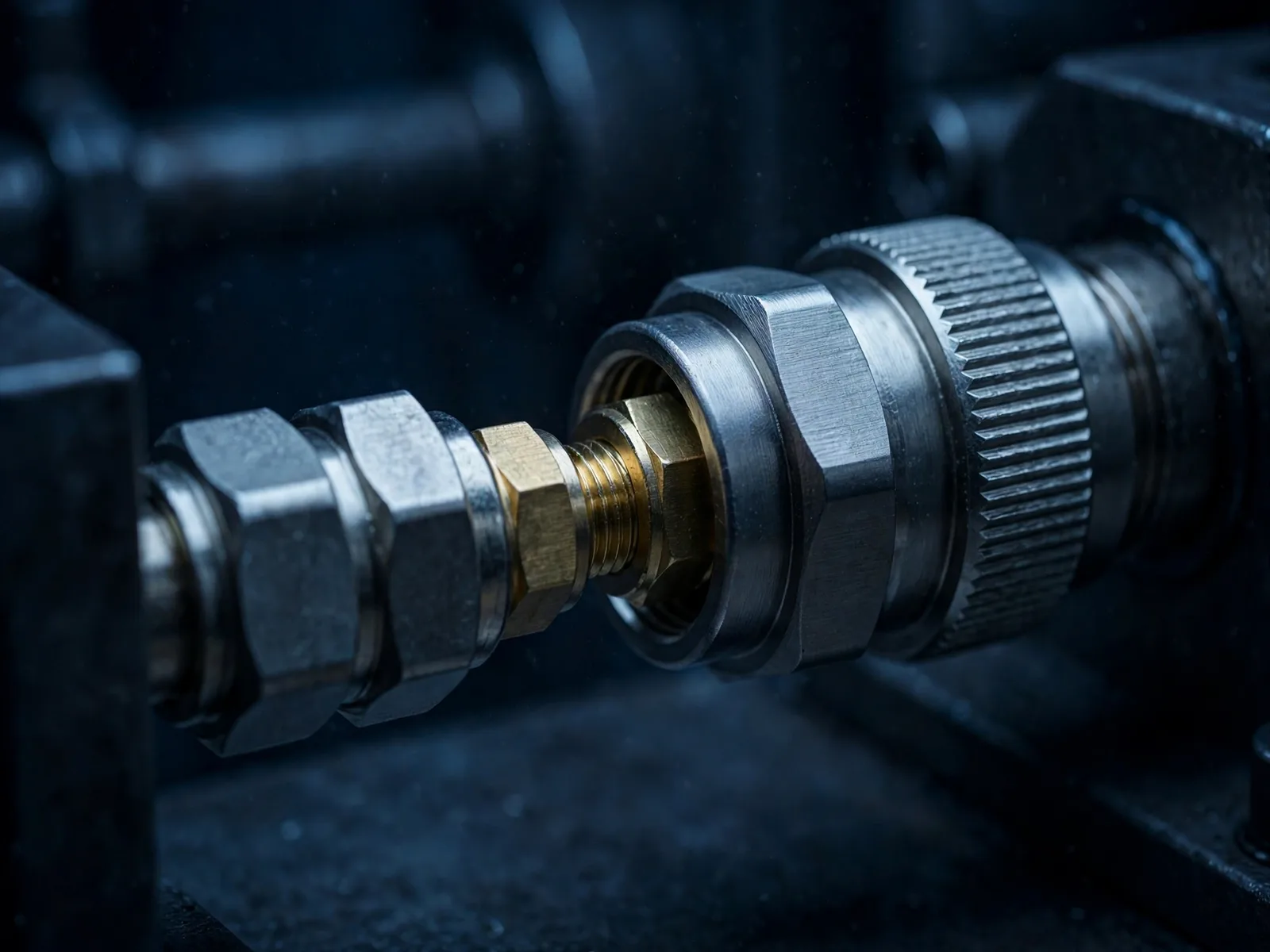
Threaded connectors screw together. They give the most stable electrical contact and resist vibration, which makes them the choice for lab instruments, outdoor sites and high-frequency applications.
The SMA connector is the most common small RF connector. It uses a 1/4-36 thread, works to 18 GHz in standard form and is found on instruments, antennas, filters and microwave modules. An SMA male plug should be tightened with a torque wrench (about 5 to 8 in-lb): over-tightening damages the threads and the contact face.
The N connector is larger and more robust than SMA, handles more power, and seals well against weather. It is the standard for base station antennas, outdoor cabling and high-power links up to about 11 GHz.
The TNC is a threaded version of the BNC. The thread keeps it stable under vibration, so it is used on GPS antennas, aircraft and vehicle radios.
These precision connectors use an air dielectric at the mating plane and very small outer conductors, which lets them run to 40, 50 and 67 GHz. They appear on millimeter-wave test equipment and 5G research setups. The 2.92 mm connector mates mechanically with SMA, but precision connectors wear quickly if joined with low-grade parts.
These large connectors carry high power with low passive intermodulation (PIM) in cellular base stations. The 4.3-10 is newer and smaller, and is replacing 7/16 DIN on many compact remote radio units.

These connectors trade some stability for speed and size. They connect with a twist or a push rather than several turns of a thread.
The BNC uses a quarter-turn bayonet lock. It is quick to connect and is common on oscilloscopes and video systems. It comes in 50 Ω and 75 Ω versions.
SMB connectors use a snap-on connection and are smaller than SMA. They suit board-to-cable connections inside telecom equipment where the link is set once and rarely disturbed.
MCX connectors are about 30% smaller than SMB, and MMCX is smaller again. Both are miniature connectors that click into place, and MMCX can rotate after it is connected, which helps in tight spaces. They are common in GPS receivers, wireless modules and wearable devices.
SMP connectors push on and tolerate small misalignment, which allows board-to-board links in high-density designs up to 40 GHz.
U.FL, IPEX and similar micro connectors join antennas to modules inside laptops and IoT devices. They are tiny and cheap but rated for only a few dozen mating cycles.
Selecting a connector starts with the signal and ends with the space you have. Work through these questions in order:
When no standard connector fits your space, frequency or mounting, a custom connector may be cheaper than redesigning the board or housing. See our custom RF connector manufacturing service.
An RF adapter joins two different connector types or genders, such as SMA to N-type. Adapters are handy on the test bench, but each one adds a small loss and another point of reflection. In a permanent installation, cable assemblies with the right connectors on each end are better than a chain of adapters.
Connector bodies are usually machined from brass or stainless steel, center contacts from beryllium copper or brass, and insulators from PTFE. Bodies are plated with nickel or a white bronze alloy, and center contacts with gold for low, stable contact resistance. Stainless steel bodies last longer in high-cycle test use.
Because frequency performance depends on dimensions measured in hundredths of a millimeter, connector parts are turned on precision lathes, often Swiss-type machines. Our communication CNC machining page explains how we machine these and other RF parts. Connectors that pass through a shielded wall use bulkhead versions with a gasket; see our RF shielding enclosure page.
For telecom housings that carry these connectors, see our telecom equipment manufacturing page.