Need expert machining solutions? Our team at Tuowei Proto is here to assist with all your manufacturing needs. Get in touch today for a quote on your ongoing or upcoming projects!
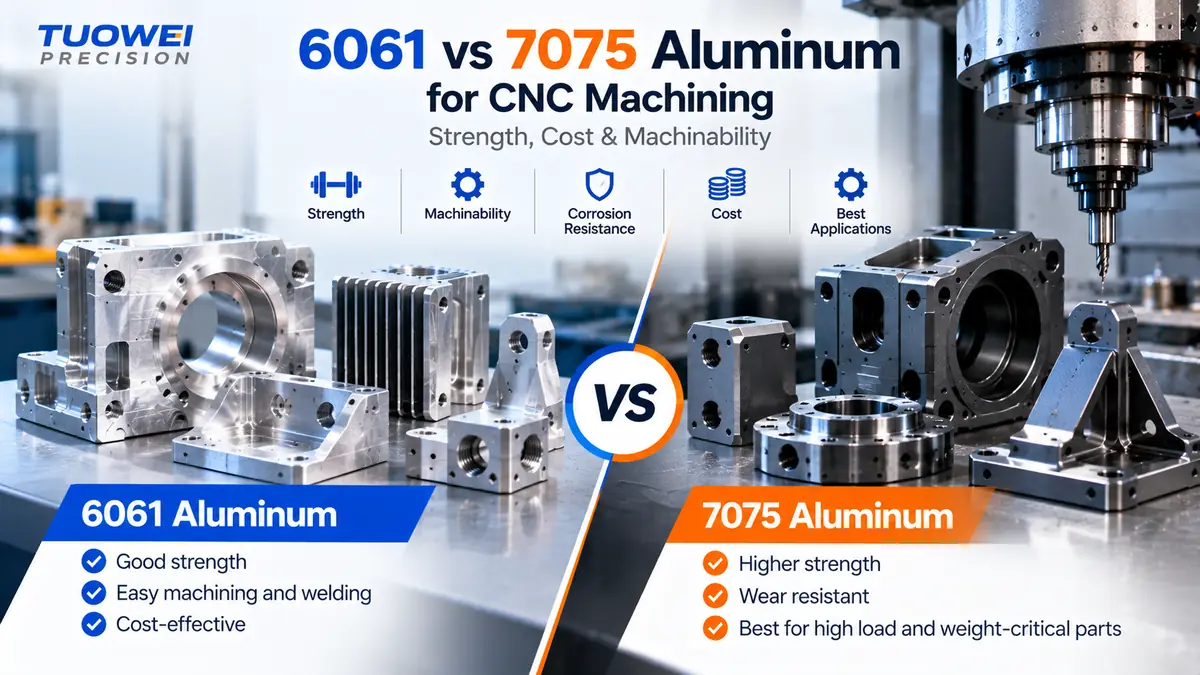
6061 vs 7075 aluminum comes down to one trade. 7075-T6 is about 1.7 times as strong as 6061-T6, but it costs more, cannot be fusion welded, and resists corrosion less well. 6061 is the cheaper, more forgiving choice for most machined parts. Pick 7075 only when a load calculation says the part needs the extra strength.
Short answer: Use 6061-T6 for brackets, housings, enclosures, fixtures and heat sinks, where it gives good strength, easy machining, weldability and a clean anodized finish at a lower price. Use 7075-T6 or T651 for highly loaded, weight-critical parts in aerospace, robotics and defense work. Both alloys are almost equally stiff, so 7075 will not stop a part from flexing.
Below, the property numbers come from NASA’s materials handbooks rather than supplier blogs, which is also why some of them look lower than figures you may have seen elsewhere.
The difference starts with chemistry. 6061 belongs to the 6xxx series, strengthened by magnesium and silicon. 7075 belongs to the 7xxx series, where zinc is the main alloying element, with magnesium and copper added.
Both are heat treatable. “T6” means solution heat treated and then artificially aged to full strength. “T651” adds a controlled stretch after quenching to relieve residual stress, which matters a great deal once you start removing material from a plate.
That zinc and copper content is what gives 7075 its strength. It is also why 7075 is harder to weld and less resistant to corrosion.
The table uses the design values for T6 sheet and T651 plate listed in the NASA Materials Data Handbooks for aluminum alloy 6061 and aluminum alloy 7075.
| Property | 6061-T6 / T651 | 7075-T6 / T651 |
| Ultimate tensile strength (design value) | 45 ksi (310 MPa) | 77 ksi (531 MPa) |
| Tensile yield strength (design value) | 40 ksi (276 MPa) | 66 ksi (455 MPa) |
| Elongation | 8 to 10%, depending on thickness | 7% |
| Density | 2.70 g/cm³ | 2.80 g/cm³ |
| Modulus of elasticity | 10.0 × 10³ ksi (68.9 GPa) | 10.3 × 10³ ksi (71.0 GPa) |
| Thermal conductivity (T6) | About 167 W/m·K | About 131 W/m·K |
| Fusion welding | Good with proper procedures | Not recommended |
| Stress corrosion cracking | Good general corrosion resistance | Resistant only in the T73 temper |
| Machinability (handbook rating) | Excellent in T4 and T6 | Good; more difficult in hardened tempers |
A few conclusions fall straight out of the table. 7075 is about 70% stronger in tension. It is about 4% heavier for the same volume. It is only about 3% stiffer. And 6061 conducts heat roughly 27% better, which is why it is the usual choice for machined heat sinks.
Search for 7075 vs 6061 strength figures and you will find several different answers. Most of the gap comes from mixing two kinds of numbers.
Typical values are averages from test lots. Minimum or design values are set lower, so that nearly every lot of material meets them. The NASA 7075 handbook shows both: typical tensile and yield strengths of 83 ksi and 73 ksi for T6, against design values of 77 ksi and 66 ksi for T6 sheet and T651 plate.
Neither number is wrong. They answer different questions.
Our view: size structural parts from minimum values in the product specification for your actual form and thickness, and use typical values only to compare 6061 and 7075 against each other. For plate, the governing specification is ASTM B209, and minimums drop as plate gets thicker. The 6061 handbook shows the same trend in elongation, which falls from 10% on mid-gauge plate to 8% at 1 to 2 in. thick.
Yes in strength, barely in stiffness. That distinction decides more alloy choices than any other number on the datasheet.
If a part fails by yielding or breaking under load, a straight 6061-T6 vs 7075-T6 comparison says 7075 lets you carry roughly 1.7 times the stress, or keep the same load in a thinner and lighter section. That is why it shows up in aerospace components, drone arms, robot links and high-load fixtures.
If the part’s real problem is deflection, 7075 does almost nothing. Stiffness depends on the modulus of elasticity, and 7075’s is only about 3% higher. A 6061 bracket that bends too much will bend nearly as much in 7075. The fix is geometry: deeper sections, ribs or a shorter span.
So before switching alloys to cure a “weak” part, check whether it is failing on strength or on stiffness. 7075 is stronger than 6061, but only one of those two problems gets solved by the swap.
Choosing 6061 or 7075 rarely changes cycle time much. Both machine well, and between them they cover most of what buyers mean by the best aluminum for CNC machining. The NASA handbooks rate 6061 as excellent in the T4 and T6 tempers and describe 7075 as good in conventional machining but more difficult in its hardened tempers.
In practice the difference shows up in the chips and the surface. 6061-T6 is softer and can smear or build up on the tool edge if tools are dull or feeds are too light. 7075-T6 is harder, breaks chips more cleanly and often gives a crisper finish on fine features, at the cost of somewhat faster tool wear.
The bigger machining risk with either alloy is distortion. Heavy pocketing releases stress locked into the plate, and a thin part can bow after it comes off the fixture. Starting from T651 stress-relieved plate, roughing, releasing the clamps and then finishing keeps most parts flat. Our CNC milling services plan that roughing and finishing sequence for thin-walled aluminum parts, since the extra step is cheaper than scrapping a warped part.
Welding. 6061 fusion welds well with proper procedures. Welding does soften the heat-affected zone, so a welded 6061 assembly will not keep full T6 strength at the joint unless it is heat treated again. The NASA handbook states plainly that fusion welding is not recommended for 7075. If a design needs welded joints, 7075 is usually the wrong alloy.
Corrosion. 6061 has good general corrosion resistance. 7075-T6 is less resistant, and it is susceptible to stress corrosion cracking; the handbook identifies T73 as the stress-corrosion-resistant temper. Exposed 7075 parts usually need a protective finish.
Anodizing. Both alloys anodize well, including hard anodizing. 6061 gives the clearest, most even color, which is why it is the default for cosmetic parts. 7075 can come out slightly darker or more yellow in clear and light colors, so avoid mixing 7075 and 6061 parts in one visible assembly. Where a part must stay electrically conductive, chromate conversion coating protects both alloys without insulating the surface.
The alloy is only half the callout. The temper after it changes how the part behaves on the machine and in service.
| Temper | What it means | When to specify it |
| 6061-T6 | Solution treated and artificially aged | Bar and extrusions for general parts |
| 6061-T651 | T6 plus stretch stress relief | Plate for flat, pocketed or thin-walled parts |
| 7075-T6 | Full strength | Bar, and parts where maximum strength matters |
| 7075-T651 | T6 plus stretch stress relief | Plate for machined structural parts |
| 7075-T73 | Over-aged for stress corrosion resistance | Parts under sustained load in corrosive service |
T73 gives up part of the strength of T6 in exchange for stress corrosion resistance. Our position: for plate parts that will be heavily machined, specify T651 in either alloy, and reserve T73 for parts where a stress engineer has identified sustained tensile stress in a corrosive environment. On the material list at Tuowei, 7050-T7451 is also available for thick aerospace plate where 7075 is not the best fit.
Most 7075 vs 6061 decisions sort themselves out once you know what limits the part. The table reflects how the two alloys are typically used in CNC machined work.
| Part type | Better choice | Why |
| Electronics enclosures and housings | 6061-T6 | Enough strength, clean anodized color, lower cost |
| Heat sinks and cold plates | 6061-T6 | About 27% higher thermal conductivity |
| Welded frames and brackets | 6061-T6 | 7075 should not be fusion welded |
| Jigs, fixtures and machine bases | 6061-T651 | Stiffness and flatness matter more than strength |
| Drone arms and robot links | 7075-T651 | High strength in thin, light sections |
| Aerospace fittings and brackets | 7075-T651 or T73 | Strength, with T73 where stress corrosion is a risk |
| Highly loaded clamps, gears and shafts | 7075-T6 | Higher strength and a harder surface |
| Outdoor or marine parts left unfinished | 6061-T6 | Better general corrosion resistance |
When a part sits between the columns, the 6061-T6 vs 7075-T6 decision usually comes down to one question. Will a thinner 7075 section save enough weight to pay for the extra material and finishing? If the answer is no, 6061 wins.
The 7075 aluminum price for bar and plate sits noticeably above 6061, and 7075 is stocked in fewer sizes. Published premiums vary widely by supplier, form and size, so check current distributor or mill pricing for the stock you need rather than relying on a rule of thumb.
The premium on the finished part is usually smaller than the premium on the metal. On a CNC machined part, machine time, setup and finishing often outweigh the material line, and since both alloys machine at similar rates, cycle time barely changes. The metal premium mostly hits parts cut from large billets, or high volumes where material is a bigger share of the unit cost.
Two hidden costs are worth adding. 7075 often needs a protective finish that a 6061 part could skip, and its stress corrosion behavior may push you to the more expensive T73 temper. When you request a quote through our CNC machining services, ask for 6061 and 7075 at the same quantity so the real difference is visible.
Whichever you choose between 6061 and 7075, a vague callout such as “aluminum 7075” lets a supplier ship any form, temper or origin. A complete callout names the alloy, temper and product specification, for example:
Ask for a mill test report (a certificate from the producing mill showing chemistry and tested properties for that lot) with the parts. For aerospace and defense work, the contract may also call for a specific AMS (Aerospace Material Specification) standard and full traceability.
The most common mistake is swapping alloys late. A design validated in 6061 is switched to 7075 “for strength” after testing, and nobody rechecks welds, anodize color or corrosion protection. Treat an alloy change as a design change, not a purchasing change.
For most machined parts, 6061-T6 is the best aluminum for CNC machining: cheaper, easier to weld and finish, and strong enough. Move to 7075-T6 or T651 when a strength calculation, not a hunch, shows that 6061 falls short, and remember that 7075 will not fix a stiffness problem.
If you are still weighing 6061 vs 7075 aluminum for a specific part, send the drawing and load case to Tuowei Precision. Our engineers can quote both alloys side by side and point out where temper, finish or geometry matters more than the alloy itself. Our 7075-T651 material page lists its properties if you want to check the numbers first.
Q: Is 7075 aluminum stronger than 6061?
A: Yes. In the NASA handbooks, 7075-T6 sheet and T651 plate have design tensile and yield strengths of 77 and 66 ksi, against 45 and 40 ksi for 6061-T6. That is about 1.7 times stronger. Stiffness is almost identical, so 7075 does not reduce deflection.
Q: Which is easier to machine, 6061 or 7075?
A: Both machine well. 6061-T6 is more forgiving and rated excellent for machinability, but it can form built-up edge. 7075-T6 is harder, breaks chips cleanly and often gives a finer finish, with somewhat faster tool wear. Distortion from residual stress matters more than the alloy choice.
Q: Can you weld 7075 aluminum?
A: Fusion welding is not recommended for 7075, according to the NASA handbook, and welded 7075 joints are prone to cracking and strength loss. If an assembly needs welded joints, 6061 is the better choice, although welding still softens the 6061 heat-affected zone unless the part is heat treated again.
Q: Is 7075 worth the extra cost?
A: Only when a part is limited by strength or weight. For brackets, housings and fixtures that are limited by stiffness, cost or appearance, 6061-T6 performs as well for less. Because machining time dominates most part prices, the real premium on a finished 7075 part is often smaller than the 7075 aluminum price suggests.
Q: Does 7075 anodize differently from 6061?
A: Yes, slightly. 6061 gives the clearest and most even color. 7075 can look darker or more yellow in clear and light dyes, which becomes obvious when the two alloys sit side by side. Both accept Type II and Type III anodizing, so the difference is mostly cosmetic.

Written by Andy, Manufacturing Engineer at TUOWEI Precision. Andy specializes in CNC machining, precision manufacturing, and production engineering, with hands-on experience supporting projects from rapid prototyping through full-scale production. He works closely with engineering and manufacturing teams to evaluate materials, tolerances, machining processes, and design manufacturability. His articles provide practical, technically informed insights to help engineers and buyers make better manufacturing decisions, optimize production efficiency, and achieve consistent part quality. Explore TUOWEI Precision’s CNC machining and custom manufacturing solutions for your next project.
From rapid prototypes to scalable production, Tuowei Precision delivers reliable CNC machining with accuracy and consistency at every step. Start your project today.
Keep updated on the real CNC machining, industry trends, and production insights in Tuowei Precision, but is installed to enable you to make better production decisions.