需要专业的机械加工解决方案吗?拓维模型的团队随时准备为您提供全方位的制造支持。立即联系我们,获取您正在进行或即将开展的项目的报价!
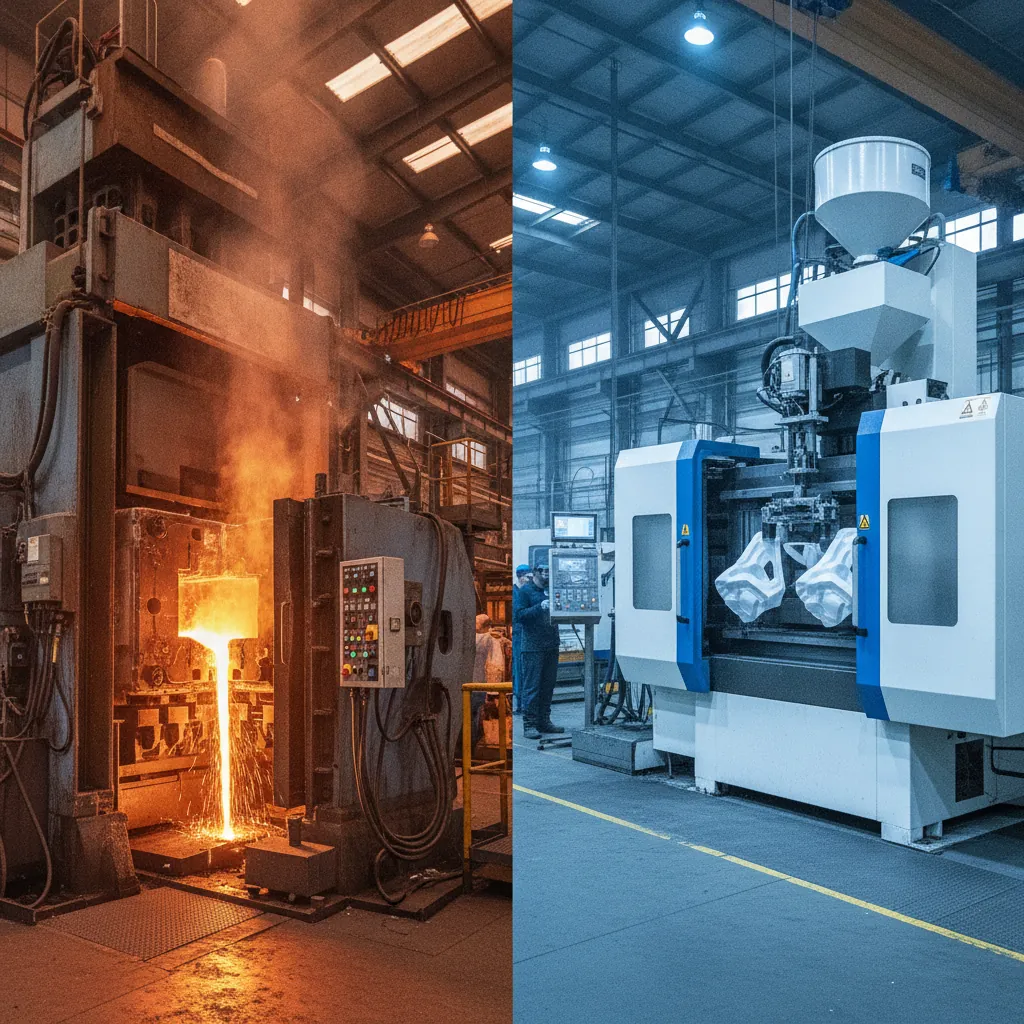
Die casting and injection molding are the same idea executed in different worlds: force fluid material into a steel mold under pressure, cool, eject, repeat. One fills the mold with molten metal, the other with molten plastic — and that single difference cascades into different machines, tolerances, costs and failure modes. Add metal injection molding (MIM), which molds metal powder like a plastic and then sinters it, and you have three processes that engineers regularly mix up. This guide compares all three with numbers — cycle times, tooling costs, tolerances and the volume thresholds where each wins.
| 压铸 | 塑料注塑 | Metal injection molding (MIM) | |
|---|---|---|---|
| 材料 | Non-ferrous metals: aluminum, zinc, magnesium | Thermoplastics (ABS, PP, PC, nylon…) | Fine metal powder + binder: stainless, low-alloy steel, titanium |
| Part size sweet spot | 10 g – 10 kg | 1 g – several kg | 0.1 – 100 g (small, complex) |
| Tolerance (typical) | ±0.05–0.1 mm + 0.1%/25 mm | ±0.05–0.1 mm (precision grades tighter) | ±0.3–0.5% of dimension (sinter shrink ~15–20%) |
| 表面处理 | Ra 1.6–3.2 µm as-cast | Mirror to textured — mold defines it | Ra 0.8–1.6 µm as-sintered |
| 周期时间 | 20–60 s (zinc faster than aluminum) | 10–60 s | Molding 15–45 s + days of debind/sinter |
| 模具成本 | $8,000–80,000 | $3,000–60,000 | $10,000–50,000 |
| Economic volume | 5,000+ pcs | 1,000+ pcs (aluminum tooling lower) | 10,000+ pcs |
Molten aluminum (~660 °C), zinc (~420 °C) or magnesium is injected into hardened H13 steel dies at 10–200 MPa. Hot-chamber machines (zinc, magnesium) cycle fastest; cold-chamber machines handle aluminum, which would attack an immersed gooseneck. Strengths: real metal strength and stiffness, thin walls (to ~1 mm in zinc), excellent thermal/EMI shielding, and per-part costs of cents to a few dollars at volume. Weaknesses: porosity (limits welding and pressure-tightness unless vacuum-assisted), draft angles required, trimming flash adds steps, and dies cost more than plastic molds because metal erodes them. Full process details in our what is die casting guide 和 压铸服务 page; for zinc specifics see zinc die casting.
Plastic pellets are melted (~180–320 °C) and screwed forward into the mold at 50–150 MPa. Cooling channels in the mold — not water spray — pull heat out, and the cycle repeats every 10–60 seconds. Strengths: enormous material palette (flexible to glass-filled), in-mold texture and color, living hinges, overmolding, inserts, and the lowest per-part costs in manufacturing. Weaknesses: plastic properties (temperature, creep), sink marks over thick sections, weld lines, and tooling lead time. Our 塑料注塑成型服务 cover prototype aluminum tooling through million-shot production molds.
Metal injection molding mixes fine metal powder (<20 µm) with a polymer binder, molds it like plastic, chemically or thermally removes the binder, then sinters at ~1,200–1,400 °C to 95–99% density. The part shrinks 15–20% — predictably — during sintering. MIM owns one niche completely: small, complex, high-volume steel or stainless parts — surgical instrument jaws, firearm components, watch cases, phone hinges. Versus die casting: MIM does ferrous metals and titanium (die casting cannot), achieves better mechanical properties than castings, but tops out around 100 g economically and adds days of furnace time. Versus CNC: at 10,000+ pieces MIM crushes machining on cost for complex small geometry; below that, machining wins — see our CNC vs injection molding comparison.
| Scenario (typical 50 g part) | 工具 | Per part @10k | Per part @100k |
|---|---|---|---|
| 铝压铸 | $15,000–40,000 | $1.5–4 | $0.8–2 |
| Zinc die casting | $10,000–30,000 | $1–3 | $0.5–1.5 |
| Injection molding (ABS) | $5,000–25,000 | $0.4–1.5 | $0.15–0.6 |
| MIM (316L) | $15,000–40,000 | $2–6 | $1–3 |
| CNC machining (reference) | ~$0 fixed | $8–25 | $6–20 |
The pattern: processes with tooling start expensive and get cheap; CNC starts cheap and stays flat. The crossover is why prototypes are machined and products are molded or cast.
| Your situation | 选择 |
|---|---|
| Plastic part, any volume above ~1,000 | 注塑成型 |
| Metal housing/bracket, 5,000+ pcs, aluminum/zinc OK | 压铸 |
| Small complex steel/stainless/Ti part, 10,000+ pcs | MIM |
| Metal part needing pressure-tightness or welding | Machining from billet, or vacuum die casting + impregnation |
| Under ~1,000–5,000 pcs, any material | 数控加工 — no tooling to amortize |
| Metal look at plastic cost | Injection molding + plating/painting |
Die casting injects fully molten metal into a die and the part is finished in seconds; MIM injects a metal-powder/binder feedstock, then needs debinding and sintering over days. Die casting suits aluminum/zinc parts up to kilograms; MIM suits steel, stainless and titanium parts under ~100 g with superior mechanical properties.
Per part, no — plastic parts mold cheaper than metal parts cast, and plastic tooling wears slower. The comparison is really material-driven: if the part can be plastic, molding is cheaper; if it must be metal at volume, die casting is the cheap metal route.
Convention only: the steel tooling is called a “die” in metal casting and stamping, and a “mold” in plastic molding. Functionally both are matched cavity-and-core blocks with cooling, venting and ejection.
Yes — that is exactly what MIM is: metal powder molded in an injection molding machine, then sintered solid. There is also die casting’s cousin thixomolding for magnesium. For one-offs and low volume, though, machining metal remains the practical route.
Tuowei Precision runs 压铸, 注塑 和 数控加工 under one roof — so we quote your part in the process that actually minimizes your cost at your volume, and bridge you from machined prototypes to production tooling without changing suppliers. Send your drawing for a 24-hour quote with process recommendation.

作者:安迪,拓维模型制造工程师。. 安迪专攻数控加工、精密制造和生产工程领域,在从快速原型制作到大规模量产的整个项目过程中拥有丰富的实践经验。他与工程和制造团队紧密合作,共同评估材料、公差、加工工艺以及设计可制造性。 他的文章提供了实用且具有技术深度的见解,旨在帮助工程师和采购人员做出更明智的制造决策、优化生产效率,并确保零件质量的一致性。欢迎了解拓维模型的数控加工和定制制造解决方案,为您的下一个项目提供支持。.
从快速原型制作到可扩展的生产,Tuowei Precision 提供可靠的数控加工服务,在每个环节都确保精度与一致性。立即启动您的项目。.
阅读我们关于数控加工、材料、表面处理及行业趋势的最新指南,以做出更明智的生产决策。