
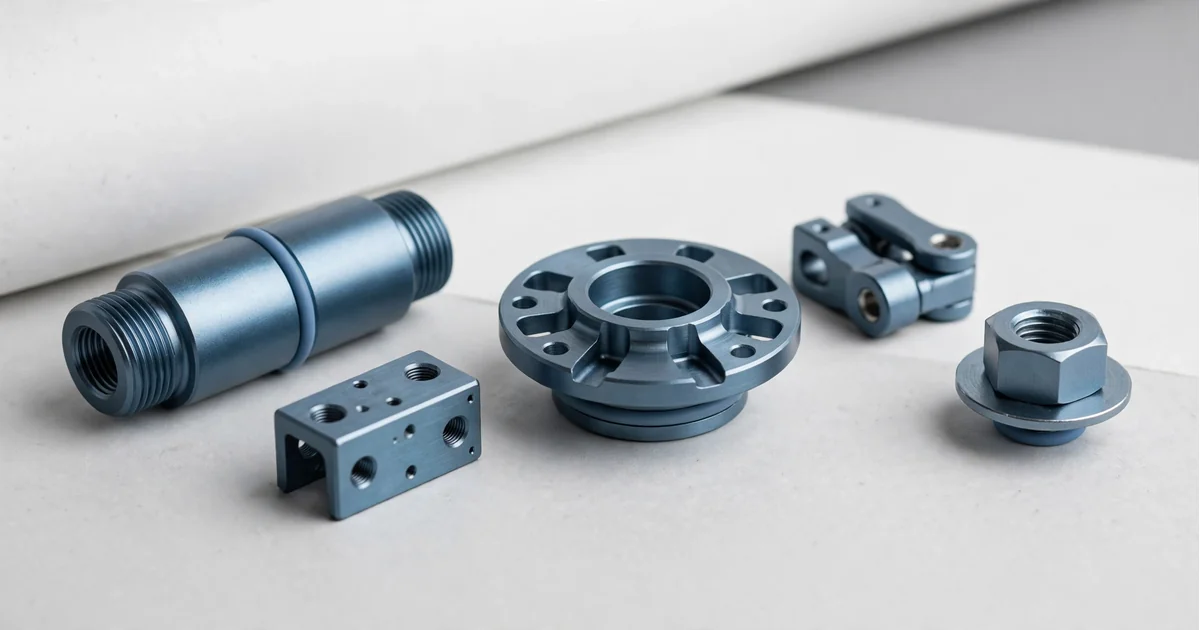
No, you cannot anodize steel in the normal sense. Anodizing only works on metals whose oxide forms a tight, protective layer, such as 铝质, titanium and magnesium. Iron oxide is loose, porous and flaky (we call it rust), so running steel through an anodizing tank just dissolves or corrodes it. Steel parts get their protection from other finishes instead, such as zinc plating, electroless nickel, black oxide, phosphate, powder coating or, for stainless steel, passivation.
This guide explains why steel cannot be anodized, what products sold as “anodized steel” really are, which finish to choose for a steel part, and how anodizing compares with electroplating.
Anodizing is an electrochemical process: an electrolytic oxidation, also called the anodizing process or anodic oxidation. The part is made the anode (the positive electrode) in an acidic electrolyte, usually sulfuric acid. Current pulls oxygen to the surface, and the metal grows its own oxide layer out of itself.
On aluminum, that oxide (aluminum oxide, Al₂O₃) is hard, dense, bonded to the metal and grows in an ordered porous structure that can be dyed and sealed. That is why anodized aluminum resists corrosion and wear.
Steel behaves differently for three reasons:
There is one lab exception. Steel can grow a thin black magnetite (Fe₃O₄) film when it is made the anode in a hot caustic (sodium hydroxide) solution. Some hobby videos call this “anodizing steel”, but it is really an electrochemical version of black oxide: thin, decorative and not a corrosion barrier on its own. It is not a commercial finish for machined parts.
| 金属 | Can it be anodized? | What the oxide does |
|---|---|---|
| 铝质 | Yes, the most common | Hard, dense Al₂O₃, can be dyed |
| 钛 | 是 | Thin TiO₂ that gives bright interference colors |
| 镁 | 是 | Protective film, often used as a paint base |
| 锌 | Yes, rarely used | Thin protective film |
| Carbon and alloy steel | 没有 | Porous rust that flakes off |
| 不锈钢 | Not with standard anodizing | See the next section |
The process of anodizing works because aluminum forms a natural oxide layer that is thin but tight, and anodizing grows a thicker, consistent oxide layer from the bare metal. Iron or carbon steel instead forms iron oxide, commonly known as rust, which is porous and gives no protection against corrosion. Even plasma electrolytic oxidation, a high voltage variant used on aluminum, magnesium and titanium, does not give a useful anodized coating on steel. That is why drawings carry MIL-A-8625 Type III or Type II anodizing callouts only for light metals, and why an anodized finish is never quoted for steel metal parts.

Stainless steel, especially austenitic stainless steel such as 304 and 316, already protects itself. Its chromium (at least 10.5%) forms a very thin, invisible chromium oxide film that heals when scratched. That is called the passive layer, and it is why stainless does not rust in normal use.
When you see “anodized stainless steel” for sale, it is almost always one of these:
True anodizing of stainless steel exists in research labs (for example, special fluoride containing electrolytes that grow nanoporous oxide), but it is not an industrial finish you can order for machined parts. For stainless parts, the standard treatment is passivation to ASTM A967 or A380, which removes free iron and restores the passive layer.

Since steel is not truly anodized, the honest answer depends on what finish the part has. Plain carbon steel rusts quickly. Zinc plated or galvanized steel resists rust until the zinc is used up or scratched through. Black oxide steel rusts easily unless it is kept oiled. Stainless steel resists rust on its own, and colored or PVD stainless keeps that resistance as long as the base grade is right for the environment.
If you searched for “anodized steel colors” or “how to anodize steel black”, these are the real processes behind the look:
| Look you want | 过程 | 耐用性 |
|---|---|---|
| Black on carbon steel | Black oxide (hot, mid temperature or room temperature chemical bath), then oil or wax | Low corrosion protection, near zero size change |
| Black with better rust protection | Black zinc plating or black electroless nickel | 好 |
| Blue, straw or purple on steel | Heat coloring (temper colors) with a torch or oven | Cosmetic only, wears and can rust |
| Gold, bronze, blue or black on stainless | PVD coating or electrochemical coloring | 非常好 |
| Any color on steel | Powder coating or wet paint over phosphate | Good while the coating is intact |
Heat coloring screws with a torch, as shown in many YouTube “anodizing” videos, only grows a thin oxide. It looks like anodized titanium, but it protects very little.
Many searches for anodized steel are really about pots and pans. Hard anodized cookware is aluminum, not steel. The aluminum is given a thick Type III anodized layer that is harder than stainless steel and will not react with food. Stainless steel cookware is usually 18/10 or 18/8 stainless, often bonded to an aluminum core for heat spread.
Hard-anodized cookware is popular because hard-anodized pans heat up quickly, are resistant to scratches and are easy to clean, and hard-anodized aluminum is far tougher than untreated aluminum. Many nonstick pans use this base. Cast iron cookware is the other common choice, but like any iron, cast iron rusts if it is not seasoned.
| Hard anodized aluminum | 不锈钢 | |
|---|---|---|
| 贱金属 | 铝质 | Iron, chromium, nickel |
| Heat spread | Fast and even | Slower unless it has an aluminum or copper core |
| 重量 | 打火机 | Heavier |
| Induction cooktop | Only with a steel base plate | Yes, if the grade is magnetic |
| Dishwasher | Often not recommended | 是 |
| Food reaction | Sealed oxide does not react with food | Very low, very durable |
For more on grades, see our guide to 18/8 vs 18/10 vs 18/0 stainless steel.
The right finish depends on what the part needs most: rust protection, wear resistance, looks, conductivity or a base for paint. If a steel part must be corrosion resistant, the finish does the work: a corrosion-resistant layer of zinc, nickel or paint keeps the metal parts underneath resistant to corrosion.

| 完成 | 典型厚度 | Corrosion protection | Hardness / wear | Common spec | 最适合 |
|---|---|---|---|---|---|
| Zinc electroplating (clear, yellow, black) | 5 to 25 µm | Good, sacrificial | 低 | ASTM B633 | Brackets, fasteners, general hardware |
| Zinc-nickel plating | 5 to 15 µm | 非常好 | 低至中 | ASTM B841 | Automotive and harsh outdoor parts |
| 无电解镍 | 5 to 75 µm, very even | 非常好 | High, higher after heat treat | ASTM B733 | Precision parts, bores, threads, molds |
| Hard chrome | 2 to 250 µm | 好 | 非常高 | AMS 2460 | Shafts, rods, wear surfaces |
| 黑色氧化物 | About 1 µm | Low, needs oil or wax | 无变化 | MIL-DTL-13924 | Tools, gun parts, low glare parts |
| Phosphate (zinc or manganese) | 2 to 25 µm | Low alone, good under paint or oil | Helps break in | TT-C-490, MIL-DTL-16232 | Paint base, sliding parts |
| 粉末涂装 | 50 to 150 µm | Very good while intact | 中型 | AAMA 2604 (architectural) | Enclosures, frames, outdoor parts |
| Hot dip galvanizing | 45 to 100+ µm | 优秀 | 中型 | ASTM A123 | Structural steel, outdoor fabrications |
| Nitriding / QPQ | Diffusion layer, no added size | 好 | 非常高 | AMS 2759/10 | Gears, shafts, wear parts |
| Passivation (stainless only) | No added layer | Restores stainless performance | 无变化 | ASTM A967, A380 | All machined stainless parts |
Read more about one of the most common options in 什么是黑氧化物涂层.
Anodizing and electroplating both use an electrolyte bath and electric current, but they work in opposite ways. In anodizing the part is the anode and its own surface turns into oxide. In electroplating the part is the cathode and a different metal is deposited on top of it.
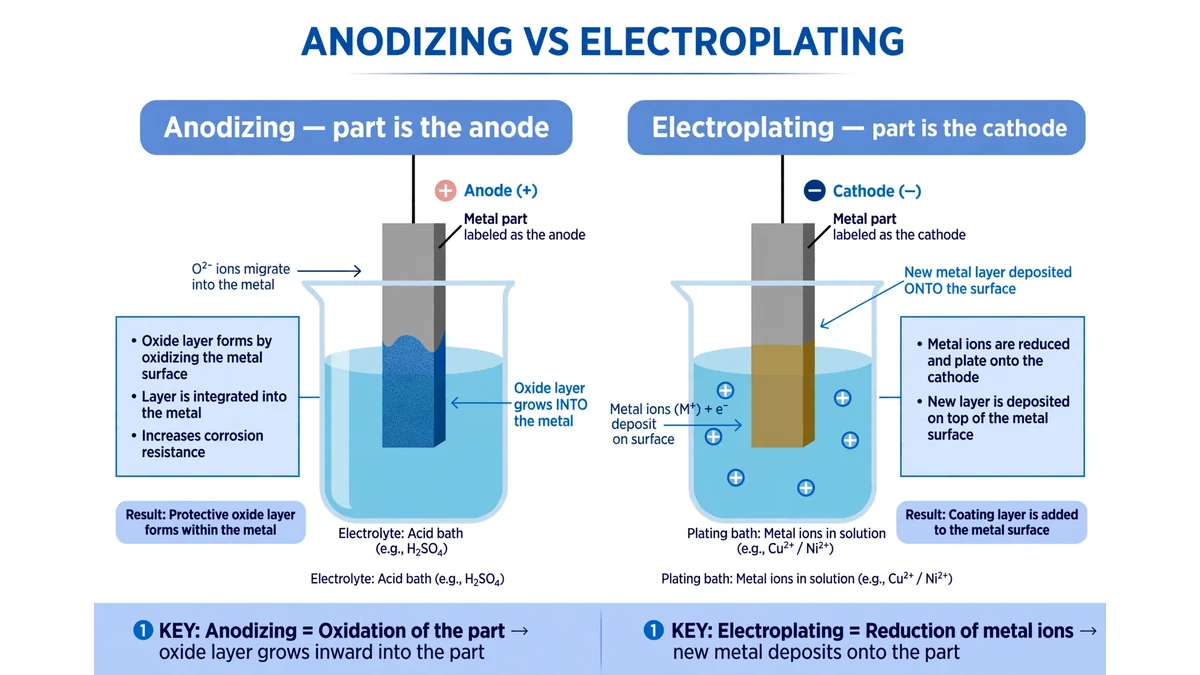
| 系数 | 阳极氧化 | 电镀 |
|---|---|---|
| Part’s role | Anode (positive) | Cathode (negative) |
| What forms | Oxide grown from the base metal | A new metal layer (zinc, nickel, chrome, copper, gold) |
| Base metals | Aluminum, titanium, magnesium | Steel, stainless, copper, brass, zinc die castings, some plastics |
| 邦德 | Part of the metal, cannot peel | Adhered layer, can peel or blister if prep is poor |
| Electrical | Insulating | Conductive |
| 颜色 | Dyes in almost any color | Metallic colors, plus chromate tints on zinc |
| 典型厚度 | Type II 5 to 25 µm, Type III 25 to 100 µm | Usually 5 to 25 µm, hard chrome thicker |
| Size change | About half the layer grows outward | Full layer thickness is added |
| Hydrogen embrittlement risk | None for aluminum | Yes on high strength steel, needs a bake per ASTM B850 |
| Common spec | MIL-A-8625 | ASTM B633, ASTM B733, AMS 2460 |
In metal finishing terms, anodizing converts the substrate itself, while plating adds a new metal on top. Anodized surfaces give corrosion resistance and wear resistance with good durability, the anodic film is a good base for paint primers and glues, and an anodizing color is locked into the pores before sealing. Plating baths can be acidic or alkaline, and any impurity left on the substrate causes poor adhesion, so cleaning is critical before both processes. In the UK the same process is often spelled anodise.
Choose anodizing for aluminum parts that need corrosion-resistance, a hard surface, electrical insulation or a dyed color, such as enclosures, heat sinks, consumer products and aerospace brackets. See II型与III型阳极氧化处理 to pick the right type.
Choose electroplating for steel, brass and copper parts, or when the surface must stay electrically conductive, solderable or very wear resistant. Plating is also the way to give a steel part a decorative chrome or nickel look.
| Anodizing downsides | Electroplating downsides |
|---|---|
| Only works on aluminum, titanium and magnesium | Layer can peel or blister if cleaning is poor |
| Insulating, so ground points must be masked | Hydrogen embrittlement risk on hardened steel |
| Color can vary between alloys and batches (6061 vs 7075) | Thickness builds up on edges and stays thin in holes (except electroless nickel) |
| Can craze if heated well above about 80 °C | Some chemistries (hexavalent chrome, cadmium) are tightly regulated |
| Grows the part, so threads and fits need allowance | Adds full thickness, so tight fits need masking or allowance |
Neither process has one fixed price. Finishers quote by lot or rack load, surface area, coating thickness and masking time, and most add a minimum lot charge, so small batches cost more per part. As a general guide, Type II clear anodizing is one of the cheapest finishes for aluminum, and dyed colors or Type III hardcoat cost more. For steel, zinc plating is usually the cheapest plating, electroless nickel costs more, and hard chrome or precious metals cost the most. Masking, hydrogen embrittlement baking and certifications all add to the price.
Tuowei Precision machines carbon steel, alloy steel, stainless steel and aluminum parts and finishes them in one order. Aluminum parts can be Type II or Type III anodized. Steel parts can be finished with electroless nickel plating, black oxide or powder coating, aluminum can also get chromate conversion coating, and stainless parts can be brushed and electropolished. Our engineers will suggest the finish that matches your corrosion, wear and cost targets.
Explore our 表面处理服务, including 无电解镀镍, 黑色氧化物, 粉末涂装 和 brushed and electropolished stainless steel,请参阅我们的 stainless steel CNC machining service, or upload your drawing for an 即时报价.
No. Standard anodizing needs a metal whose oxide forms a tight, protective film. Steel forms loose rust and dissolves in the acid bath, so it is plated, coated or blackened instead.
Not with industrial anodizing. Stainless steel can be colored electrochemically or with PVD, and it should be passivated after machining to restore its natural chromium oxide layer.
The term is usually used loosely for colored stainless steel, PVD coated steel or black oxide steel. None of these are true anodizing.
Iron oxide is porous, flakes off and keeps conducting current, so it never builds a protective layer. In a sulfuric acid bath the steel simply corrodes.
It depends on the job. Anodized aluminum is about one third the weight and machines faster. Stainless steel is stronger, more heat resistant and keeps its protection when scratched. Compare them in aluminum vs stainless steel for CNC parts.
Usually black oxide, a thin conversion coating sealed with oil. Some parts use black zinc plating or black phosphate instead.
On aluminum, anodizing is more durable because the layer is part of the metal and cannot peel. On steel, anodizing is not an option, and electroless nickel or hard chrome give the most durable plated surfaces.
It depends on part size, quantity, anodize type and color. Clear Type II on aluminum is among the cheapest finishes per part in production, while small lots pay a minimum charge and Type III hardcoat costs more. Steel cannot be anodized, so it is priced for plating or coating instead.
Not in a useful way. Home anodizing kits are made for aluminum. What home videos show on steel is usually heat coloring with a torch or a hot caustic black oxide, both thin finishes that need oil or wax to resist rust.
