هل تحتاج إلى حلول متخصصة في مجال التصنيع الآلي؟ فريقنا في Tuowei Precision جاهز لمساعدتك في تلبية جميع احتياجاتك التصنيعية. تواصل معنا اليوم للحصول على عرض أسعار لمشاريعك الجارية أو المرتقبة!
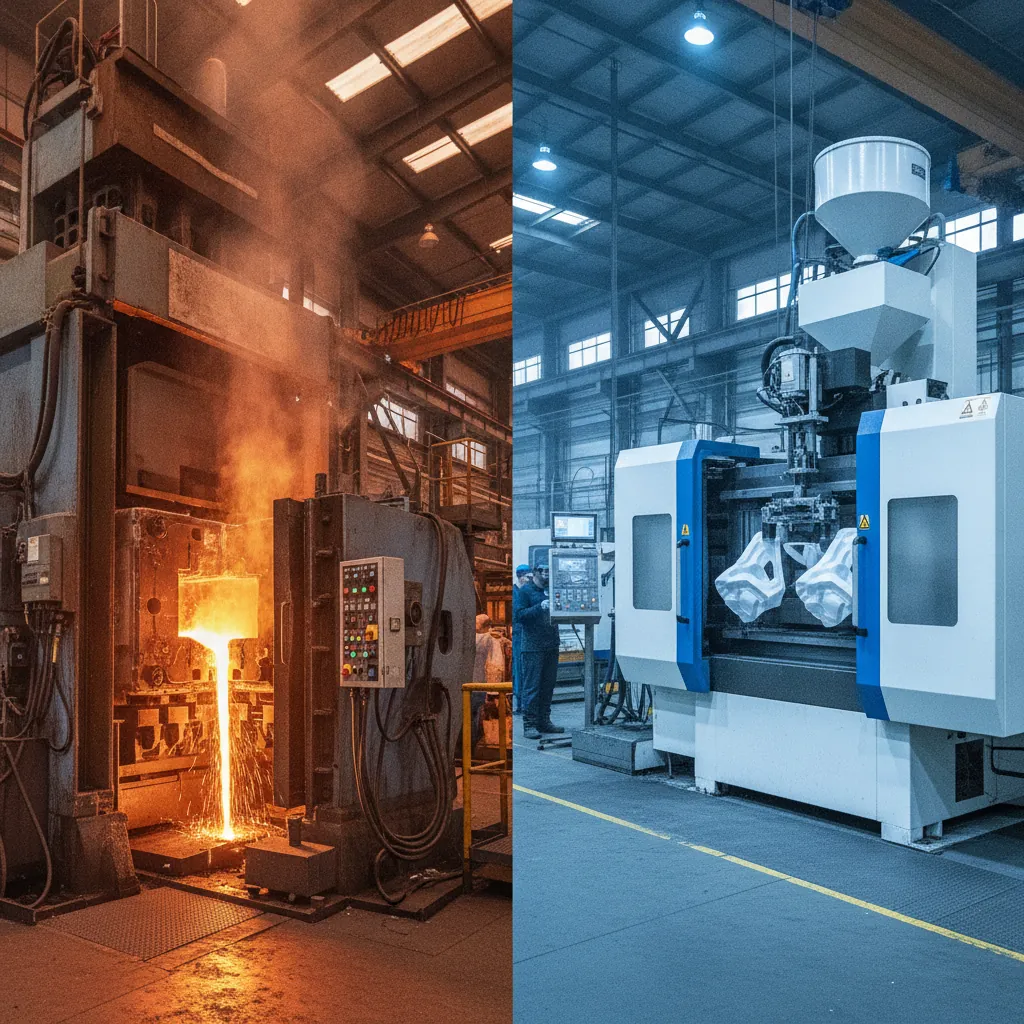
Die casting and injection molding are the same idea executed in different worlds: force fluid material into a steel mold under pressure, cool, eject, repeat. One fills the mold with molten metal, the other with molten plastic — and that single difference cascades into different machines, tolerances, costs and failure modes. Add metal injection molding (MIM), which molds metal powder like a plastic and then sinters it, and you have three processes that engineers regularly mix up. This guide compares all three with numbers — cycle times, tooling costs, tolerances and the volume thresholds where each wins.
| الصب بالقالب | قولبة حقن البلاستيك | Metal injection molding (MIM) | |
|---|---|---|---|
| المواد | Non-ferrous metals: aluminum, zinc, magnesium | Thermoplastics (ABS, PP, PC, nylon…) | Fine metal powder + binder: stainless, low-alloy steel, titanium |
| Part size sweet spot | 10 g – 10 kg | 1 g – several kg | 0.1 – 100 g (small, complex) |
| Tolerance (typical) | ±0.05–0.1 mm + 0.1%/25 mm | ±0.05–0.1 mm (precision grades tighter) | ±0.3–0.5% of dimension (sinter shrink ~15–20%) |
| تشطيب السطح | Ra 1.6–3.2 µm as-cast | Mirror to textured — mold defines it | Ra 0.8–1.6 µm as-sintered |
| زمن الدورة | 20–60 s (zinc faster than aluminum) | 10–60 s | Molding 15–45 s + days of debind/sinter |
| تكلفة الأدوات | $8,000–80,000 | $3,000–60,000 | $10,000–50,000 |
| Economic volume | 5,000+ pcs | 1,000+ pcs (aluminum tooling lower) | 10,000+ pcs |
Molten aluminum (~660 °C), zinc (~420 °C) or magnesium is injected into hardened H13 steel dies at 10–200 MPa. Hot-chamber machines (zinc, magnesium) cycle fastest; cold-chamber machines handle aluminum, which would attack an immersed gooseneck. Strengths: real metal strength and stiffness, thin walls (to ~1 mm in zinc), excellent thermal/EMI shielding, and per-part costs of cents to a few dollars at volume. Weaknesses: porosity (limits welding and pressure-tightness unless vacuum-assisted), draft angles required, trimming flash adds steps, and dies cost more than plastic molds because metal erodes them. Full process details in our what is die casting guide و خدمات صب القوالب page; for zinc specifics see zinc die casting.
Plastic pellets are melted (~180–320 °C) and screwed forward into the mold at 50–150 MPa. Cooling channels in the mold — not water spray — pull heat out, and the cycle repeats every 10–60 seconds. Strengths: enormous material palette (flexible to glass-filled), in-mold texture and color, living hinges, overmolding, inserts, and the lowest per-part costs in manufacturing. Weaknesses: plastic properties (temperature, creep), sink marks over thick sections, weld lines, and tooling lead time. Our خدمات القولبة بالحقن للبلاستيك cover prototype aluminum tooling through million-shot production molds.
Metal injection molding mixes fine metal powder (<20 µm) with a polymer binder, molds it like plastic, chemically or thermally removes the binder, then sinters at ~1,200–1,400 °C to 95–99% density. The part shrinks 15–20% — predictably — during sintering. MIM owns one niche completely: small, complex, high-volume steel or stainless parts — surgical instrument jaws, firearm components, watch cases, phone hinges. Versus die casting: MIM does ferrous metals and titanium (die casting cannot), achieves better mechanical properties than castings, but tops out around 100 g economically and adds days of furnace time. Versus CNC: at 10,000+ pieces MIM crushes machining on cost for complex small geometry; below that, machining wins — see our CNC vs injection molding comparison.
| Scenario (typical 50 g part) | الأدوات | Per part @10k | Per part @100k |
|---|---|---|---|
| Aluminum die casting | $15,000–40,000 | $1.5–4 | $0.8–2 |
| Zinc die casting | $10,000–30,000 | $1–3 | $0.5–1.5 |
| Injection molding (ABS) | $5,000–25,000 | $0.4–1.5 | $0.15–0.6 |
| MIM (316L) | $15,000–40,000 | $2–6 | $1–3 |
| CNC machining (reference) | ~$0 fixed | $8–25 | $6–20 |
The pattern: processes with tooling start expensive and get cheap; CNC starts cheap and stays flat. The crossover is why prototypes are machined and products are molded or cast.
| Your situation | اختر |
|---|---|
| Plastic part, any volume above ~1,000 | القولبة بالحقن |
| Metal housing/bracket, 5,000+ pcs, aluminum/zinc OK | الصب بالقالب |
| Small complex steel/stainless/Ti part, 10,000+ pcs | MIM |
| Metal part needing pressure-tightness or welding | Machining from billet, or vacuum die casting + impregnation |
| Under ~1,000–5,000 pcs, any material | التصنيع الآلي باستخدام الحاسب الآلي — no tooling to amortize |
| Metal look at plastic cost | Injection molding + plating/painting |
Die casting injects fully molten metal into a die and the part is finished in seconds; MIM injects a metal-powder/binder feedstock, then needs debinding and sintering over days. Die casting suits aluminum/zinc parts up to kilograms; MIM suits steel, stainless and titanium parts under ~100 g with superior mechanical properties.
Per part, no — plastic parts mold cheaper than metal parts cast, and plastic tooling wears slower. The comparison is really material-driven: if the part can be plastic, molding is cheaper; if it must be metal at volume, die casting is the cheap metal route.
Convention only: the steel tooling is called a “die” in metal casting and stamping, and a “mold” in plastic molding. Functionally both are matched cavity-and-core blocks with cooling, venting and ejection.
Yes — that is exactly what MIM is: metal powder molded in an injection molding machine, then sintered solid. There is also die casting’s cousin thixomolding for magnesium. For one-offs and low volume, though, machining metal remains the practical route.
Tuowei Precision runs صب القوالب, القولبة بالحقن و التصنيع الآلي باستخدام الحاسب الآلي under one roof — so we quote your part in the process that actually minimizes your cost at your volume, and bridge you from machined prototypes to production tooling without changing suppliers. Send your drawing for a 24-hour quote with process recommendation.

بقلم آندي، مهندس تصنيع في شركة TUOWEI Precision. يتخصص آندي في التصنيع باستخدام الحاسب الآلي (CNC) والتصنيع الدقيق وهندسة الإنتاج، ويتمتع بخبرة عملية في دعم المشاريع بدءًا من النماذج الأولية السريعة وصولًا إلى الإنتاج على نطاق واسع. وهو يعمل عن كثب مع فرق الهندسة والتصنيع لتقييم المواد والتفاوتات المسموح بها وعمليات التصنيع وقابلية التصميم للتصنيع. تقدم مقالاته رؤى عملية ومستندة إلى المعرفة التقنية لمساعدة المهندسين والمشترين على اتخاذ قرارات تصنيع أفضل، وتحسين كفاءة الإنتاج، وتحقيق جودة متسقة للأجزاء. اكتشف حلول التصنيع باستخدام الحاسب الآلي (CNC) والتصنيع المخصص التي تقدمها TUOWEI Precision لمشروعك القادم.
بدءًا من النماذج الأولية السريعة وصولاً إلى الإنتاج القابل للتوسع، تقدم شركة Tuowei Precision خدمات تصنيع موثوقة باستخدام الحاسب الآلي (CNC) تتسم بالدقة والاتساق في كل خطوة. ابدأ مشروعك اليوم.
اقرأ أحدث أدلةنا حول التصنيع باستخدام الحاسب الآلي (CNC) والمواد والتشطيب واتجاهات الصناعة لاتخاذ قرارات إنتاجية أفضل.