¿Necesitas soluciones de mecanizado especializadas? El equipo de Tuowei Precision está a tu disposición para ayudarte con todas tus necesidades de fabricación. ¡Ponte en contacto con nosotros hoy mismo para solicitar un presupuesto para tus proyectos actuales o futuros!
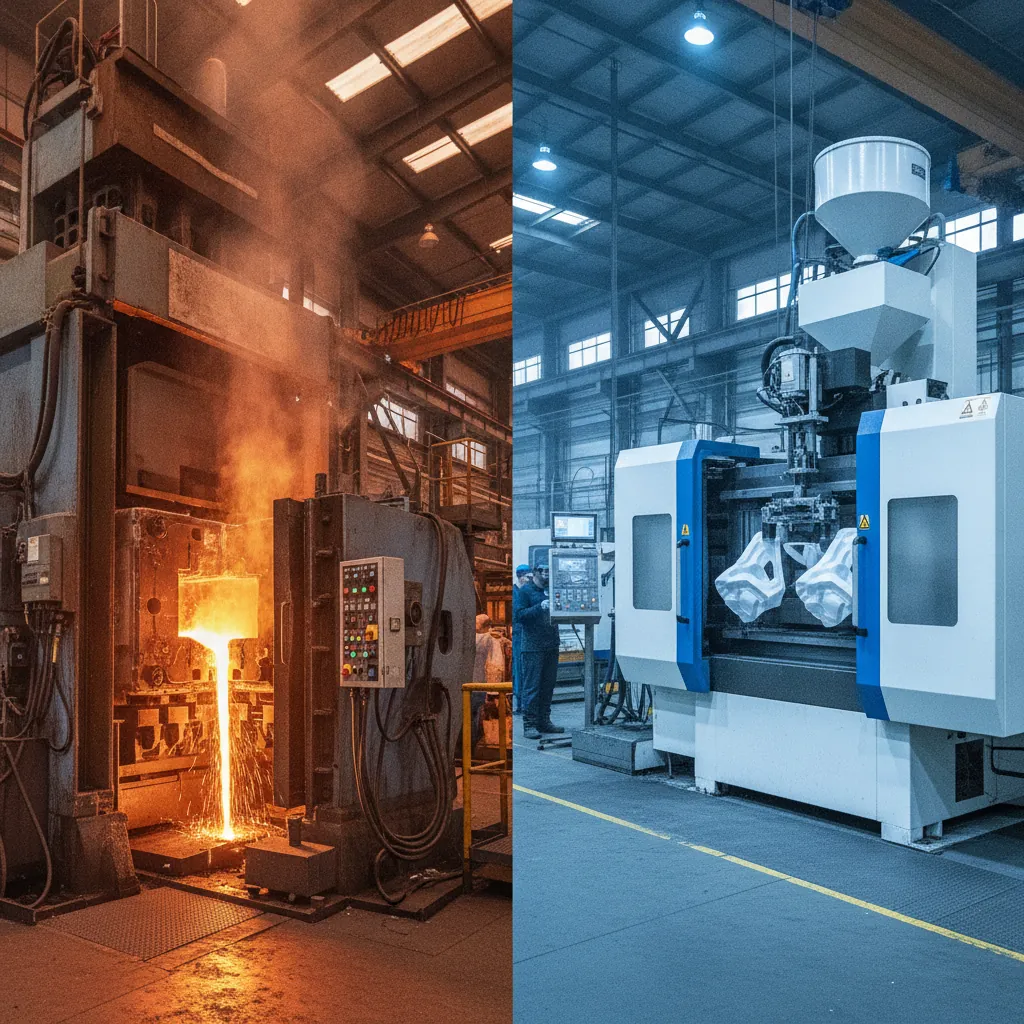
Die casting and injection molding are the same idea executed in different worlds: force fluid material into a steel mold under pressure, cool, eject, repeat. One fills the mold with molten metal, the other with molten plastic — and that single difference cascades into different machines, tolerances, costs and failure modes. Add metal injection molding (MIM), which molds metal powder like a plastic and then sinters it, and you have three processes that engineers regularly mix up. This guide compares all three with numbers — cycle times, tooling costs, tolerances and the volume thresholds where each wins.
| Fundición a presión | Moldeo por inyección de plástico | Metal injection molding (MIM) | |
|---|---|---|---|
| Material | Non-ferrous metals: aluminum, zinc, magnesium | Thermoplastics (ABS, PP, PC, nylon…) | Fine metal powder + binder: stainless, low-alloy steel, titanium |
| Part size sweet spot | 10 g – 10 kg | 1 g – several kg | 0.1 – 100 g (small, complex) |
| Tolerance (typical) | ±0.05–0.1 mm + 0.1%/25 mm | ±0.05–0.1 mm (precision grades tighter) | ±0.3–0.5% of dimension (sinter shrink ~15–20%) |
| Acabado de la superficie | Ra 1.6–3.2 µm as-cast | Mirror to textured — mold defines it | Ra 0.8–1.6 µm as-sintered |
| Duración del ciclo | 20–60 s (zinc faster than aluminum) | 10–60 s | Molding 15–45 s + days of debind/sinter |
| Coste de los utillajes | $8,000–80,000 | $3,000–60,000 | $10,000–50,000 |
| Economic volume | 5,000+ pcs | 1,000+ pcs (aluminum tooling lower) | 10,000+ pcs |
Molten aluminum (~660 °C), zinc (~420 °C) or magnesium is injected into hardened H13 steel dies at 10–200 MPa. Hot-chamber machines (zinc, magnesium) cycle fastest; cold-chamber machines handle aluminum, which would attack an immersed gooseneck. Strengths: real metal strength and stiffness, thin walls (to ~1 mm in zinc), excellent thermal/EMI shielding, and per-part costs of cents to a few dollars at volume. Weaknesses: porosity (limits welding and pressure-tightness unless vacuum-assisted), draft angles required, trimming flash adds steps, and dies cost more than plastic molds because metal erodes them. Full process details in our what is die casting guide y servicios de fundición a presión page; for zinc specifics see zinc die casting.
Plastic pellets are melted (~180–320 °C) and screwed forward into the mold at 50–150 MPa. Cooling channels in the mold — not water spray — pull heat out, and the cycle repeats every 10–60 seconds. Strengths: enormous material palette (flexible to glass-filled), in-mold texture and color, living hinges, overmolding, inserts, and the lowest per-part costs in manufacturing. Weaknesses: plastic properties (temperature, creep), sink marks over thick sections, weld lines, and tooling lead time. Our servicios de moldeo por inyección de plástico cover prototype aluminum tooling through million-shot production molds.
Metal injection molding mixes fine metal powder (<20 µm) with a polymer binder, molds it like plastic, chemically or thermally removes the binder, then sinters at ~1,200–1,400 °C to 95–99% density. The part shrinks 15–20% — predictably — during sintering. MIM owns one niche completely: small, complex, high-volume steel or stainless parts — surgical instrument jaws, firearm components, watch cases, phone hinges. Versus die casting: MIM does ferrous metals and titanium (die casting cannot), achieves better mechanical properties than castings, but tops out around 100 g economically and adds days of furnace time. Versus CNC: at 10,000+ pieces MIM crushes machining on cost for complex small geometry; below that, machining wins — see our CNC vs injection molding comparison.
| Scenario (typical 50 g part) | Herramientas | Per part @10k | Per part @100k |
|---|---|---|---|
| Fundición a presión de aluminio | $15,000–40,000 | $1.5–4 | $0.8–2 |
| Zinc die casting | $10,000–30,000 | $1–3 | $0.5–1.5 |
| Injection molding (ABS) | $5,000–25,000 | $0.4–1.5 | $0.15–0.6 |
| MIM (316L) | $15,000–40,000 | $2–6 | $1–3 |
| CNC machining (reference) | ~$0 fixed | $8–25 | $6–20 |
The pattern: processes with tooling start expensive and get cheap; CNC starts cheap and stays flat. The crossover is why prototypes are machined and products are molded or cast.
| Your situation | Elija |
|---|---|
| Plastic part, any volume above ~1,000 | Moldeo por inyección |
| Metal housing/bracket, 5,000+ pcs, aluminum/zinc OK | Fundición a presión |
| Small complex steel/stainless/Ti part, 10,000+ pcs | MIM |
| Metal part needing pressure-tightness or welding | Machining from billet, or vacuum die casting + impregnation |
| Under ~1,000–5,000 pcs, any material | Mecanizado CNC — no tooling to amortize |
| Metal look at plastic cost | Injection molding + plating/painting |
Die casting injects fully molten metal into a die and the part is finished in seconds; MIM injects a metal-powder/binder feedstock, then needs debinding and sintering over days. Die casting suits aluminum/zinc parts up to kilograms; MIM suits steel, stainless and titanium parts under ~100 g with superior mechanical properties.
Per part, no — plastic parts mold cheaper than metal parts cast, and plastic tooling wears slower. The comparison is really material-driven: if the part can be plastic, molding is cheaper; if it must be metal at volume, die casting is the cheap metal route.
Convention only: the steel tooling is called a “die” in metal casting and stamping, and a “mold” in plastic molding. Functionally both are matched cavity-and-core blocks with cooling, venting and ejection.
Yes — that is exactly what MIM is: metal powder molded in an injection molding machine, then sintered solid. There is also die casting’s cousin thixomolding for magnesium. For one-offs and low volume, though, machining metal remains the practical route.
Tuowei Precision runs fundición a presión, moldeo por inyección y Mecanizado CNC under one roof — so we quote your part in the process that actually minimizes your cost at your volume, and bridge you from machined prototypes to production tooling without changing suppliers. Send your drawing for a 24-hour quote with process recommendation.

Escrito por Andy, ingeniero de fabricación en TUOWEI Precision. Andy está especializado en mecanizado CNC, fabricación de precisión e ingeniería de producción, y cuenta con experiencia práctica en el apoyo a proyectos que abarcan desde la creación rápida de prototipos hasta la producción a gran escala. Trabaja en estrecha colaboración con los equipos de ingeniería y fabricación para evaluar materiales, tolerancias, procesos de mecanizado y la facilidad de fabricación de los diseños. Sus artículos ofrecen información práctica y con base técnica para ayudar a ingenieros y compradores a tomar mejores decisiones de fabricación, optimizar la eficiencia de la producción y lograr una calidad constante de las piezas. Descubre las soluciones de mecanizado CNC y fabricación a medida de TUOWEI Precision para tu próximo proyecto.
Desde prototipos rápidos hasta la producción a gran escala, Tuowei Precision ofrece un mecanizado CNC fiable, con precisión y uniformidad en cada paso. Empieza tu proyecto hoy mismo.
Lee nuestras últimas guías sobre mecanizado CNC, materiales, acabados y tendencias del sector para tomar mejores decisiones de producción.