作者:林欧文,图威精密工程师 · 2026年11月
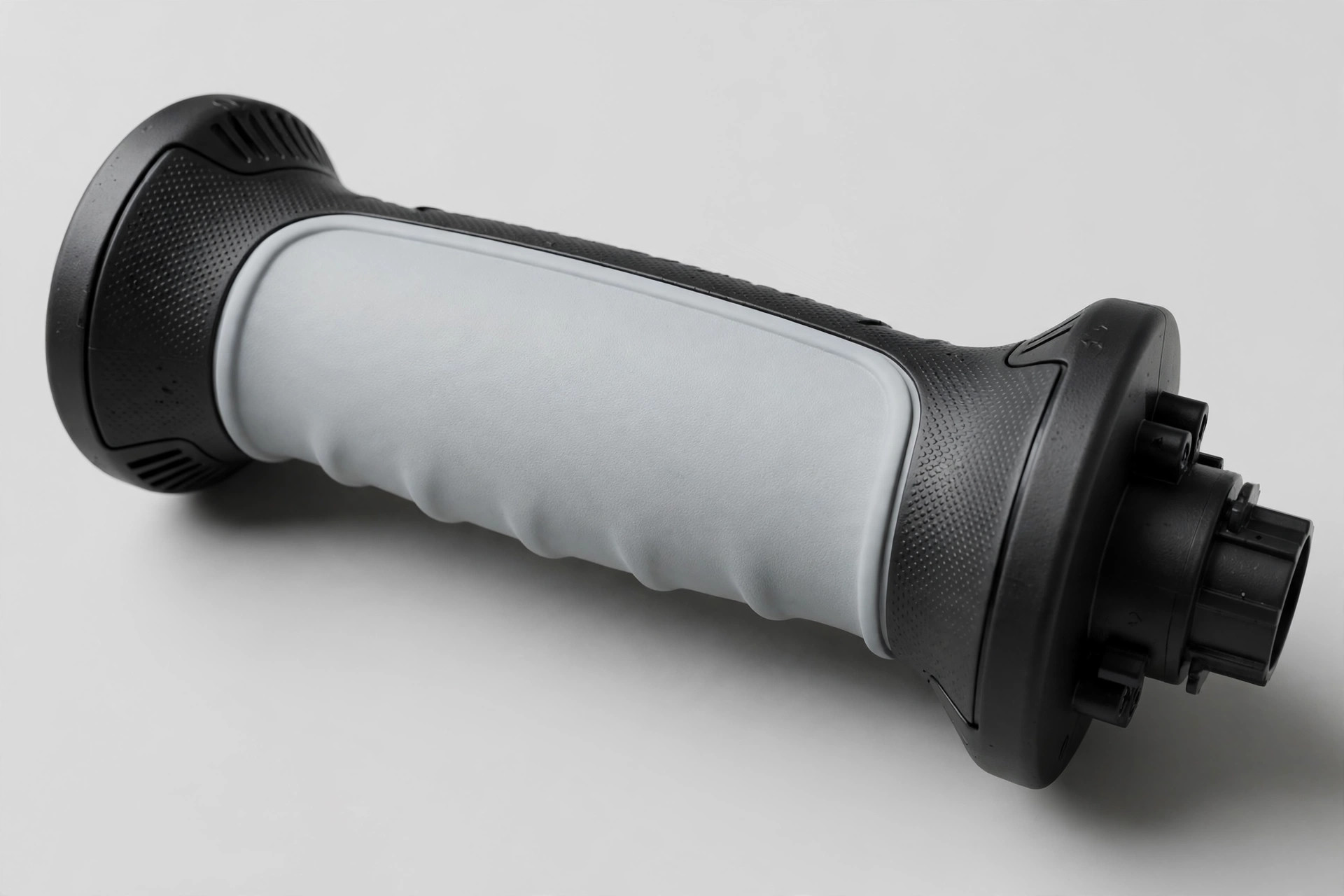
When engineers ask what is overmolding, the short version is this: it is an 注塑工艺 that molds one material directly over or around another to make a single, bonded part. The first part, called the substrate, is usually a rigid plastic. The second layer is usually softer, such as a thermoplastic elastomer (TPE) or silicone.
You handle these parts every day. Toothbrush handles, power tool grips, phone cases, sealed connectors and medical device handles all combine a stiff structure with a soft, grippy or sealing surface this way, without glue or assembly. This guide covers how the process works, the two main production methods, which material pairs bond, the design rules that prevent peeling, and when the extra tooling cost pays off.
Short answer: Overmolding is a multi-step injection molding process in which a second material is molded onto a previously molded substrate, forming one integrated part. The bond comes from chemical adhesion between compatible materials, mechanical interlocks in the design, or both. It is used for soft-touch grips, seals, vibration damping and protection of electronics.
The process is a variation of standard injection molding. Each material is still melted, injected into a steel or aluminum mold, cooled and ejected. The difference is that the mold for the second shot already holds the first part, and the new material flows against that part’s surface.
Three terms come up often and are easy to confuse. Our guide on 包覆成型与嵌件成型的区别 compares the two side by side:
Whatever the method, every job follows the same basic sequence:
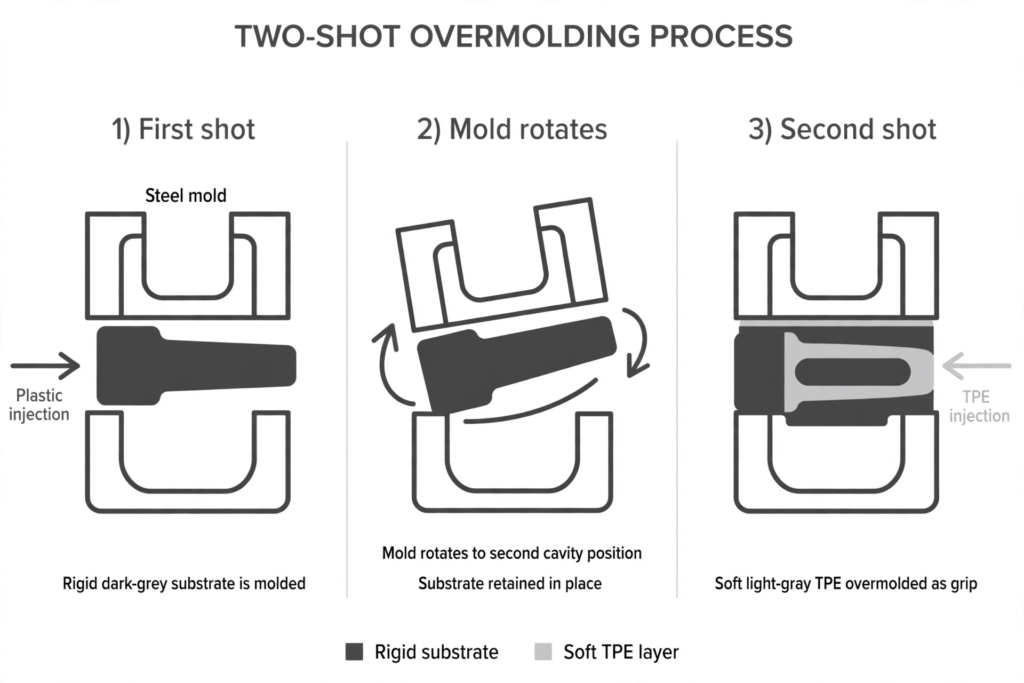
In two-shot molding, a press with two injection units makes both shots in one cycle. After the first shot, the mold rotates, or a core moves, so the fresh substrate sits in the second cavity. The soft material goes in while the substrate is still warm, which helps adhesion.
Two-shot tooling is complex and expensive, and it needs a multi-shot press. In return, cycle times are short, alignment between the two materials is very consistent and labor is minimal.
Here the substrates are molded first, often in a separate tool and machine. A robot or operator then loads each one into a second mold for the second shot.
The tools are simpler and cheaper, and standard single-shot presses can run them. Cycle time and labor cost per part are higher, though. The substrate has also cooled by the time it is covered, which weakens the bond for some material pairs. Preheating or plasma treatment helps.
Our view: for prototypes and runs up to the low tens of thousands of parts, pick-and-place is usually the right starting point. Move to two-shot when volumes are high enough to pay back the tool, or when bond and alignment need the consistency of a single cycle. The break-even point varies with part size and labor cost, so ask your molder to quote both routes.
| 系数 | 两枪成型 | Pick-and-place |
|---|---|---|
| 工具 | One complex multi-shot mold | Two simpler molds |
| Press | Multi-shot press with two injection units | Standard single-shot presses |
| 周期时间 | Short | Longer per part, plus handling time |
| Bond | Stronger, second shot lands on a warm substrate | Weaker for some pairs, substrate has cooled |
| 最适合 | High volumes, consistent bond and alignment | Prototypes and runs up to the low tens of thousands |
Material compatibility is the most important decision in the whole project. If the two materials do not bond chemically, the design has to hold the outer layer mechanically, or it will peel.
| Substrate | Common outer material | Bond notes |
|---|---|---|
| 聚丙烯(PP) | SEBS-based TPE | Strong chemical bond with standard grades |
| ABS, PC, PC/ABS | Modified TPE or TPU | Needs grades formulated to bond to these plastics |
| Nylon (PA6, PA66) | Nylon-bonding TPE or TPU | Dry the nylon; moisture weakens the bond |
| PC, PA | Self-bonding liquid silicone (LSR) | Needs self-bonding LSR and a substrate that tolerates the cure heat |
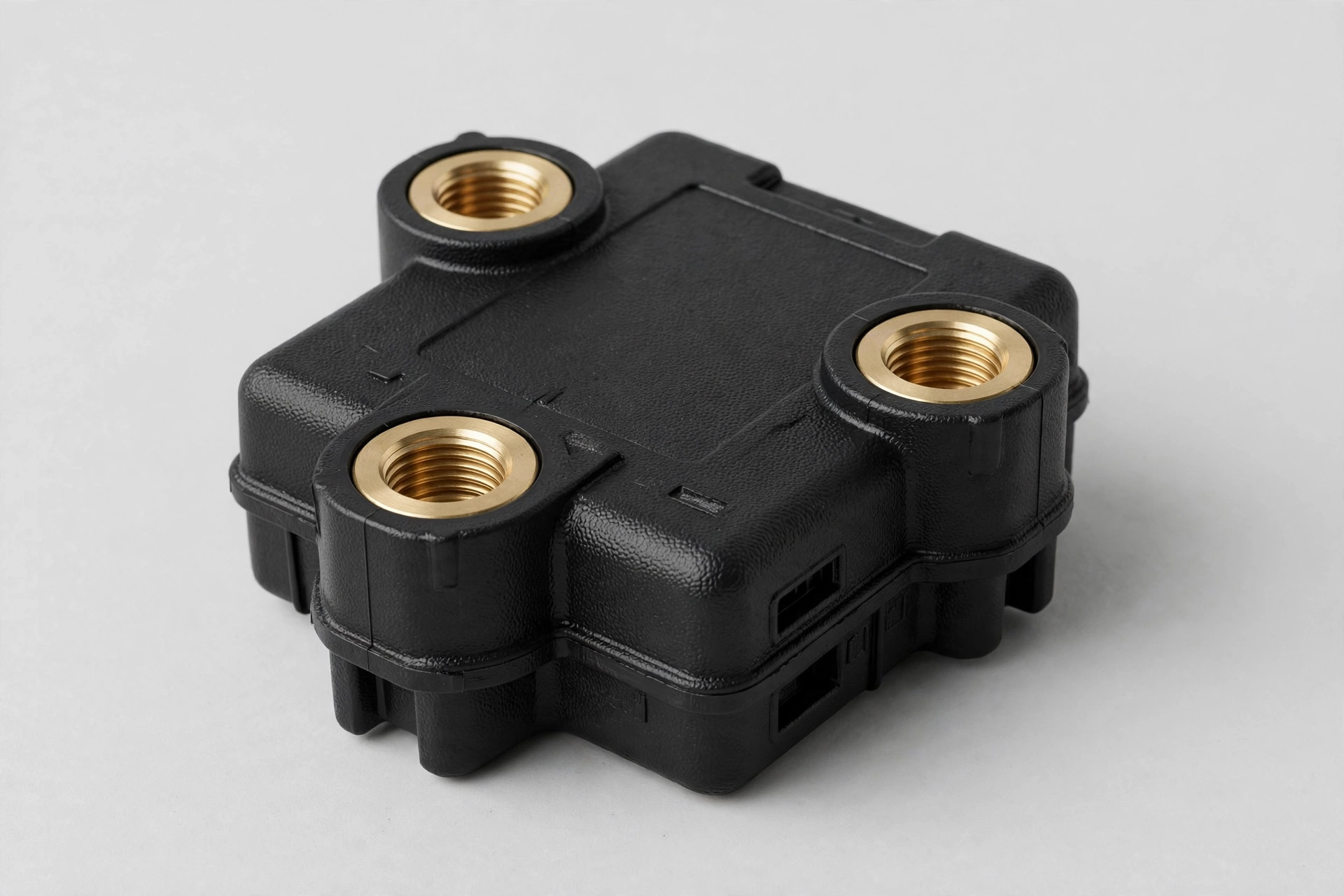
| 金属 | TPE, TPU, rubber or rigid plastic | Usually relies on mechanical locks or primers |
The softness of the outer layer is specified as durometer hardness, usually on the Shore A scale for grips and seals. It is measured following ASTM D2240, so state both the scale and the value on the drawing. Two materials with the same Shore value can still feel quite different in the hand, so sample parts are worth the wait.
Material suppliers publish bonding charts, and they are the best first check. Bond strength still varies with grade, molding conditions and color, so test real parts before committing to production.
Engineers use the process to add a property the substrate cannot provide alone:
In electronics, the second material encapsulates components to protect them from water, dust and impact. Cable assemblies are a common example. The plastic molded over a connector both seals the joint and acts as a strain relief, so the cable does not break at the plug.
Covering a populated circuit board is more delicate. Standard injection pressure and temperature can damage components or solder joints, so low-pressure molding with hot-melt polyamides is often used instead. Tell the molder exactly which components sit under the encapsulation and their temperature limits.
Medical devices use it for secure grips on instruments, soft patient-contact surfaces, and seals that keep fluids out of housings. A one-piece part has no glue line and fewer crevices than an assembly, which helps cleaning and sterilization.
The trade-off is qualification. Every material that touches the patient must be a medical grade with the right biocompatibility testing, commonly under the ISO 10993 series, and the bond must survive the chosen sterilization method. Those requirements depend on the device and its market, so confirm them with your regulatory team before selecting materials.
Most failures trace back to design, not processing. These rules prevent the common ones:
Two-material parts hold tolerances similar to standard molded parts, with a little extra variation where the materials meet. ISO 20457 is the international standard for tolerances on plastic molded parts, and it is a useful shared reference for drawings. Typical values for two-material parts:
| Type of work | 典型公差 |
|---|---|
| Standard two-material parts | ±0.005 英寸(±0.127 毫米) |
| Precision work | ±0.002 英寸(±0.051 毫米) |
| Over metal inserts | ±0.005 英寸(±0.127 毫米) |
| 复杂部件 | ±0.003 英寸(±0.076 毫米) |
Soft surfaces compress under a probe or caliper, so agree how they will be measured. Hold tight tolerances on the rigid substrate and keep looser ones on the elastomer.
| 优势 | 缺点 |
|---|---|
| Combines rigid and soft properties in one part | Two molds or a complex two-shot tool raise upfront cost |
| Removes assembly, glue and fasteners | Not every material pair bonds |
| Strong, permanent bond when designed well | Longer development and sampling time |
| Built-in seals and grips | A defect scraps both materials, not one |
| Two colors or textures without painting | Harder to recycle because materials are joined |
| Better vibration damping and drop protection | 模具制作完成后的设计变更成本高昂 |
It costs more upfront than single-material molding, because it needs either two molds or one complex multi-shot mold. Per-part cost depends on the route. Two-shot parts are cheap once tooled, while pick-and-place adds handling time to every part.
The comparison that matters is against the assembly it replaces. If the soft layer removes a separate gasket, an adhesive step or a snap-fit cap, savings in labor and part count can outweigh the tool cost at moderate volumes. If the part only needs a soft surface for looks, a soft-touch paint or a separate grip sleeve may be cheaper.
Overmolding means molding one material over another to create a single part. A rigid plastic or metal substrate is placed in a mold, and a second material, often a soft TPE or silicone, is injected around it. The two bond chemically, mechanically or both, so no assembly is needed afterwards.
It depends on the material pair, grade, color and molding conditions. Compatible pairs such as PP with SEBS-based TPE can bond so well that the elastomer tears before it separates. Incompatible pairs barely stick, so they need mechanical locks. Always test peel strength on real molded samples before production.
Overmolding is the general process of molding one material over another. Two-shot molding is one way to do it, with both materials molded in a single cycle on one machine using a rotating or shuttling mold. Pick-and-place is the other common method, using two separate molding steps.
Thermoplastic elastomers are the most common, followed by TPU and liquid silicone rubber. TPE grades are formulated to bond with specific substrates such as PP, ABS, PC or nylon. Silicone needs self-bonding grades and heat-tolerant substrates. Rigid plastics are sometimes molded over other plastics for color or structure.
Lifespan depends on mold steel, part material and maintenance. Aluminum prototype tools may make thousands of parts, while hardened steel production molds can make hundreds of thousands to over a million. Molds for glass-filled or abrasive materials wear faster. Confirm the expected tool life with your molder when you quote.
在 拓维精密, we mold plastic over plastic, rubber over plastic and plastic or rubber over metal, from prototypes to production. Our quality system is certified to ISO 9001:2015 and ISO 14001:2015. Where a part needs metal threads rather than a soft layer, our insert molding service covers it.
For a useful quote, send STEP files for both the substrate and the outer layer, your preferred materials and hardness, colors, annual volume and any sealing or bond-strength requirements. Our engineers check material compatibility, shut-offs and mechanical locks before tooling. You can start on our custom overmolding page.
林欧文是图威精密的一名工程师。他负责规划工装和生产工艺,并与质量团队合作,确保每批产品的质量一致。
This article is general engineering information. Medical device material and regulatory requirements vary by device and market; confirm them with qualified regulatory professionals.