Por Leon Xu, ingeniero de Tuowei Precision · Noviembre de 2026
To bend sheet metal, you clamp the sheet along a straight line and apply force on one side until it folds to the angle you want. By hand that means a vise, two hardwood blocks and a mallet, or a small sheet metal brake. In production it means a CNC press brake pushing a punch into a V-shaped die.
Either way, how to bend sheet metal well comes down to three things: the right inside radius, an accurate flat pattern and correcting for springback.
Respuesta breve: Mark the bend line, clamp the sheet so the line sits exactly at the clamping edge, and push the free side over evenly along its whole length. Overbend slightly, because the metal springs back. For accurate parts, calculate the flat length with a bend allowance based on the material’s K-factor, and keep the inside radius at least equal to the thickness.
This guide covers simple hand bending first, then how press brake bending works, the main bending methods, the K-factor and bend allowance math, springback and the design rules that keep parts from cracking or coming out short.
Metal bending is a forming process that changes the angle of a sheet along a straight line without removing any material. The sheet is stressed past its yield point, so it takes a permanent set, but its thickness stays almost the same.
During a bend, the outside surface stretches and the inside surface compresses. Somewhere between them sits a layer that does neither. That layer is called the neutral axis, and it is the key to calculating flat patterns later in this guide.
Bending is the step that turns a flat blank, usually laser cut, into a bracket, channel or enclosure. It is one stage of the wider sheet metal fabrication process, which also includes cutting, joining and finishing.
For thin sheet, a one-off part and no machine, you can still bend sheet metal cleanly at home.
Tools: a bench vise, two straight hardwood blocks or lengths of angle iron longer than the bend, a rubber or wooden mallet, a marker, a square and gloves.
Without a vise, a sturdy table edge and a clamped board can do the same job. For repeated bends, a small bench-top bending brake or hand seamer gives much straighter results than a mallet.
There are limits. Hand sheet metal bending works for thin, soft material such as aluminio or mild steel sheet, and short bends. Acero inoxidable, thicker sheet and long bends need far more force than a vise and mallet can give evenly, and the angle will wander along the length. Wear gloves throughout, because sheet edges cut easily.
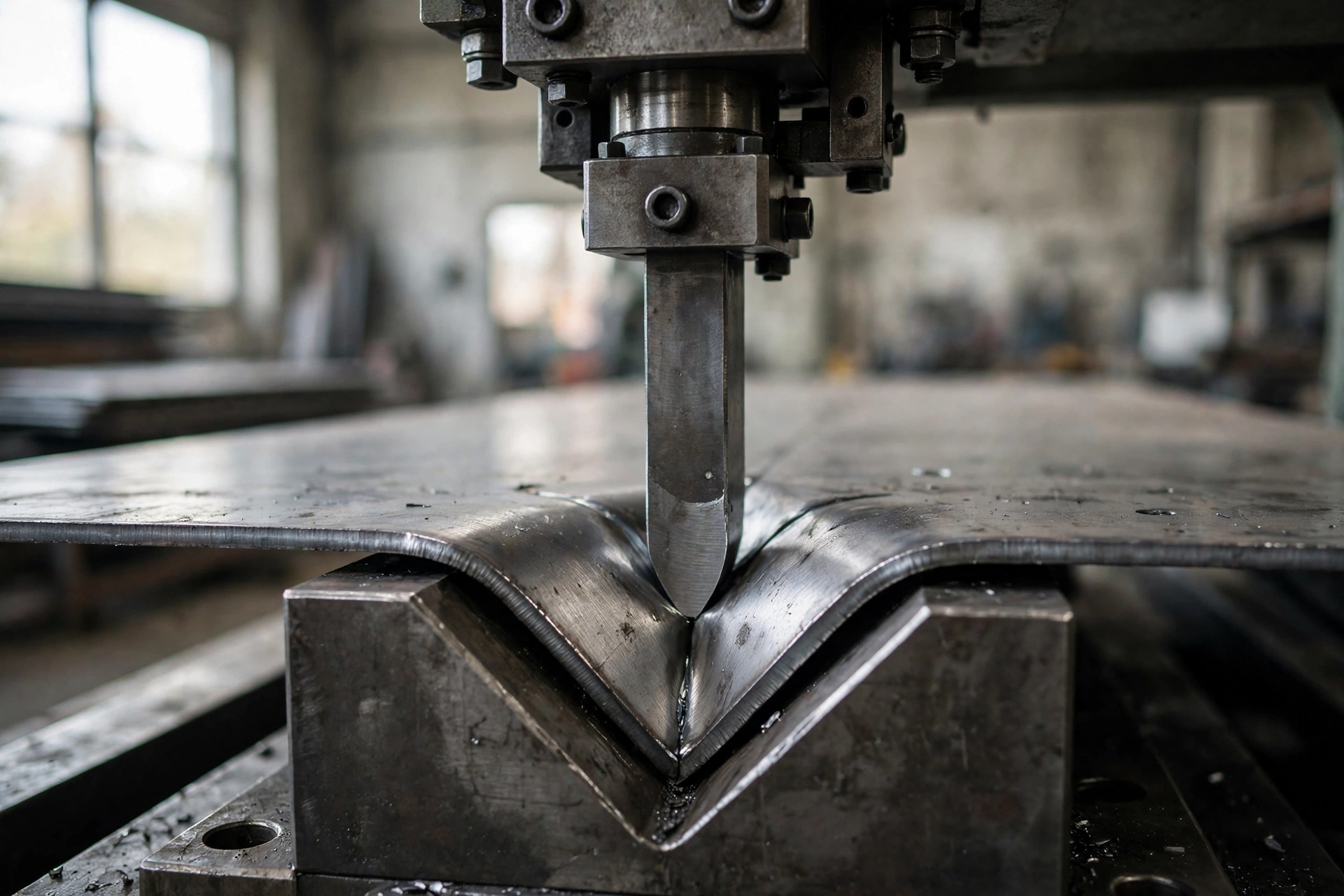
Industrial sheet metal bending is done on a press brake. The machine has a punch on top and a V-shaped die underneath. The sheet sits on the die against a backgauge, which sets where the bend falls. The punch comes down, pushes the sheet into the die opening and forms the angle.
A CNC press brake controls the punch depth and backgauge position from a program, so the same bend repeats from the first part to the last. The operator plans the bend sequence so that earlier flanges do not hit the machine or tooling on later bends.
Press brakes are powerful machines with a crushing hazard at the point of operation. In the US, OSHA’s mechanical power press standard 29 CFR 1910.217 specifically excludes press brakes, so they fall under OSHA’s general machine guarding requirements. ANSI B11.3 is the consensus safety standard written for press brakes.
| Método | Cómo funciona | Force needed | Angle control | Ideal para |
|---|---|---|---|---|
| Control del aire | Punch pushes the sheet partway into the die, touching only at three points | Mínimo | Good, with springback compensation | Most parts; one tool set makes many angles |
| Bottoming | Sheet is pressed until it contacts the die walls | Moderate to high | Better, less springback | Repeated, exact angles |
| Acuñación | High force stamps the punch tip into the sheet | Highest | Best, springback almost removed | Tight angle control on thin sheet |
| Wipe (edge) bending | Sheet is clamped and a pad wipes the flange down | Moderado | Bien | Short flanges in high volume |
| Curvado con rodillos | Sheet passes through rollers in stages | Low per pass | Radius-based | Curves, cylinders and cones |
Air bending is the standard method for sheet metal bending on a press brake. The punch never forces the sheet to the bottom of the die, so the bend angle depends on how deep the punch travels. The big advantage is flexibility: one punch and die can produce many angles and work across several thicknesses. The trade-off is springback, which the machine compensates for by pushing slightly deeper.
In air bending, the inside radius is set mainly by the die opening, not by the punch tip. A wider die gives a larger radius and needs less force, which is why die choice is part of planning any sheet metal bending job.
Air bending uses less force, wears tooling less and is far more flexible. Coining gives more consistent angles but needs several times more tonnage and dedicated tooling for each angle. Our view: specify air bending for nearly all custom parts and accept a bend angle tolerance of about ±1°. Ask for bottoming or coining only when a function, such as a sealing face, truly needs tighter angles.
The inside bend radius is the single most important number in sheet metal bending.
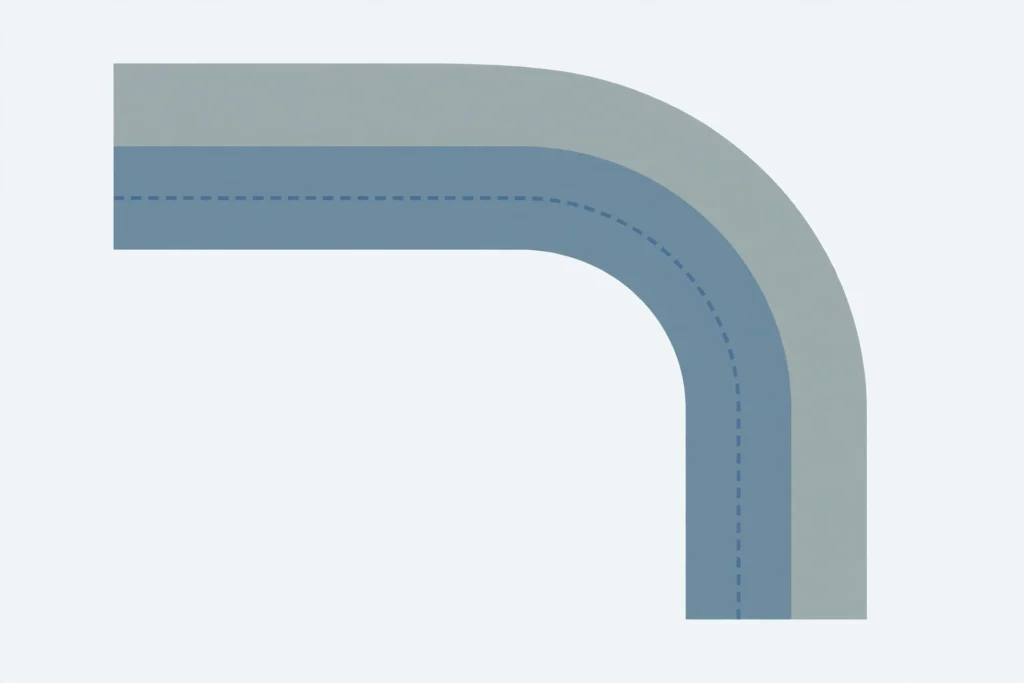
The K-factor is the position of the neutral axis expressed as a fraction of the material thickness:
K = t / T, where t is the distance from the inside surface to the neutral axis, and T is the sheet thickness.
In theory the neutral axis sits at the middle of the sheet, giving K = 0.5. In practice it shifts toward the inside of the bend, so most real values fall between about 0.3 and 0.5. Tight radii push it lower. Large radii relative to thickness push it back toward 0.5.
The K-factor depends on material, temper, thickness, inside radius, die opening and bending method. That is why values from a generic chart are only a starting point. The reliable approach is to bend a test piece on the actual tooling, measure it and calculate the K-factor back from the result. Shops keep these values in bend tables for each material and tool combination.
The bend allowance (BA) is the length of the neutral axis through the bend. Adding it to the straight flange lengths gives the flat blank size. BA = (π / 180) × A × (R + K × T), where A is the bend angle in degrees, R the inside radius, K the K-factor and T the thickness.
Muchos CAD systems and shops use bend deduction (BD) instead. It is the amount you subtract from the sum of the outside flange dimensions: BD = 2 × (R + T) × tan(A / 2) − BA.
Worked example: an L-bracket in 2 mm steel, 90° bend, 2 mm inside radius, K-factor 0.42, outside flange lengths of 50 mm and 30 mm.
| Step | Calculation | Resultado |
|---|---|---|
| Bend allowance | (π / 180) × 90 × (2 + 0.42 × 2) | 4.46 mm |
| Outside setback × 2 | 2 × (2 + 2) × tan 45° | 8.00 mm |
| Bend deduction | 8.00 − 4.46 | 3.54 mm |
| Flat length | 50 + 30 − 3.54 | 76.46 mm |
Get the K-factor wrong and every time you bend sheet metal, the part picks up a small error. On a part with four or five bends, those errors stack up and the last flange comes out short or long. This is the most common reason a first prototype does not match the model.
Springback is the small amount a bend in sheet metal opens back up after the punch is released. The outer fibers of the bend relax elastically, so a part bent to 90° under load might settle at 91° or 92°. Springback increases with:
When you bend sheet metal in production, the usual fixes are overbending by the expected springback, switching to bottoming or coining, and using CNC press brakes with angle measurement that correct the depth during the bend. On a new material or thickness, shops bend a test piece first and adjust. If your drawing calls for an exact 90° on stainless, expect that first-article check to be part of the schedule.
Most sheet metal bending problems are designed in, not caused by the machine. The rules below are general guidelines; exact values depend on material, thickness and the shop’s tooling, so check them with your fabricator.
Para piezas que requieran precisión o que deban repetirse, lo mejor es utilizar una prensa plegadora CNC con sistema de plegado neumático. Esta máquina controla el ángulo y la posición, y un solo juego de herramientas permite trabajar con múltiples ángulos. Para una sola pieza fina en casa, una plegadora manual o un tornillo de banco con bloques de madera dura y un mazo permiten conseguir un pliegue limpio y recto.
Sujeta la chapa entre dos bloques rectos de madera dura o piezas de hierro angular en un tornillo de banco, con la línea de doblado en el borde. Empuja el lado libre con la mano y, a continuación, dale unos golpecitos con un mazo contra un bloque. Este método solo funciona con chapas finas y blandas y en dobleces cortos.
Las herramientas más habituales son un tornillo de banco con bloques de madera dura, un mazo de goma, dobladoras manuales, una plegadora de banco y, en el ámbito industrial, una prensa plegadora. Las dobladoras de rodillos permiten crear curvas. La herramienta adecuada depende del grosor, el material, la longitud del pliegue y el número de piezas idénticas que se necesiten.
Las aleaciones de aluminio blandas, como la 5052 y el cobre recocido, son las más fáciles de doblar, seguidas del acero dulce. El acero inoxidable requiere más fuerza y presenta una mayor recuperación elástica. Las aleaciones más duras, como el aluminio 6061-T6, pueden agrietarse en curvas cerradas, por lo que necesitan radios interiores más amplios.
Bending work-hardens the metal at the bend, which often makes the part stiffer overall. However, a radius that is too tight can create micro-cracks on the outside of the bend, and those weaken the part. Using a radius of at least one material thickness avoids most of this risk.
En Precisión Tuowei our sheet metal bending runs on electric and hydraulic CNC press brakes, programmed directly from your CAD file.
We hold bend angles to ±1° and bend-to-edge dimensions to ±0.254 mm (±0.010 in), work to an inside radius equal to the material thickness, and bend aluminum, stainless steel, carbon steel, copper and galvanized steel.
Typical bending lead time is 5 days or more, depending on the part. Our quality system is certified to ISO 9001:2015 and ISO 13485.
Send a STEP file of the formed part along with the material and thickness. Our engineers check bend radii, flange lengths and bend sequence before quoting, and set the flat pattern from bend tables built on our own tooling. Start with our doblado de metal página de servicios.
About the author: Leon Xu is an engineer at Tuowei Precision. He reviews customer drawings, gives DFM feedback and plans Mecanizado CNC processes to hold tight tolerances.