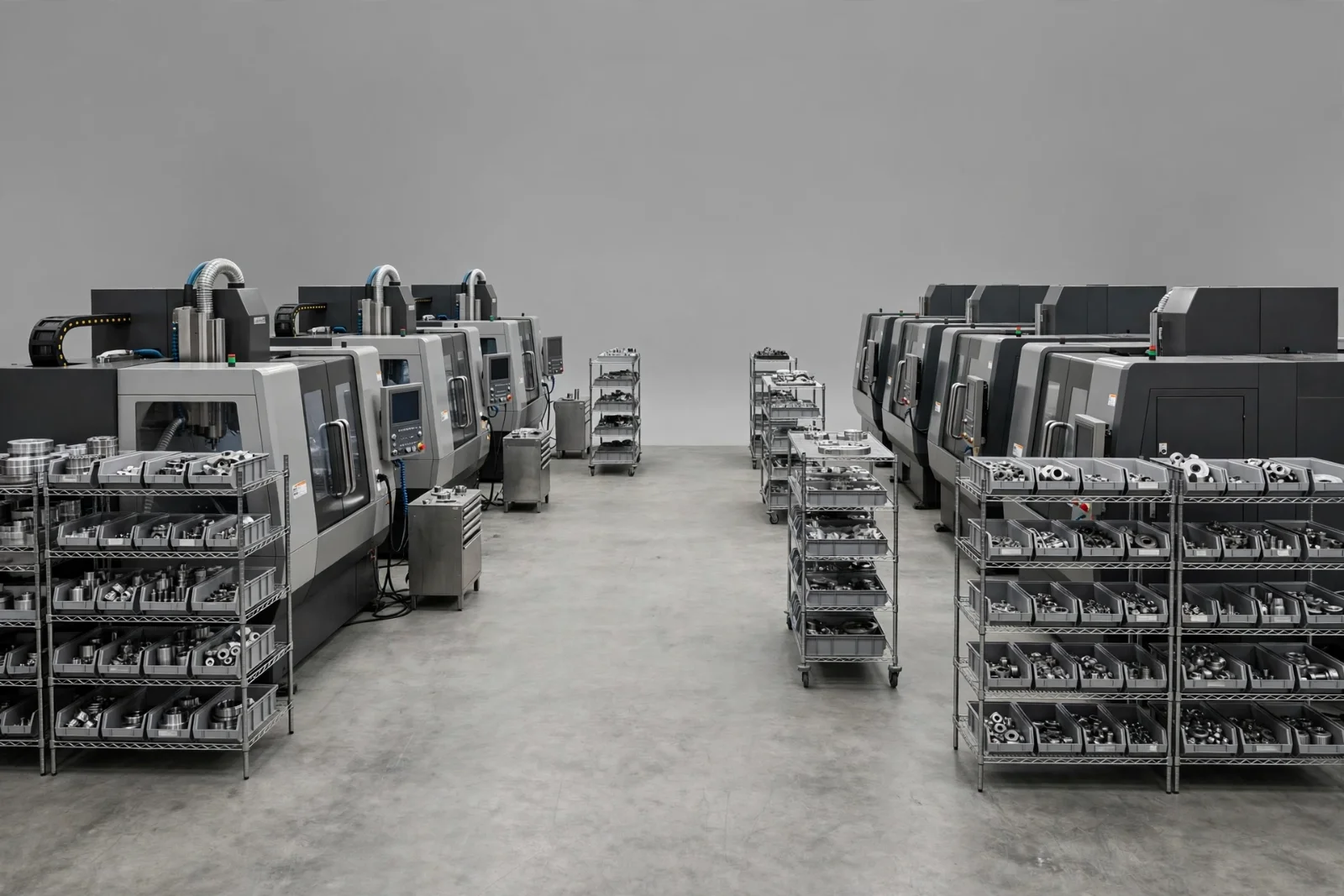
Custom manufacturing breaks the rules behind mass production supply chains. Every order can bring a different material, tolerance, or finish, so repeatable-volume networks struggle when variety is the norm. An elastic supply chain answers that problem: it stretches, reconfigures, and scales capacity up or down as orders change. This guide explains what elasticity means for custom CNC machining services and how manufacturers build networks that bend without breaking.
Elasticity is not a synonym for chaos or for keeping every option open at any cost. It is a design choice: standard processes where they help, flexible capacity where demand varies, and supplier relationships that can be activated quickly. The sections below compare elastic and traditional models, show a worked example, set out the building blocks, and close with a supplier network checklist.
An elastic supply chain is a production and logistics network that can expand or contract capacity, switch suppliers, and reroute work as order requirements change. GEP defines elastic logistics, the logistics half of the idea, as the ability to rapidly reduce or expand logistics activities and infrastructure in line with supply chain demand, using data-driven technology. The wider version applies the same logic upstream to materials, capacity, and suppliers.
The test of elasticity is response time, not the size of the supplier list. When a primary supplier reaches capacity, when a material becomes scarce, or when a design changes late, an elastic network already has qualified alternatives, visible capacity, and a way to move work. That readiness separates a network that adapts from one that improvises under pressure, and it is built deliberately, long before a disruption arrives.

Take an illustrative order: 200 custom aluminum enclosures, with machined housings, a powder-coated finish, and a four-week deadline. In week two, the primary machine shop reports it is over capacity, and the coating supplier flags a material delay. Nothing in the order was unusual, yet the plan no longer works.
An elastic network responds without a redesign. Machining moves to a second supplier qualified in advance, the coating step shifts to an alternate finisher, and a small bridge quantity is printed while the main run is rescheduled. The order still ships on time because the alternatives, the capacity picture, and the process documents were ready before the problem appeared.
Traditional supply chain thinking comes from mass production, where volumes can be forecast, processes standardized, and suppliers optimized for scale. Custom manufacturing reverses those assumptions. The next order may need an uncommon alloy, a special finish, or tooling that has not been used for months, and no forecast can list every capability the coming quarter will require.
Forcing a traditional model onto custom work usually fails in one of two directions. A bloated vendor list spreads attention so thin that no relationship is managed well, while a narrow list leaves the business exposed when a single supplier hits a limit. Both look efficient on paper. Both leave the manufacturer scrambling when real orders refuse to match the plan.
The practical question is not how many suppliers to hold, but which ones, and for what. A workable network favors capability diversity over headcount: vendors who excel at different specialties, serve different volume ranges, and cover different regions. Geographic spread helps, but a second supplier with the same limits as the first adds paperwork, not resilience.
The table below sets out the contrast in plain terms. The difference is not effort or spending: traditional networks optimize a known pattern, while elastic networks are designed for patterns that keep changing. Judged by cost per unit alone, the traditional model often looks better. Judged by orders won, deadlines kept, and disruptions absorbed, the elastic model earns its keep.
| Aspect | Traditional | Elastic |
|---|---|---|
| Capacity | Fixed for forecast volume | Scales up and down with demand |
| Supplier base | Few, deeply optimized | Diverse, with qualified alternatives |
| Visibility | Problems surface after commitment | Capacity visible before committing |
| Response to change | Renegotiation and delay | Work reroutes to alternatives |
| Inventory | Stockpiled safety stock | Flexible capacity instead of excess stock |
Neither model is right for every business. Stable, high-volume production with predictable demand may suit a traditional setup. Custom manufacturing rarely offers that stability, which is why elasticity matters more here: the cost of a missed deadline or a lost order usually outweighs the savings from a leaner, more rigid network.
Flexible and elastic are related, but they are not synonyms. A flexible supply chain adapts within its existing options, changing order quantities or schedules when demand moves. An elastic supply chain goes further: it scales capacity up or down and reconfigures the network itself, adding or releasing suppliers, capacity, and logistics as conditions change.
A multi-tier network maps not just direct suppliers, but the suppliers behind them, so a constraint two levels down is visible before it stops production. Design starts with complementarity: each supplier should add a capability, a capacity range, or a region the others lack. Overlap is deliberate where a capability is critical, and avoided where it only duplicates administration.
Tiering also clarifies who to call first. Primary suppliers handle the bulk of steady work, secondary suppliers absorb peaks and specialty jobs, and niche suppliers cover rare processes. When roles are defined in advance, moving work does not become a negotiation about price and priority in the middle of a deadline.
Visibility means knowing supplier capacity, lead times, and capability availability before committing to a delivery date, not after. Cloud systems, shared forecasts, and simple status reporting all serve the same purpose: decisions made on current facts rather than last month’s assumptions.
Visibility must extend beyond the first tier. A delay at a material mill or a coating shop can matter as much as a delay at the direct supplier, and it surfaces later if nobody tracks it.
Visibility only helps if the data behind it is current and shared. Cloud planning systems, shared forecasts, and connected shop-floor data let buyers, suppliers, and logistics partners work from the same picture of capacity and demand. DCL notes that elastic logistics is driven by big data and increased automation, with analytics predicting volumes in ever smaller time frames.
Data also changes how decisions get made. Instead of reacting to a missed delivery, planners use forecasts and risk signals to qualify an alternative source or reserve capacity before the gap appears. The tools matter less than the habit: one shared dashboard, updated daily, beats three systems that disagree about the same open order.
Modular thinking designs production for reconfiguration rather than for one fixed flow. Cells, tooling, and workstations are arranged so capacity can shift between jobs, and processes are documented well enough that work can move between suppliers without relearning the job. Additive manufacturing supports this logic: metal 3D printing builds complex, low-volume parts directly from a digital model, which suits custom orders that change often.
The goal is sustainable responsiveness, not maximum efficiency on a single job. A line tuned perfectly for one product resists every change, while a modular setup accepts slightly lower peak efficiency in exchange for faster changeovers. Turning capacity shifts the same way when the process is documented and the tooling is standard: CNC turning moves between machines and suppliers as orders change.
Additive manufacturing is the clearest example of elasticity built into a process. A research paper on the elastic supply chain in additive manufacturing lists virtual warehousing, distributed and localized manufacturing, and product customization among its core features: parts are printed near demand instead of stocked in a central warehouse. Metal 3D printing builds complex, low-volume parts directly from a digital model, which suits custom orders that change often.
The same logic covers prototypes and bridge quantities. When a design is still changing, rapid prototyping services produce test parts quickly across 3D printing, CNC machining, and sheet metal work, so decisions are made on real parts rather than assumptions. Once the design settles, the same digital model feeds production without retooling the whole program.
Capacity is people as well as machines. Custom manufacturers handle variable workloads with a mix of full-time staff, part-time specialists, and contract experts matched to each project, rather than hiring for the peak and carrying the cost through quiet months. The skill mix matters more than headcount: a machinist, a coatings specialist, and a quality inspector are not interchangeable.
Elastic logistics applies the same flexibility to warehousing, transport, and fulfillment. GEP describes it as the ability to rapidly expand or reduce logistics activities and infrastructure in line with demand, using data-driven technology. In practice that means microfulfillment points near demand, automation that scales with volume, and cloud platforms that turn real-time data into routing and inventory decisions.
The benefits GEP lists are practical rather than abstract: lower costs and faster deliveries, real-time tracking for customers, reduced pricing volatility as facilities flex with demand, and fewer deadstock or out-of-stock situations. For custom manufacturers, the logistics layer matters because finished custom parts still have to reach customers on time. Third-party logistics adds another lever: leased warehouse space and external fleets cover short-term peaks without permanent investment, as DCL describes.
The payoff shows up first in time. Manufacturers with elastic networks respond to quotes, order changes, and design revisions faster, because no single bottleneck decides the schedule. Just-in-time sourcing and digital forecasting also cut the stock held against uncertainty, so less cash sits in raw material and finished goods that may never be needed.
Continuity is the second payoff. When a supplier fails or a route closes, an elastic network keeps shipping while competitors explain delays, which protects both deadlines and customer trust. The same logic applies to tooling: a mold is a fixed cost, so understanding the injection mold cost breakdown before committing helps teams judge where flexibility is worth paying for and where it is not.
Use the checklist below when reviewing an existing network or qualifying a new supplier. Each row is a question to answer with evidence, not assumption: a supplier that cannot show capacity, quality data, or a backup plan has not been qualified, only listed.
| Checklist question | What good looks like |
|---|---|
| Capability fit | Covers a capability or volume range others lack |
| Capacity visibility | Current capacity and lead time confirmed before quoting |
| Quality system | Inspection standards agreed in writing |
| Second-tier risk | Critical material and process dependencies mapped |
| Activation test | A small real order has proven the relationship |
| Communication | A named contact and an agreed escalation route |
| Digital visibility | Capacity and order status visible on one shared dashboard |
| Exit route | Work can move without stranded tooling or data |
Review the checklist at least once a year and after any disruption. Supplier capabilities drift, ownership changes, and capacity that existed last year may not exist now.
Elasticity can be checked with four signals. First, reroute time: how fast can a real order move to a qualified alternative without renegotiation. Second, coverage: how much of critical spend has at least one qualified alternative. Third, visibility: is capacity confirmed before quoting, or discovered after committing. Fourth, proof: has an alternative supplier completed a real trial order.
No single number proves elasticity, and no published benchmark fits every business, so treat these as a self-check rather than a score. If all four answers are documented and recent, the network is elastic in practice. If any answer is a guess, that gap is the next improvement, not a reason to redesign everything at once.
EY defines elasticity in supply chain software as the optimal balance of standardization and customization. Standardized processes keep costs and integration manageable, while targeted customization serves genuine business needs. Firms that build elasticity into their software configuration can respond to changing needs in a resilient and flexible manner, because responsiveness is designed in, not added during a crisis.
Integration is where the gains appear. EY notes that linking warehouse and transportation management lets the two functions exchange load plans and flag inventory shortages. EY reports that firms with elasticity-enabled software can realize transport cost savings, citing its experience of 6 to 15 percent annually.
Building an elastic network takes upfront investment, new supplier relationships, and process changes that touch quoting, quality, and scheduling. Integration work, training, and cybersecurity all need attention, and managing a more diverse supplier base demands different skills than traditional procurement. None of this is a reason to stay rigid, but underestimating it is how elastic projects stall halfway.
Quality management gets harder as supplier diversity grows. Maintaining standards across variable production setups requires documented criteria, agreed inspection methods, and clear communication before work starts. The alternative, staying rigid in an increasingly variable market, carries its own risk, but flexibility without quality control trades one failure for another. Cloud systems that hold customer and order data need protection against breaches, and access rules matter as much as the software itself.
Several trends make elastic networks both more necessary and more achievable. Artificial intelligence improves demand forecasting and disruption warnings, additive manufacturing enables localized on-demand production, and digital platforms make finding and qualifying new suppliers faster than before. Each trend rewards networks that can absorb new tools without rebuilding from scratch. Sustainability and reshoring push the same way, favoring shorter routes and better material tracking.
Reshoring and nearshoring add momentum. As manufacturers bring production closer to end customers, shorter routes and local supplier networks reduce dependence on distant suppliers with long lead times and limited visibility. Collaborative platforms that connect manufacturers with vetted suppliers and logistics providers make that shift faster, by turning supplier search into a managed service rather than a cold search.
Custom manufacturing companies that keep traditional supply chain models are competing with outdated tools. The market rewards responsiveness and adaptability, not efficiency alone, and every rigid network eventually meets an order it cannot handle.
The question is not whether to adapt, but whether to do it deliberately or under pressure. Start with one qualified alternative for each critical capability, one visibility habit, and one checklist review, then expand from evidence. For teams comparing production routes, the range of custom manufacturing services available shapes which elastic options are realistic, so network design and production capability should be planned together.
Traditional supply chains optimize fixed capacity and a stable supplier base for predictable, repeatable volume. Elastic supply chains scale capacity up or down, keep qualified alternative suppliers ready, and reroute work as orders change. The elastic model trades peak efficiency for responsiveness when requirements keep shifting.
A custom parts buyer orders 200 aluminum enclosures, then the primary machine shop hits capacity. In an elastic network, machining moves to a second supplier qualified in advance, coating shifts to an alternate finisher, and a small bridge quantity is printed while the main run is rescheduled. The order ships on time because the alternatives were ready.
A flexible supply chain adapts within its existing options, changing quantities or schedules when demand moves. An elastic supply chain also scales capacity up or down and reconfigures the network itself, adding or releasing suppliers, capacity, and logistics. Flexibility adjusts the plan; elasticity changes the network behind it.
Yes. Because capacity, suppliers, and logistics flex together, an elastic network absorbs demand swings without a full redesign. When orders surge, qualified alternatives and visible capacity take the extra work. When orders fall, the network contracts instead of carrying idle stock and warehouse space it no longer needs.
Elastic logistics is the logistics layer of an elastic supply chain. It covers warehousing, transport, and fulfillment that expand or shrink with demand, using data-driven technology. GEP lists benefits such as lower costs, faster deliveries, real-time tracking, and fewer stockouts, helping custom orders reach customers on time.
Manufacturing as a Service is a model where customers connect with manufacturing networks on demand through digital platforms, rather than owning every machine and process. It fits custom work because capacity can be booked for a specific job, then released. Quality, communication, and clear specifications decide whether the result meets the requirement.
They can, but the saving comes from avoided disruption rather than cheaper unit prices. Better supplier use, shorter lead times, and less idle capacity all reduce waste. EY reports transport cost savings from elasticity-enabled software based on its own experience. The honest test is total cost across delays and lost orders, not one quote alone.
Check four signals: reroute time, or how fast a real order can move to a qualified alternative; coverage, or how much critical spend has an alternative; visibility, or whether capacity is confirmed before quoting; and proof, or whether an alternative supplier has completed a real trial order. Documented answers mean the network is elastic in practice.
Start small and gather evidence. Qualify one alternative supplier for each critical capability, agree quality criteria in writing, and place a real trial order. Add one visibility habit, such as weekly capacity checks, and review the network after every disruption. Expand what proves itself, and drop what does not.
Process and logistics claims in this guide follow the sources below.
Reviewed by Leon Xu, Engineer, Tuowei Precision. Last updated: November 2026. This guide gives general elastic supply chain guidance; no Tuowei price, lead time, or service specification is claimed.