
Tuowei Precision is a heat sink manufacturer in Shenzhen making custom aluminum heat sinks for laptops, LED lighting, power supplies, chargers, routers and wearables. We combine aluminum extrusion, CNC machining and die casting in one factory, so your heat sink design moves from first prototype to mass production without changing supplier.
Every electronic component turns part of its power into heat. A CPU, GPU, LED driver or power transistor that is allowed to overheat slows down, ages faster or fails. A heat sink is a passive heat exchanger: heat transfer moves the heat generated by the chip into a flat base and across the fins, where air carries it away by convection. Good heat dissipation is the core of thermal management in any device.
Off-the-shelf heatsinks fit standard packages, but consumer devices are rarely standard. Housings are thin, boards are crowded, and the heat sink often doubles as a structural part or even the outer case. A custom heatsink fits the exact space, mounting points and airflow of your device, so you avoid paying for metal that does no thermal work.
We are a manufacturing company, not a thermal design consultancy. You bring the heat load and space envelope, or a finished design; we tell you which heat sink manufacturing process will hit your cost target and what fin geometry that process can really produce.
The heat sink manufacturing process decides fin thickness, fin density, cost per part and tooling cost. Here is how the main methods compare.
| Method | Best for | Fin limits | Tooling cost |
|---|---|---|---|
| Extrusion | Long profiles, LED bars, amplifiers, power supplies | Fins must follow one straight cross-section | Low (extrusion die) |
| CNC machining | Prototypes, low volume, complex 3D shapes | Very flexible; cost rises with fin count | None |
| Die casting | High volume, fins plus bosses and walls in one part | Thin fins possible, needs draft | High (casting die) |
| Extrusion + machining | Most aluminum heat sinks | Extruded fins, machined holes, pockets and cross-cuts | Low |
| Skived or bonded fin | Very dense fins for high-performance cooling | Thin, tall fins | Varies |
Skiving slices thin fins from a solid block, and bonded designs glue or braze fins into a base. Both suit servers and power conversion equipment, and liquid cooling with cold plates goes further still. For most consumer devices, extrusion, machining or die casting give the better balance of cost and performance, and those are the processes we run in-house.
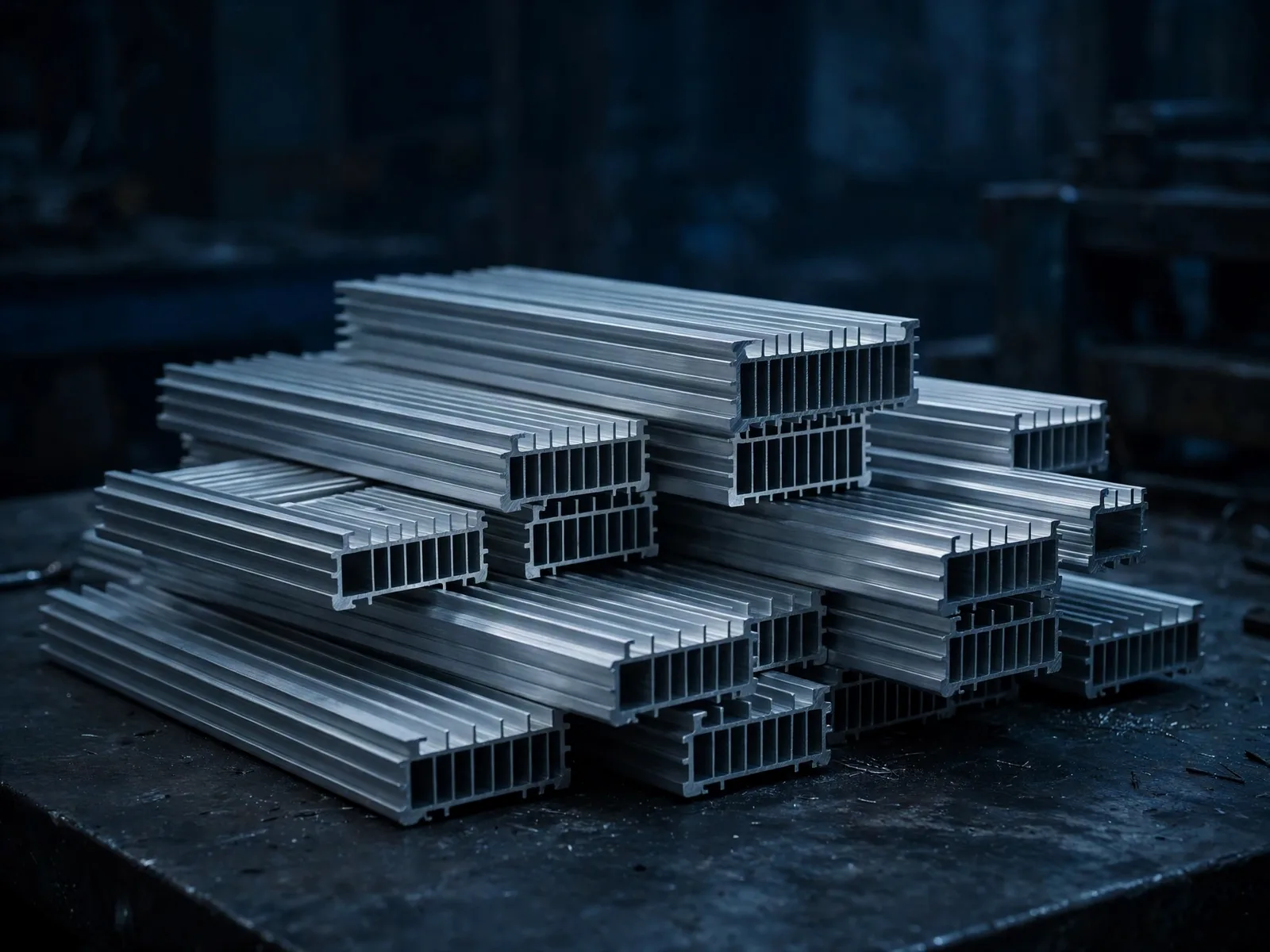
An extruded heat sink is made by pushing heated aluminum through a steel die shaped like the fin profile. Because the extrusion tool is cheap compared with a casting die, an aluminum extruded heat sink is the most economical option for straight-fin designs in LED lights, audio amplifiers, motor drivers and power banks.
Our aluminum extrusion service runs 70 press lines from 600 to 3,800 tons in ISO 9001:2015 certified factories. Most heat sink extrusions use 6063, which conducts heat well and anodizes to an even finish. Profiles are then cut to length and machined for mounting holes, threads, component pockets and cross-cut pin fins.
The trade-off: extruded fins can only run in one direction, and very tall, thin fins are limited by the fin height-to-gap ratio the die can hold. If your design needs omnidirectional pin fins or fins that change direction, machining or die casting is the better route.
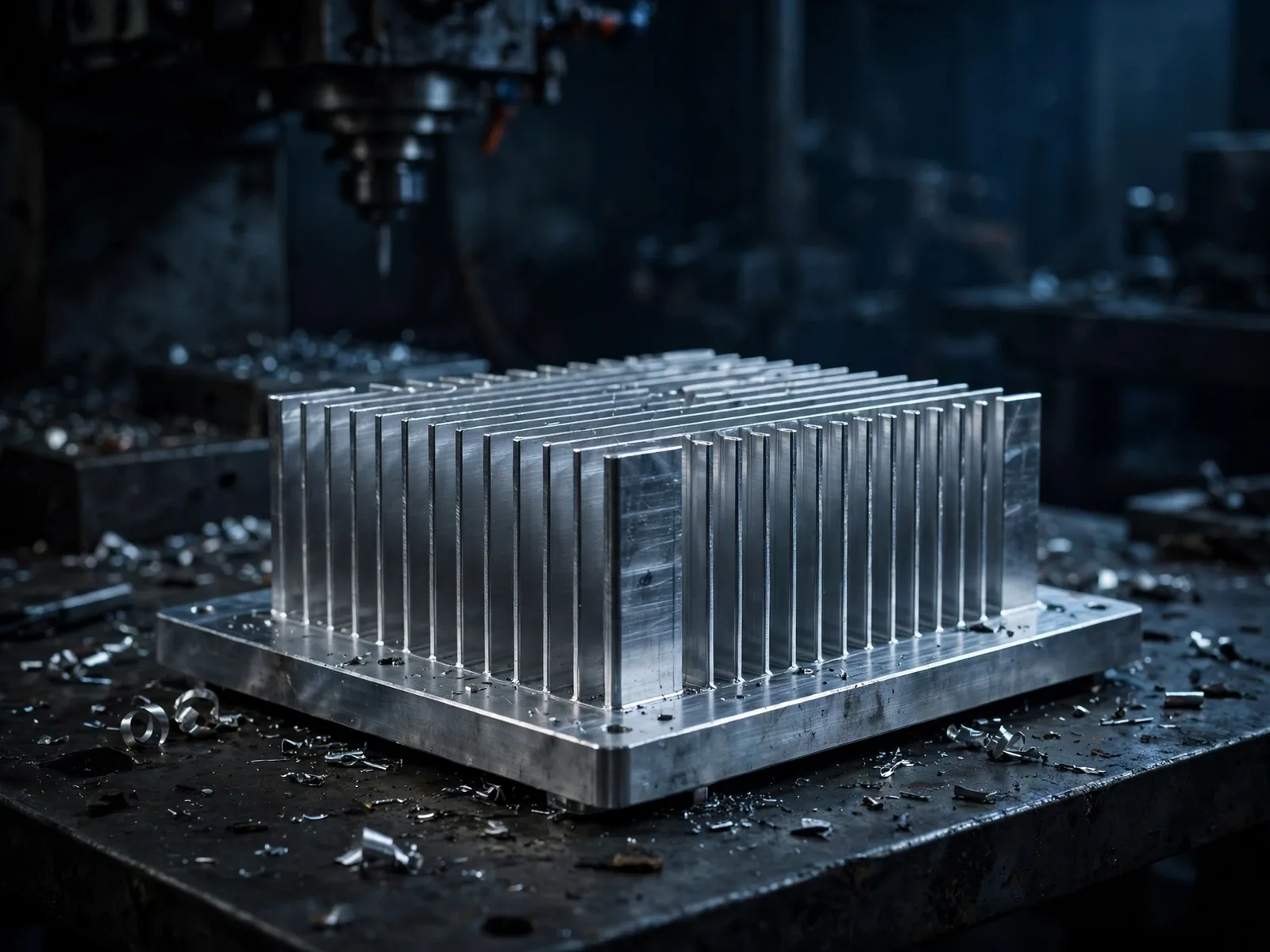
Machining cuts a heat sink from solid aluminium or copper plate. There is no tooling, so it is the fastest rapid prototyping route into a thermal test, and the only way to make some complex 3D shapes, such as curved fins that follow a laptop's housing or a base with pockets for several components at different heights.
CNC machining services also give the flattest contact faces. A flat, smooth base with tight tolerances reduces thermal resistance at the joint between the chip and the heat sink, which matters more than most buyers expect: a poor contact face can waste the benefit of extra fins. We hold tolerance down to ±0.005 mm on small machined parts. Machined fins cost more as their number rises, so for volumes above a few hundred we usually move the design to extrusion or die casting.
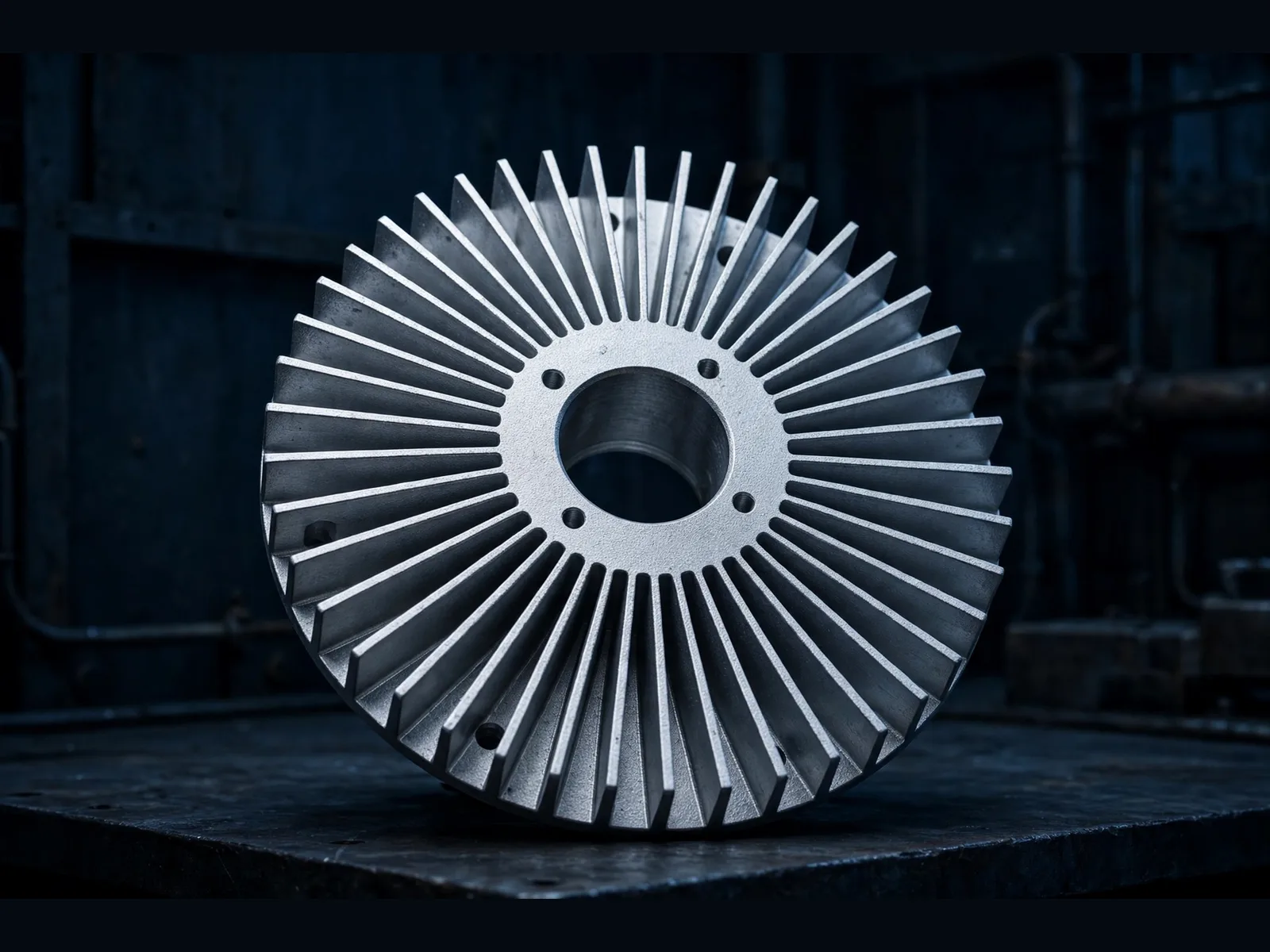
Die casting forms fins, mounting bosses, walls and screw holes in a single shot. That makes it ideal for high volume consumer products where the heat sink is also the housing, such as LED downlights, routers, projectors and outdoor speakers. We cast A380 and ADC12 aluminum and then machine the contact faces flat.
Die cast aluminum conducts heat less well than extruded 6063, so the design needs slightly more fin area for the same thermal performance. The casting die is a large upfront cost that pays back over thousands of parts. Our die casting services page explains alloys and tolerances.
Thermal conductivity tells you how easily heat moves through a material. The alloy you choose changes weight, cost and finish options as much as cooling.
| Material | Typical thermal conductivity | Best use |
|---|---|---|
| Aluminum 6063 | About 200 W/m·K | Extruded heat sinks, anodized consumer parts |
| Aluminum 6061 | About 167 W/m·K | Machined heat sinks that also carry load |
| Die cast aluminum (ADC12, A380) | About 96 W/m·K | Housings with integrated fins at volume |
| Copper | About 390 W/m·K | Small, hot spots such as CPU bases |
Copper moves heat almost twice as well as aluminum, but it is three times heavier and costs more to machine. For phones, laptops and wearables, aluminum heat sinks win on weight. Copper earns its place only in small, concentrated hot spots, sometimes fed by heat pipes. Browse all options on our materials page.
Our engineering support team raises these points most often in DFM reviews:
A thermal simulation is useful, but the first machined prototype in your real housing tells you more. Build it early and test it with the device running.
Black anodizing is the classic heat sink finish. It gives corrosion resistance, insulates the surface electrically, and slightly improves radiation in still air. Clear anodizing keeps a natural metal look for visible parts. A powder coat suits large die cast heat sinks, while chromate conversion coating keeps the surface conductive for grounding. See our surface finishes page.
Small devices need cooling systems that fit tight spaces and look good when visible. We also supply mechanical components for medical equipment and industrial temperature control.
Many of these heat sinks sit inside a housing we also make. Our electronic enclosure manufacturing service builds the enclosure around the thermal part, so fit is checked once. For the full range of parts and processes, see our consumer electronics prototyping and manufacturing page.