Need expert machining solutions? Our team at Tuowei Proto is here to assist with all your manufacturing needs. Get in touch today for a quote on your ongoing or upcoming projects!
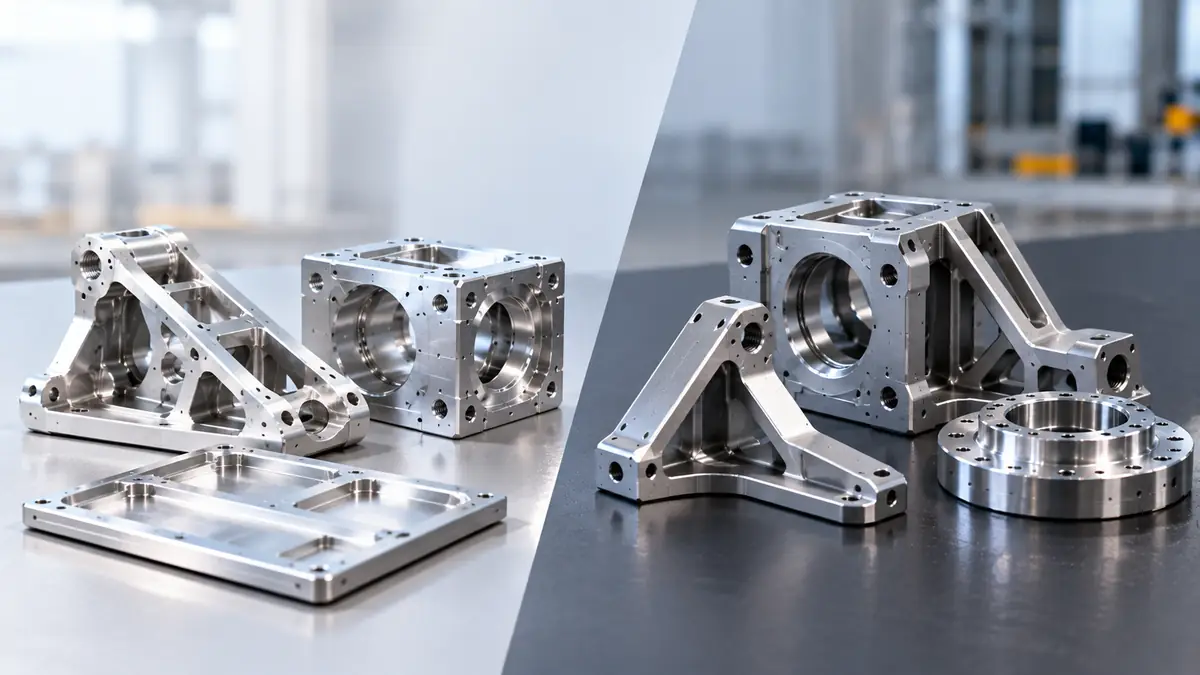
2024 vs 7075 aluminum is a choice between two kinds of strength. 7075-T6 wins on tensile and yield strength, so it suits parts that must carry high static or compressive loads. 2024-T3 gives up some of that strength but grows fatigue cracks far more slowly, which is why it is favored for tension-loaded skins and parts where a crack must be found before it becomes dangerous.
Short answer: Choose 7075-T6 or T651 when the part is sized by static strength or compression and weight matters most. Choose 2024-T3 or T351 when the part sees repeated tension loads and damage tolerance matters. In NASA tests, cracks in 2024-T3 took two to four times as many cycles to grow to the same length.
Below, the numbers come from NACA and NASA test reports rather than supplier tables, which is also why they settle an argument that most comparison pages get wrong.
Both are high-strength aerospace aluminum alloys, but they are built on different chemistry. 2024 is a 2xxx series alloy with copper as its main alloying element, plus magnesium. 7075 is a 7xxx series alloy with zinc as its main element, plus magnesium and copper.
Their usual tempers differ too:
2024 sheet is often supplied as Alclad, with a thin layer of pure aluminum rolled onto each face for corrosion protection. Machined parts cut from bare 2024 plate or bar do not have that layer, which matters later when you choose a finish.
The static values below are for the sheet tested in NACA TN 2389, measured with the grain direction. The crack growth comparison comes from NASA TN D-5390.
| Property | 2024-T3 | 7075-T6 |
| Ultimate tensile strength (NACA test sheet) | 73,000 psi (503 MPa) | 82,500 psi (569 MPa) |
| Yield strength (NACA test sheet) | 54,000 psi (372 MPa) | 76,000 psi (524 MPa) |
| Elongation (NACA test sheet) | 18.2% | 11.4% |
| Crack growth rate (NASA TN D-5390) | 2 to 4 times as many cycles to reach the same crack length | Faster crack growth under the same loading |
| Stress corrosion cracking | Susceptible in some tempers and directions | Susceptible in T6; resistant in T73 |
| General corrosion resistance | Poor when bare; often clad or coated | Better than 2024, but usually still finished |
| Fusion welding | Generally avoided | Not recommended |
| Typical aircraft use | Fuselage skins, lower wing skins, tension-loaded fittings | Upper wing structure, stringers, highly loaded fittings |
Read the 2024-T3 vs 7075-T6 table as a trade. 7075-T6 has about 13% more tensile strength and about 40% more yield strength than the 2024-T3 sheet in the same test program. 2024-T3 stretches further before breaking and resists crack growth much better.
Most 7075 vs 2024 comparison pages blur three separate properties, and that is why they contradict each other on which alloy is “better in fatigue.”
Tensile and yield strength tell you the load a part can carry once. They come from pulling a specimen until it yields and breaks.
Fatigue strength is the stress a smooth or notched specimen survives for a set number of cycles, often 10 million, before a crack starts and grows through it. It is plotted on an S-N (stress versus number of cycles) curve.
Fatigue crack growth measures how fast an existing crack gets longer under repeated loading. Closely related is fracture toughness, which describes how long a crack can get before the part breaks.
An alloy can lead on the first two and still trail on the third. That is exactly the 2024-T3 vs 7075-T6 story.
Whether 2024 or 7075 resists fatigue better depends on which question you ask.
For crack initiation on smooth, carefully finished specimens, 7075-T6 generally reaches higher fatigue stresses, in line with its higher static strength. Once you add a notch, the picture narrows. In the NACA axial-load program on notched sheet, the long-life fatigue strengths of the two alloys ended up much closer together than their static yield strengths. Real parts have holes, fillets and fastener sites, so the notched result is the one that matters.
For crack growth, 2024-T3 is clearly better. NASA TN D-5390 tested 0.090 in. thick, 12 in. wide sheet at stress ratios from −1.0 to 0.8. Under identical loading, 2024-T3 needed two to four times as many cycles as 7075-T6 for a crack to reach a given length.
Our view: for any part where a fatigue crack is expected to be found by inspection before it becomes critical, fatigue crack growth should outweigh S-N fatigue strength in the alloy decision. More cycles between “detectable” and “critical” means more inspections that can catch the crack, and that is the whole basis of damage-tolerant design.
Aircraft structure puts 2024 and 7075 where each one’s type of strength fits the load.
Fuselage skins and lower wing skins spend most of their lives in tension, cycling with every pressurization and every gust. Slow crack growth and residual strength matter most there, so 2024-T3 has been the classic choice. Upper wing skins and stringers are mostly in compression when the wing lifts, where static and compressive strength drive the sizing, so 7xxx alloys such as 7075 take over.
Regulation reinforces this. For transport category airplanes, 14 CFR 25.571 requires a damage-tolerance and fatigue evaluation of the structure, and the FAA explains how to comply in Advisory Circular 25.571-1D, issued in January 2011. Material choice is only one part of meeting that rule, and the applicable requirements for a specific program should be confirmed with the certifying engineer.
For machined aerospace components such as fittings, brackets, ribs and clips, the same logic applies. A fitting loaded mostly in tension through a fastener hole is a 2024-T351 candidate. A compact, highly loaded fitting sized by static strength is a 7075-T651 or T7351 candidate.
Neither of these aircraft aluminum grades should be left bare in service.
2024 has poor general corrosion resistance because of its copper content, which is why sheet is so often clad. A machined 2024 part has no cladding, so it relies on anodizing, chromate conversion coating or primer. For Type III hardcoat, MIL-PRF-8625 applies a looser wear limit to alloys with 2% or more copper, and 2024 falls in that group.
7075-T6 resists general corrosion better than 2024 but is susceptible to stress corrosion cracking, especially when sustained tension acts across the short-transverse grain direction of thick plate. The NASA 7075 handbook identifies T73 as the stress-corrosion-resistant temper. For thick machined fittings under sustained load, 7075-T7351 or 7050-T7451 is often the safer call, and both carry a strength penalty compared with T651.
One more trade-off: anodic coatings reduce fatigue strength, and thicker coatings reduce it more. On fatigue-critical parts, choose the finish with the fatigue analysis in mind, not after it.
Between 2024 and 7075, weight is close to a tie. The NASA 7075 handbook lists a density of 2.80 g/cm³ for 7075, and 2024 is very close to it. Any weight saving comes from strength: a 7075 part sized by static load can be made thinner, while a 2024 part sized by crack growth usually cannot.
7075-T6 is the harder of the two, which helps it hold fine features and resist dents in handling. 2024-T3 is softer and tougher, which is part of why it tolerates damage better.
Both are premium aerospace aluminum alloys, priced well above 6061 and often sold with full traceability and mill certificates for flight hardware. Availability can matter as much as price. Some tempers and thick plate sizes are stocked less widely than 7075-T651, so check availability before you lock the alloy into a drawing. For most aircraft aluminum parts, the finished-part price is driven more by machining time and inspection than by the alloy premium.
In practice, no, not by conventional fusion welding. The NASA 7075 handbook states that fusion welding is not recommended for 7075, and 2024 is also generally avoided for fusion-welded structure because welds crack and lose strength. Aircraft structure in these alloys is joined with rivets, bolts and other fasteners. Friction stir welding can join both, but it needs qualification for each application.
That rules out both 2024 and 7075 for welded frames and brackets, where 6061 is the usual choice.
2024 and 7075 both machine well in their standard tempers, and the NASA handbook describes 7075 as having good machinability in conventional operations. For aerospace parts, though, the machining details that matter most are the ones that affect fatigue life:
Our CNC milling services plan finishing passes, edge breaks and fixture releases around these risks, and every part can be checked on a CMM before it ships.
A common RFQ (request for quote) mistake is a fatigue-critical drawing with no surface finish callout on the loaded radii. The machinist then treats it as a general surface, and the part’s fatigue life depends on whichever tool happened to cut it.
Choosing between 2024 and 7075 starts with the load that sizes the part, then the environment.
| If the part is | Lean toward | Reason |
| Sized by static tension or compression, weight critical | 7075-T651 | Higher yield strength per pound |
| Cyclic tension, inspected for cracks in service | 2024-T351 | Slower crack growth |
| Thick fitting under sustained tension in a corrosive environment | 7075-T7351 or 7050-T7451 | Stress corrosion resistance |
| Thin, tension-loaded skin or doubler | 2024-T3 (often clad) | Damage tolerance and toughness |
| Welded assembly | Neither; consider 6061 | Fusion welding not recommended |
Our position: when a part is both fatigue-loaded and inspected in service, start with 2024 and move to 7075 only if a static strength margin forces it. When a part is sized by static load with no inspection-based damage-tolerance requirement, 7075 usually gives the lighter design.
Tuowei machines 2024-T3, 7075-T6 and T651, and 7050-T7451, so the alloy can follow the load case rather than what happens to be on the shelf. Our CNC machining services can quote the same part in two alloys at the same quantity.
The 2024 vs 7075 aluminum decision is really a question about how the part is expected to fail. If it would fail by overload, 7075’s higher yield strength buys margin. If it would fail by a fatigue crack growing from a hole or fillet, 2024’s slower fatigue crack growth buys time, and time is what inspections depend on.
Send your drawing, load case and material callout to Tuowei Precision, and our engineers will confirm temper, finish and machining details before any metal is cut. You can also check the 7075-T651 properties we work with first.
Q: Is 7075 stronger than 2024?
A: Yes, in static strength. In the NACA test sheet, 7075-T6 reached 82,500 psi tensile and 76,000 psi yield, against 73,000 psi and 54,000 psi for 2024-T3. That is about 13% more tensile strength and 40% more yield strength, but 2024-T3 stretched further before breaking.
Q: Which has better fatigue resistance, 2024 or 7075?
A: It depends on the measure. 7075-T6 usually reaches higher smooth-specimen fatigue stresses, but notched results are much closer. For crack growth, 2024-T3 is clearly better: NASA found it took two to four times as many cycles for a crack to reach the same length.
Q: Why is 2024-T3 used for aircraft skins?
A: Fuselage and lower wing skins are loaded in tension on every flight cycle, so slow crack growth and damage tolerance matter more than peak strength. 2024-T3 grows cracks more slowly than 7075-T6, and clad sheet adds corrosion protection, which suits skins that are inspected throughout service.
Q: Can 2024 or 7075 be welded?
A: Not by conventional fusion welding. The NASA handbook does not recommend fusion welding 7075, and 2024 welds also tend to crack and lose strength. Both are normally joined with rivets or bolts. Friction stir welding can work but needs qualification, and 6061 is the usual choice for welded parts.
Q: Does 2024 aluminum corrode?
A: Yes, more readily than most aluminum alloys, because of its copper content. That is why 2024 sheet is often supplied clad with pure aluminum. Machined 2024 parts have no cladding, so they need anodizing, chromate conversion coating or primer before going into service.

Written by Andy, Manufacturing Engineer at TUOWEI Precision. Andy specializes in CNC machining, precision manufacturing, and production engineering, with hands-on experience supporting projects from rapid prototyping through full-scale production. He works closely with engineering and manufacturing teams to evaluate materials, tolerances, machining processes, and design manufacturability. His articles provide practical, technically informed insights to help engineers and buyers make better manufacturing decisions, optimize production efficiency, and achieve consistent part quality. Explore TUOWEI Precision’s CNC machining and custom manufacturing solutions for your next project.
From rapid prototypes to scalable production, Tuowei Precision delivers reliable CNC machining with accuracy and consistency at every step. Start your project today.
Keep updated on the real CNC machining, industry trends, and production insights in Tuowei Precision, but is installed to enable you to make better production decisions.