
Tuowei Precision is a molding company that provides medical device injection molding for housings, connectors, handles, seals and disposable medical device components. With in-house mold making, free mold flow analysis and a certified quality system, we take injection molded components from prototype molds to high-volume production for the healthcare industry. Custom molded parts are available in as few as 5 business days.
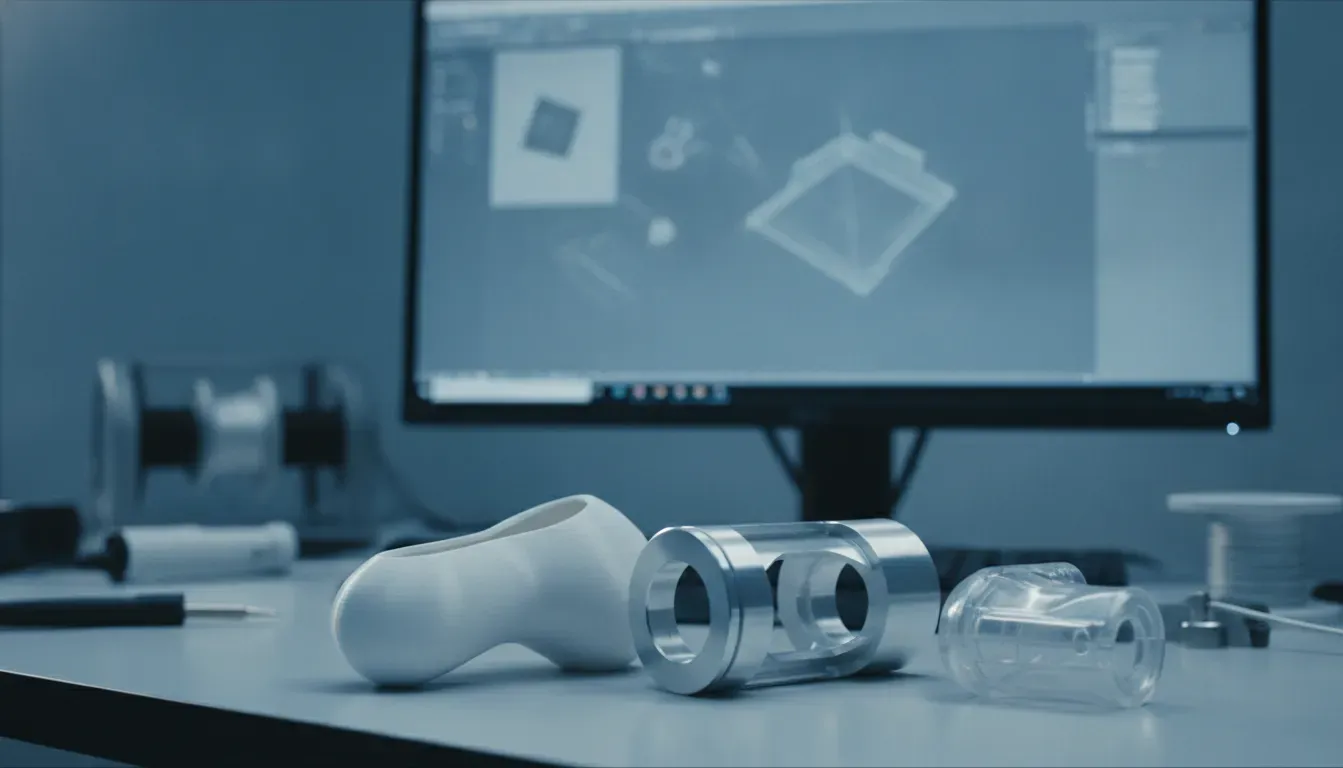
The injection molding process pushes melted plastic into a precision mold, where it cools into a finished part. Once the mold is made, every shot produces an identical component, which is exactly what the medical industry needs: thousands of parts with the same dimensions, the same material and the same documentation.
Most plastic parts used in medical devices are injection molded, from the housing of a patient monitor to the luer connector on an infusion set. Medical plastic molding gives low cost per part at volume, complex shapes with snap fits and living hinges, and fine detail that machining cannot match economically. That is why injection molding is used in medical equipment, surgical tools and lab products across the medical field.
The standard process for housings, connectors, clips and structural parts. Standard tolerances are ±0.127 mm, with tight tolerances down to about ±0.025 mm on selected features. See our plastic injection molding service.
Overmolding adds a soft-touch TPE grip over a rigid handle, much like two-shot molding; insert molding embeds metal pins, threads or electrical contacts in plastic. Both remove assembly steps and make parts more reliable. See overmolding.
Liquid silicone injection molding produces flexible seals, gaskets, membranes and grips with thermal stability and elasticity. Biocompatibility depends on the silicone grade and its certifications, which we confirm against your device requirements.
Micro molding makes very small, precise parts for minimally invasive devices, drug delivery components and miniaturized sensors.
The right resin depends on strength, clarity, chemical resistance, sterilization method and whether the part touches the patient.
| Material | Typical medical use | Key property |
|---|---|---|
| Polycarbonate (PC) | Housings, connectors, clear components | Tough and transparent |
| ABS | Equipment housings, handles | Easy to mold, good finish |
| POM (Acetal) | Gears, clips, moving parts | Low friction, stable dimensions |
| Nylon (PA6, PA66) | Structural parts, clips | Strong and tough |
| PP | Disposables, containers | Chemical resistant, low cost |
| PEEK | High-temperature, implant-adjacent parts | Withstands repeated sterilization |
| LSR (silicone molding) | Seals, membranes, soft grips | Flexible and heat stable |
For parts that contact patients, use resin grades with data from the material supplier, and confirm them against industry standards for your device. Medical-grade plastics cost more than commodity grades, but they come with the documentation your design history needs.
Most molding problems start in the mold. Our engineers make the mold tooling in-house and run a free mold flow analysis on every tool to predict filling, sink marks, warpage and weld lines before steel is cut. Design rules we check include even wall thickness, draft, gate location and rib proportions.
For medical parts, process validation proves the mold makes good parts every time and supports regulatory compliance with Food and Drug Administration (FDA) expectations. A typical sequence is installation qualification, operational qualification and performance qualification (IQ, OQ, PQ). We agree the required level of validation and inspection with you before production starts.
Not every medical part needs a cleanroom. Implant components, parts in the sterile fluid path and many drug delivery parts are usually molded in a certified cleanroom (often ISO Class 7 or 8). Equipment housings, handles, brackets and external covers are normally molded in a controlled standard environment and cleaned before packaging.
Tell us your device classification and cleanliness requirements when you request a quote. We will be clear about which parts fit our molding environment, so you do not discover a mismatch during supplier qualification.
The trade-off is the mold, and it is where traditional injection molding differs from machining. Tooling costs money and takes time, and changes after the mold is built are expensive. For fewer than a few hundred parts, or while the design is still changing, machining or vacuum casting is usually smarter. Our medical device prototyping page explains how to test the design before tooling and bring devices to market faster. Medical device companies often use injection molding only after the design is frozen.
Molded components can be combined with machined components and assembly in one order through our medical device contract manufacturing service. For the full range of medical capabilities, see our medical device manufacturing page.