Vous avez besoin de solutions d'usinage spécialisées ? L'équipe de Tuowei Precision est là pour répondre à tous vos besoins en matière de fabrication. Contactez-nous dès aujourd'hui pour obtenir un devis concernant vos projets en cours ou à venir !
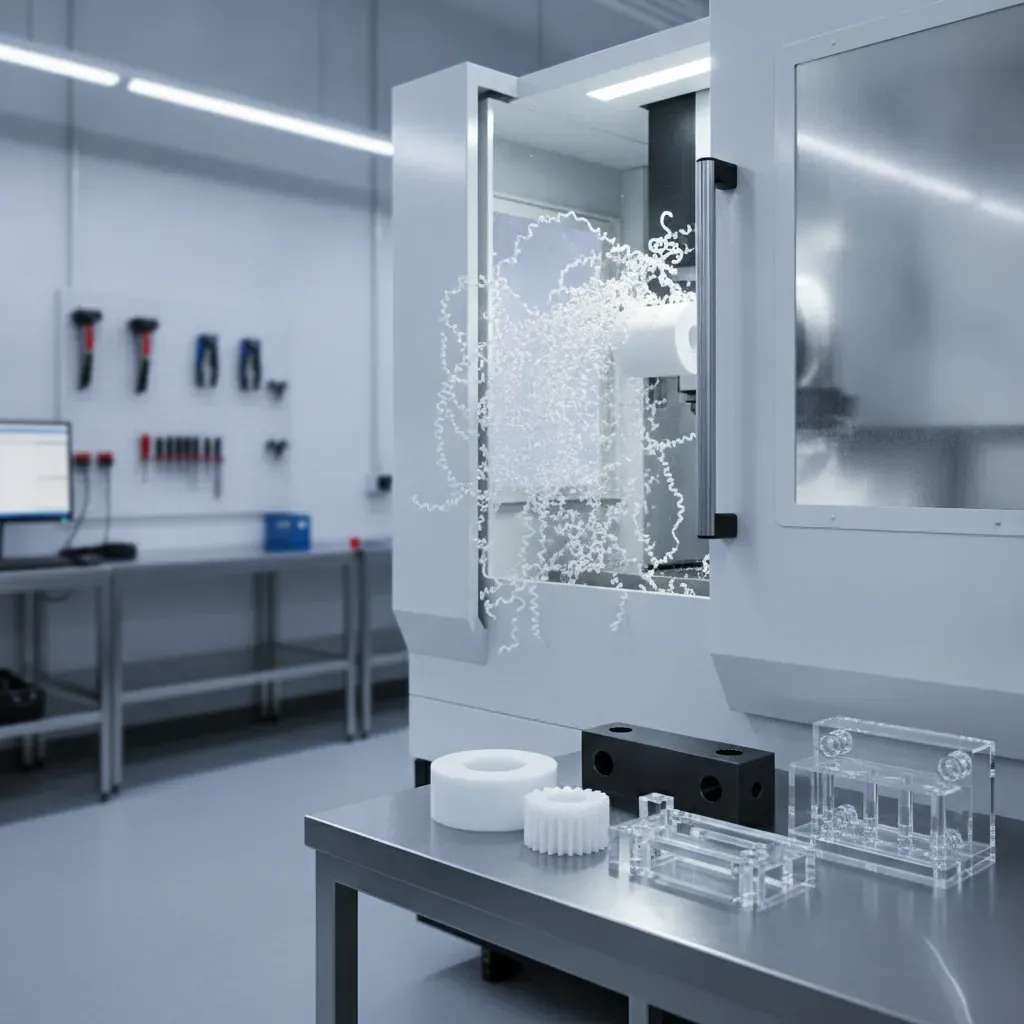
Plastic machining services produce precision polymer parts by CNC milling, turning and drilling — no mold required. For prototypes, low-to-mid volumes, and high-performance materials like PEEK that are costly to mold, machining is usually the fastest and most economical route. But plastics behave nothing like metals on a machine: they expand with heat, spring away from the tool, and warp when internal stresses are released. This page covers the materials we machine, the tolerances that are realistic for each, how deformation is controlled, and when machining beats molding.
| Parameter | Capacité |
|---|---|
| Processus | 3/4/5-axis CNC milling, turning, drilling & tapping |
| Taille de la pièce | Up to 1,500 × 1,000 × 500 mm plates; Ø600 mm turned |
| Tolérance standard | ±0.05 mm (POM, PEEK) |
| Tolérance serrée | ±0.02 mm with annealing and stabilized measurement |
| Finition de surface | Ra 0.8–1.6 µm machined; polished optical finish on PMMA/PC |
| Quantities | 1 to ~5,000 parts (beyond that, consider injection molding) |
| Matériau | Points forts | Points à surveiller | Pièces courantes |
|---|---|---|---|
| POM / Acetal (Delrin) | Most machinable; stiff, stable, low friction | Hard to glue | Gears, bushings, jigs — see POM/Delrin CNC machining |
| PEEK | 250 °C continuous use, chemical resistance, strength | Expensive; glass-filled grades abrasive | Semiconductor, medical, aerospace |
| PTFE (Téflon) | Lowest friction, inert, 260 °C | Soft, creeps under load — loose tolerances | Seals, valve seats, insulators |
| Nylon (PA6/PA66) | Tough, wear-resistant, economical | Absorbs moisture — dimensions drift ±0.2% | Rollers, wear pads, sprockets |
| Polycarbonate (PC) | Transparent, impact-resistant | Stress-cracks with aggressive coolants | Guards, sight windows |
| PMMA (Acrylique) | Optical clarity, polishes beautifully | Brittle — sharp tools, gentle clamping | Light guides, displays, manifolds |
| PE-UHMW | Best abrasion resistance, cheap | Flexible — hard to hold flat tolerances | Chute liners, wear strips |
| Ultem (PEI) | Flame rated, 170 °C, strong | Costly; notch-sensitive | Aerospace interiors, sterilizable trays |
| Matériau | Standard | Achievable (annealed, 20 °C measured) |
|---|---|---|
| POM, PEEK | ±0,05 mm | ±0,02 mm |
| PC, PMMA, Ultem | ±0,1 mm | ±0,05 mm |
| Nylon (dried) | ±0,1 mm | ±0,05 mm |
| PTFE, UHMW | ±0.1–0.2 mm | ±0.05 mm small features |
Specifying metal-like tolerances (±0.01 mm) on plastics drives cost and scrap without improving function — plastics expand ~5–10× more than steel per °C, so a POM part measured at 26 °C can read 0.03 mm larger per 100 mm than at 20 °C.
| Facteur | Usinage CNC | Moulage par injection |
|---|---|---|
| Coût des outillages | Aucun | Mold: $3,000–$50,000+ |
| Lead time (first parts) | 3–7 days | 4–8 weeks |
| Unit cost at 100 pcs | Faible | Very high (mold amortized) |
| Unit cost at 50,000 pcs | Haut | Très faible |
| Material options | Any extruded stock incl. PEEK, PTFE | Injectable grades only |
| Typical break-even | ~2,000–10,000 parts depending on size and mold complexity | |
Many programs start machined, then shift to molding at volume — often keeping machining for post-mold critical features.
POM (Delrin) is the gold standard: rigid, stable and fast-cutting with excellent tolerances. PEEK machines well for high-temperature service; PTFE and UHMW machine easily but hold looser tolerances due to softness.
±0.05 mm is standard on stable polymers like POM and PEEK; ±0.02 mm is achievable with annealing and controlled measurement. Soft materials like PTFE are realistic at ±0.1 mm.
Nylon absorbs up to 2–3% moisture, growing roughly 0.2% in dimension. Precision nylon parts should be machined from dried stock and specified with moisture-conditioned tolerances.
Below a few thousand parts, machining wins (no mold cost, days not weeks). Above ~5,000–10,000 parts of a stable design, molding’s lower unit price pays back the mold.
Tuowei Precision machines POM, PEEK, PTFE, Nylon, PC, PMMA, UHMW and Ultem on 3- to 5-axis CNC centers, with stress-relief annealing and temperature-stabilized inspection reports. Pair plastic parts with metal components from our Services d'usinage CNC, or move to volume with contract machining. For tiny polymer components, see micro machined parts. Upload your STEP file for a quote in 24 hours.
Rédigé par Andy, ingénieur de production chez TUOWEI Precision. Andy est spécialisé dans l'usinage CNC, la fabrication de précision et l'ingénierie de production. Il possède une expérience pratique dans l'accompagnement de projets, du prototypage rapide à la production à grande échelle. Il travaille en étroite collaboration avec les équipes d'ingénierie et de fabrication pour évaluer les matériaux, les tolérances, les procédés d'usinage et la fabricabilité des conceptions. Ses articles offrent des conseils pratiques et techniquement fondés pour aider les ingénieurs et les acheteurs à prendre de meilleures décisions en matière de fabrication, à optimiser l’efficacité de la production et à garantir une qualité constante des pièces. Découvrez les solutions d’usinage CNC et de fabrication sur mesure de TUOWEI Precision pour votre prochain projet.
Du prototypage rapide à la production à grande échelle, Tuowei Precision propose des services d'usinage CNC fiables, alliant précision et régularité à chaque étape. Lancez votre projet dès aujourd'hui.
Consultez nos derniers guides sur l'usinage CNC, les matériaux, les finitions et les tendances du secteur pour prendre de meilleures décisions en matière de production.