¿Necesitas soluciones de mecanizado especializadas? El equipo de Tuowei Precision está a tu disposición para ayudarte con todas tus necesidades de fabricación. ¡Ponte en contacto con nosotros hoy mismo para solicitar un presupuesto para tus proyectos actuales o futuros!
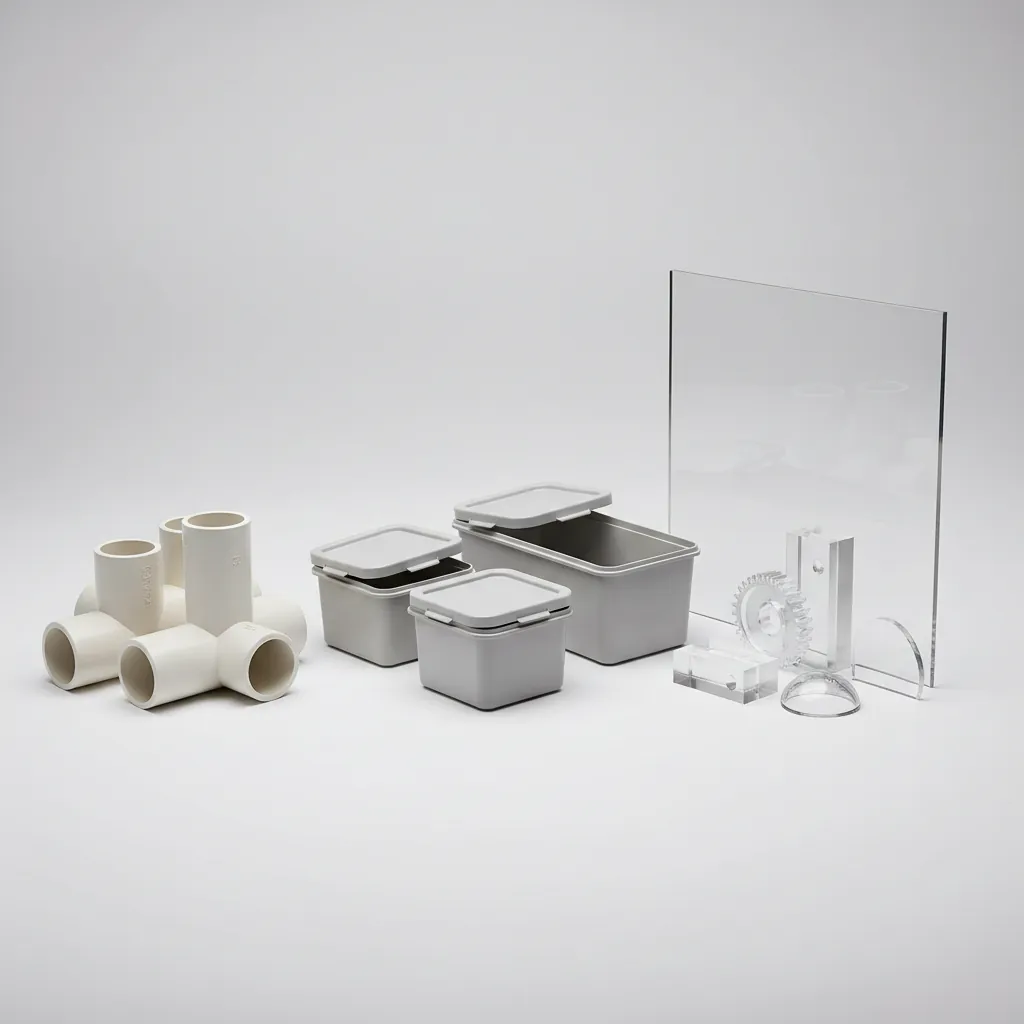
PVC, polypropylene (PP) and polycarbonate (PC) are three of the most used thermoplastics on earth, and they get confused constantly because all three show up in pipes, housings and containers. They could hardly be more different: PVC is the cheap, flame-resistant chemical workhorse; polypropylene is the light, fatigue-proof, food-safe one; polycarbonate is the transparent tank. This guide compares all three with complete property data — including the density and modulus numbers most comparisons omit — plus cost and processing guidance for molding and machining.
| Propiedad | PVC (rigid) | Polipropileno (PP) | Policarbonato (PC) |
|---|---|---|---|
| Densidad | 1.38–1.45 g/cm³ | 0.90–0.92 g/cm³ (floats!) | 1.20–1.22 g/cm³ |
| Resistencia a la tracción | 40–55 MPa | 25–40 MPa | 55–70 MPa |
| Módulo de elasticidad | 2.4–3.3 GPa | 1.1–1.6 GPa | 2.2–2.4 GPa |
| Izod impact (notched) | 2–10 kJ/m² | 3–8 kJ/m² (copolymer higher) | 60–85 kJ/m² — virtually unbreakable |
| Max continuous temp | 60 °C (CPVC ~95 °C) | 100 °C | 115–130 °C |
| Heat deflection (0.45 MPa) | ~70 °C | ~85–100 °C | ~140 °C |
| Transparency | Clear grades hazy | Translucent at best | Water-clear, 88–91% transmission |
| Flammability | Self-extinguishing (UL94 V-0 typical) | Burns (HB) | V-2 to V-0 grades |
| Water absorption (24 h) | 0.04–0.4% | <0.02% — best of the three | 0.15–0.35% |
| Typical resin cost | ~$0.9–1.3/kg | ~$1.0–1.4/kg | ~$2.5–4.0/kg |
Polyvinyl chloride owes its career to chlorine: inherent flame resistance, broad chemical resistance (acids, bases, salts, oils) and the lowest price of the three. Rigid PVC (uPVC) builds pipes, fittings, window frames and tanks; plasticized PVC becomes cable insulation, hose and seals. Weaknesses: low service temperature (softens near 80 °C), brittle in cold, attacked by many solvents (ketones, chlorinated solvents), and it releases HCl when burned — which is why machining it calls for ventilation and why some shops decline it.
PP is the lightest major engineering plastic — it floats — with outstanding fatigue resistance: a molded-in PP living hinge survives millions of flex cycles, which neither PVC nor PC can do. It shrugs off acids and bases even better than PVC, absorbs almost no water, and is FDA-friendly in food-contact grades. Weaknesses: UV degradation unless stabilized, poor bonding and painting (low surface energy), soft surface that scratches, and brittleness below 0 °C (copolymer grades fix this partially). See our polypropylene CNC machining service for tolerances and design notes.
PC is the impact champion of common thermoplastics — riot shields, machine guards, safety glasses — with glass-like clarity and the highest temperature capability of the three. It machines beautifully and molds into precise, stable parts. Weaknesses: scratches without hard-coating, stress-cracks in contact with many chemicals (ammonia, ketones, some oils), hydrolyzes in hot water over time, and costs 2–4× the other two. More in our polycarbonate injection molding guide y PC machining service.
| Medio | PVC | PP | PC |
|---|---|---|---|
| Dilute acids | Excelente | Excelente | Feria |
| Strong bases | Bien | Excelente | Poor (attacked) |
| Alcohols | Bien | Excelente | Feria |
| Ketones / chlorinated solvents | Deficiente | Bien | Poor (crazing) |
| Fuels and oils | Bien | Fair (swells warm) | Poor–Fair |
| Hot water / steam | Deficiente | Good (to ~100 °C) | Poor (hydrolysis) |
No in tension and stiffness — rigid PVC is roughly 40% stronger and twice as stiff. But PP wins on fatigue (flex cycles), impact at matching grades, strength-to-weight, and chemical breadth. “Stronger” depends on the load you mean.
UV sensitivity unless stabilized, poor paintability and bondability, a soft easily-scratched surface, cold-temperature brittleness, flammability, and high mold shrinkage (1–2.5%) that demands good tooling for tight tolerances.
Polycarbonate, decisively: 88–91% light transmission, 10–30× the impact resistance, and nearly double the temperature capability. Clear PVC exists but is hazier, more brittle and limited to ~60 °C — its advantage is price and flame rating.
PVC and PP resins are close (roughly $1–1.4/kg in 2026), with PVC usually slightly cheaper and PP cheaper per part by volume thanks to its low density. Polycarbonate runs 2–4× either. For machined parts, material is a minor cost next to machine time, so choose by properties first.
We machine and mold PVC, PP, PC and 20+ other engineering plastics — prototypes without tooling via plastic machining, production via moldeo por inyección. Material selection help is free: send your part’s environment and loads with your drawing for a 24-hour quote.

Escrito por Andy, ingeniero de fabricación en TUOWEI Precision. Andy está especializado en mecanizado CNC, fabricación de precisión e ingeniería de producción, y cuenta con experiencia práctica en el apoyo a proyectos que abarcan desde la creación rápida de prototipos hasta la producción a gran escala. Trabaja en estrecha colaboración con los equipos de ingeniería y fabricación para evaluar materiales, tolerancias, procesos de mecanizado y la facilidad de fabricación de los diseños. Sus artículos ofrecen información práctica y con base técnica para ayudar a ingenieros y compradores a tomar mejores decisiones de fabricación, optimizar la eficiencia de la producción y lograr una calidad constante de las piezas. Descubre las soluciones de mecanizado CNC y fabricación a medida de TUOWEI Precision para tu próximo proyecto.
Desde prototipos rápidos hasta la producción a gran escala, Tuowei Precision ofrece un mecanizado CNC fiable, con precisión y uniformidad en cada paso. Empieza tu proyecto hoy mismo.
Lee nuestras últimas guías sobre mecanizado CNC, materiales, acabados y tendencias del sector para tomar mejores decisiones de producción.