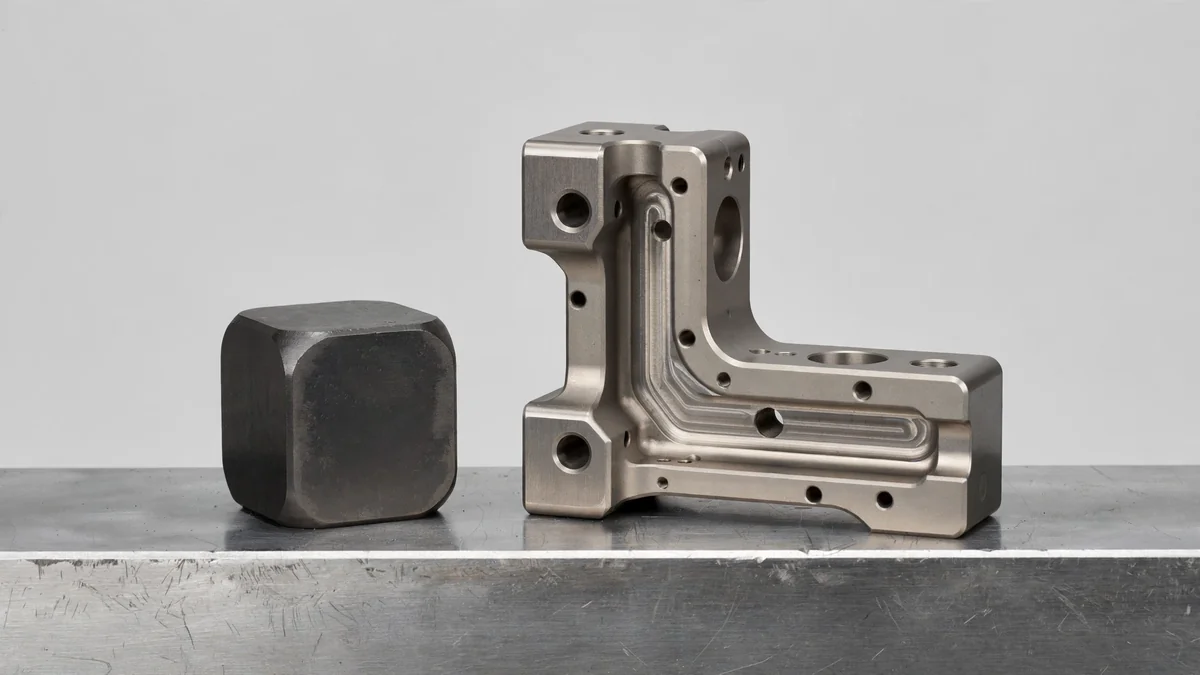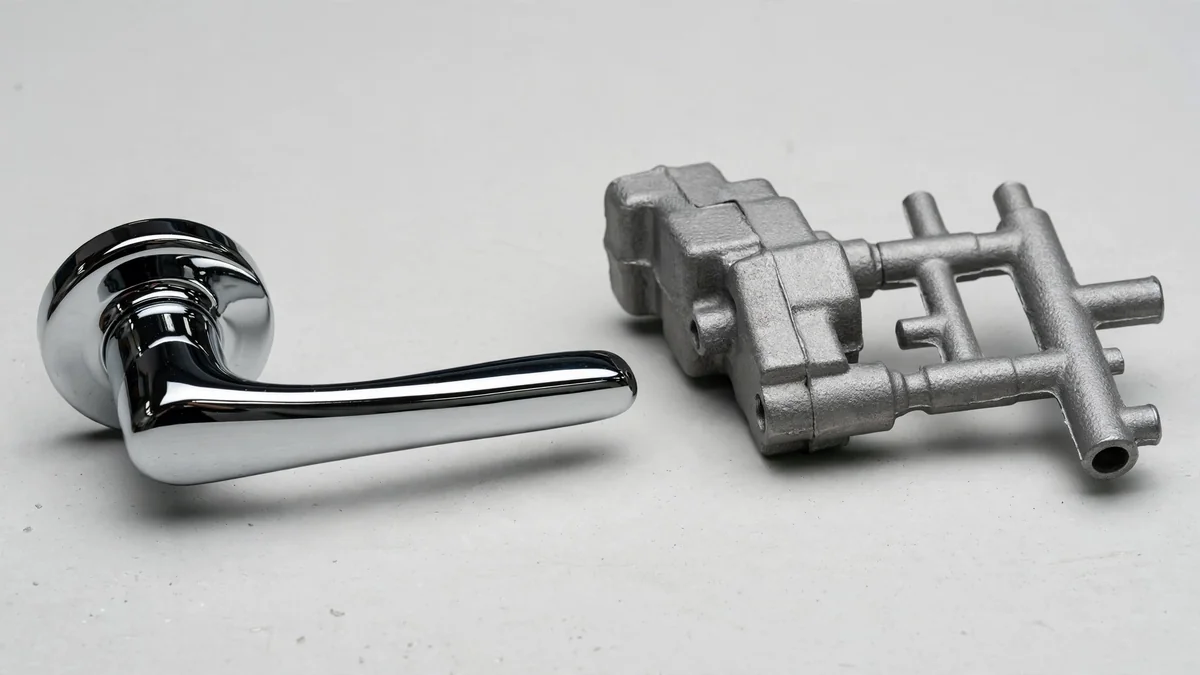
Zinc die casting forces molten zinc alloy into a hardened steel die under high pressure to make precise, thin-walled metal parts at very high volume. Zinc melts at only about 385 °C, so it runs on fast hot chamber machines, gives long die life and produces parts with fine detail and smooth surfaces that plate well.
Die casting is ideal for small, detailed metal parts made by the thousands or millions: lock bodies, faucet handles, connector housings, zipper sliders and trim for the automotive industry, which is the largest user of zinc die cast components. Below we cover the alloys with real numbers, how the process works, the design rules that cut cost, and the limits most suppliers leave out.
The advantages of zinc die casting come from the metal itself. Zinc’s superior casting fluidity and low melting temperature give it a casting capability that aluminum or magnesium cannot match, and zinc alloys offer a combination no other die casting metal matches:
The trade-offs are weight (zinc is about 2.4 times denser compared to aluminum), creep under sustained load, and lower maximum service temperature. We cover those below. For most small parts, though, the use of zinc delivers reduced finishing and machining, and the advantages of zinc usually outweigh its weight.
Zinc casting alloys fall into two groups. Zamak alloys contain about 4% aluminum, while ZA alloys contain higher amounts of aluminum (8 to 27%). Each alloy in die casting is chosen for its mechanical and physical properties and castability, so the properties of zinc alloys below should drive your material choice. Typical die cast values are shown; alloy specs are defined in ASTM B86 and B240.
| Aleación | Resistencia a la tracción | Alargamiento | Brinell hardness | Densidad | Tipo de máquina | Ideal para |
|---|---|---|---|---|---|---|
| Zamak 3 | about 283 MPa | about 10% | about 82 | 6.6 g/cm³ | Hot chamber | General purpose, best dimensional stability and plating |
| Zamak 5 | about 331 MPa | about 7% | about 91 | 6.7 g/cm³ | Hot chamber | Higher strength and hardness, some loss of ductility |
| Zamak 2 | about 359 MPa | about 7% | about 100 | 6.8 g/cm³ | Hot chamber | Highest Zamak strength, better creep and wear |
| Zamak 7 | about 283 MPa | about 13% | about 80 | 6.6 g/cm³ | Hot chamber | High purity, best fluidity and ductility, thin walls |
| ZA-8 | about 374 MPa | about 8% | about 103 | 6.3 g/cm³ | Hot chamber | Strength and creep resistance with hot chamber speed |
| ZA-12 | about 404 MPa | about 5% | about 100 | 6.0 g/cm³ | Cold chamber | Bearings and higher-load parts |
| ZA-27 | about 426 MPa | about 2.5% | about 119 | 5.0 g/cm³ | Cold chamber | Highest strength, wear and bearing applications |
For comparison, aluminum alloy A380 has a tensile strength around 324 MPa, elongation near 3.5% and density of about 2.7 g/cm³. The International Zinc Association die casting site publishes full alloy data sheets.
These physical and mechanical properties are for die cast test bars; real die cast parts vary with wall thickness and porosity, so ask your die casting supplier for material properties measured on parts like yours.
Our recommendation: start with Zamak 3, the most widely used zinc casting alloy. It covers most parts, is easiest to cast and plate, and holds dimensions best over time. Move to Zamak 5 or Zamak 2 only when you need better mechanical properties such as strength or hardness, and to ZA-8 or EZAC when creep under load is the concern.
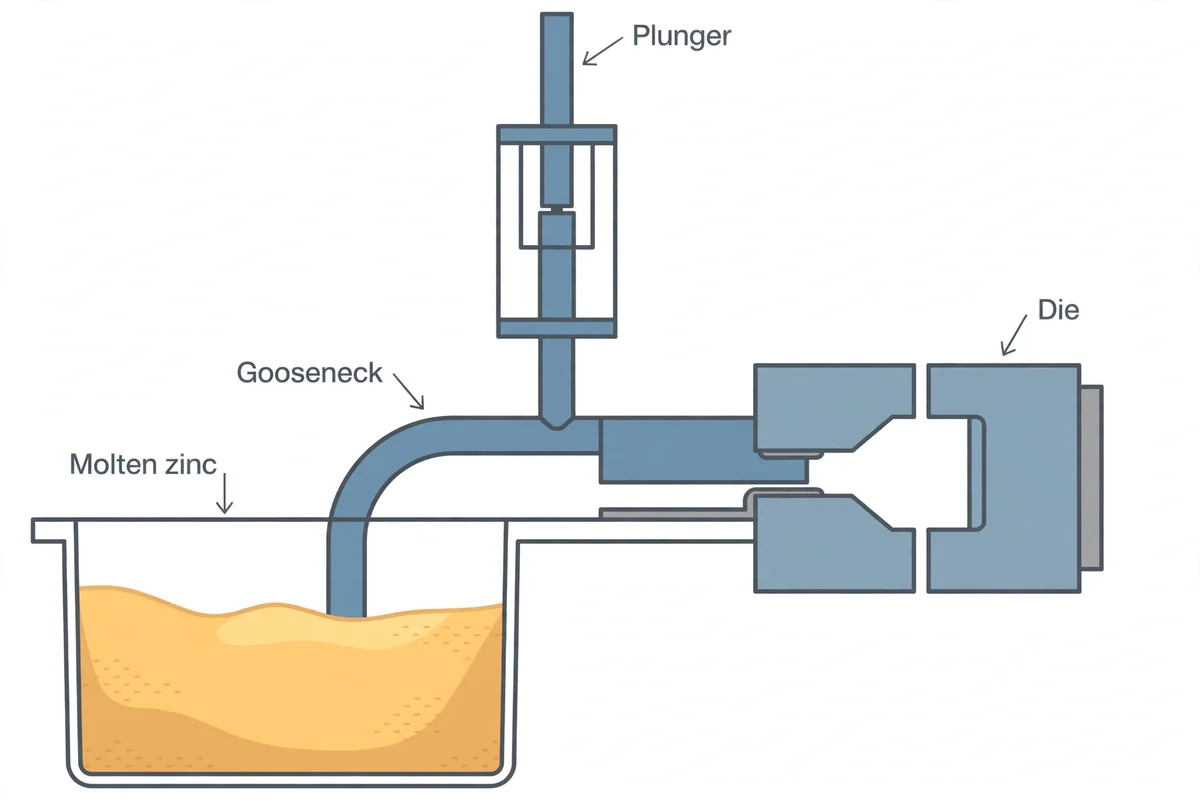
Die casting is a process in which molten metal is forced into a steel die under high pressure. Zinc can be cast with the hot chamber process, the fastest form of chamber die casting. The name describes the machine layout: the injection cylinder (the gooseneck) sits submerged in the bath of molten metal. Aluminum die casting cannot work this way because molten aluminum attacks iron or steel components, so it uses the slower cold chamber process.
A typical cycle looks like this:
Small parts may run several cycles per minute, and multi-cavity dies multiply output. High-strength ZA-12 and ZA-27 need cold chamber machines because of their higher aluminum content and melting range.
Historically, the most commonly used zinc grades were developed for this hot chamber route, and nearly every die cast zinc part today follows it. Our servicios de fundición a presión page lists our machine sizes and capabilities, and the general guide ¿Qué es la fundición a presión? explains how zinc compares with aluminum and magnesium.
Good design cuts tooling cost and scrap more than any other factor. These are typical starting points; final values depend on part size and the caster’s process.
| Design feature | Typical guideline for zinc |
|---|---|
| Grosor de la pared | As thin as about 0.5 mm on small parts; 1 to 2.5 mm is common |
| Wall uniformity | Keep walls as even as possible; core out thick sections |
| Draft angle | Often under 1° on outside walls, slightly more on inside walls and deep cores |
| Fillets and radii | Add radii at all internal corners, about 0.4 mm minimum |
| Agujeros | Small cored holes are possible; deep, small holes are better drilled |
| Hilos | External threads can be cast; internal threads are usually tapped |
| Ribs | Thinner than the adjoining wall, with draft and root radii |
Design tips we give clients most often:
En North American Die Casting Association publishes design standards and tolerance tables that most casters work to.
Zinc castings accept almost every common finish:
One finish that does not work: anodizing. Anodizing is for aluminum and titanium, and people often ask for it on zinc parts by mistake. For a hard, colored metal look on zinc, use plating or powder coat instead.
Plating quality depends heavily on casting quality. Surface porosity traps plating chemicals, which later bubble as blisters. Ask your caster about porosity control on cosmetic faces. See our servicios de acabado de superficies for available options.
Zinc is excellent for many parts, but not all. Be aware of these limits before committing to tooling:
Weight. At about 6.6 g/cm³, a cast zinc part weighs roughly 2.4 times as much as the same die cast part in aluminum. That is a plus for premium-feel hardware and a minus for anything carried or flown.
Creep. Zinc alloys slowly deform under sustained load, and the effect grows quickly with temperature. Bolted joints can lose clamp force over time. Use ZA-8, Zamak 2 or EZAC for parts under constant stress, and keep bolt loads moderate.
Temperatura. Continuous service above roughly 95 to 120 °C, depending on alloy, is not recommended. Engine-bay or hot-appliance parts often need aluminum instead.
Dimensional aging. Zamak castings shrink very slightly over the first weeks after casting. For precision parts, a low-temperature stabilizing heat treatment, done before final machining, reduces this.
Corrosión. Zinc does not rust, but in wet, salty or acidic conditions it forms white corrosion products. Parts for outdoor or marine use need plating, paint or conversion coating. Any claim that zinc castings “never corrode” is not accurate.
Tooling cost. Steel dies are a significant upfront investment, so zinc casting pays off at volume. For a few dozen parts, CNC machining or other low-volume processes are usually cheaper.
Choosing between aluminum and zinc is the most common decision buyers face, and any experienced die caster will ask about part size, weight and finish first. Here is how they compare in practice, alongside cast iron for context. Unlike iron casting in sand molds, both are high-volume die casting production processes:
| Factor | Zinc (Zamak 3) | Aluminum (A380) |
|---|---|---|
| Peso | Heavy, about 6.6 g/cm³ | Light, about 2.7 g/cm³ |
| Strength and ductility | Higher ductility, good strength | Good strength, low ductility |
| Thinnest practical walls | Thinner | Thicker |
| As-cast tolerances | Tighter | Wider |
| Velocidad del ciclo | Faster (hot chamber) | Slower (cold chamber) |
| Die life | Much longer | Shorter |
| High-temperature service | Limitado | Mejor |
| Plating | Excelente | More difficult |
| Material cost per part | Higher for large parts (more mass) | Lower for large parts |
Rule of thumb: for small, detailed or plated parts, zinc usually wins on total cost even though the metal is heavier. For larger structural parts, lightweight parts and anything running hot, aluminum usually wins.
The usual defects are porosity (gas and shrinkage), cold shuts, flash, soldering of metal to the die and blisters after plating. Most trace back to part design, gate placement, die temperature or metal temperature. Our guide to casting defects, causes and fixes covers how to diagnose each one.
It is used for small, precise metal parts made in high volumes. Common examples include locks and keys, door and cabinet hardware, faucet and shower parts, electrical connectors, EMI shielding housings, automotive interior trim, seat belt components, gears and zipper sliders. Plated decorative hardware is one of the largest markets.
Zamak alloys have similar or higher tensile strength than common aluminum die casting alloys such as A380, and much better ductility and impact resistance. Aluminum has the better strength-to-weight ratio and handles high temperatures better. For small, compact parts zinc is often the stronger practical choice.
Zamak 3 is the best starting point for most parts because it offers good strength, excellent castability, dimensional stability and plating quality. Zamak 5 adds strength and hardness. Zamak 2, ZA-8 and EZAC suit parts needing better creep or wear resistance. ZA-27 gives the highest strength but needs cold chamber casting.
Zinc does not rust like steel, because rust is iron oxide. In moist, salty or acidic environments, though, zinc forms white corrosion products that can damage appearance and function. Outdoor and marine zinc parts should be plated, powder coated, painted or conversion coated for long-term protection.
Small zinc parts can be cast with walls of about 0.5 mm, and some miniature casting processes go thinner. Most production parts use 1 to 2.5 mm walls for reliable filling and strength. Thinner walls than aluminum are possible because molten zinc is very fluid.
Die casting is highly efficient once the steel die is built, and die casting can produce millions of identical cast parts, so the material choice and design decisions you make early matter most. Zinc die casting is the best route when you need small, detailed metal parts with tight tolerances, a quality plated finish and very high volumes. Choose Zamak 3 unless you have a reason not to, design walls thin and uniform, and plan for creep, weight and temperature limits from the start.
Tuowei Precision supports zinc parts from design review and tooling through casting, Mecanizado CNC and finishing. Send your drawing for an presupuesto al instante, o visita la Página de inicio de Tuowei Precision to see all our services.