Counterbores and countersinks both let a fastener head sit flush with (or below) a surface — but they are different features for different screws, and mixing them up scraps parts. The short version: a counterbore is a flat-bottomed cylindrical recess for socket head cap screws; a countersink is a conical recess for flat head screws. This guide gives the dimension charts, drawing symbols, tooling and machining practice for both.
The Core Difference
特点
Counterbore ⌴
Countersink ⌵
形状
Cylindrical, flat bottom
Conical (82°, 90°, 100°, 120°)
Fastener
Socket head cap screw (SHCS), hex bolt + washer
Flat head / countersunk screw
Bearing surface
Flat shoulder under the head
Cone matches the head taper
Head position
Below surface, visible recess
Flush with surface
Self-centering
No — hole pattern tolerance is forgiving
Yes — cone centers the screw (over-constrains multi-hole patterns)
Metric Counterbore Dimensions (Socket Head Cap Screws)
Standard clearance per ISO 273 medium fit, counterbore per common practice (EN/ISO 4762 heads):
螺钉
Clearance hole Ø
Counterbore Ø
Min. c’bore depth
M3
3.4
6.5
3.4
M4
4.5
8.0
4.6
M5
5.5
9.5
5.7
M6
6.6
11.0
6.8
M8
9.0
14.0
9.0
M10
11.0
17.5
11.2
M12
13.5
19.5
13.7
Depth note: minimum depth hides the head (head height + ~0.2–0.4 mm). Dimension depth to the flat bottom, and add washer thickness if used.
Metric Countersink Dimensions (Flat Head Screws, 90°)
螺钉
Clearance hole Ø
Countersink Ø (top of cone)
M3
3.4
6.3–6.5
M4
4.5
8.4–8.6
M5
5.5
9.7–10.0
M6
6.6
12.0–12.4
M8
9.0
16.0–16.4
M10
11.0
20.0–20.4
Angle trap: metric flat heads (ISO) are 90°; inch flat heads (ANSI) are 82°. Cutting an 82° seat for a 90° screw leaves the head proud and bearing on its rim — always match the standard of the fastener.
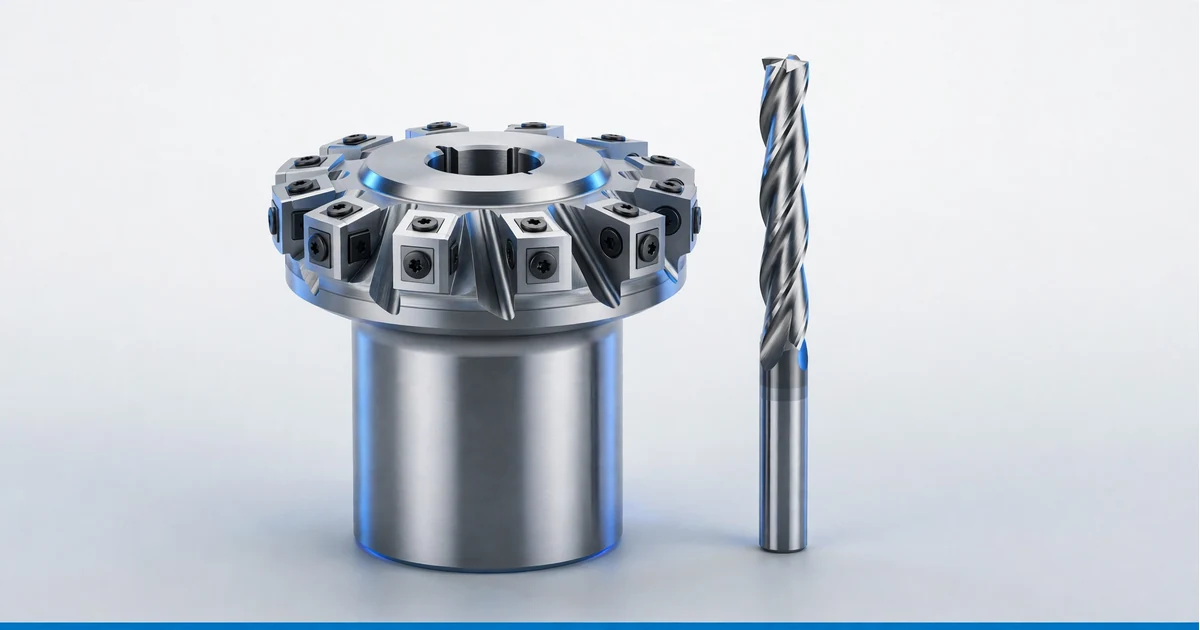
Counterbores: on CNC mills, a flat end mill helically interpolated makes any diameter — piloted counterbore tools suit drill presses. Flatness of the seat matters: finish with a light bottom pass.
Countersinks: single-flute or three-flute countersink cutters chatter least; chamfer mills on CNC give the cleanest cones. Control depth by diameter-at-top, not Z-depth from an uncertain surface.
Deburring bonus: a 90° countersink at 0.2–0.3 mm depth is also the standard hole-edge break — see our deburring guide.
常见问题
What is the difference between counterbore and countersink?
A counterbore is a flat-bottomed cylindrical recess that houses a socket head cap screw; a countersink is a cone-shaped recess that lets a flat head screw sit flush. Different screws, different geometry, different symbols (⌴ vs ⌵).
What is a counterbore used for?
Recessing socket head cap screws (or bolt heads with washers) below the surface — protecting the head, cleaning up the look, and providing a flat, strong bearing seat.
What angle is a countersink?
Match the fastener: 90° for metric/ISO flat heads, 82° for inch/ANSI flat heads, 100° for many aerospace rivets and screws, 120° for sheet-metal applications.
What is a spotface?
A very shallow counterbore that simply flattens a rough or angled surface so a fastener head or washer can seat squarely — common on castings and extrusions.
Precision Holes by Tuowei Precision
Counterbores, countersinks and spotfaces are standard features in our 数控加工服务 — interpolated to size, depth-controlled, burr-free. For complete fastener-ready assemblies, see contract machining services. Upload your drawing for a 24-hour quote.