
- What Is Glass Transition Temperature (Tg)?
- Tg vs Melting Temperature (Tm)
- Amorphous vs Semi-Crystalline Polymers
- Polymer Structure and Tg at a Glance
- What Happens to Properties Across Tg
- Tg Values for Common Engineering Polymers
- How Tg Is Measured
- What Shifts Tg
- How Tg Guides Material Selection
- Tg and Injection Molding
- Tg and CNC Machining
- Common Tg Mistakes to Avoid
- Questions fréquemment posées
- Sources
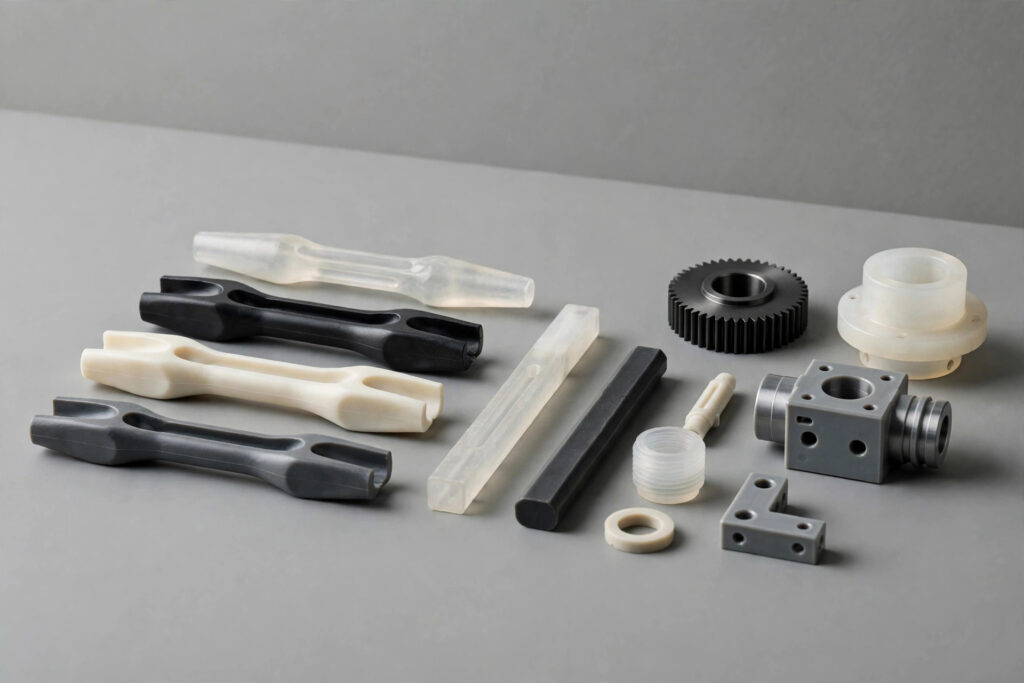
What Is Glass Transition Temperature (Tg)? #
The glass transition temperature, or Tg, is the temperature range where a polymer changes from a hard, glassy solid to a softer, rubbery material. It is one of the most useful numbers in plastics engineering because it marks the point where stiffness, strength, and impact resistance start to fall away. Common plastics such as polypropylene (PP) show this change clearly, and the Tg depends on the polymer type, its molecular structure, and the grade used.
Tg is a range, not a single sharp point. A polymer softens gradually as it warms through this range, and the change involves no melting and no latent heat. That is why Tg is called a second-order transition. Test methods report slightly different values, so datasheets list a typical Tg rather than a fixed physical constant, and designers should treat the number as a guide.
The Temperature of Glass Transition #
Engineers also call Tg the temperature of glass transition, and it is the single most quoted thermal property on a plastics datasheet. The phrase means the same thing as glass transition temperature, so a datasheet that lists one is listing the other. When a supplier quotes a Tg value, ask which test method was used, since DSC and DMA report slightly different numbers.
Tg vs Melting Temperature (Tm) #
Tg and melting temperature, or Tm, are often confused, but they describe different events. Tg marks the softening of the amorphous regions in a polymer. Tm marks the point where ordered crystalline regions break apart and the material becomes a true liquid. Amorphous polymers have a Tg but no distinct Tm, while semi-crystalline polymers have both.
Confusing the two leads to real design errors. A part made from a semi-crystalline polymer can stay solid and useful well above its Tg, because the crystals still hold it together until Tm. A part made from an amorphous polymer has no such backup, so it loses stiffness soon after Tg and should not carry load above it.
Amorphous vs Semi-Crystalline Polymers #
Thermoplastics fall into two main groups, and Tg behaves differently in each. Amorphous polymers have random, disordered chains. Semi-crystalline polymers mix ordered crystalline regions with disordered amorphous regions. Thermosets form a third group, with crosslinked chains that behave differently again. The sections below explain each group in turn.
Amorphous Polymers #
Below Tg, amorphous polymers are hard, rigid, and often brittle. As heat rises through Tg, they soften gradually, turning leathery and then rubbery before they flow. Common examples are polycarbonate (PC), polystyrene (PS), polymethyl methacrylate (PMMA), and ABS. These materials are usually used below Tg, where they keep their stiffness and shape.
Amorphous polymers are often transparent, which suits lenses, covers, and displays. They also show low shrinkage and good dimensional stability in molding, so they hold tight tolerances well. Their main weakness is chemical resistance, which is lower than that of most semi-crystalline polymers, and they soften steadily once Tg is passed.
Semi-Crystalline Polymers #
Semi-crystalline polymers contain ordered crystalline regions alongside amorphous regions. The amorphous regions pass through Tg as usual, but the crystalline regions stay ordered and keep the part solid. That is why many of these materials work well above their Tg, up to near their melting temperature.
Polypropylene (PP) is a clear example, with a Tg near minus 20 degrees Celsius. PP lawn furniture stays tough and flexible through warm summers but can turn brittle in cold winters, when the temperature falls toward Tg. Polyethylene, acetal (POM), and nylon behave in the same general way, with usable strength above Tg.
Thermodurcissables #
Thermosets have crosslinks that tie their polymer chains into one large network. These bonds are so strong that a thermoset has no melting point, since it decomposes before it could melt. Some thermosets, such as liquid silicone rubber, are used well above Tg, while rigid ones such as phenolics are used below Tg.
Crosslinking also gives thermosets strong chemical resistance, dimensional stability, and heat resistance. They range from clear to opaque and from elastomeric to rigid. Because they cannot be remelted, they are shaped during curing, and any design change after cure means making a new part.
Polymer Structure and Tg at a Glance #
The table below sums up how the three polymer groups compare. It is a quick reference for material selection, and the Tg values table further down adds the numbers for individual plastics.
| Propriété | Amorphous | Semi-crystalline | Thermosodur |
|---|---|---|---|
| Chain structure | Random, disordered | Ordered, stable | Crosslinked |
| Melting point | None, softens gradually | Distinct melting point | None, decomposes first |
| Shrinkage | Faible | Haut | Faible |
| Aspect | Transparent | Opaque | Variable |
| Résistance chimique | Faible | Haut | Haut |
| Examples | ABS, PC, PS | PP, PET, POM | Epoxy, LSR |
What Happens to Properties Across Tg #
The sharpest change across Tg is in stiffness. The elastic modulus of a polymer can fall by a large factor as it passes through Tg, and tensile strength falls with it. Impact behavior changes too: many plastics that are tough above Tg become brittle below it, which matters for parts used outdoors or in cold storage.
Thermal expansion also rises above Tg, so dimensions shift more with temperature, and creep becomes faster under steady load. A part that holds its shape for years below Tg may slowly deform above it. For that reason, the service temperature of a loaded part should sit safely on the correct side of Tg for its polymer type.
Tg Values for Common Engineering Polymers #
The table below lists typical Tg values for plastics used in machining, molding, and product design. Values come from Protolabs for the first group and from published reference tables for the rest. All values are approximate, since Tg shifts with grade, fillers, and test method. Always check the datasheet for the exact grade you plan to use. PETG, near 80 degrees, is a common 3D printing and thermoforming plastic.
| Matériau | Type | Tg (degrees C) | Tm (degrees C) | Utilisations courantes |
|---|---|---|---|---|
| PEI (polyetherimide) | Amorphous | 217 | Aucun | Electronics, medical, aerospace housings |
| PSU (polysulfone) | Amorphous | 190 | Aucun | Medical, plumbing, membranes |
| PC (polycarbonate) | Amorphous | 145 | Aucun | Lenses, covers, enclosures |
| PEEK (polyetheretherketone) | Semi-crystalline | 140 | Approx 340 | High temperature, medical, aerospace parts |
| LCP (liquid crystal polymer) | Semi-crystalline | 120 | See datasheet | Thin wall connectors, electronics |
| ABS | Amorphous | Approx 105 | Aucun | Housings, consumer goods, prototypes |
| GPPS (general purpose polystyrene) | Amorphous | 100 | Aucun | Packaging, displays, disposable goods |
| PMMA (acrylique) | Amorphous | Approx 90 to 105 | Aucun | Lenses, signs, light guides |
| PPS (polyphenylene sulfide) | Semi-crystalline | Approx 90 | See datasheet | Chemical resistant parts, automotive |
| PVC (polyvinyl chloride) | Amorphous | Approx 80 | Aucun | Pipe, profiles, cable jackets |
| PETG (polyethylene terephthalate glycol) | Amorphous | Approx 80 | Aucun | Bottles, 3D printing, medical packaging |
| PET (polyethylene terephthalate) | Semi-crystalline | Approx 70 | Approx 250 | Bottles, films, engineering parts |
| PLA (polylactic acid) | Semi-crystalline | Approx 60 | See datasheet | 3D printing, packaging, disposable goods |
| Nylon 6 (PA6) | Semi-crystalline | Approx 50 | Approx 220 | Gears, bearings, housings |
| Nylon 66 (PA66) | Semi-crystalline | Approx 50 | Approx 260 | Gears, bearings, automotive parts |
| POM (acétal) | Semi-crystalline | Approx -60 | Approx 175 | Gears, bearings, precision parts |
| TPU (thermoplastic polyurethane) | Elastomer | Approx -30 | Cela varie selon le niveau scolaire | Seals, grips, flexible parts |
| PP (polypropylène) | Semi-crystalline | -20 to 0 | Approx 165 | Packaging, furniture, automotive parts |
| HDPE (high density polyethylene) | Semi-crystalline | -120 | Approx 130 | Bottles, tanks, pipe |
| LDPE (low density polyethylene) | Semi-crystalline | -110 | Approx 110 | Films, bags, flexible packaging |
| LSR (liquid silicone rubber) | Thermosodur | -125 | Aucun | Seals, medical, baby care products |
| UHMWPE (ultra-high molecular weight polyethylene) | Semi-crystalline | Approx -150 | Approx 135 | Wear parts, liners, medical implants |
Notes: PTFE is left out of this table on purpose, because published Tg values disagree widely, from about 19 to about 115 degrees Celsius depending on the source and grade. Tg for PP covers atactic (about -20) to isotactic (about 0) grades. TPU values vary by hardness grade, with published ranges from about -48 to about -20.
What the Tg Table Shows #
Two patterns stand out. High Tg plastics such as PEI, PSU, PC, and PEEK keep their stiffness at elevated temperatures, which suits under hood parts, medical tools, and electronics. Low Tg plastics such as PE, PP, and TPU stay flexible at room temperature but can turn brittle in deep cold, so check the lowest service temperature before choosing them.
How Tg Is Measured #
Differential scanning calorimetry, or DSC, is the most common way to measure Tg. A small sample is heated at a steady rate, and the instrument records heat flow. Tg shows up as a step change in heat capacity rather than a peak, and the reported value is usually the midpoint of that step. DSC is fast and needs only a few milligrams of material.
Dynamic mechanical analysis, or DMA, measures stiffness while the sample is heated, and Tg appears as a sharp drop in storage modulus. Thermomechanical analysis, or TMA, tracks dimensional change with temperature. DMA often reports a slightly higher Tg than DSC, so always note which method a datasheet used before comparing values.
What Shifts Tg #
Chain stiffness is the main driver. Rigid backbones, bulky side groups, and strong attractions between chains all raise Tg, which is why PC and PEI sit far above PE and PP. Higher molecular weight also raises Tg up to a point, since longer chains entangle more and move less freely. Crosslinking raises Tg too, by locking chains in place.
Additives and environment shift Tg as well. Plasticizers push Tg down by letting chains slide more easily, while rigid fillers can push it up. Moisture is a real concern for nylon, since absorbed water acts as a plasticizer and lowers Tg, so a nylon part can behave differently in humid service than in dry lab tests. Copolymer choice shifts Tg between the values of its parts.
How Tg Guides Material Selection #
Start with the service temperature range, then pick a material whose Tg sits safely outside it for the job at hand. For a rigid amorphous part, keep the top service temperature well below Tg. For a semi-crystalline part, Tg is less of a hard limit, but stiffness still falls as temperature rises, so keep a margin and check creep data for long term loads.
High temperature work points to PEEK, PEI, or PC. Our Guide d'usinage CNC du PEEK covers how this high Tg polymer is cut and where it earns its cost. For flexible parts, seals, and grips, low Tg elastomers work better, and our guides to TPE materials et urethane explain the options and their trade offs.
Tg and Injection Molding #
Tg shapes molding choices from the start. Amorphous polymers need mold temperatures that control cooling through Tg, since fast cooling can freeze in stress and slow cooling improves clarity and stability. Semi-crystalline polymers need enough mold heat for crystals to form, which sets shrinkage and warpage, and they shrink more than amorphous grades.
Annealing can help parts that must stay stable near Tg, by relaxing molded in stress before the part enters service. If a part warps, cracks, or loses tolerance in hot use, check whether the service temperature is crossing Tg before changing the tool. Our moulage par injection de plastique page covers the process these choices fit into.
Tg and CNC Machining #
Machining below Tg keeps a plastic stiff, so cuts stay clean and tolerances hold. Cutting heat is the risk: a dull tool or a fast feed can warm a low Tg plastic past Tg at the cut, leaving melted edges, burrs, and poor surface finish. PEEK machines well because its Tg near 140 degrees Celsius gives a wide safe margin at normal cutting temperatures.
Practical steps are simple: use sharp tools, keep feeds and speeds moderate, clear chips so they do not reheat the cut, and use air or coolant where the material allows it. Clamp lightly but firmly, since a part that softens under the cutter can shift in the fixture. These steps matter most for low Tg plastics such as PE, PP, and UHMWPE.
Common Tg Mistakes to Avoid #
The most common mistake is loading an amorphous part above its Tg and expecting it to stay stiff. A PC cover that is fine at room temperature can sag in a hot enclosure, and an ABS housing can warp near a heat source. The second mistake is ignoring moisture in nylon, where water lowers Tg and changes strength and dimensions after the part absorbs humidity.
Two more errors show up often. Some designers confuse Tg with melting temperature or with heat deflection temperature, which are different measures with different test loads. Others take one datasheet Tg as fixed for every grade, while fillers, plasticizers, and copolymers can move it by tens of degrees. Check the grade datasheet and the test method every time.
Questions fréquemment posées #
What is a glass transition temperature? #
Tg is the temperature range where a polymer changes from a hard, glassy solid to a softer, rubbery material. It marks the point where stiffness, strength, and impact resistance start to fall. Designers use Tg to set safe service temperatures and to choose between plastics for hot, cold, or loaded parts.
How is Tg different from melting temperature? #
Tg marks softening of the amorphous regions, while melting temperature marks the breakdown of ordered crystalline regions. Amorphous polymers have a Tg but no distinct melting point and soften gradually. Semi-crystalline polymers have both, and they stay solid above Tg until they reach their melting temperature.
Can a plastic be used above its Tg? #
Yes, but it depends on the polymer type. Semi-crystalline plastics such as PP and nylon keep useful strength above Tg because their crystalline regions hold the structure together. Amorphous plastics such as PC and PS lose stiffness soon after Tg, so they should not carry load above it.
How is Tg measured? #
Tg is usually measured by differential scanning calorimetry (DSC), which finds the step change in heat capacity as a sample warms. Dynamic mechanical analysis (DMA) is also used, and it shows Tg as a sharp drop in stiffness. DMA often reports a slightly higher value than DSC, so check which method was used.
Which common plastics have the highest Tg? #
Among common engineering plastics, PEI leads at about 217 degrees Celsius, followed by PSU near 190, PC near 145, and PEEK near 140. These high Tg materials keep their stiffness in hot service, which suits electronics, medical tools, and under hood parts. Low Tg plastics such as PE and PP stay flexible instead.
Sources #
- Protolabs, “Glass Transition Temperature (Tg) of Polymers”, https://www.protolabs.com/resources/design-tips/glass-transition-temperature-of-polymers/ (Tg values for GPPS, HDPE, LCP, LSR, PC, PEEK, PEI, PMMA, PP, PPS, PSU, SPS; polymer structure table; amorphous vs semi-crystalline behavior)
- Matmake, “Glass Transition Temperature of Polymers and Plastics”, https://matmake.com/properties/glass-transition-temperature-of-polymers-and-plastics.html (Tg values for ABS, nylon 6, nylon 66, PET, PLA, POM, PTFE, PVC)
- McGraw-Hill Access Engineering, “The Basics of Temperature Effects”, Table 8.4 Glass Transition Temperature for Common Materials (Tg values for ABS, HDPE, LDPE, nylon 66, PET, PLA, PMMA, PP, PTFE, PVC, PS, PC)
- ScienceDirect, “Glass Transition Temperature” topic, https://www.sciencedirect.com/topics/materials-science/glass-transition-temperature (Tg ranges for ABS, nylon 6, nylon 66, POM, PET, PMMA, TPU, UHMWPE)
- Want.Net, “Plastic Melting Point Chart: Tg, Tm, and Processing Temperatures”, https://www.want.net/blogs/plastic-melting-point-chart-tg-tm-and-processing-temperatures/ (Tg and Tm values for HDPE, LDPE, UHMWPE, PP, PET, ABS, PC, PMMA, PS)


