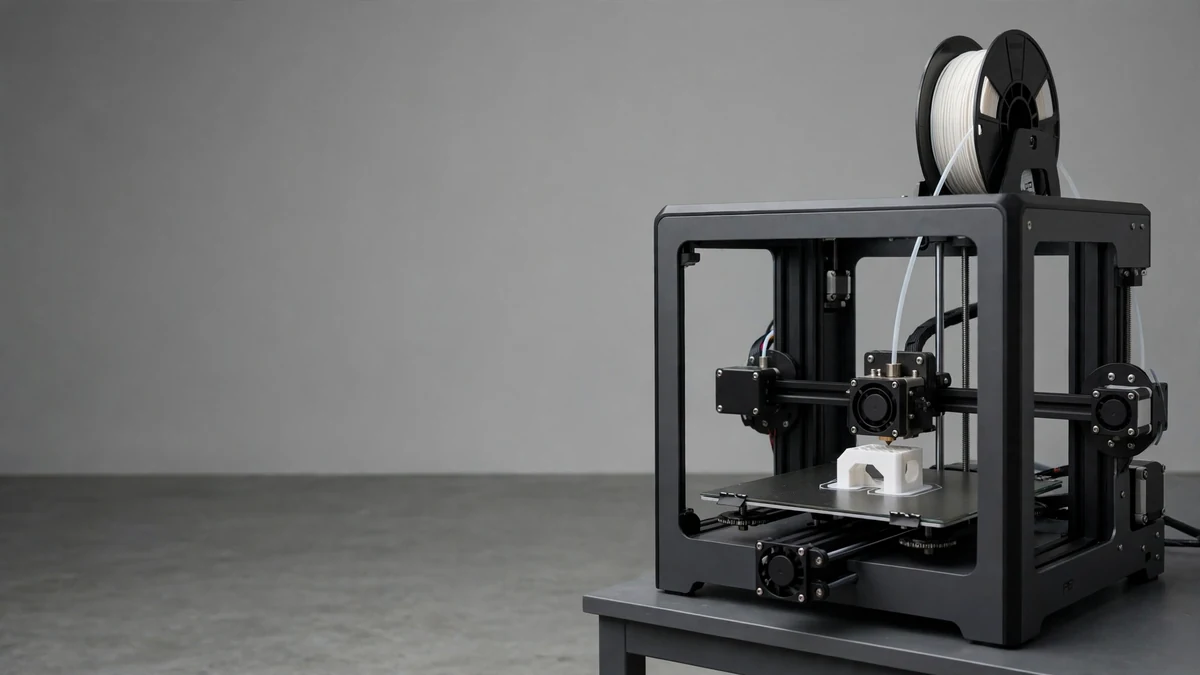
PLA and ABS are the two most common filaments in FDM 3D printing, and the choice between them decides how your part prints, how strong it is, and how it holds up in heat. This guide compares ABS vs PLA with numbers, so you can pick the right filament for your part. If you are new to the process, our FDM 3D printing guide explains how fused deposition modeling builds parts layer by layer.
It is the same comparison many makers search as PLA vs ABS, and the short answer is that neither filament wins on every point. PLA prints easier and holds fine detail, while ABS takes heat and impact better. The rest of this guide walks through the numbers, then matches each filament to the parts it suits best.
PLA, or polylactic acid, is a bio-based thermoplastic made from renewable sources such as corn starch and sugarcane. It is the easiest FDM filament to print, which is why it is the default choice for beginners and for visual models. It prints at low temperatures, sticks well to the bed, and barely warps, so even an open-frame printer without a heated chamber can print it well.
PLA is stiff and holds detail well, but it is brittle and softens at low temperatures. It starts to lose strength near 55 to 60 °C, so it suits parts that stay indoors and carry light loads. It is biodegradable under industrial composting conditions, though it does not break down in a home compost bin or in landfill.
ABS, or acrylonitrile butadiene styrene, is a petroleum-based engineering thermoplastic. It is the plastic used for LEGO bricks, appliance housings, and many automotive parts, and it is also one of the most used filaments for functional FDM prints. It is tougher than PLA and keeps its shape at higher temperatures, but it needs more care to print well.
ABS shrinks as it cools, so it warps and cracks without a heated bed and an enclosed chamber. It also gives off fumes while printing, so good ventilation or filtration matters. When those conditions are met, it produces strong, impact-resistant parts that can be sanded, machined, and smoothed with acetone vapor.
| الممتلكات | PLA | ABS |
|---|---|---|
| Base material | Corn starch, sugarcane (bio-based) | Petroleum-based |
| درجة حرارة الفوهة | 180–220 °C | 210–250 °C |
| Heated bed | 50–60 °C (optional) | 90–110 °C |
| Enclosure | Not needed | Needed |
| قوة الشد | 50–60 ميجا باسكال | 40–50 ميجا باسكال |
| مقاومة الصدمات | Low, brittle | High, tough |
| انحراف الحرارة | 52–55 °C | 90–100 °C |
| Warping risk | منخفضة | عالية |
| تشطيب السطح | Glossy, fine detail | Matte, sands well |
| Biodegradable | Yes, industrial composting | لا يوجد |
| Typical cost | منخفضة | Low, similar |
| الأفضل لـ | Visual prototypes, concept models | Functional parts, enclosures, auto parts |
The table above sums up the PLA vs ABS comparison in one place. Two points stand out: PLA is stronger in a straight pull, while ABS survives drops and heat far better. That trade is what the rest of this guide explains in detail.
| Setting | PLA | ABS |
|---|---|---|
| درجة حرارة الفوهة | 180–220 °C | 210–250 °C |
| Heated bed | 50–60 °C | 90–110 °C |
| Chamber | Open frame is fine | Enclosed, 40–50 °C helps |
| Cooling fan | 100% after first layers | Low or off |
| سرعة الطباعة | Up to 60–80 mm/s | 40–60 mm/s typical |
| Bed surface | PEI, glass, painter’s tape | PEI with glue or ABS slurry |
PLA is forgiving. It prints well on an open-frame printer, cools fast, and holds sharp corners without warping. That is why it is the standard first filament for new printer owners and for quick concept models that need to look right.
ABS needs a stable, warm environment. A heated bed near 100 °C and an enclosed chamber stop the corners lifting as the part cools. Print it in a cold or draughty room and the part will warp, split between layers, or crack at the base.
On paper, PLA is the stronger of the two in a straight pull, at 50 to 60 MPa against 40 to 50 MPa for ABS. It is also stiffer, so a PLA bracket deflects less under the same load. But stiffness is not toughness: PLA snaps where ABS bends, and a thin PLA clip can break the first time it flexes.
ABS wins on impact and fatigue. It absorbs knocks, survives repeated bending, and holds snap fits that get used again and again. For a full comparison of how plastic parts behave under load, see our guide to rapid prototyping materials. If the part will be dropped, clipped, or flexed, ABS is the safer pick.
Heat is where the two filaments part ways most clearly. PLA starts to soften near 55 to 60 °C and loses strength fast above that, so a PLA part left in a hot car can warp out of shape. Its heat deflection temperature sits at 52 to 55 °C, which rules it out for anything near an engine or a heater.
ABS keeps its shape to around 90 to 100 °C, which covers most indoor and automotive uses. That is why housings, brackets, and under-hood parts are usually printed in ABS or a similar engineering filament. If your part will see sustained heat, there is no contest here.
PLA is the easiest filament in common use. It sticks to the bed with little help, needs no enclosure, and prints clean overhangs and fine detail at standard speeds. Failed prints are rare once the first layer is set, which makes it the best choice for fast iteration and for printers without a heated chamber.
ABS takes more work. It needs a hot bed, an enclosure, and slow cooling, and even then large flat parts can lift at the corners. The fumes need ventilation, and the filament must stay dry or it will bubble and string. Experienced operators get clean ABS parts, but beginners should expect a few failed prints while they learn the settings.
PLA prints with a slight gloss and holds fine detail, so visual models often need no finishing beyond removing supports. It can be sanded and painted, though it softens easily under friction, so sanding needs a light touch and low speed.
ABS prints matte and shows layer lines more clearly, but it is easier to finish. It sands cleanly, takes paint well, and responds to acetone vapor smoothing, which melts the outer layer into a glossy skin. Our guide to vapor smoothing explains how solvent vapor works on printed parts, and its solvent table shows why each plastic needs its own treatment.
Both filaments are cheap, and a standard spool of either costs about the same per kilogram. The real cost difference is in failed prints and machine time: PLA wastes less filament on warping and prints faster, so a PLA prototype usually costs less in practice than the same part in ABS.
For production volumes, the material choice matters less than the process. Both PLA and ABS can also be injection molded, and at volume molding beats printing on price per part. If you need a flexible part instead, our guide to TPE material covers the rubber-like option that sits between rigid plastics and silicone.
The ABS vs PLA decision comes down to what the part must survive. Choose PLA for visual models, concept prototypes, and parts that stay indoors at room temperature. Choose ABS for functional prototypes, enclosures, and parts that take heat, impact, or repeated use.
| Use case | اختر |
|---|---|
| Visual prototype, concept model | PLA |
| Low-stress housing, display part | PLA |
| Snap fits, clips, flexed parts | ABS |
| Automotive interior, under-hood | ABS |
| Enclosure near heat | ABS |
| Outdoor part in sun | Neither, consider ASA or PETG |
| Food contact | Neither without a certified grade |
When in doubt, print the first version in PLA to check fit and shape, then switch to ABS for the working part. That two-step approach is fast and cheap, and it catches design mistakes before you spend time tuning ABS settings. A similar side-by-side method works for other plastics too: our polypropylene vs polyethylene guide compares another common pair the same way.
Both plastics are also injection molded at volume, and the same trade-offs apply. PLA molds well but stays heat-sensitive, so it suits disposable packaging and short-life parts. ABS is the workhorse for molded housings, automotive trim, and consumer goods that must survive drops and warm rooms.
If your part needs metal rather than plastic, the decision changes completely. Our die casting guide explains when cast metal beats any printed plastic on strength and heat. For most plastic prototypes, though, the filament choice above is what matters.
Tuowei prints both filaments on industrial FDM machines, with enclosed chambers and controlled cooling for ABS. Send a drawing or a 3D file and tell us what the part must do, and we will recommend the filament, the print settings, and the finish. Our خدمة الطباعة ثلاثية الأبعاد covers prototypes in PLA, ABS, and PETG, plus CNC machining and injection molding when the part outgrows printing.
If you are still unsure, start with a single prototype in each material and test them side by side. It is the fastest way to settle the question for your exact part, and it costs less than a failed production run.
In the end, the ABS vs PLA choice is simple: PLA for looks and easy printing, ABS for strength, heat, and real use. Match the filament to the job, not to habit, and the part will do what you designed it to do.
PLA has higher tensile strength, at 50 to 60 MPa against 40 to 50 MPa for ABS, so it resists a pull better. But ABS is tougher: it absorbs impact and bends instead of snapping. For parts that get dropped or flexed, ABS is the stronger choice, even though PLA wins the tensile number.
PLA is a poor choice outdoors. It softens near 60 °C, so sun and summer heat can warp it, and UV light makes it brittle over time. ABS handles heat better but also degrades in sunlight without stabilizers. For outdoor parts, ASA or PETG usually last longer than either filament.
ABS gives off styrene fumes while printing, so it needs ventilation or filtration and is best printed in an enclosed machine. Keep the printer out of bedrooms and small closed rooms. PLA is the safer home filament because it prints cooler and gives off far less odor.
PLA, without question. It prints at lower temperatures, sticks to the bed easily, barely warps, and needs no enclosure or heated chamber. Most new printer owners learn on PLA, then move to ABS once they need stronger, heat-resistant parts and have an enclosed printer.
No. Acetone vapor smoothing works on ABS but does almost nothing to PLA. PLA can be sanded and painted, or smoothed with ethyl acetate or tetrahydrofuran, though both need care and ventilation. For a glossy finish, printing PLA well and sanding lightly is usually the safer route.