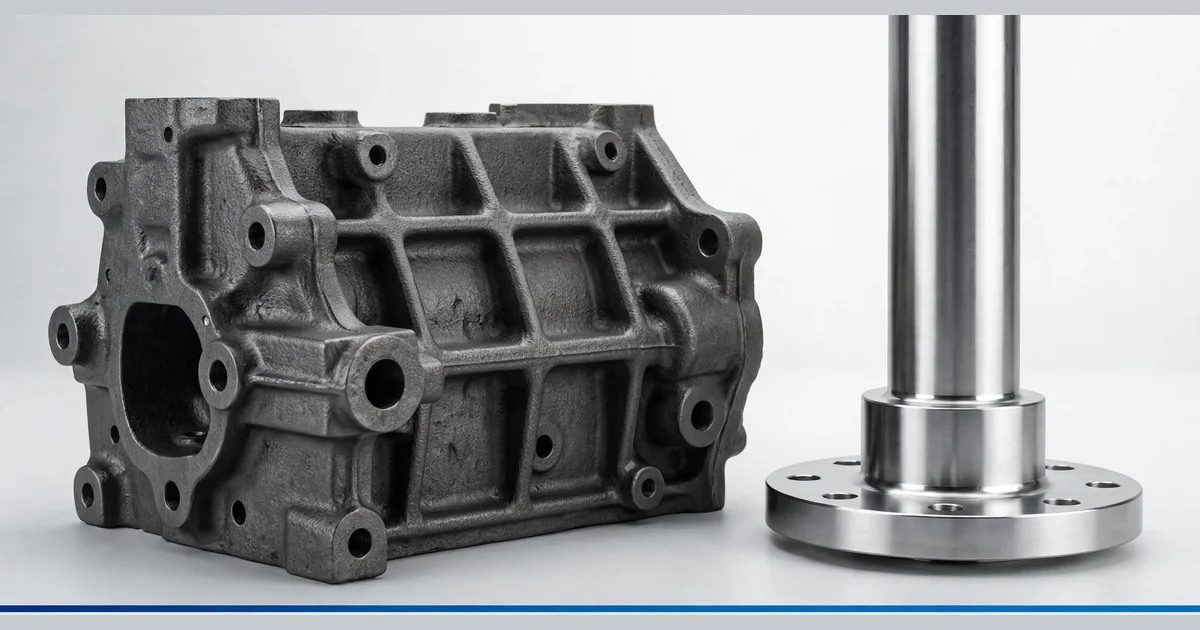
The main difference between cast iron and الفولاذ is carbon. Cast iron has about 2 to 4% carbon, plus silicon, while most steels have less than 1% (and always under about 2.1%). That extra carbon makes cast iron easy to cast, hard, great at damping vibration and strong in compression, but also brittle. Steel has high tensile strength and better hardness control compared to cast iron. It is tougher, can bend before it breaks and can be welded and heat treated.
This guide compares steel and cast iron, explains the use of cast iron vs steel on composition, strength, machinability, welding, corrosion and cost, explains the main types of cast iron, shows how to tell cast iron from steel, and covers the popular cookware question of cast iron vs carbon steel and stainless steel.
| الممتلكات | Cast iron (gray / ductile) | الفولاذ الكربوني |
|---|---|---|
| Carbon content | About 2 to 4% (+1 to 3% silicon) | Usually 0.05 to 1%, below about 2.1% |
| Carbon form | Free graphite flakes or nodules | Dissolved, as iron carbide in the structure |
| نطاق الانصهار | About 1,150 to 1,300 °C | About 1,370 to 1,540 °C |
| الكثافة | About 7.0 to 7.3 g/cm³ | About 7.85 g/cm³ |
| قوة الشد | Gray: about 140 to 410 MPa; ductile: about 410 to 830 MPa | Mild steel about 400 to 550 MPa; alloy steel up to 1,000+ MPa |
| Compressive strength | Very high, gray iron about 3 to 4 times its tensile strength | Similar to its tensile strength |
| Elongation (ductility) | Gray under 1%; ductile 2 to 18% | Typically 15 to 30% |
| Impact toughness | Low (gray), moderate (ductile) | عالية |
| Vibration damping | Excellent (gray iron) | ضعيف |
| قابلية المعالجة الآلية | Excellent for gray iron, dusty chips | Good to fair, depends on grade |
| قابلية اللحام | Poor, needs preheat and nickel rod | Good for low carbon grades |
| قابل للمعالجة الحرارية | محدودة | Yes: harden, temper, case harden |
| Typical standards | ASTM A48 (gray), ASTM A536 (ductile) | AISI 1018, 1045, 4140 and others |
| التكلفة النسبية | Lower for complex castings | Lower for bar, plate and fabrication |
Cast iron is an iron alloy with roughly 2 to 4% carbon and 1 to 3% silicon that is melted and poured into molds, usually sand molds. Because it melts at a lower temperature than steel and flows well, it fills complex shapes like engine blocks, pump housings and machine bases at low cost.
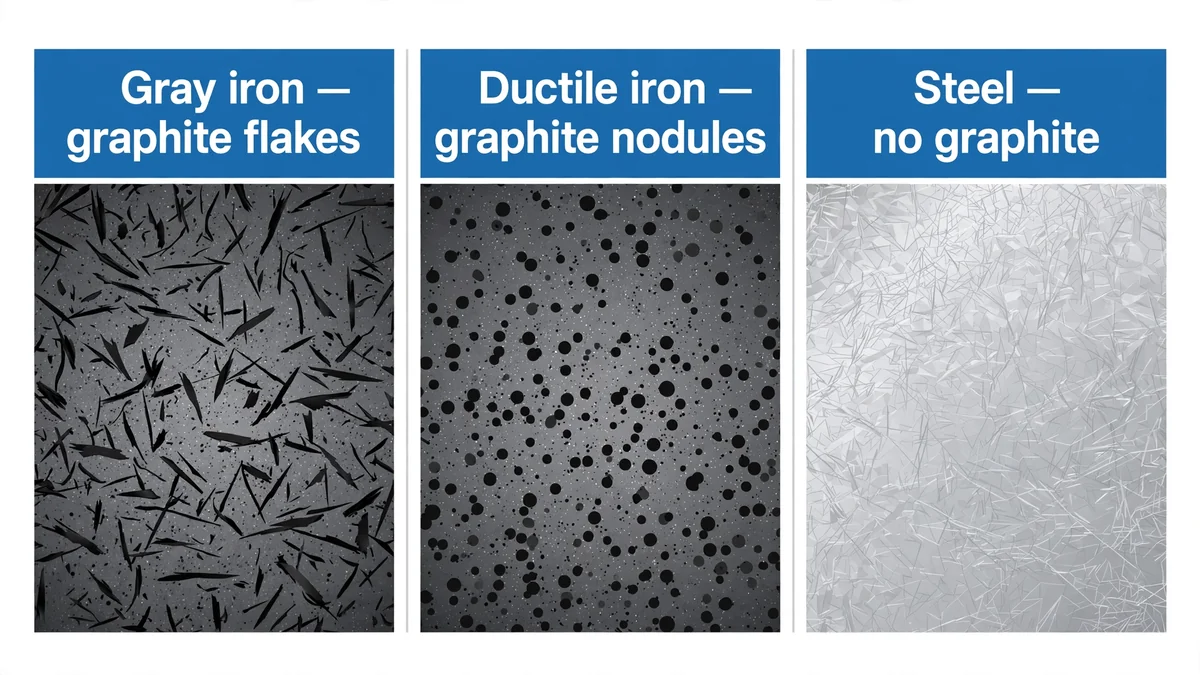
The extra carbon cannot stay dissolved in the iron, so much of it forms free graphite. The shape of that graphite decides the forms of cast iron and their properties, from gray to white cast iron, malleable cast iron and ductile cast iron.
| النوع | Graphite form | Key traits | الاستخدامات الشائعة |
|---|---|---|---|
| Gray iron | Flakes | Easy to machine, damps vibration, brittle in tension | Machine tool beds, brake discs, engine blocks, manhole covers |
| Ductile (nodular) iron | Spheres (nodules) | Much tougher, can bend before breaking | Crankshafts, gears, pipe, suspension parts |
| White iron | Iron carbide, no free graphite | Very hard and wear resistant, very brittle | Grinding balls, slurry pump liners |
| Malleable iron | Irregular clusters after heat treatment | Tougher than gray, good for thin sections | Pipe fittings, brackets, hand tools |
| Compacted graphite iron | Worm-like particles | Between gray and ductile | Diesel engine blocks and heads |
Steel is an alloy of carbon and iron with less carbon, typically 0.05 to 1%, plus elements such as manganese, chromium, nickel and molybdenum. It is made in large volumes as plate, bar, sheet and tube, then rolled, forged, machined and welded into parts.
Both metals start the same way. Iron ore in a blast furnace is reduced with coke to make molten iron, also called liquid iron or pig iron. Pig iron holds about 3.5 to 4.5% carbon, which is too much for most uses, because pure iron is soft and the amount of carbon decides how the metal behaves. Steel and cast iron are both an alloy of iron with carbon; the difference is the percentage of carbon.
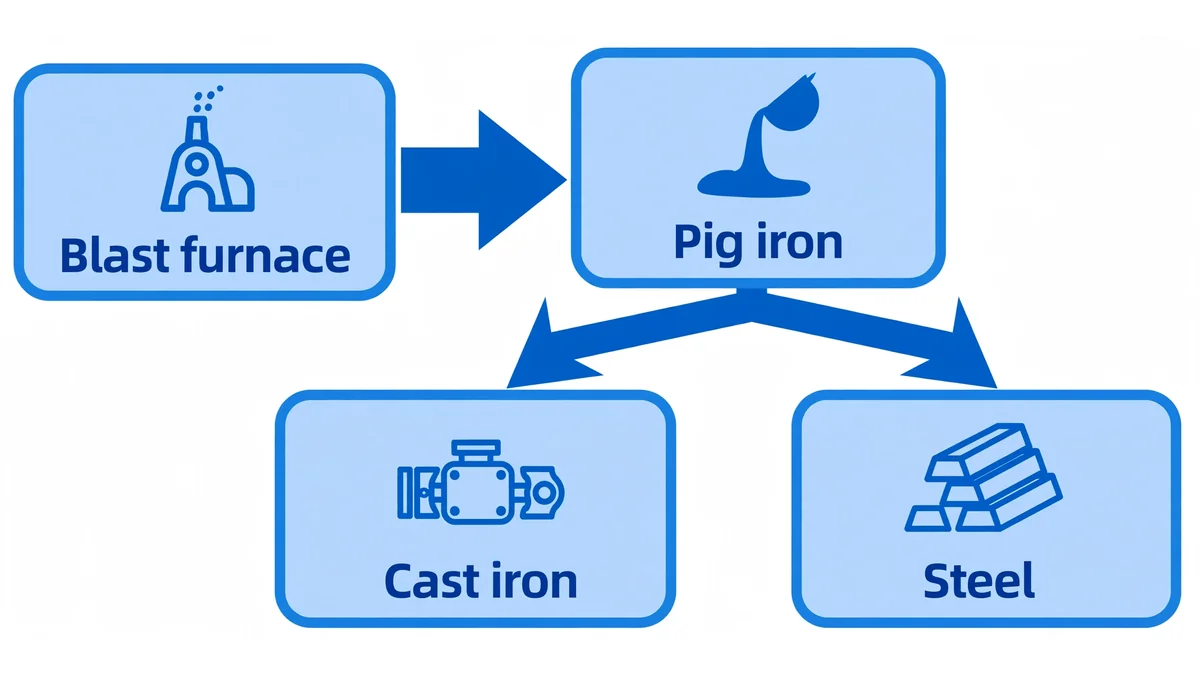
Cast iron is made by remelting pig iron with scrap and adjusting the silicon, then pouring the molten metal into molds. Cast iron is an alloy, and cast iron typically contains 2 to 4% carbon, so its higher carbon content separates into graphite inside the iron matrix. Steel requires the opposite step: oxygen is blown through the liquid iron to burn off most of the carbon, giving raw steel with a carbon percentage under about 2.1%. That raw steel is then cast into slabs and rolled into steel products such as plate, bar and sheet. Low-carbon steel, with under 0.3% carbon, gives the best strength and ductility for forming and welding.
Wrought iron is a third, older material: almost pure iron with fibrous slag, worked by hammering rather than casting. Comparing cast iron and wrought iron shows the extremes: cast iron and wrought iron sit at the high and low ends of carbon, with steel in between.
It depends on the load. Steel is stronger in tension, bending and impact, so it is used for beams, shafts, fasteners and anything that may be hit or stretched. Gray cast iron is very strong in compression, which is why it works well for heavy bases and columns, but it can crack under a sharp blow. Ductile iron closes much of the gap and can replace steel in many castings at lower cost.
The graphite flakes in gray iron act like tiny cracks. That is why a cast iron part usually snaps with little warning, while steel bends and stretches first. Ductile iron, with round nodules instead of flakes, can stretch 10% or more.
Gray cast iron is one of the easiest metals to machine, and much easier to machine than steel. The graphite lubricates the cut and breaks chips into small pieces. The downside is black, abrasive dust that needs extraction. Steel machinability depends on the grade: free machining steels cut easily, while stainless and hardened steels are harder on tools.
Low carbon steel welds easily with standard processes. Cast iron is hard to weld because its high carbon makes the weld zone brittle and prone to cracking. Repairs need careful preheat, nickel-based filler and slow cooling, or brazing instead of welding.
Cast iron has excellent vibration damping and absorbs vibration far better than steel, which is why lathe beds and milling machine frames are cast iron. Cast iron has better sliding wear resistance than steel in many machine slides, as graphite acts as a built-in lubricant.
Both cast iron and carbon steel rust when unprotected. Cast iron often develops a thicker surface scale that can slow attack in some environments, but neither is corrosion resistant without paint, coating or alloying. Only stainless steel resists rust on its own.
Gray iron and carbon steel conduct heat at a similar rate, but cast iron parts are usually thicker and heavier, so they hold heat longer. Cast iron also resists thermal distortion well, which helps in brake discs and exhaust manifolds.
For complex shapes, sand cast iron is usually the cheapest option because the casting comes close to final shape. For simple parts, plates and frames, steel bar and plate is cheaper and faster to buy, cut and weld.
Cast steel is steel (usually 0.1 to 0.5% carbon) poured into molds like cast iron. It is tougher and weldable, but it melts hotter, shrinks more and is harder to cast, so it costs more. Choose cast steel when a complex part also needs impact toughness, such as valve bodies under pressure or heavy equipment parts. Choose cast iron when vibration damping, machinability and low cost matter more. Typical standards are ASTM A27 and A216 for cast steel. Learn how to avoid problems in any casting with our guide to casting defects.
Both are magnetic, so a magnet will not help. Try these checks instead:
| اختبار | الحديد الزهر | الفولاذ |
|---|---|---|
| Spark test (grinder) | Short, dull red sparks with few bursts | Long, bright yellow-white sparks; more bursts as carbon rises |
| File or drill chips | Gray powder and short broken chips | Long curling chips |
| Fracture surface | Gray, grainy (gray iron) | Bright, fine, often with a bent lip |
| الصوت عند الضرب | Dull thud (gray iron) | حلقة شفافة |
| Surface and shape | Parting lines, sand texture, thick sections | Rolled, forged or machined surfaces, welds |

Many people searching for cast iron vs steel are choosing a pan.
| العامل | الحديد الزهر | الفولاذ الكربوني | Stainless steel (clad) |
|---|---|---|---|
| الوزن | Heaviest | About 30 to 40% lighter than cast iron | متوسط |
| Heat up speed | بطيء | سريع | Fast (thanks to aluminum core) |
| Heat retention | ممتاز | جيد | عادلة |
| Seasoning needed | نعم | نعم | لا يوجد |
| Acidic foods | Can react if unseasoned | Can react if unseasoned | No reaction |
| Rust risk | Yes if left wet | Yes if left wet | منخفض جدًّا |
| الأفضل لـ | Searing, baking, cornbread | Woks, crepes, quick searing | Sauces, everyday cooking |
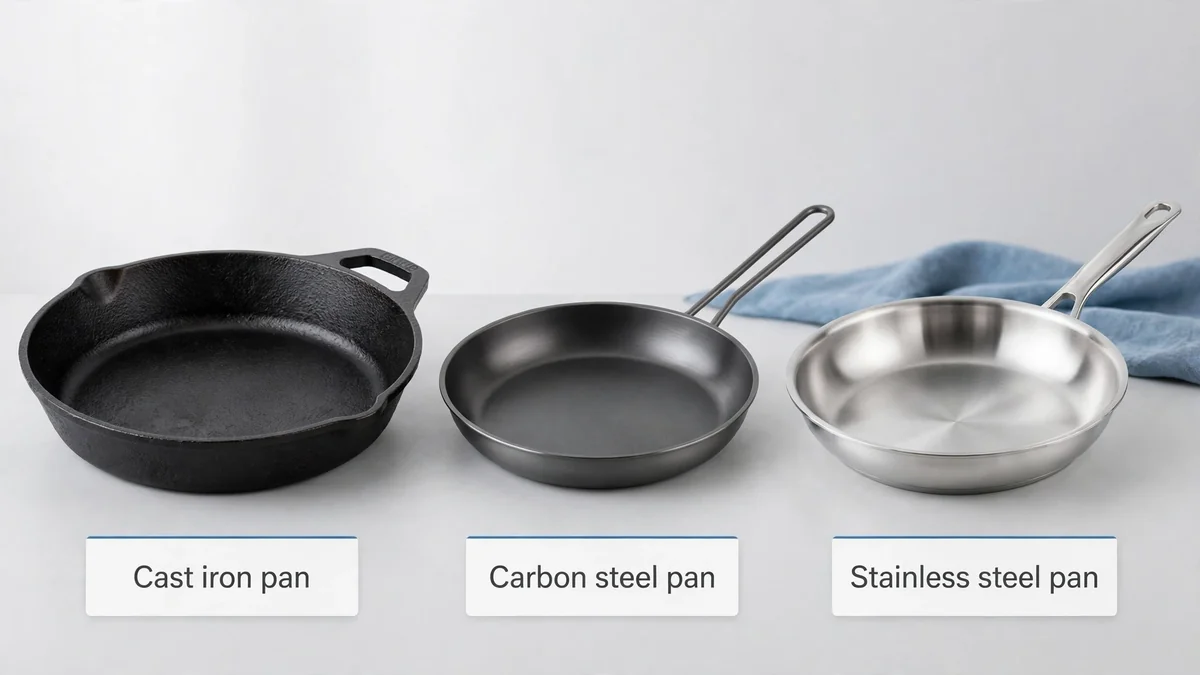
When to use cast iron vs stainless steel: use cast iron when you want steady, stored heat, such as searing steak or baking. Use stainless steel for acidic sauces, boiling and dishes that need quick temperature changes.
Cast iron’s big strength in the kitchen is mass. Cast iron retains heat so well that a preheated cast iron skillet barely cools when food goes in, which makes cast iron ideal for searing. Cast iron cookware and cast iron pans take longer to heat and are heavier, while carbon steel pans are thinner, lighter and more responsive. Steel vs cast iron in the kitchen is really a choice between speed and stored heat.
Tuowei Precision machines carbon steel, alloy steel and stainless steel parts with tight tolerances through its stainless steel CNC machining service. For lighter cast parts, Tuowei offers aluminum and zinc die casting, which can replace small cast iron housings with thinner walls and better surface finish. Read more about صب الزنك بالقالب, or upload your drawing for an عرض أسعار فوري.
Neither is better overall. Cast iron is better for complex, heavy parts that need damping, wear resistance and low cost. Steel is better for parts that need toughness, tensile strength, welding or heat treatment.
Brittleness. Gray cast iron has almost no ductility, so it can crack under impact or bending, and it is difficult to weld.
Steel is stronger in tension and impact. Gray cast iron can match or beat many steels in compression. Ductile iron has tensile strength close to many steels.
Use a spark test, look at the chips when filing or drilling, or check a fracture surface. Cast iron gives short dull sparks, powdery chips and a gray grainy break. A magnet will not tell them apart.
No. Both are iron-carbon alloys, but cast iron has more than about 2% carbon and steel has less. The extra carbon changes how the metal behaves.
Both rust when bare. Cast iron sometimes forms a thicker protective scale, but in practice both need paint, oil, seasoning or coating.