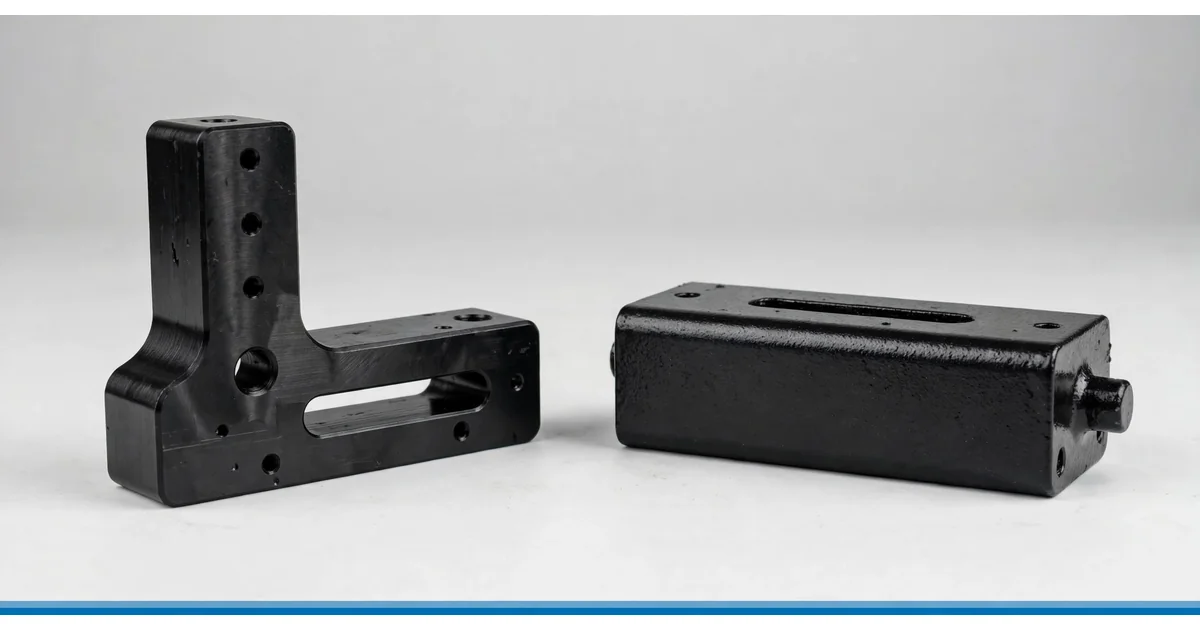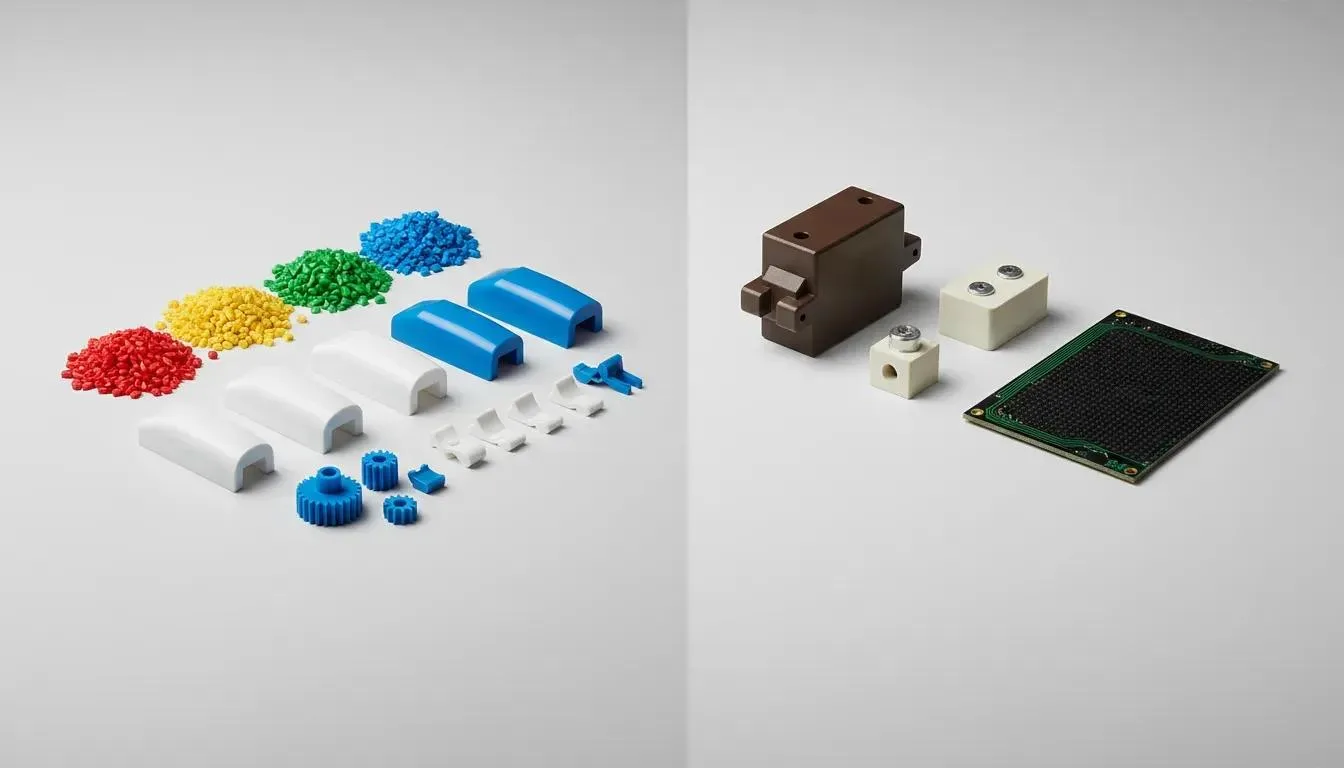
The difference between a thermoset and a thermoplastic comes down to what happens when you heat it. A thermoplastic softens and melts, so you can reshape, remold and recycle it. A thermoset cures once into a rigid, cross-linked network. After that it never melts again: it chars or breaks down instead.
That one difference drives almost every other trade-off: heat resistance, toughness, recyclability, cycle time and tooling cost. Choosing between thermoset materials and thermoplastic materials is one of the first decisions in plastic part design. This guide covers how the two families differ at the molecular level, how their properties compare, how each one is processed, where each is used, and how to choose the right one for your part.
Réponse rapide : Thermoplastics (PE, PP, PVC, ABS, PC, nylon, PEEK) melt when heated and can be remolded and recycled. Thermosets (epoxy, phenolic, polyester, silicone, polyurethane) cure through an irreversible chemical reaction, so they cannot be remelted but keep their shape at higher temperatures and resist chemicals better.
| Propriété | Thermoplastique | Thermosodur |
|---|---|---|
| Molecular structure | Linear or branched polymer chains held by weak intermolecular forces | Chains joined by strong covalent cross-links into a 3D network |
| Response to heat | Softens above Tg, melts above Tm | Does not melt; chars or decomposes at high temperature |
| Reprocessable | Yes, can be remelted and remolded multiple times | No, curing is an irreversible chemical reaction |
| Recyclability | Widely recyclable (regrind, resin codes 1–7) | Hard to recycle; usually ground into filler or landfilled |
| Résistance aux chocs | Generally higher; tends to dent or deform | Generally lower; more brittle unless reinforced |
| Heat resistance | Moderate for commodity grades; high for PEEK, PEI, PPS | High; holds structural integrity under heat and load |
| Stabilité dimensionnelle | Can creep under sustained load and heat | Excellent; very low creep |
| Résistance chimique | Varies widely by polymer | Generally excellent |
| Electrical insulation | Good (many grades) | Excellent, including at elevated temperatures |
| Finition de surface | Glossy, textured or clear finishes straight from the mold | Very good; SMC and BMC parts can be painted to Class A |
| Main processes | Injection molding, extrusion, blow molding, thermoforming, 3D printing, CNC machining | Compression, transfer and reaction injection molding (RIM), resin transfer molding (RTM), casting, lay-up |
| Durée du cycle | Short (seconds) | Longer (cure time, often minutes) |
| Common examples | PE, PP, PVC, PS, ABS, PC, nylon (PA), POM, PEEK | Epoxy, phenolic, polyester, vinyl ester, silicone, polyurethane (thermoset grades), melamine |
A thermoplastic (also called a thermosoftening plastic) is a polymer that becomes soft and moldable when heated and hardens again when cooled. You can repeat that cycle many times. Its long polymer chains are not chemically bonded to each other. Weak intermolecular forces (van der Waals forces and hydrogen bonds) hold them together, and heat overcomes those forces so the chains can slide past one another.
The temperature where an amorphous thermoplastic starts to soften is its glass transition temperature (Tg). Semi-crystalline grades also have a distinct melting point (Tm).
A thermoset (thermosetting plastic, or thermoset polymer) starts as a liquid resin or a soft, moldable compound. During the curing process, heat, a catalyst, a hardener or UV light triggers a chemical reaction that forms covalent cross-links between the polymer chains. The result is one rigid, three-dimensional network.
Curing is a chemical change, not a physical one, so it cannot be reversed. Once cured, the part keeps its material properties even in extreme conditions. Reheat a cured thermoset and it will not melt. Past its limit it chars and decomposes. The thermoset still has a Tg, where it gets softer and more rubbery, but it does not flow.
| Thermoplastique | Type | Utilisations courantes |
|---|---|---|
| Polypropylène (PP) | Semi-crystalline | Living hinges, food containers, automotive interior parts |
| Polyéthylène (HDPE, LDPE) | Semi-crystalline | Bottles, tanks, piping systems, film |
| Polyvinyl chloride (PVC) | Amorphous | Pipe, window profiles, cable insulation, medical tubing |
| Polystyrene (PS, HIPS) | Amorphous | Packaging, disposable cutlery, appliance liners |
| ABS | Amorphous | Housings, enclosures, consumer goods |
| Polycarbonate (PC) | Amorphous | Lenses, light covers, safety guards |
| Nylon (PA6, PA66) | Semi-crystalline | Gears, bushings, clips, under-hood parts |
| Acétal (POM) | Semi-crystalline | Precision gears, cams, low-friction parts |
| PEEK | Semi-crystalline | Aerospace, medical and semiconductor parts |
| Thermosodur | Utilisations courantes |
|---|---|
| Epoxy | Adhesives, coatings, carbon-fiber composites, PCB laminates (FR-4) |
| Phenolic (Bakelite) | Electrical switchgear, handles, brake pads, laminates |
| Unsaturated polyester | Fiberglass boat hulls, bathtubs, SMC/BMC body panels |
| Vinyl ester | Corrosion-resistant tanks and pipe |
| Silicone (LSR and HTV) | Seals, gaskets, medical and food-contact parts |
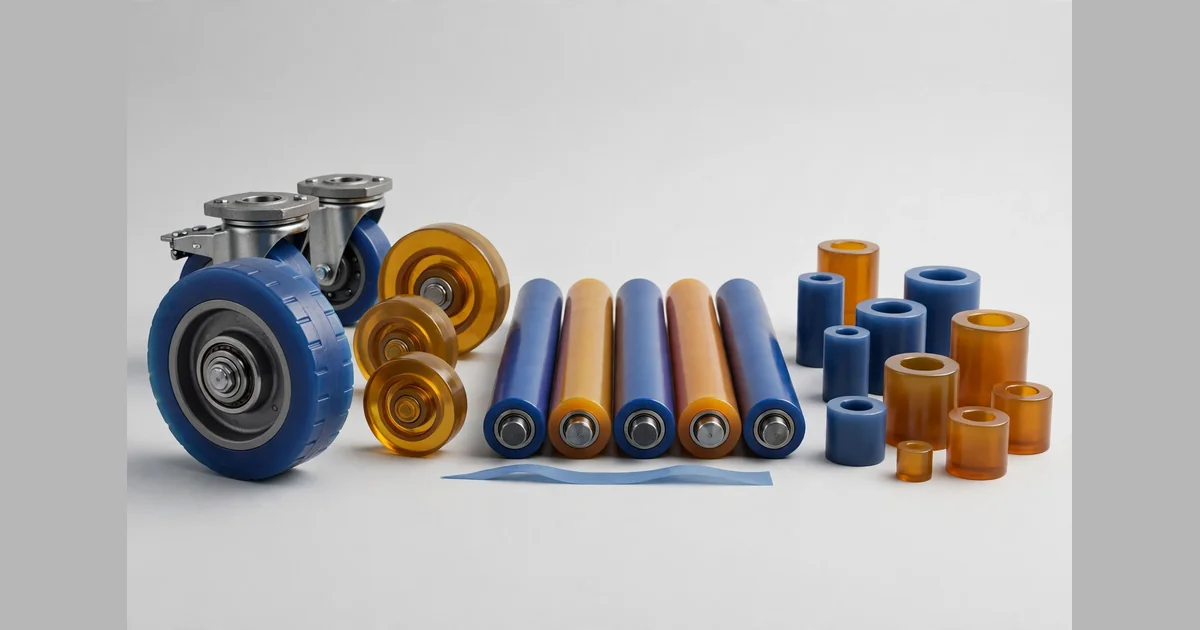
| Polyurethane (thermoset grades) | Foams, rigid RIM housings, wheels and rollers |
| Polydicyclopentadiene (pDCPD) | Large, tough RIM body panels for trucks and agricultural equipment |
| Melamine and urea-formaldehyde | Dinnerware, laminate countertops, electrical fittings |
Powder coatings are thermosets too. The powder melts, flows and then cross-links in the oven, which is why a powder-coated finish is so tough.
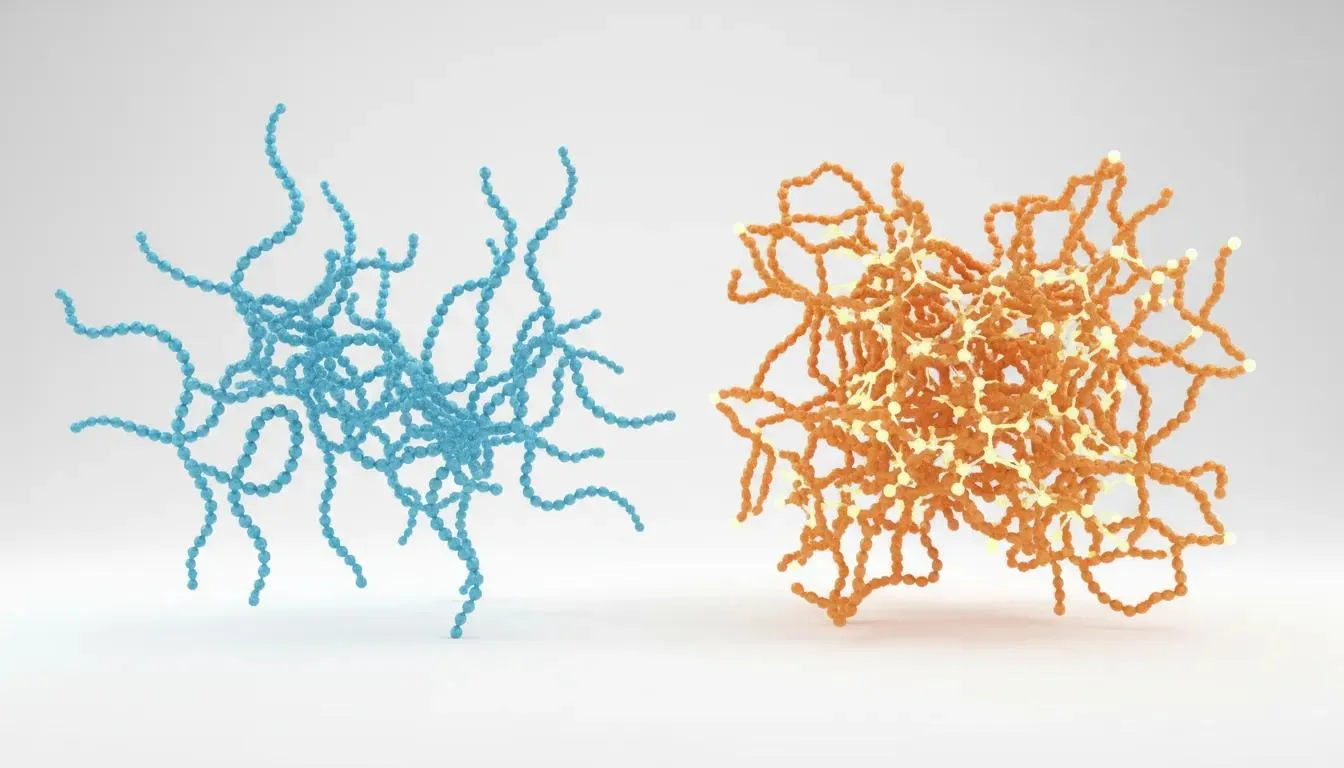
In a thermoplastic, the chains are separate and can move once heated. A thermoset’s chains are tied together by covalent cross-links. Picture cooked spaghetti that you can stir and reshape, compared with a knotted net that holds its form.
Thermoplastics have a temperature limit set by Tg or Tm. Commodity grades such as PP and ABS soften roughly in the 80–110 °C range under load. High-performance grades like PEEK work continuously at about 250 °C. Thermosets never melt, and many epoxies and phenolics keep their shape under load at 150 °C and above. That is why thermosetting plastics are used near engines, motors and electrical arcs, and anywhere a part is exposed to heat for long periods.
Unfilled thermosets are stiff and hard but brittle: they crack rather than bend. Thermoplastics are usually tougher and absorb impact by deforming. Add glass or carbon fiber and both families get much stronger. Fiber-reinforced thermosets such as carbon/epoxy are still the benchmark for structural composites. Fiber-reinforced thermoplastics (glass-filled nylon, carbon-filled PEEK) are catching up because they mold faster and can be recycled.
The dense cross-linked network makes most thermosets very hard for solvents and acids to penetrate. That is why vinyl ester and epoxy line chemical tanks and pipes. Thermoplastic chemical resistance depends on the grade: PP, PE, PVDF and PEEK resist many chemicals, while ABS and PC can be attacked by solvents.
Thermoplastics can be remelted, so sprues, runners and end-of-life parts can be reground and reused. Thermosets can’t be remelted. They are mostly ground into filler, burned for energy or landfilled. Researchers are working on recyclable thermosets (vitrimers, for example), but they are not yet common in production.
Thermoplastics are molded hot and cooled in the mold, so cycles take seconds. That suits high volumes. Thermosets have to cure inside a heated mold or react after being mixed. Cycles are longer, but compression-molding and RIM tools can be simpler and cheaper for large parts and lower volumes.
| Processus | Thermoplastique | Thermosodur |
|---|---|---|
| Moulage par injection | Main process: melt, inject, cool, eject | Possible with BMC, phenolic and LSR, using a heated mold to cure |
| Compression molding | Rarely used | Common for SMC, BMC, phenolic and rubber |
| Reaction injection molding (RIM) | Not used | Two liquid components react in the mold (PU, pDCPD) |
| Resin transfer molding (RTM) | Not used | Resin injected into a closed mold holding dry fiber |
| Extrusion | Pipe, profiles, sheet, film | Limited (pultrusion for fiber composites) |
| Thermoformage | Heated sheet formed over a mold | Not possible |
| Impression 3D | FDM, SLS and MJF | SLA and DLP photopolymer resins (UV-cured thermosets) |
| Usinage CNC | Easy to machine, but watch heat build-up | Machinable; glass-filled grades need carbide or diamond tooling and dust extraction |
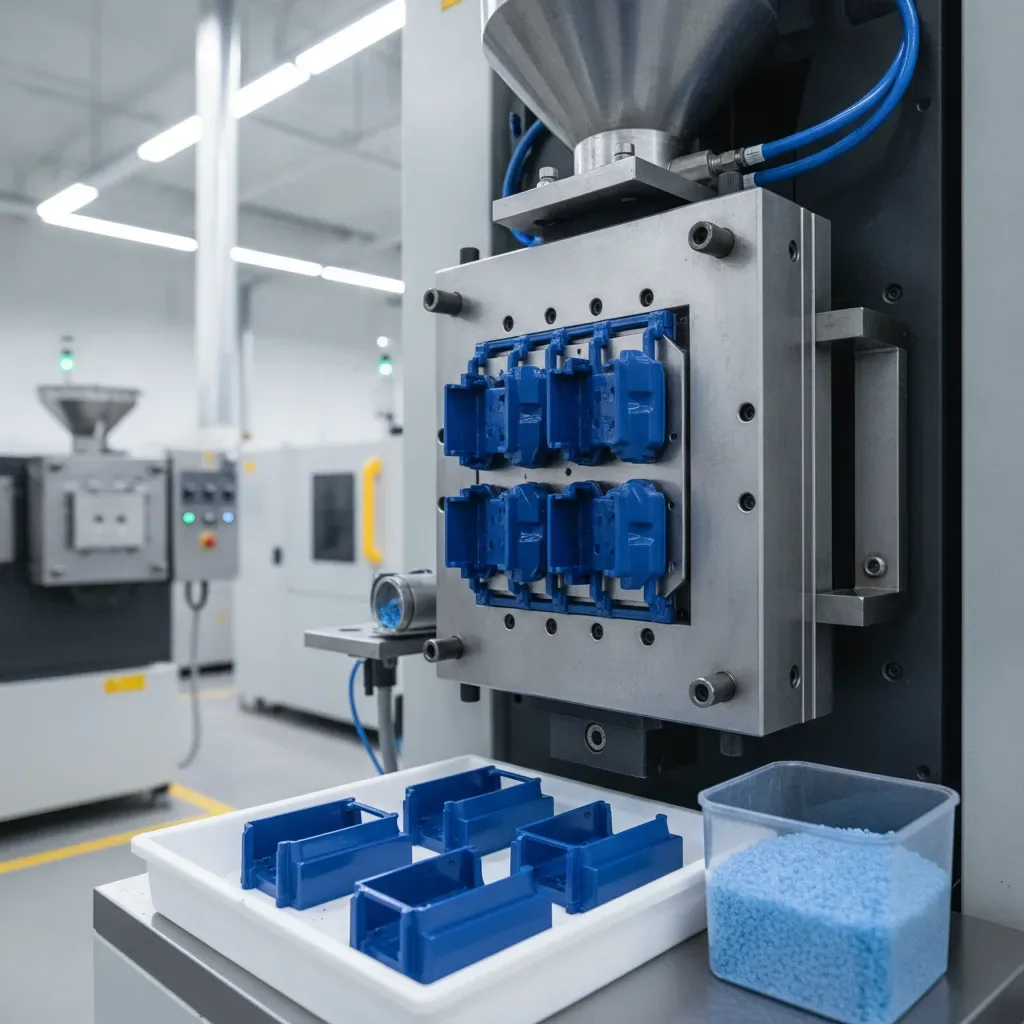
At Tuowei Precision, thermoplastic parts usually go through moulage par injection de plastique for production or CNC machining for prototypes. Large, low-volume thermoset parts can be made by moulage par injection de réaction. See thermoforming vs injection molding for the sheet-based route, or what is FDM 3D printing for fast thermoplastic prototypes.
| L'industrie | Typical thermoplastic parts | Typical thermoset parts |
|---|---|---|
| Automobile | Bumpers, interior trim, clips, fuel lines (PP, ABS, PA) | Under-hood electrical parts, brake pads, SMC body panels |
| Aérospatiale | Cabin interiors, brackets, ducting (PEI, PEEK) | Carbon/epoxy structural composites, radomes |
| Electrical and electronics | Connectors, housings, cable insulation (PA, PBT, PVC) | Circuit boards (FR-4), switchgear, motor insulation |
| Medical | Syringes, housings, tubing (PP, PC, PVC) | Silicone seals and implants, dental resins |
| Consumer goods | Appliance housings, toys, packaging (ABS, PP, PS) | Cookware handles, melamine dinnerware |
| Alimentation et boissons | Containers, conveyor parts (PP, HDPE, POM) | Food-grade silicone seals, gaskets |
| Construction and piping | Pipe, window profiles, membranes (PVC, HDPE) | Fiberglass tanks, vinyl ester pipe, insulation foam |
Elastomers are rubbery polymers that stretch a long way and spring back. Conventional rubbers such as EPDM, nitrile and silicone rubber are lightly cross-linked, which makes them thermosets. Thermoplastic elastomers (TPE and TPU) behave like rubber at room temperature but melt like a thermoplastic, so they can be injection molded and recycled. Read our guide to TPE material for grades and Shore hardness.
| Thermoplastique | Thermosodur | Elastomer | |
|---|---|---|---|
| Cross-linking | Aucun | Dense | Light (or physical, in TPE) |
| Ressentir | Rigid to semi-flexible | Rigid, hard | Soft, stretchy |
| Remeltable | Oui | Non | TPE yes; vulcanized rubber no |
| Examples | ABS, PP, PC, nylon | Epoxy, phenolic, polyester | EPDM, nitrile, silicone rubber, TPE, TPU |
Choose a thermoplastique when:
Choose a thermoset when:
If a thermoplastic almost meets the temperature requirement, consider a high-performance grade such as PEEK, PEI or PPS before switching families. Not sure which one fits? Send us your drawing and our engineers will recommend a material and process.
What is the main difference between a thermoset and a thermoplastic?
A thermoplastic melts when heated and can be remolded. A thermoset cures irreversibly into a cross-linked network and will not melt again.
Is PVC a thermoplastic or a thermoset?
PVC is a thermoplastic. It softens when heated, which is why it can be extruded into pipe and profiles and thermoformed.
What are 5 examples of thermoplastics?
Polyethylene, polypropylene, PVC, ABS and polycarbonate. Nylon, acetal and PEEK are other common engineering thermoplastics.
What is an example of a thermoset?
Epoxy is the most familiar example. Phenolic (Bakelite), unsaturated polyester, silicone and melamine are also thermosets.
Which is stronger, thermoset or thermoplastic?
Thermosets are usually stiffer and keep their strength better at high temperatures. Thermoplastics are usually tougher and better at taking impacts. With fiber reinforcement, both can reach very high strength.
Can thermosets be recycled?
They cannot be remelted, so recycling is limited. Cured scrap is usually ground and used as filler.
Is polyurethane a thermoset or a thermoplastic?
It can be either. Foams and cast or RIM polyurethanes are thermosets. TPU is a thermoplastic.
Is nylon a thermoset or a thermoplastic?
Nylon (polyamide) is a semi-crystalline thermoplastic.
Is epoxy a thermoplastic?
No. Epoxy is a thermoset. Once the resin and hardener react, it cures permanently and cannot be remelted.