Young’s modulus (E) measures how stiff a material is when it is pulled or pushed along one axis. It is the ratio of stress to strain in the elastic range: E = σ / ε. A high value means the material stretches very little under load. Structural steel sits around 200 GPa, aluminum alloys around 69 to 72 GPa, and titanium alloys around 105 to 114 GPa, so an aluminum part deflects roughly three times as much as an identical steel part under the same load.
The property is also called the modulus of elasticity, elastic modulus or tensile modulus. All four names refer to the same number.
Picture a metal rod hanging from a ceiling with a weight on the end. The rod gets slightly longer. Double the weight and, as long as you stay below the yield point, the stretch doubles too. That straight-line relationship is Hooke’s law, and the slope of that line is the modulus of elasticity.
Two terms do the work here:
Because strain is dimensionless, the modulus carries the same units as stress. Engineers almost always quote it in gigapascals (GPa) or in millions of psi (Msi).
The full formula combines both definitions:
E = σ / ε = (F × L₀) / (A × ΔL)
Rearranged, it predicts how much a part will stretch: ΔL = (F × L₀) / (A × E).
Worked example. A 6061-T6 aluminum bar is 500 mm long with a 20 mm × 20 mm section (A = 400 mm²). It carries a 10 kN tensile load. Take E = 68.9 GPa (68,900 N/mm²).
Swap the bar for carbon steel (E ≈ 200 GPa) and the stretch drops to about 0.06 mm. Same load, same shape, one-third of the deflection. That difference is why a frame that feels rigid in steel can feel springy when redesigned in aluminum without changing its section.
The usual symbol is E. Some physics texts write Y, but engineering drawings and standards use E. Common unit conversions:
| Unit | Equivalent |
|---|---|
| 1 GPa | 1,000 MPa = 1,000 N/mm² |
| 1 GPa | 145,038 psi ≈ 0.145 Msi |
| 1 Msi (10⁶ psi) | 6.895 GPa |
| 29,000 ksi | ≈ 200 GPa (common steel design value) |
Mixing MPa and GPa is the most frequent arithmetic error we see in hand calculations. Keep everything in N and mm, and use the modulus in N/mm² (MPa).
The table lists typical room-temperature values. Treat them as design starting points, not certified figures. Supplier data sheets and test reports govern for critical parts.
| 材料 | E (GPa) | E (Msi) |
|---|---|---|
| Carbon steel (A36, 1018, 1045) | 200 to 210 | 29 to 30 |
| 304/316不锈钢 | 190 to 200 | 27.6 to 29 |
| 铝 6061-T6 | 68.9 | 10.0 |
| Aluminum 7075-T6 | 71.7 | 10.4 |
| Titanium Grade 2 (CP) | about 105 | 15.2 |
| 5级钛合金(Ti-6Al-4V) | about 114 | 16.5 |
| 铜 C110 | about 115 | 17 |
| 黄铜 C360 | about 97 | 14 |
| Gray cast iron | 66 to 157 (grade dependent) | 9.6 to 22.8 |
| PEEK (unfilled) | about 3.6 | 0.52 |
| Acetal (POM) | about 2.8 to 3.1 | 0.41 to 0.45 |
| ABS | about 2.0 to 2.4 | 0.29 to 0.35 |
| Nylon 6/6 (dry) | about 2.5 to 3.0 | 0.36 to 0.44 |
Two patterns stand out. First, the modulus barely changes within an alloy family. All steels sit near 200 GPa whether they are mild or hardened. Second, plastics are 20 to 100 times less stiff than metals, which matters far more for deflection than their lower strength.
Historic reference data on these values comes from sources such as the NBS Circular 447, Mechanical Properties of Metals and Alloys (NIST).
No. This is the most common misunderstanding about the property.
Stiffness and strength are different things. The modulus describes how much a part deflects under load. 屈服强度 describes how much load it can take before it bends permanently. Heat treating 4140 steel can more than double its yield strength, yet the modulus stays at roughly 205 GPa. Likewise, 7075-T6 aluminum is much stronger than 6061-T6, but the two have almost the same stiffness.
In practice this means you cannot fix a part that flexes too much by switching to a stronger grade of the same metal. You fix it by adding material where it counts (a deeper section, ribs, a larger diameter) or by moving to a stiffer material family. Our guide to choosing the best aluminum alloy for CNC machining covers this trade-off for aluminum grades.
For isotropic materials, three elastic constants are linked:
G = E / [2(1 + ν)]
Here G is the shear modulus and ν is 泊松比. For steel, with E ≈ 200 GPa and ν ≈ 0.29, G works out to roughly 78 GPa. If you know any two values, you can calculate the third. We cover shear behavior in detail in our article on shear modulus and material rigidity.
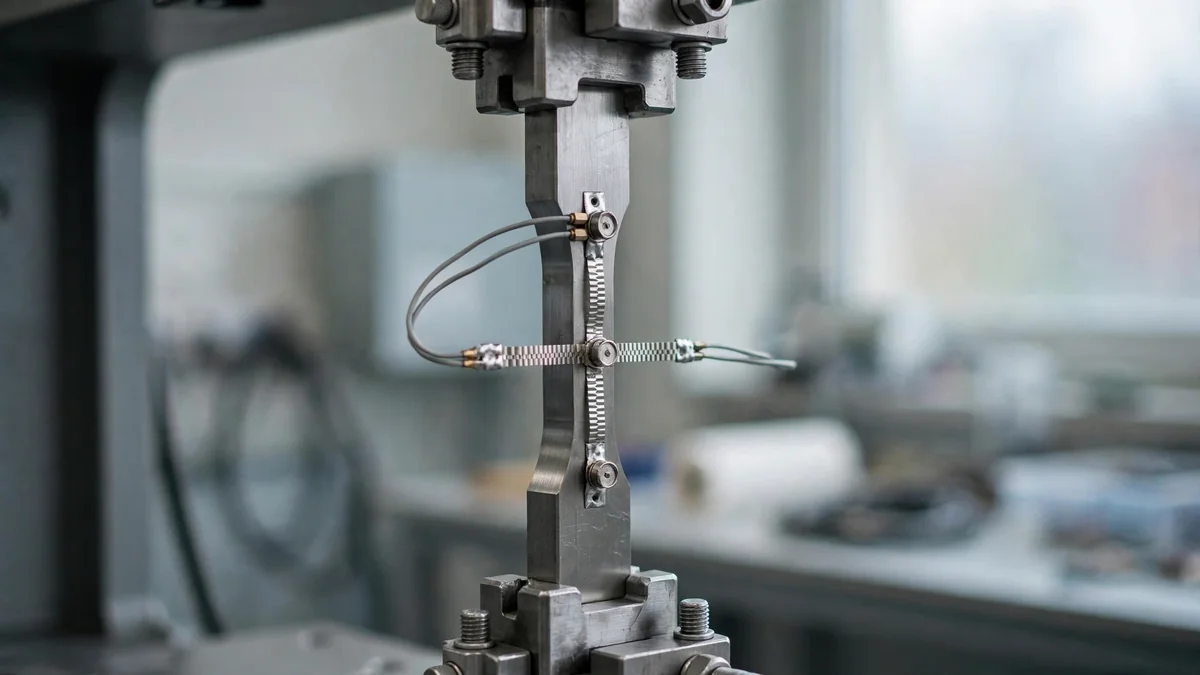
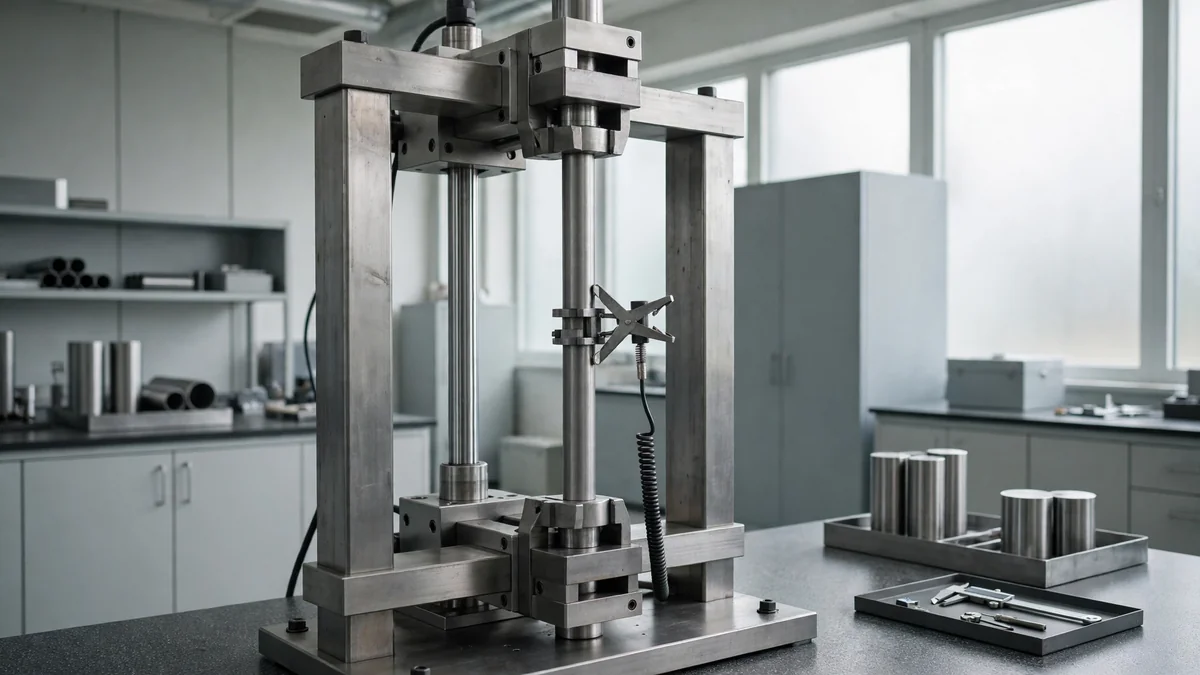
The standard method for structural materials is ASTM E111, Standard Test Method for Young’s Modulus, Tangent Modulus, and Chord Modulus. A specimen is loaded in tension or compression while an extensometer records strain, and E is taken from the slope of the straight part of the stress-strain curve.
Two details from that standard trip people up:
Non-destructive options also exist. Ultrasonic and resonance methods measure how fast sound travels through the material and calculate E from density, which suits finished parts and ceramics.
Less than most people expect, for metals at least. Alloying, cold work and heat treatment shift it by only a few percent. The factors that do matter:
Stiffness shows up in machining as well as in service. Low-modulus materials push away from the cutter, so thin aluminum walls and long plastic features chatter and spring back. On a 1 mm aluminum rib, deflection during finishing can exceed a ±0.02 mm tolerance unless the toolpath uses light, multiple passes or the part is supported. Plastics like POM and PEEK need similar care.
A practical warning: designers sometimes switch a steel bracket to aluminum to save weight and keep the same thickness. Weight drops by about two-thirds, but deflection triples, and the part fails stiffness checks it used to pass. Run a deflection estimate with the new modulus before releasing the drawing.
If you are weighing metals for a part, our 数控加工服务 team can review stiffness and machinability before quoting, and the materials page lists every grade we stock.
Engineering standards, drawings and design codes use E, which comes from “elasticity.” Some physics textbooks use Y instead. Both symbols refer to the same property: the ratio of tensile or compressive stress to strain in the elastic range. Use E in engineering calculations to match material data sheets.
Elastic modulus has the same units as stress because strain has no units. The SI unit is the pascal, but values are usually given in gigapascals (GPa). In US customary units, it is quoted in psi or Msi. One GPa equals about 145,000 psi, and steel is close to 29 Msi.
Carbon and low-alloy steels are about 200 to 210 GPa (29 to 30 Msi). Common aluminum alloys such as 6061-T6 and 7075-T6 are about 69 to 72 GPa (10 to 10.4 Msi). Steel is therefore close to three times stiffer, so aluminum parts need larger sections to match its deflection.
Among engineering metals, tungsten is one of the stiffest, at roughly 400 GPa, about twice the stiffness of steel. Molybdenum is also high, at around 330 GPa. These metals are used where deflection must be minimal. They are dense, costly and harder to machine than steel, so they are chosen only when stiffness justifies it.
Divide stress by strain within the elastic range. Measure the force and divide it by the cross-sectional area to get stress, then divide the change in length by the original length to get strain. In formula form, E = (F × L₀) / (A × ΔL). Testing to ASTM E111 gives reliable values.
The modulus of elasticity tells you how much a part will deflect, not how much load it can survive. Use it to compare material families, predict stretch and bending, and check whether a lighter material will still meet stiffness targets. Pair it with yield strength for the full picture.
Have a design where stiffness is critical? Send your drawing for a free instant quote and our engineers will flag material or geometry risks before machining starts. Learn more about 拓维精密 and the industries we support.