Medical Devices · Precision CNC Machining

Medical Precision Machining for Devices, Implants and Instruments

Tuowei Precision provides medical precision machining for device makers who need narrow limits, clean surfaces and full traceability. We use advanced CNC machining centers, 5-axis milling and Swiss-type turning to make parts in titanium, stainless steel, PEEK and aluminum, with tolerances down to ±0.005 mm under an ISO 13485 certified quality system.
Tous les téléchargements sont sécurisés et confidentiels
ISO 13485
±0.005 mm tolerances
5-axis and Swiss-type
Contrôle par machine à coordonnées (CMM)
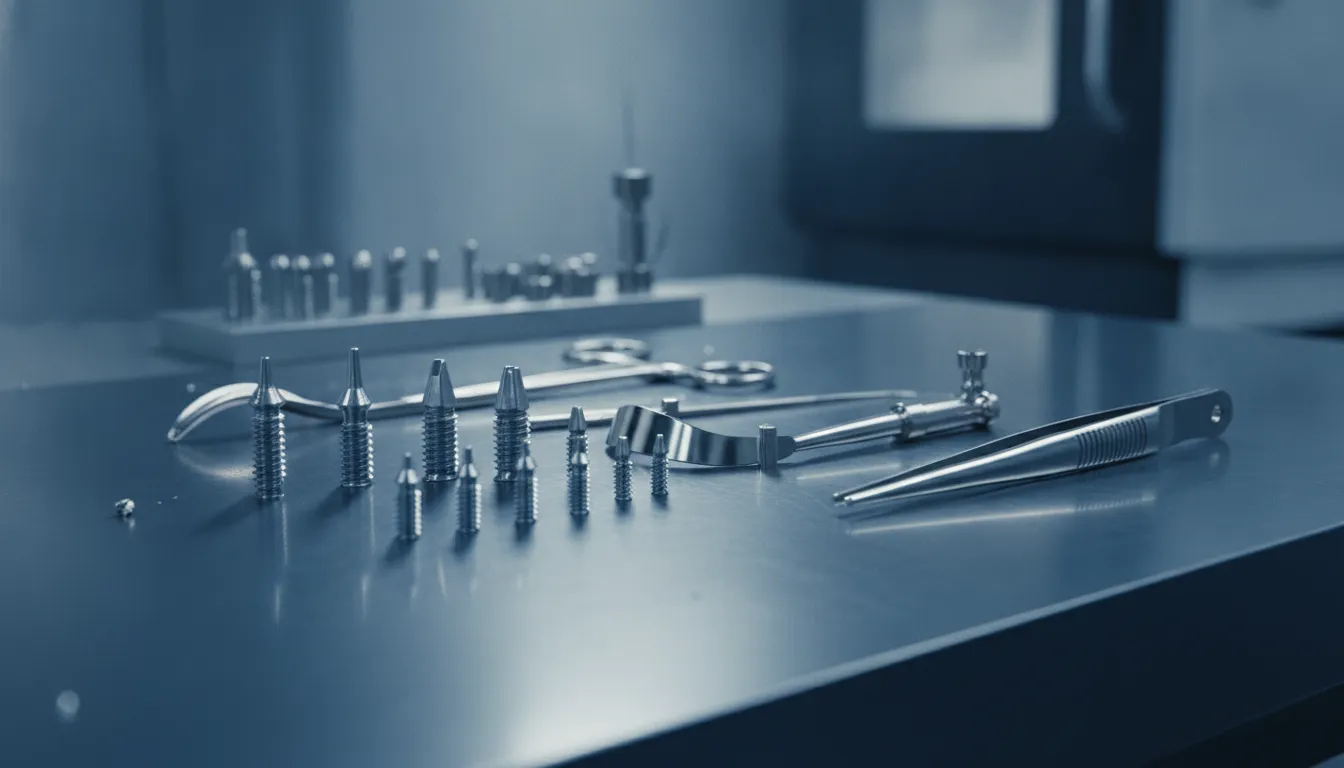
Fabrication de dispositifs médicaux : vis osseuses en titane et pièces d'instruments chirurgicaux en acier inoxydable usinées par CNC
Why Precision

The Role of Precision Machining in Medical Devices and Components

In most sectors a part that is slightly out of tolerance causes an assembly problem. In the medical industry it can cause a failed implant, a jammed surgical instrument or a leaking fluid connection, and patient safety is at stake. Medical machining is about more than accuracy on one part; it is about producing the same parts thousands of times, and proving it with records. That is how reliable medical devices are built in the medical sector.

Computer numerical control (CNC) gives that repeatability. A CNC machine follows the same programme for every workpiece, and with a stable fixture and a defined inspection plan, critical features stay inside tolerance from the first article to the last lot. Machining allows complex medical shapes without tooling.

Processus

Precision CNC Machining Services for the Medical Industry

Fraisage CNC 5 axes

Usinage CNC à 5 axes reaches five sides of a part in one setup. That suits machining complex parts such as orthopedic implants, instrument jaws and housings, because fewer setups mean fewer chances for errors from repositioning. Part sizes range from 5 × 5 × 5 mm up to 4000 × 1500 × 600 mm.

Swiss-Type Turning

Swiss-type CNC turning on a sliding-headstock metal lathe supports the bar close to the cutting tool, so long, slender parts stay straight. It is the right process for bone screws, pins, dental implant parts and catheter components. See our Tournage CNC services.

Precision CNC Milling and Turning With Live Tooling

3- and 4-axis milling handles plates, brackets and housings; turning centers with live tooling add flats, slots and cross-holes to round parts in the same setup.

Deburring and Finishing

Burrs are not acceptable on any medical device part. Edges are deburred and inspected under magnification, then finished by passivation, electropolishing, anodizing or bead blasting.

Pièces

Medical Device Machining for the Medical Device Industry

  • Orthopedic implants: bone screws, plates, spinal cages and trial implants
  • Precision surgical instruments: forceps jaws, handles, shafts and drill guides
  • Dental components: implant abutments, surgical guides and handpiece parts
  • Diagnostic and imaging medical equipment: MRI and CT scan housings, brackets and mechanisms
  • Minimally invasive surgery tools: endoscope and catheter components
  • Fluid delivery: connectors, valves and manifolds
  • Lab equipment and instrumentation: sample holders and fixtures, plus prosthesis parts

These precision components for medical applications serve medical manufacturers, surgeons and patients across health care, which you can see on our fabrication de dispositifs médicaux page.

Matériaux

Biocompatible Materials for Medical Component Manufacturing

Biocompatibility, strength, weight and sterilization method decide the biomaterial. All metals come from approved suppliers with material certificates.

MatériauUtilisation médicale couranteMachining note
Titane de grade 5 (Ti-6Al-4V)Implants, instrumentsStrong and light; needs sharp tools and controlled heat
Titane Grade 2Dental and implant partsCommercially pure, very corrosion resistant
Acier inoxydable 316LInstruments, implants, fittingsLow carbon, good corrosion resistance after passivation
Acier inoxydable 17-4PHInstruments needing hardnessHeat treatable for strength and wear
PEEKSpinal implants, instrument partsRadiolucent, so it does not block X-ray images
Aluminum 6061 / 7075Housings, equipment partsLight, easy to machine and anodize
Tolérances

Engineering Tolerances and Precision in Medical Devices

Medical device components need exceptional precision, tight tolerances and reliable records. We hold tolerances down to ±0.005 mm on critical features of small machined parts. Standard work typically runs ±0.05 mm or better, depending on geometry and material. We recommend narrow limits only where the function needs them, because every extra decimal adds machining and inspection time.

Quality control is built into production: drawing review, first article inspection, in-process checks and final measurement with coordinate measuring machines (CMM). Medical orders include material certificates, CMM reports and dimensional records against the specification, and our quality system is certified to ISO 13485, which supports customers selling to Food and Drug Administration (FDA) regulated markets. Details are on our l'assurance qualité page.

Our Machinists

Precision and Repeatability: How Our Machinists Work

Technology alone does not make a good medical part. Our machinists prove out each programme on the first piece, check critical features before the batch runs, and record tool changes that could affect size or surface finish. That discipline gives both precision and accuracy: parts are close to nominal and close to each other. For customers in orthopedic surgery, dental and diagnostics, this reliability of medical components matters more than raw machine speed, because it drives better medical outcomes, and it is what turns advanced machining into dependable machining solutions for medical products.

Challenges

Challenges in the Medical CNC Machining Process

  • Titanium heat and tool wear: rigid setups, sharp tooling and conservative cutting data protect surface integrity
  • Micro features: Swiss-type turning and small tools for features under a millimetre, the hardest test of our machining capabilities
  • Burrs in threads and cross-holes: dedicated deburring steps and magnified inspection
  • Contamination: separate handling, cleaning and packaging for implant-grade parts
  • Documentation: inspection plans agreed before production, so records are complete on delivery
Du prototype à la production

From Prototype to Mass Production in Medical Manufacturing

The manufacturing process needs no tooling, so it is the fastest route from a CAD file to a functional medical prototype. Most CNC medical prototypes ship within 5–7 business days. Small batches of 101 to 10,000 pieces typically take 5–15 business days. Learn more on our prototypage de dispositifs médicaux page, or see how machining fits into our fabrication en sous-traitance de dispositifs médicaux service.

Pourquoi Tuowei ?

Why Choose Tuowei for CNC Machining for Medical Devices

  • Advanced manufacturing: 130+ three-, four- and five-axis CNC machines in Shenzhen
  • Swiss-type turning for small, slender components
  • Tolerances down to ±0.005 mm and smooth surface finish for custom medical parts
  • Precision and quality backed by ISO 13485, ISO 9001:2015 and AS9100D certification
  • Material certificates and CMM reports with medical orders
Demander un devis

Start Your Medical Machining Project

Upload your 3D file and drawing with quantity, material, finish and critical tolerances. Our engineers will review manufacturability and return a quote with DFM suggestions.

Obtenir un devis immédiat
🔒 Tous les fichiers téléchargés sont sécurisés et confidentiels
Prenez contact avec nous !
Réponse rapide garantie dans les 24 heures
🔐 Tous les téléchargements sont sécurisés et confidentiels
— Foire aux questions —

Questions fréquemment posées

Dispositifs médicaux
Qu'est-ce qu'un CNC dans le domaine médical ?

L'usinage médical CNC utilise des fraiseuses et des tours à commande numérique pour usiner des implants, des instruments chirurgicaux et des composants de dispositifs médicaux à partir de métal ou de plastique. Il permet d'obtenir des tolérances serrées, des formes complexes et une qualité constante sans nécessiter d'outillage, ce qui convient aussi bien à la fabrication de prototypes qu'à la production en série dans le domaine des technologies médicales.

Quelles tolérances l'usinage de précision médical permet-il d'atteindre ?

Nous respectons des tolérances allant jusqu'à ±0,005 mm sur les caractéristiques critiques des petites pièces, les tolérances standard étant généralement de ±0,05 mm ou mieux. La tolérance réalisable dépend du matériau, de la taille et de la géométrie, et nous ne recommandons des limites étroites que lorsque la fonction l'exige.

Quels matériaux usinez-vous pour la fabrication de dispositifs médicaux ?

We machine titanium Grade 2 and Grade 5 (Ti-6Al-4V), stainless steel 316L and 17-4PH, PEEK, aluminum 6061 and 7075, and plastics such as POM and PC. Medical orders ship with material certificates that trace each part to its raw material lot.

Can you machine medical implants?

Yes. We machine bone screws, plates and other implant components in titanium and PEEK. Surface integrity and cleanliness are protected through deburring, magnified inspection and careful handling, and implantable-device orders ship with material certifications and inspection reports.

How much does it cost to machine a medical component?

Price depends on material, part size, number of setups, tolerances, finish and inspection requirements. Titanium and narrow limits cost more to machine than aluminum with standard limits. Send your drawing and quantity for a quote with DFM suggestions that can lower cost.