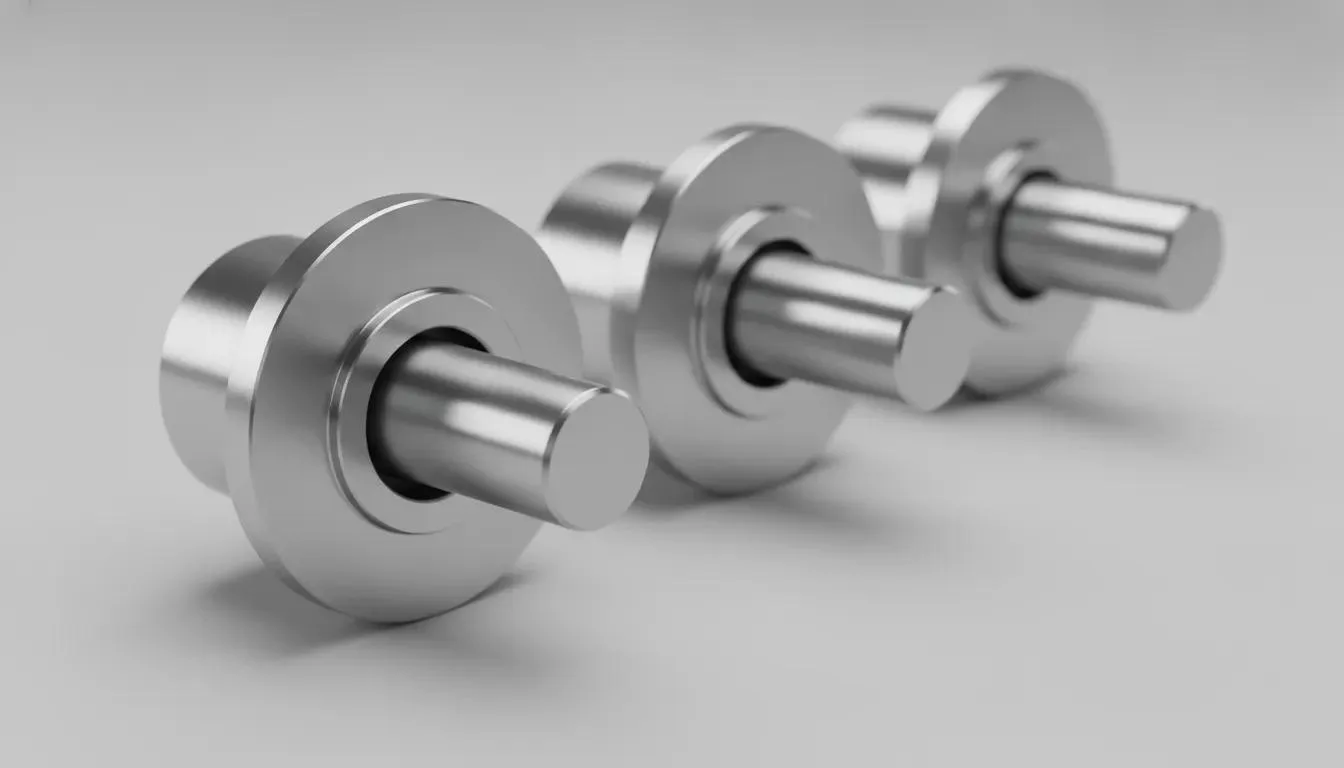
In mechanical engineering, a fit describes the dimensional relationship between two mating parts, usually a shaft and a hole. There are three main types of engineering fits:
Fit selection determines whether the parts slide freely, locate accurately or lock together. It also sets which machining processes you need and what the part costs. This guide covers the terms, tolerance zones, the ISO and ANSI fit systems, worked examples with real numbers, and how to pick the right fit.
简答: The three types of fits are clearance (always a gap, e.g. H7/g6), transition (small gap or small overlap, e.g. H7/k6) and interference (always an overlap, e.g. H7/p6). They are defined in ISO 286 and ANSI B4.1.
Fits and tolerances work together: the tolerance on each part decides which fit you actually get. Before choosing a fit, it helps to know the vocabulary of limits and fits used on drawings and in the ISO 286 standard.
| Term | 含义 |
|---|---|
| Nominal (basic) size | The size both parts are designed around, e.g. Ø25 mm |
| 极限 | The largest and smallest allowed sizes of a feature (upper and lower limits) |
| 宽容 | The difference between the upper and lower limits |
| Deviation | How far a limit sits from the nominal size (upper and lower) |
| Fundamental deviation | The deviation closest to nominal, shown by a letter (H, g, p…) |
| Tolerance zone | The band between the upper and lower limits, drawn relative to the nominal size |
| IT grade | International Tolerance grade, IT01 to IT18; a lower number means a tighter tolerance range |
| Allowance | The intended difference between the parts at maximum material (tightest condition) |
In ISO notation, uppercase letters describe holes 和 lowercase letters describe shafts. A fit is written hole over shaft, for example H7/g6: an H hole at tolerance grade IT7 with a g shaft at IT6.
Every fit is decided by where the hole’s tolerance zone sits relative to the shaft’s. Picture a horizontal line at the nominal size:
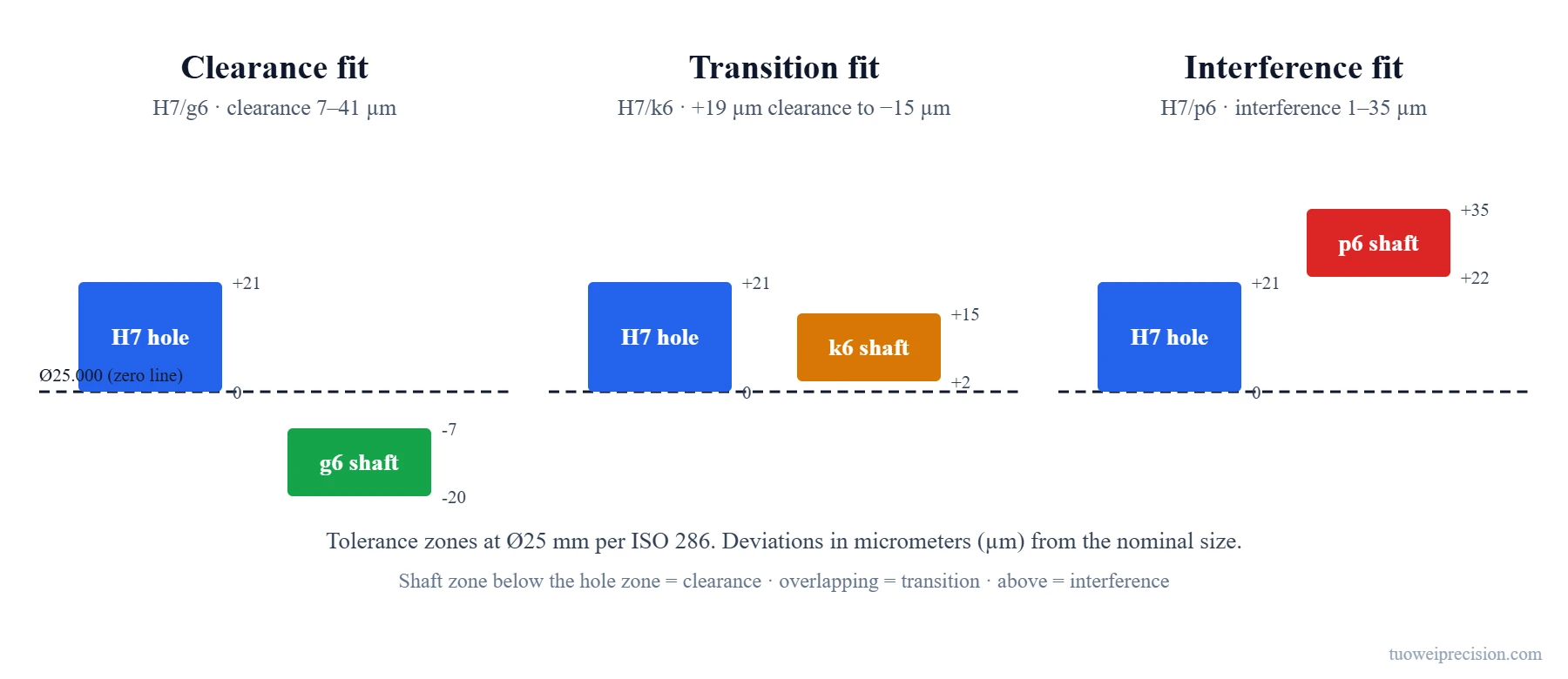
The letter (g, h, k, p…) sets the zone’s position. The IT number sets its width. That is why changing only the shaft letter while keeping an H7 hole moves you from clearance to transition to interference.
To keep tooling simple, one of the two parts is held at a standard deviation and the other is varied to get the fit you want.
For the different hole types you’ll see called out on drawings, see our guide to types of holes in engineering.
In a clearance fit, the largest possible shaft is still smaller than the smallest possible hole. There is always a gap, so the parts slide or rotate freely. Clearance fits allow easy assembly by hand.
Min clearance = Holemin – Shaftmax > 0
In a transition fit, the tolerance zones of the hole and shaft overlap. Depending on the actual machined sizes, an assembled pair may end up with a little clearance or a slight interference. Transition fits are used where accurate positioning matters more than free movement. Parts usually need light pressing, a rubber mallet or a small arbor press to assemble.
In an interference fit, the smallest possible shaft is still larger than the largest possible hole. Assembly needs force or a temperature difference. Interference fits are also called press fits. Once assembled, the contact pressure between the mating surfaces transmits torque and axial load through friction, without keys or fasteners.
Min interference = Shaftmin – Holemax > 0
An interference fit is assembled in one of three ways:
| 方法 | 工作原理 | 最适合 |
|---|---|---|
| Press fit (force fit) | Pressed together cold with an arbor or hydraulic press | Small parts and light-to-medium interference |
| Shrink fit | The outer part is heated so the hole expands, then cools onto the shaft | Large parts and heavy interference, without scoring surfaces |
| Expansion fit | The shaft is chilled (e.g. dry ice or liquid nitrogen) so it shrinks | Parts that can’t be heated, such as bearings or assemblies with seals |
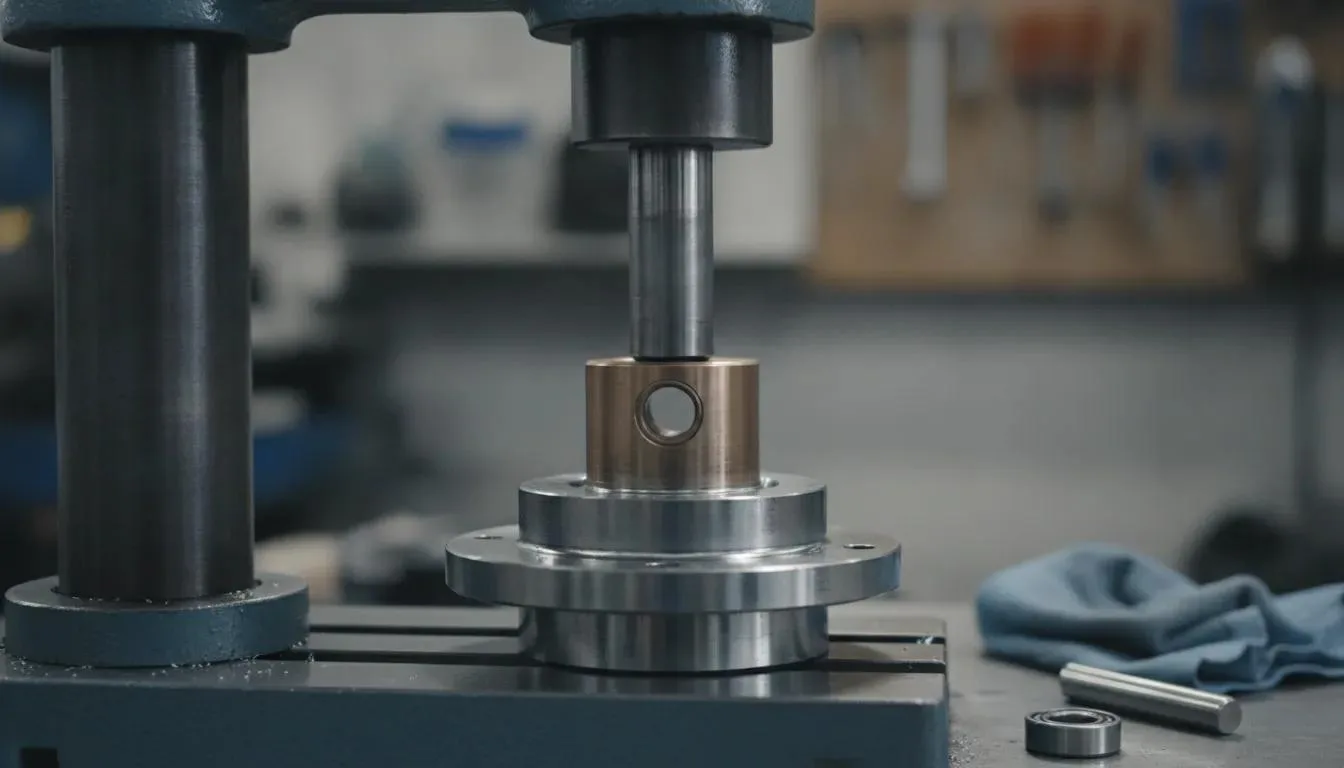
“Press fit” is often used loosely to mean any interference fit. Strictly, it is the cold assembly method.
Machinists and designers often use informal names. Here is how they map to the three types and to ISO fits:
| 通用名称 | 类型 | Typical ISO equivalent | How it assembles |
|---|---|---|---|
| Running fit | Clearance | H8/f7, H9/d9 | Rotates freely with a lubricant film |
| Slip fit / sliding fit | Clearance | H7/g6 | Slides by hand with little play |
| Snug fit / location fit | Clearance | H7/h6 | Hand assembly, almost no play |
| Push fit / tap fit | Transition | H7/k6 | Push by hand or tap with a rubber mallet |
| Light press fit | Transition / interference | H7/n6, H7/p6 | Light pressing |
| Press fit / drive fit | Interference | H7/s6 | Arbor or hydraulic press |
| Shrink fit / force fit | Interference | H7/u6 | Heating or cooling one part |
The table shows the actual limits and the resulting clearance (+) or interference (−) for ten common ISO hole-basis fits at a nominal size of 25 mm. Values are in micrometers (µm; 1 µm = 0.001 mm), from the ISO 286-2 deviation tables for the 24–30 mm size range.
| Fit | 类型 | Hole limits (µm) | Shaft limits (µm) | Max clearance (µm) | Min clearance / max interference (µm) |
|---|---|---|---|---|---|
| H11/c11 | Loose running | 0 / +130 | −110 / −240 | +370 | +110 |
| H9/d9 | Free running | 0 / +52 | −65 / −117 | +169 | +65 |
| H8/f7 | Close running | 0 / +33 | −20 / −41 | +74 | +20 |
| H7/g6 | Sliding | 0 / +21 | −7 / −20 | +41 | +7 |
| H7/h6 | Locational clearance | 0 / +21 | 0 / −13 | +34 | 0 |
| H7/k6 | Locational transition | 0 / +21 | +2 / +15 | +19 | −15 |
| H7/n6 | Locational transition | 0 / +21 | +15 / +28 | +6 | −28 |
| H7/p6 | Locational interference | 0 / +21 | +22 / +35 | −1 (min interference) | −35 |
| H7/s6 | Medium drive | 0 / +21 | +35 / +48 | −14 (min interference) | −48 |
| H7/u6 | Force | 0 / +21 | +48 / +61 | −27 (min interference) | −61 |
If the minimum value comes out negative and the maximum positive, it is a transition fit. If both are negative, it is an interference fit.
ANSI B4.1 groups inch-based fits into five classes, each with numbered grades. A higher number means a looser running fit or a tighter force fit. ISO and ANSI fits cover the same three types; ISO is used worldwide on metric drawings and ANSI mainly on US inch drawings.
| 班级 | 名称 | Fit type | Grades |
|---|---|---|---|
| RC | Running and sliding | Clearance | RC1–RC9 |
| LC | Locational clearance | Clearance | LC1–LC11 |
| LT | Locational transition | Transition | LT1–LT6 |
| LN | Locational interference | Interference | LN1–LN3 |
| FN | Force and shrink | Interference | FN1–FN5 |
What does FN2 mean? FN2 is a medium drive fit. It suits ordinary steel parts and shrink fits on light sections, and is about the tightest fit usable with high-grade cast-iron outer members. It is roughly equivalent to ISO H7/s6.
Realistic tolerances depend on material, feature size and process. As a guide, standard CNC turning and milling hold about IT9–IT10 without special steps. IT7 holes need reaming, boring or honing. IT6 and tighter usually means grinding, which adds operations and inspection time. See our guide to CNC machining tolerances for aluminum parts for typical values, or how tolerances affect CNC machining cost. For molded plastic parts, see injection molding tolerances.
Need a shaft-and-hole pair machined to a specific fit? Send your drawing with the fit callout and Tuowei Precision will confirm the right process before quoting.
What are the 3 types of fits?
Clearance fit, transition fit and interference fit.
What is an H7 fit?
H7 describes a hole, not a whole fit. The hole’s lower limit equals the nominal size, and its tolerance width is IT7 (21 µm at 25 mm). It is paired with a shaft such as g6, h6, k6 or p6 to make a fit.
What is H7/g6?
A sliding clearance fit. At Ø25 mm it gives 7–41 µm of clearance, so the shaft moves freely but locates accurately.
Is H7/k6 a press fit?
No. H7/k6 is a transition fit. It can produce either slight clearance or slight interference, and often needs a light press or rubber mallet to assemble.
What is the difference between interference fit and press fit?
Interference fit is the type of fit (the shaft is larger than the hole). Press fit is one way to assemble it, cold under force. Shrink and expansion fits are the other ways.
What is a slip fit?
A slip fit is an informal name for a close clearance fit, usually H7/g6 or H7/h6, where the parts slide together by hand with very little play.
What is an example of a clearance fit?
A shaft turning in a plain bushing, a sliding door on its guide rail, or a hinge pin in its knuckle.
What is an example of an interference fit?
A bearing pressed onto a shaft, a gear shrink-fitted onto an axle, or a dowel pin pressed into a reamed hole.