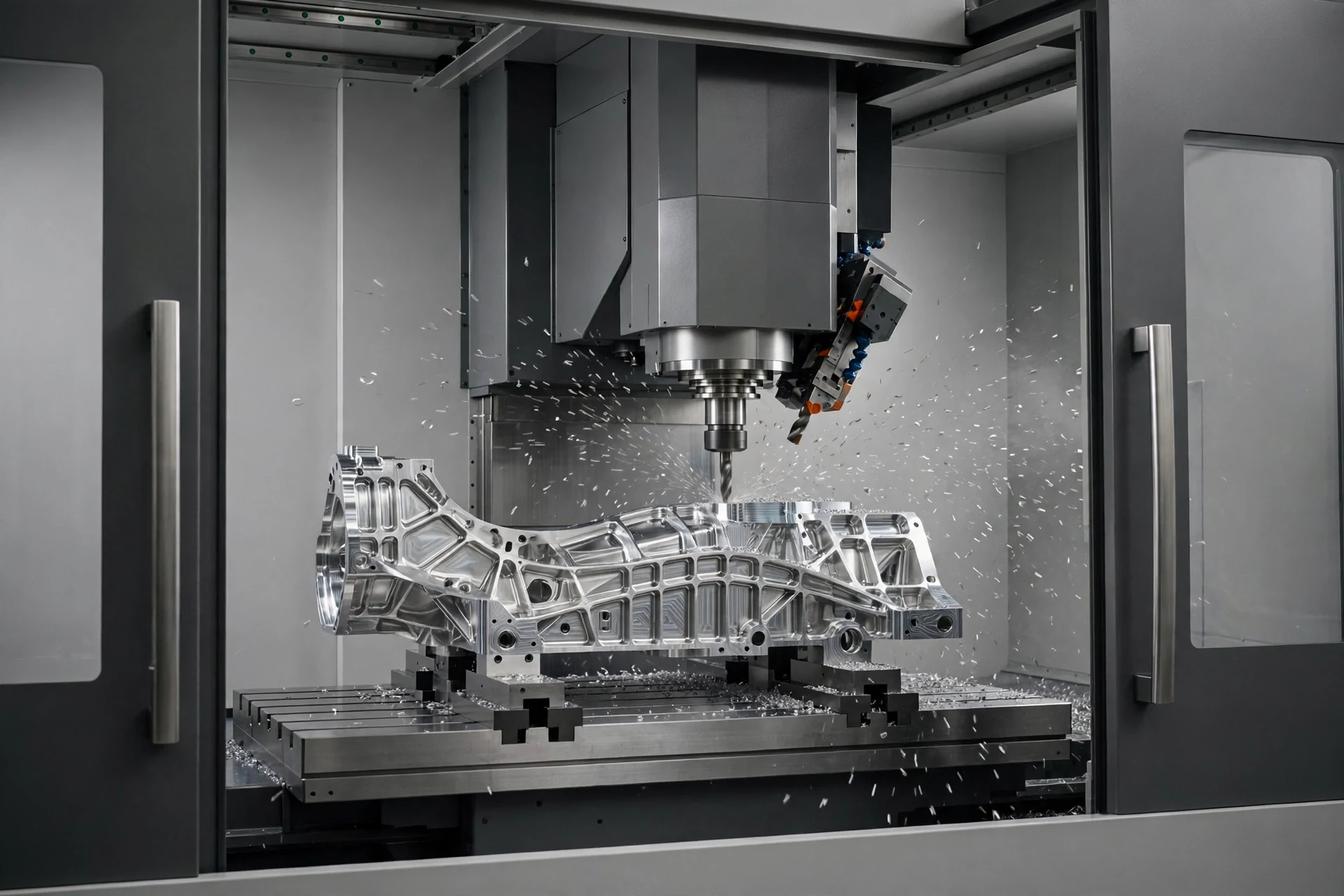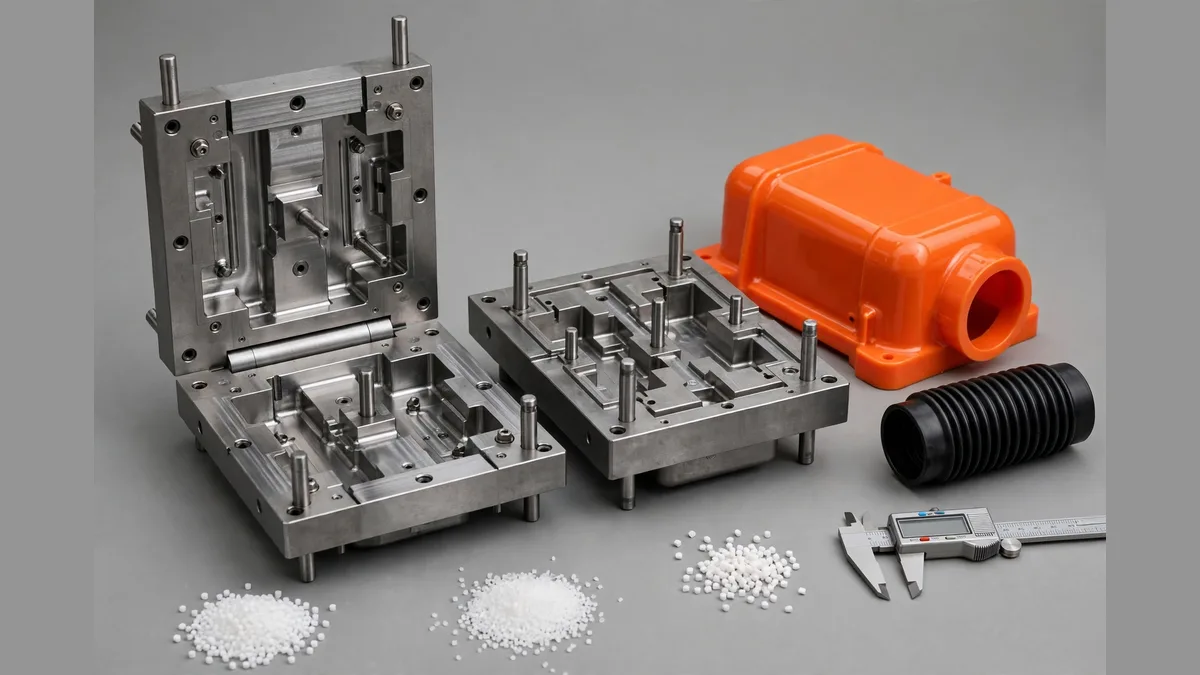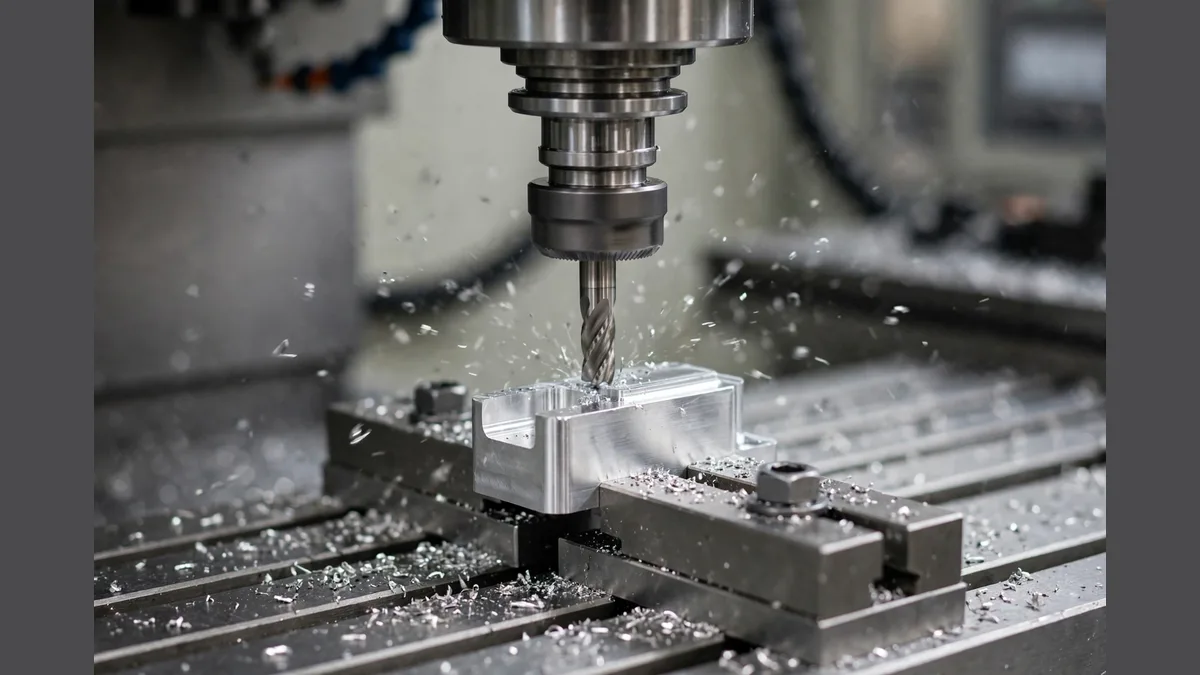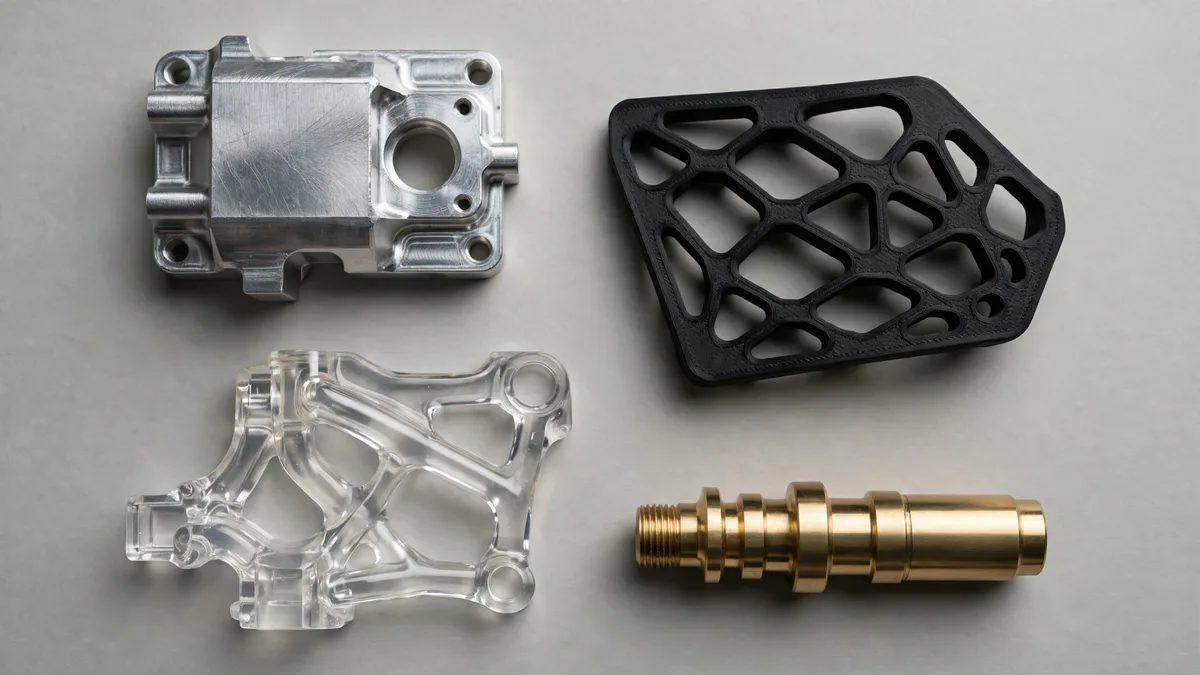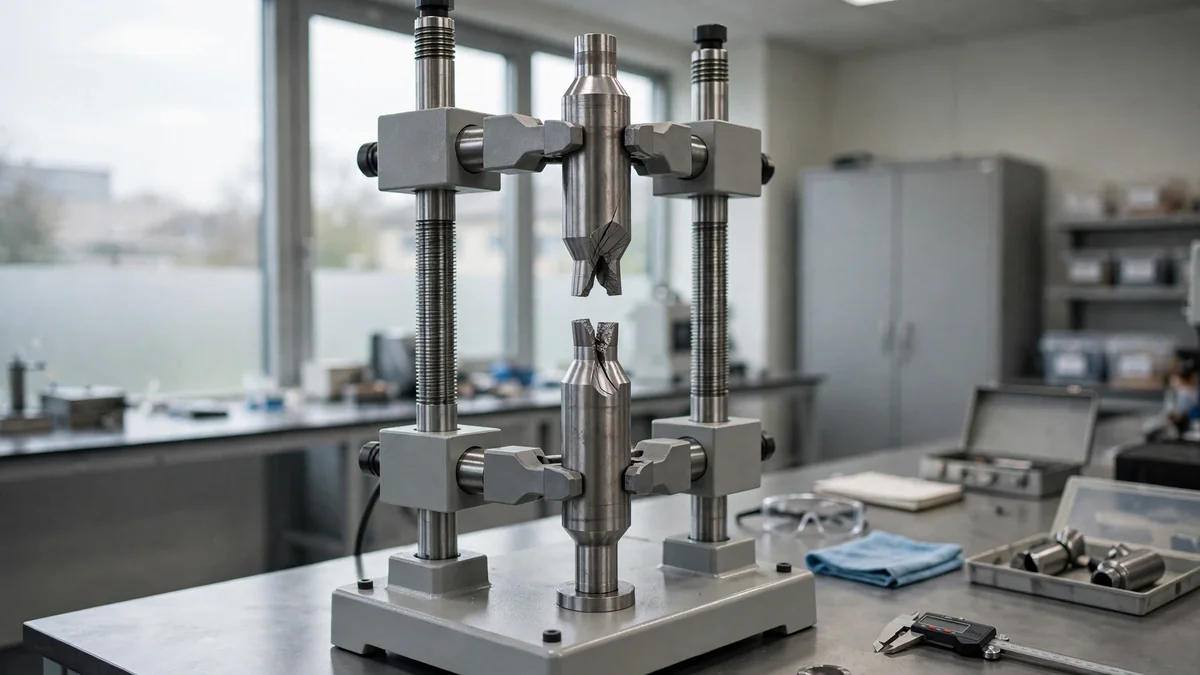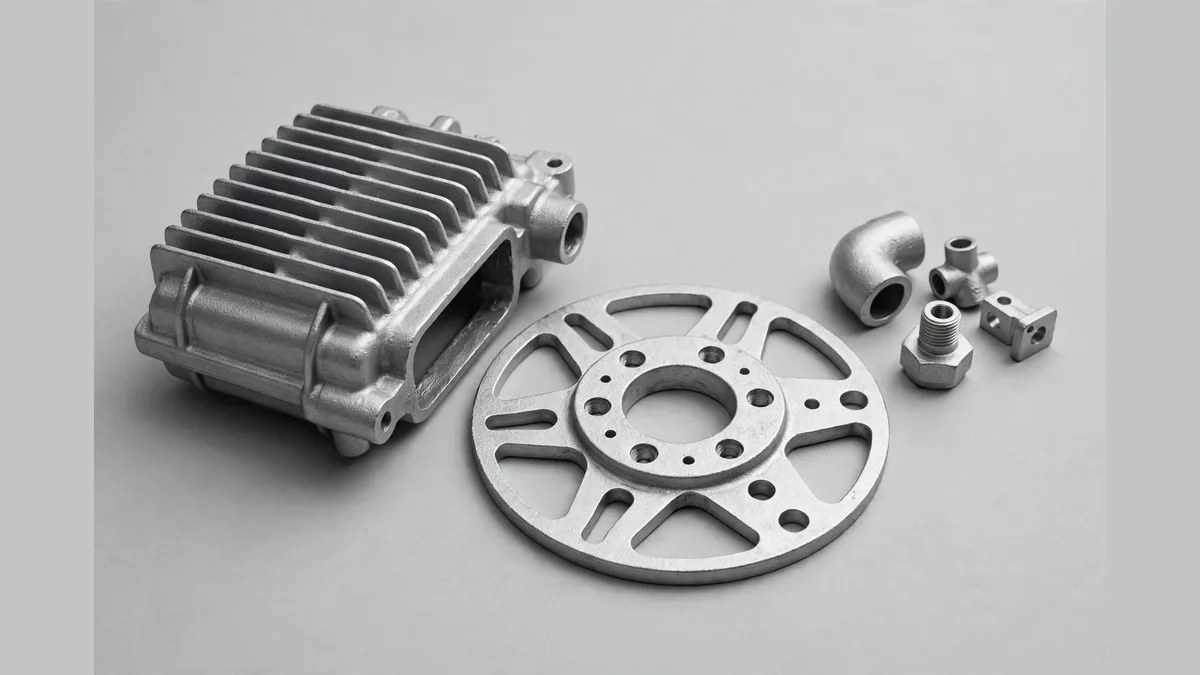
Aluminum die casting produces net-shape or near-net-shape parts by injecting molten aluminum into a steel die under high pressure. The process delivers thin walls, tight tolerances, complex geometry and excellent surface finish in a single operation, which is why it dominates high-volume production of automotive, electronics and industrial components.
Short answer: High pressure die casting (HPDC) is the most common variant. It fills the die in 10 to 100 milliseconds at pressures of 70 to 140 MPa, producing parts from a few grams to about 25 kg. Cycle times run 30 seconds to 3 minutes depending on part size, making it economical at volumes above 1,000 to 5,000 pieces. The tables below cover alloy selection, mechanical properties, tolerances and cost ranges.
In high pressure die casting, molten aluminum is ladled into a cold chamber (the shot sleeve), then a hydraulic piston drives it into the die cavity at velocities of 30 to 100 m/s. The metal solidifies against the water-cooled die walls in milliseconds, the die opens and ejector pins push the casting out.
The process runs in a repeating cycle: close die, inject metal, solidify, open die, eject part, spray die lubricant, close die. Each cycle produces one or more parts (multi-cavity dies are common for small components). The speed and repeatability of the cycle are what make HPDC cost-effective at volume.
There are two machine types. Cold-chamber machines are standard for aluminum because aluminum’s melting point (660 C) would attack the injection components of a hot-chamber machine. Hot-chamber machines are used for zinc and magnesium alloys, which melt at lower temperatures.
Die casting alloys are chosen for castability first, mechanical properties second. Good castability means the alloy flows into thin sections, resists hot tearing during solidification and releases from the die without sticking. Silicon content drives castability: alloys with 7 to 12% silicon fill best.
| Alliage | Si (%) | UTS (MPa) | Yield (MPa) | Allongement (%) | Hardness (HB) | Thermal cond. (W/mK) | Idéal pour |
|---|---|---|---|---|---|---|---|
| A380 | 7.5-9.5 | 324 | 159 | 3.5 | 80 | 96 | General purpose, most common HPDC alloy |
| A383 (ADC12) | 9.5-11.5 | 310 | 152 | 3.5 | 75 | 96 | Complex thin-wall castings |
| A360 | 9.0-10.0 | 317 | 165 | 2.5 | 75 | 113 | Pressure tightness, corrosion resistance |
| A413 | 11-13 | 296 | 145 | 2.5 | 80 | 121 | Max fluidity, intricate parts |
| AlSi9Cu3 (EN 46000) | 8-11 | 240-300 | 140-180 | 1-3 | 80-100 | 110 | European automotive standard |
| A356 (gravity/LPDC) | 6.5-7.5 | 228-262 | 165-186 | 3-5 | 75-85 | 151 | Structural, heat-treatable |
A380 accounts for roughly 80% of aluminum HPDC production in North America. It balances castability, strength and cost. A383 (the equivalent of Japan’s ADC12) offers slightly better die filling for complex thin-wall geometries. A360 gives better corrosion resistance and pressure tightness for fluid-handling components.
A356 is not a standard HPDC alloy. It is used in gravity and low-pressure die casting (LPDC), where slower fill speeds produce less porosity and allow T6 heat treatment. If the design needs elongation above 5% or heat-treated strength, LPDC with A356 is the better process, though at higher cost and longer cycle time.
Die casting tolerances depend on part size, alloy, die construction and whether the dimension crosses the parting line. Dimensions within one die half are more repeatable than those spanning both halves, because parting-line shift adds variation.
| Dimension type | Linear tolerance | Across parting line | Notes |
|---|---|---|---|
| Up to 25 mm | ±0,10 mm | ±0,15 mm | Standard precision |
| 25 to 150 mm | ±0.10 + 0.02/mm over 25 | ±0.15 + 0.03/mm over 25 | Add per mm above 25 |
| 150 to 300 mm | ±0.3 to 0.5 mm | ±0.5 to 0.8 mm | Large castings, more variation |
| Planéité | 0.1 mm per 25 mm | Measured after trim | Improves with stress relief |
| Angularity | ±0.5 degrees | Per draft face | More on textured surfaces |
| Hole diameter (cored) | ±0.05 to 0.10 mm | Same in both halves | Depth limited to 4x diameter |
These tolerances follow NADCA (North American Die Casting Association) standard tolerances. Precision tolerances (tighter by roughly 30%) are achievable with premium dies, controlled process parameters and 100% CMM inspection, but they add cost. For critical mating surfaces, secondary CNC machining holds ±0.025 mm or tighter.
GD&T (geometric dimensioning and tolerancing per ASME Y14.5) is the preferred method for specifying positional and form tolerances on die castings. Bilateral tolerances on individual dimensions can stack up and over-constrain the part. GD&T defines datums and allows the tolerance zone to float, which better reflects how the casting actually varies.
Die casting cost has two components: tooling (the die) and unit cost (each part). Tooling is a large upfront investment that amortizes over the production run. Unit cost drops as volume rises because cycle time, not material, dominates.
| Cost component | Plage typique | What drives it |
|---|---|---|
| Tooling (single-cavity) | $8,000 to $25,000 | Part size, complexity, number of slides |
| Tooling (multi-cavity) | $20,000 to $80,000+ | Number of cavities, tight tolerances |
| Unit cost (small parts <200g) | $0.50 to $3.00 | Cycle time, alloy, secondary ops |
| Unit cost (medium 200g-1kg) | $2.00 to $8.00 | Same, plus more material |
| Unit cost (large 1-5kg) | $5.00 to $20.00 | Machine tonnage, longer cycle |
| Secondary machining | $0.50 to $5.00 per part | Number of features, tolerances |
| Finition des surfaces | $0.25 to $3.00 per part | Powder coat, anodize, chromate, paint |
Break-even vs. CNC machining: For a simple aluminum part that takes 8 minutes to CNC machine at $60/hour ($8.00 per part), die casting at $2.00 per part plus $15,000 tooling breaks even at around 2,500 pieces ($15,000 / ($8.00 – $2.00) = 2,500). Below that volume, Usinage CNC is cheaper because there is no tooling investment.
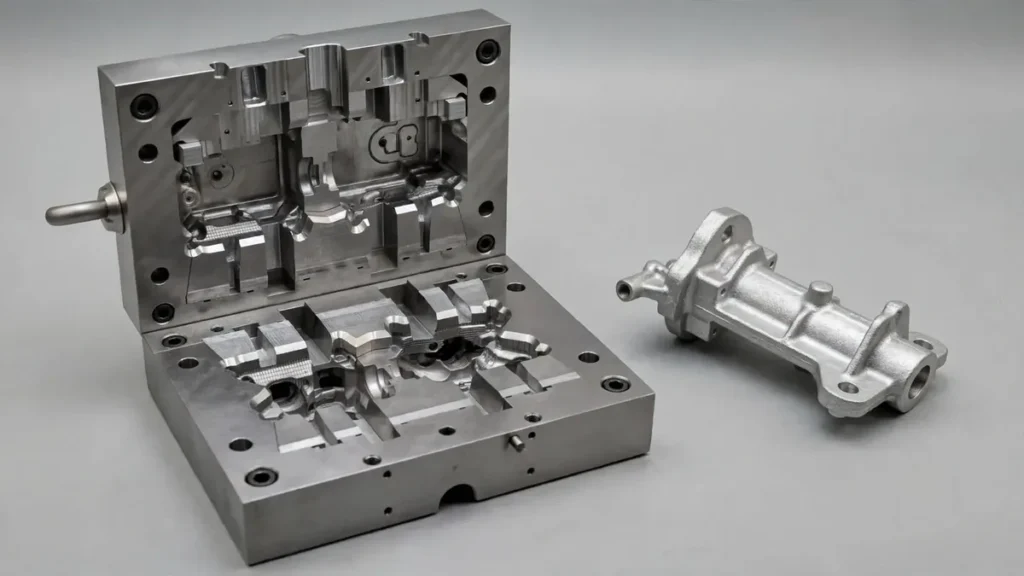
Die casting dies are made from hot-work tool steel (H13 is the standard) using CNC machining and EDM. The die must withstand thermal cycling, erosive aluminum flow and clamping forces of 400 to 4,000 tonnes without cracking or distorting.
| Scène | Timeline | Deliverable |
|---|---|---|
| DFM review and die design | 1 to 2 weeks | 2D die layout, gate/runner/vent plan |
| Die machining (simple) | 3 to 5 weeks | Single-cavity die, no slides |
| Die machining (complex) | 5 to 8 weeks | Multi-cavity, slides, tight tolerance |
| First article samples (T1) | 1 week after die completion | 5 to 20 sample parts for approval |
| Die modifications (if needed) | 1 to 2 weeks | Welding, re-machining, re-sampling (T2) |
| Production start | 1 to 2 weeks after approval | First production batch shipped |
Total time from order to first production parts is typically 6 to 12 weeks. Die life is 80,000 to 150,000 shots in A380, less in higher-silicon alloys that are more abrasive. A well-maintained die can last the entire production life of many products.
Die casting geometry is governed by how molten aluminum fills, solidifies and releases from the die. The design rules below prevent the most common defects: porosity, cold shuts, hot tears, sink marks and sticking.
Wall thickness: Minimum 0.75 mm for small parts, 1.5 to 2.5 mm for typical parts, up to 4 mm for large structural castings. Uniform walls cool evenly and reduce porosity. Transition between thick and thin sections gradually.
Draft angles: 1 to 3 degrees on external surfaces, 2 to 5 degrees on internal surfaces (cores). Zero-draft features require slides or lifters, which add die cost. Every degree of draft makes ejection easier and extends die life.
Fillets and radii: Minimum inside radius of 0.5 mm, with 1 to 2 mm preferred. Sharp inside corners concentrate stress in both the casting and the die, leading to die cracking and casting hot tears.
Ribs: Rib thickness should be 50 to 70% of the adjacent wall to prevent sink. Rib height up to 5 times the rib thickness. Add ribs for stiffness rather than increasing wall thickness, which adds weight and porosity risk.
Holes and cores: Through-holes are easier to cast than blind holes. Core pins should not exceed 4:1 depth-to-diameter ratio in HPDC because the metal flow deflects longer pins. Cross-holes require slides.
Undercuts: Avoid where possible. Each undercut requires a moving slide or collapsible core, adding $2,000 to $8,000 per slide to die cost. Redesigning a clip as a snap-in that flexes during assembly often eliminates the undercut.
Die casting quality starts with the process and ends with inspection. For automotive and aerospace applications, suppliers must hold specific certifications and follow documented quality management systems.
ISO 9001: The baseline quality management system. Required for virtually all contract manufacturing. Covers process control, traceability and corrective action procedures.
IATF 16949: The automotive quality standard, built on ISO 9001 with additional requirements for APQP (advanced product quality planning), PPAP (production part approval process), control plans and measurement system analysis. Required by most automotive OEMs and tier-one suppliers.
AS9100: The aerospace quality standard. Adds requirements for special processes (heat treatment, NDT), configuration management and counterfeit part prevention. Required for aerospace structural castings.
Inspection methods: CMM (coordinate measuring machine) for dimensional verification, X-ray for internal porosity detection, pressure testing for leak-free castings, dye penetrant inspection for surface cracks, and spectrometer analysis for alloy composition verification. First article inspection reports (FAI per AS9102 for aerospace) document every dimension on the drawing.
Aluminum is indefinitely recyclable without losing its mechanical properties. Die casting is one of the largest consumers of secondary (recycled) aluminum. Industry data from the Aluminum Association shows that secondary aluminum requires only 5% of the energy needed to produce primary aluminum from bauxite ore.
Most HPDC alloys, particularly A380 and A383, are designed to accept a high percentage of secondary aluminum. A typical A380 melt can contain 80 to 100% recycled content while meeting ASTM B85 composition limits. Die casting also generates its own recyclable scrap: runners, overflows and trim are remelted in-house, so material utilization rates of 85 to 95% are common.
For projects with sustainability requirements (automotive OEMs increasingly specify minimum recycled content), ask your supplier for their secondary aluminum percentage and energy source data. Suppliers who melt with natural gas have a significantly lower carbon footprint per kg than those using coal-fired electricity.
Au Précision Tuowei, aluminum die casting projects follow a structured path from design review through production. The first step is a DFM review that checks wall thickness, draft, parting line placement, gate location and tolerance feasibility against the chosen alloy.
Many projects start with CNC machined prototypes (Services de fraisage CNC) to validate fit and function before committing to die tooling. CNC prototypes can be machined from the same alloy family (6061 for prototyping, A380 for production casting) to approximate the production material, though the microstructure and porosity characteristics will differ.
For parts that need both cast features and precision machined surfaces, our usinage de précision et Usinage CNC à 5 axes capabilities handle secondary operations in-house, avoiding the quality risks and lead time of shipping castings to a separate machine shop.
Fabrication de tôles is an alternative for parts that are flat or folded rather than three-dimensionally complex. If the geometry can be stamped or bent from sheet, the tooling cost is typically one-third to one-half that of a die casting die, and minimum quantities are lower.
Who owns the die matters for future flexibility. In most contracts, the buyer pays for the die and owns it. This means the buyer can request the die be shipped to a different supplier, though practical constraints (die was designed for a specific machine, different supplier’s process parameters) can make transfers complicated.
Key points for the tooling agreement: Confirm that the purchase order or contract explicitly states buyer ownership of the die. Require that the supplier maintain the die at their cost for the agreed production life (typically 80,000 to 150,000 shots). Include a clause that the supplier will ship the die to a location you specify if the relationship ends. Keep a copy of the die design drawings and the steel certification.
For IP-sensitive parts, non-disclosure agreements should be signed before sharing CAD files. Some buyers split the die into components made by different shops so no single vendor sees the full part geometry.
There is no hard minimum, but the economics favor volumes above 1,000 to 5,000 pieces because of the tooling investment ($8,000 to $80,000+). Below 1,000 pieces, CNC machining is usually more cost-effective since there is no die cost. Some suppliers offer prototype dies in aluminum at lower cost for runs of 500 to 2,000 pieces.
Standard HPDC alloys like A380 anodize poorly because the high silicon content (7 to 12%) produces a dark, uneven finish. If anodizing is required, consider gravity or low-pressure casting with lower-silicon alloys (A356, 6061) or switch to CNC machined parts. HPDC parts can be powder coated, painted, chromate converted or plated without issue.
High pressure die casting (HPDC) fills the die at 30 to 100 m/s under 70 to 140 MPa, producing thin-wall parts with fast cycle times but some porosity. Low pressure die casting (LPDC) fills slowly from below at 0.03 to 0.1 MPa, producing denser castings that can be heat-treated but with longer cycle times and higher cost. HPDC suits high-volume thin-wall parts; LPDC suits structural parts that need strength.
An H13 tool steel die typically lasts 80,000 to 150,000 shots in A380 aluminum. Die life depends on the alloy (high-silicon alloys are more abrasive), part complexity (slides and thin cores wear faster), thermal management and maintenance. Periodic die refurbishment (welding, re-machining, re-polishing) can extend life significantly.
As-cast finish ranges from smooth to textured depending on the die surface. Post-casting options include shot blasting for uniform matte, tumbling for edge deburring, powder coating for color and corrosion protection, wet painting for cosmetic finishes, chromate conversion for corrosion resistance, and electroless nickel plating for wear resistance. Polishing is possible but rarely cost-effective on HPDC parts due to porosity.