
Tuowei Precision propose Impression 3D for engineers who need light brackets, ducts, housings and tooling fast, without paying for a mold. We print in engineering plastics, resins and metals, then machine critical faces when a drawing calls for tighter tolerances than printing alone can hold.

3D printing builds a part layer by layer from a CAD file. For flight hardware, the biggest advantage is weight reduction: material goes only where the load path needs it, which improves fuel efficiency and the performance of aircraft over their service life. A printed bracket can carry an internal lattice, a duct can follow a curved path in one piece, and an assembly of five machined parts can become one. These gains apply whether you build airliners, business jets or drones.
Speed matters just as much. With no tooling to build, engineers can quickly print, test and revise a design, which helps accelerate development timelines from months to weeks. For many teams, that alone can transform how they source low-volume parts, and it is why most programs start with 3D printing. The trade-off is that printed material does not behave exactly like wrought or cast metal, so safety-critical parts must pass stringent qualification before they replace a proven design, and that step can reshape a program schedule.
Each printing technology suits different work, and five 3D printing technologies can produce various aircraft components. The right 3D printer depends on whether the part must look right, fit precisely or carry load.
| Technologie | Utilisation optimale | Matériaux courants | Précision typique |
|---|---|---|---|
| FDM | Interior prototypes, jigs and fixtures | ABS, PC, nylon, PEI | ±0,5 % (min. ±0,5 mm) |
| SLA | Wind tunnel models, fit checks, patterns | Standard, tough and high-temp resins | ±0,1 mm |
| SLS | Functional ducts, brackets and clips | Nylon PA12, PA11, TPU | ±0,3 mm |
| MJF | Short runs of housings and brackets | Nylon PA12 | ±0,2 mm |
| DMLS / SLM | Supports métalliques, collecteurs, échangeurs de chaleur | Stainless steel, aluminum, Ti-6Al-4V | ±0,1 mm |
Valeurs indicatives. La tolérance définitive est précisée dans votre devis.
For a deeper look at each process, see our Services d'impression 3D page.
In practice, material decides whether a printed part is a model, a tool or a working component. These are the materials engineers most often ask us about; we confirm the exact grade in your quote.
PEI (Ultem 9085, a grade widely printed on Stratasys FDM systems) is chosen for cabin parts because of its resistance to extreme temperatures and its low smoke and toxicity behavior. Nylon PA12 from SLS or MJF gives tough, light ducts, clips and brackets for non-structural use. PC and ABS cover jigs, fixtures and early prototypes.
SLA, the process 3D Systems commercialized in the 1980s, uses résines that give the smooth surfaces and fine detail needed for wind tunnel models, display parts and casting patterns. Standard resins are brittle, so we recommend tough or high-temperature grades for any part that will be handled or loaded.
Metal printing builds parts in 17-4PH and 316L stainless steel, aluminum and Ti-6Al-4V. Ti-6Al-4V suits weight-critical fittings, aluminum suits heat exchangers and light housings, and stainless steel suits corrosion-resistant fittings and tooling. Printed metal needs stress relief, support removal and usually machining on mating faces.
3D printing applications in aerospace have moved well past concept models. Companies such as Boeing and Airbus already fly printed components, and GE prints fuel nozzles for its jet engines. Typical aircraft parts we see include:
Engine makers built their printed parts on years of material and process qualification. For most buyers, the fastest return comes from prototypes, tooling, interior parts and UAV hardware, where qualification demands are lighter and the ability to produce custom parts in days pays off quickly. These uses also facilitate faster maintenance, because a part can be printed from a stored file instead of waiting for new tooling.
Many flight parts can be made by printing or by traditional methods such as CNC machining. The better choice depends on shape, quantity and tolerance.
| Facteur | Impression 3D | Usinage CNC |
|---|---|---|
| Quantité optimale | de 1 à quelques centaines | de 1 à des milliers |
| Géométrie | Parts with complex geometries, lattices, internal channels | Formes prismatiques et tournées |
| Tolérance type | de ±0,1 à ±0,3 mm | Précision de ±0,005 mm |
| Propriétés des matériaux | Close to, not identical to, wrought stock | Full wrought or forged properties |
| Finition de surface | Rougher as printed; needs post-processing | Smooth as machined |
| Évolutivité | Cost per part stays flat with volume | Cost per part drops with volume |
| Setup cost | No tooling | Fixtures and programming |
Our rule of thumb: print when you need to produce complex shapes or low quantities, machine when the part carries high load or needs tolérances serrées, and integrate both when a printed part has a few critical features.
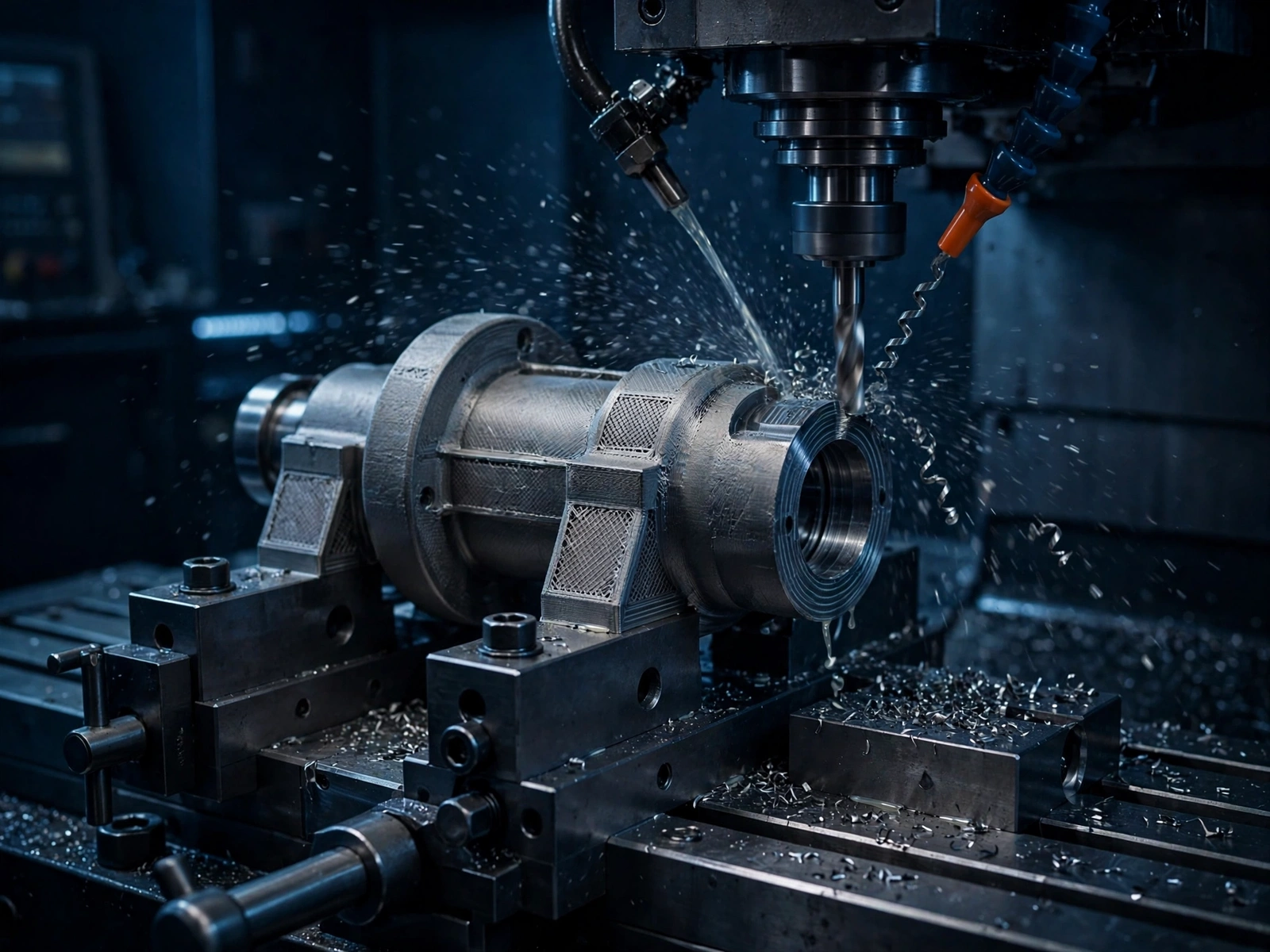
A common mistake is expecting a metal print to hold a bearing bore or sealing face straight off the build plate. Printed surfaces are rough and can distort as residual stress releases, even though printing can enable the production of internal features that no cutter can reach. We plan hybrid parts from the start: leave machining stock on critical features, print, stress relieve, remove supports, then finish bores, threads and mating faces on our CNC machines. Printing allows the freedom of the shape, and machining protects the functionality of every interface. Hybrid parts are often the most innovative solutions here, because they make it practical to produce components that neither process could manufacture well alone.
Our AS9100D and ISO 9001:2015 quality system covers 3D printed parts the same way it covers machined ones. Depending on your requirements, we provide:
Certifying printed parts for safety-critical flight use is still time-consuming, and aviation authorities continue to develop guidance for it in 2026. If your part is flight-critical, plan qualification testing with your quality team before switching from a machined or cast design. See our l'assurance qualité page pour plus de détails sur l'inspection.
Printing is often the first step in the development of new hardware. When a design is proven, we can tailor the next process to volume and cost, using manufacturing technologies that can manufacture it at scale: