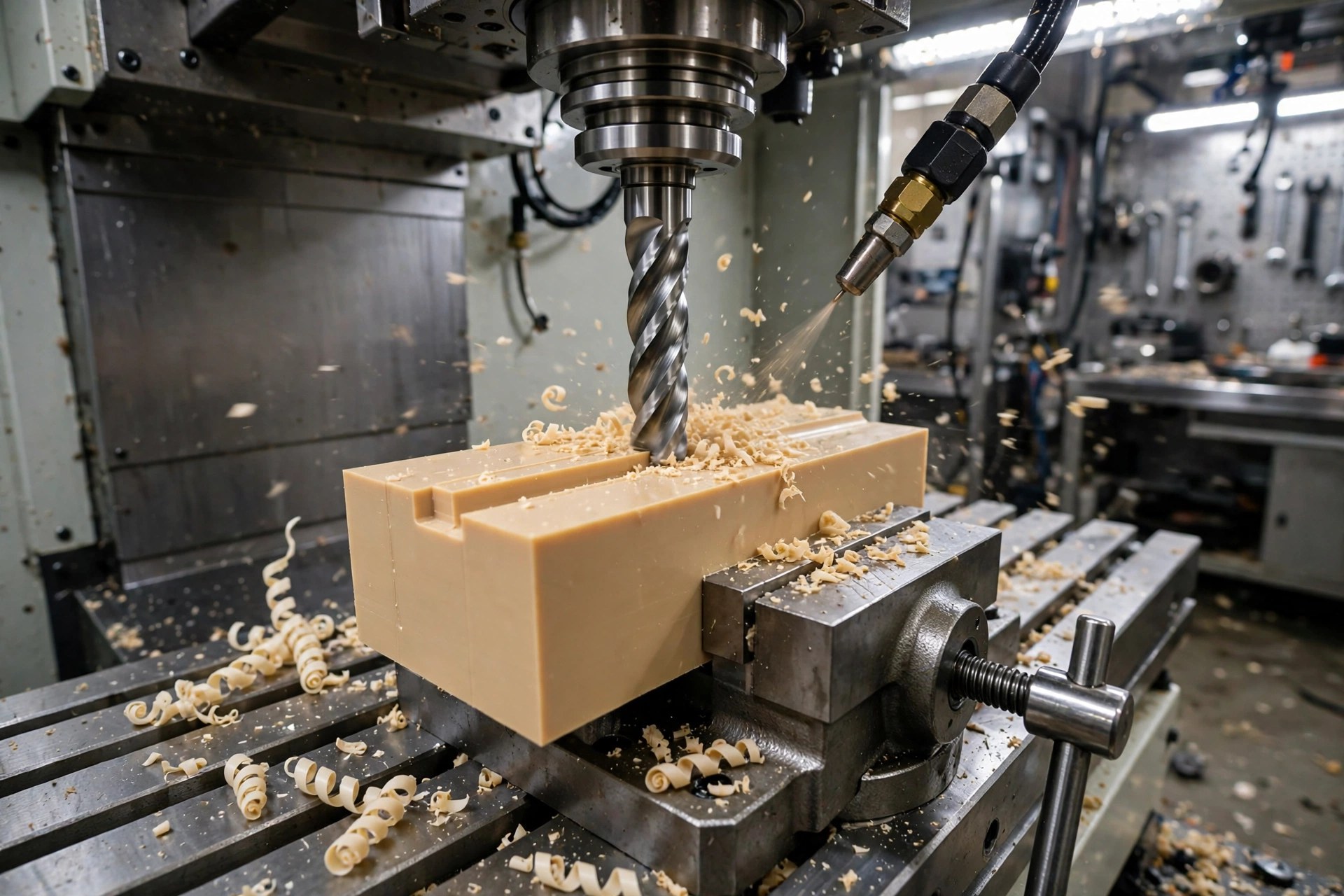
PEEK is one of the most rewarding engineering plastics to machine and one of the least forgiving of guessed parameters. It is a high-performance thermoplastic with a continuous service temperature of 260 °C, tensile strength around 100 MPa, and chemical resistance that suits it to aerospace, semiconductor, and medical device components. Run it too hot and the surface glazes and smears, because PEEK softens at its glass transition around 143 °C (289 °F), far below its 343 °C (649 °F) melting point. Run it too timidly and the tool rubs instead of cutting, building the same heat you were trying to avoid. And unlike metal, PEEK’s low thermal conductivity keeps heat at the cut instead of carrying it away, and it does not forgive dull edges: it is abrasive on cutting tools, dramatically so in its glass- and carbon-filled grades.
The problem is that the numbers machinists need are scattered across supplier PDFs and forum threads. This guide collects the PEEK machining speeds and feeds in one place: starting parameters for milling, turning, and drilling unfilled PEEK, compiled from Drake Plastics’ machining parameters for PEEK and Invibio’s machining data, with the adjustments filled grades demand. For the broader picture of properties, tooling selection, and applications, start with our complete CNC PEEK machining guide; this article is its parameter companion.
These are starting windows for unfilled (natural) PEEK with carbide tooling. Supplier ranges differ because tool geometry, machine rigidity, and coolant delivery all move the safe window; begin at the conservative end and adjust from the chips.
| Operation | Cutting speed | Feed | Notas |
|---|---|---|---|
| Face milling | 500–800 SFM (150–245 m/min) | 0.006–0.035 in/tooth | Light finishing depth of cut around 0.035 in |
| End milling | 270–450 SFM (80–140 m/min) | 0.002–0.008 in/tooth by tool size (table below) | Depths of cut up to 0.25 in in the Drake data |
| Turning | 300–800 SFM (90–245 m/min) | 0.004–0.025 in/rev (0.1–0.6 mm/rev) | Invibio data runs natural PEEK to 250–500 m/min under ideal conditions |
| Drilling | 165–650 SFM (50–200 m/min) | 0.007–0.020 in/rev by hole diameter (table below) | Peck beyond 2x diameter depth |
Two habits matter more than the exact starting number. First, PEEK wants a real chip: feeds at the bottom of these ranges with a worn edge produce rubbing, friction heat, and a glazed surface. Second, change one variable at a time and read the chips: a clean, curled chip means the cut is shearing; dust, stringy melt, or a shiny smeared surface means heat is winning.
Drake Plastics’ end milling parameters for PEEK, with depths of cut of 0.25 in, are the most complete published set:
| End mill diameter | Cutting speed | Feed per tooth |
|---|---|---|
| 1/4 in | 270–450 SFM | 0.002 in |
| 1/2 in | 270–450 SFM | 0.003 in |
| 3/4 in | 270–450 SFM | 0.005 in |
| 1 in | 270–450 SFM | 0.008 in |
For face milling, Drake specifies 500 to 800 SFM with feeds of 0.006 to 0.035 in/tooth at a light 0.035 in depth of cut. Invibio’s milling window for natural PEEK, 50 to 200 m/min (roughly 165 to 650 SFM), brackets the Drake ranges and confirms the overall scale: PEEK mills far faster than titanium or steel, closer to aluminum practice, but with stricter heat discipline.
Setup guidance from the same supplier data: climb milling is preferred over conventional milling because it removes chips better, reduces tool wear, and leaves a better finish. Use four-flute end mills with a positive rake where the geometry allows, and for the best surface finish limit stepover to 25% of tool diameter and depth of cut to 50% of tool diameter, taking finishing passes at the light end of the feed range. High spindle speeds with fast travel are deliberate: they minimize frictional heat buildup and material pullout at edges and hole exits. Because PEEK is much softer than metal, fixturing is critical; a part that shifts or chatters in the vise will not hold tolerance no matter how good the parameters are.
For turning, Drake’s window is a depth of cut around 0.025 in for finishing, 300 to 800 SFM, and feeds of 0.004 to 0.025 in/rev. Invibio’s turning data for natural PEEK is more aggressive, 250 to 500 m/min with feeds of 0.1 to 0.5 mm/rev, and is best treated as the ceiling for rigid setups with sharp tools and good coolant, not the starting point.
Tooling and workholding decide whether those numbers hold. Drake recommends inserts with a positive rake and ground peripheries, in fine-grained C-2 carbide or PCD, because sharp edges shear PEEK cleanly instead of plowing it. PEEK’s softness cuts both ways at the chuck: use 360-degree chuck pressure with machined soft jaws or pie jaws, especially on thin-walled tubular parts, and support thin walls with internal plugs so the part cannot compress, distort, and lose dimensional accuracy. Rough-turning the chucking area of the stock first improves roundness on precision diameters.
Drilling is where PEEK parts crack, so the feed discipline matters as much as the speed. Drake’s feed rates by hole diameter:
| Hole diameter | Feed |
|---|---|
| 1/16 in (0.0625) | 0.007 in/rev |
| 1/8 in (0.125) | 0.010 in/rev |
| 1/4 in (0.250) | 0.012 in/rev |
| 1/2 in (0.500) | 0.015 in/rev |
| 3/4 in and up | 0.020 in/rev |
Pair those feeds with cutting speeds in the 50 to 200 m/min window from the Invibio data. Heat control rules everything else: holes deeper than twice the diameter need care, low-helix drills with flood coolant work best, and peck drilling clears swarf before it packs and overheats. Coolant-fed drills are ideal for deep holes, and compressed air through the spindle is the fallback where flood coolant is not allowed. Either way, chip evacuation is the goal: packed swarf is stored heat. The underlying reason is PEEK’s low elongation compared with other plastics: a deep hole in a heavy cross-section drilled without enough coolant can crack the part outright.
For larger diameters, work in two steps: drill a pilot hole of 1/2 in maximum, then bore to the finish diameter. Holes of 1/2 in and smaller take a standard carbide drill; holes up to 2 in can be machined with an insert drill. To avoid breakout on the back side, mill from both sides or leave 0.005 to 0.010 in of material and remove it with a small end mill. Threading follows similar discipline: single-point inserts with flood coolant on the lathe, and two-flute uncoated spiral carbide taps with cutting fluid for tapped holes; tight-tolerance threads in PEEK may need a tap one size larger than you would choose for aluminum or steel.
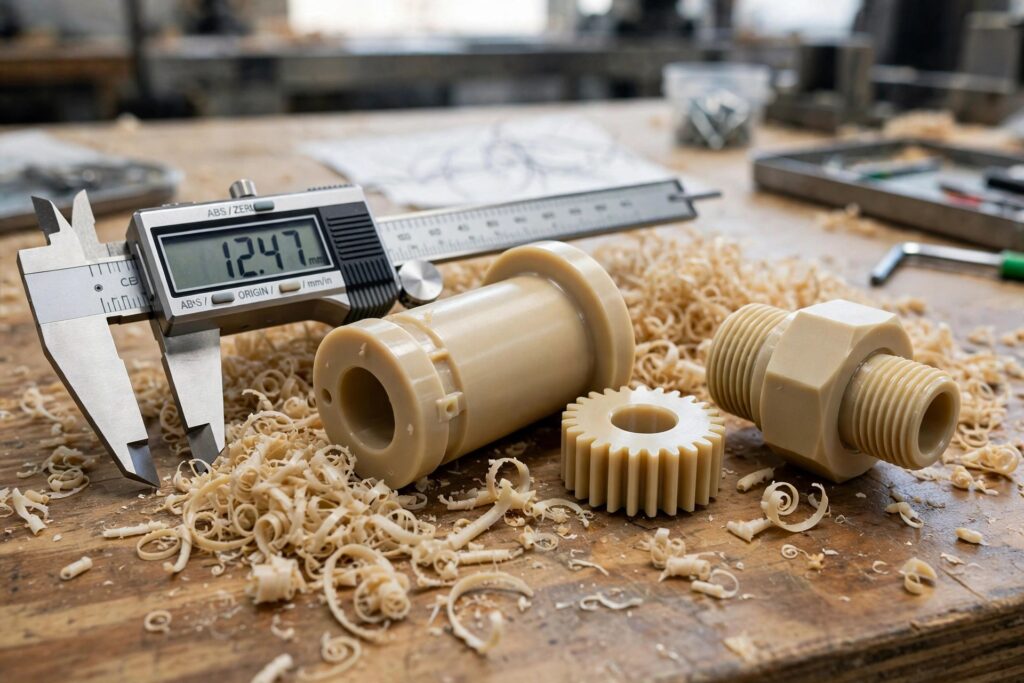
The tables give surface speed; your machine wants RPM and feed rate. Two formulas convert them.
Spindle speed: RPM = (SFM x 3.82) / tool diameter in inches. In metric: RPM = (cutting speed in m/min x 318) / tool diameter in mm.
Feed rate: IPM = RPM x number of flutes x chip load (feed per tooth).
Worked example, using the end milling table: a 1/2 in, four-flute end mill at 350 SFM gives RPM = (350 x 3.82) / 0.5, about 2,675 RPM. At the table’s 0.003 in chip load, feed = 2,675 x 4 x 0.003, about 32 IPM. The same formulas serve turning (use the workpiece diameter) and drilling (feed in IPM = RPM x feed per revolution). If a calculated RPM exceeds your spindle or makes the cut scream, reduce surface speed first and keep the chip load: dropping feed below the table minimum trades a clean cut for rubbing and heat.
Everything above is for unfilled PEEK. The reinforced grades, glass-filled PEEK GF30 and carbon-filled CF30, machine like abrasive composites wearing a PEEK uniform: the matrix cuts like the base polymer, but the fibers grind the cutting edge. Drake’s guidance is blunt: all PEEK grades are more abrasive on tooling than softer plastics, and this is especially true of the reinforced grades. Carbide survives short runs; polycrystalline diamond (PCD) tooling should always be considered for long runs and any reinforced grade. AIP’s shop practice matches: diamond tools for carbon-fiber-reinforced PEEK.
Invibio’s carbon-fiber PEEK parameters show how the window shifts:
| Operation | Unfilled PEEK | Carbon-fiber PEEK |
|---|---|---|
| Turning speed | 250–500 m/min | 150–200 m/min |
| Drilling speed | 50–200 m/min | 80–100 m/min |
| Milling speed | 50–200 m/min | 200–300 m/min (with diamond tooling) |
| Feeds | 0.1–0.5 mm/rev turning; 0.1–0.3 mm/rev drilling | Same feed ranges |
For glass-filled grades, which Invibio’s table does not isolate, the practical approach is to start at the low end of the unfilled ranges with PCD tooling, hold the same feeds, and inspect edges early and often: glass fiber dulls carbide fast enough that a “sudden” surface-finish problem is usually just a worn tool. Filled parts also warp more readily as material comes off unevenly, so remove stock symmetrically where the design allows.
One parameter never appears in supplier tables: the condition of the stock itself. Successful PEEK machining on tight-tolerance work often includes an annealing step in the middle: rough machine the part, anneal it, then take the finishing passes, because residual stress released during roughing otherwise moves the part afterward. Where tolerances as tight as the grade allows are specified, plan the anneal into the route rather than discovering the need at inspection.
Speeds and feeds only behave as tabulated when heat leaves the cut. PEEK requires active heat management: it does not dissipate heat the way metals do, so your cooling choice is part of the parameter set. Drake confirms both water-soluble and petroleum-based coolants are suitable for PEEK, and that proper coolant use extends tool life and improves surface finish; flood coolant is effectively mandatory for deep drilling. For small parts and parts where cleanup is difficult, compressed air, preferably from a cold air gun, or a light mist coolant is the accepted alternative.
The exception is medical-grade PEEK. AIP’s practice for implant and medical work is to machine dry, or with air as the coolant, specifically to avoid jeopardizing the material’s biocompatibility (medical PEEK is certified to standards such as ISO 10993), and to treat any coolant decision as a quality decision, not just a machining one. Our materials library lists the PEEK grades we run; if your part is a medical component, raise the coolant question before the first cut, not after.
Metal habits on feeds. Creeping at the bottom of the feed range makes the tool rub, and rubbing is what melts and glazes PEEK. Keep a genuine chip load from the tables.
Dull tools. PEEK is abrasive even unfilled; a tired edge raises heat, tears fibers in filled grades, and destroys surface finish. In reinforced grades, budget for PCD rather than discovering carbide’s limit mid-run.
Deep holes without pecking or coolant. Packed swarf in a hole deeper than twice its diameter is the classic route to a cracked PEEK part.
Over-clamping. PEEK is softer than metal and distorts under point loads. Soft jaws, pie jaws, and even 360-degree pressure are parameters too.
Skipping stress relief on long jobs. Residual stress in PEEK stock redistributes as you machine it. Parts with long machining times or critically tight tolerances may need intermediate annealing between roughing and finishing to hold flatness and size; the speeds and feeds above assume stable stock.
PEEK machining speeds and feeds reward confidence inside a defined window: 270 to 800 SFM depending on the operation, real chip loads instead of timid ones, feeds stepped by tool and hole size, and cooling matched to the part’s end use. Start at the conservative end of the tables, read the chips, and move up deliberately; that is the whole discipline of precision machining with this polymer. For filled grades, change the tooling before you change the numbers: PCD first, then the adjusted windows above.
Virgin PEEK and its filled grades are all production materials in our shop. If your PEEK components are headed for production and you would rather not spend your own spindle time finding the window, our Servicios de mecanizado CNC team machines unfilled and filled PEEK to tolerance every week, and the full PEEK machining guide covers the properties and tooling strategy behind these parameters.
PEEK machines cleanly and is considered highly machinable among high-performance plastics: it holds tight tolerances and dimensional stability, takes fine surface finishes, and cuts cleanly with sharp carbide or diamond tooling. Its two demands are heat management, because it dissipates heat poorly and softens well below its melting point, and respect for its abrasiveness, which shortens tool life, especially in filled grades.
No, not compared with engineering metals; it cuts far faster than titanium or stainless steel. It is less forgiving than easy plastics such as acetal (Delrin) or nylon, mainly because mistakes show up as melted, glazed, or cracked parts rather than just a poor finish, and because the raw material is expensive to scrap.
For feeds and speeds in milling, take the surface speed from the milling table, then RPM = (SFM x 3.82) / tool diameter in inches, and feed rate = RPM x flutes x chip load. Example: a 1/2 in four-flute end mill at 350 SFM runs about 2,675 RPM, and at a 0.003 in chip load the feed is about 32 IPM.
Yes, for short cuts and small parts, and dry or air-only machining is standard practice for medical-grade PEEK to protect biocompatibility. For deep drilling, long production runs, and filled grades, coolant or a cold air gun is strongly recommended because PEEK does not carry heat away from the cut on its own.
PCD (polycrystalline diamond) tooling is the reliable choice for glass-filled and carbon-filled PEEK: the fibers are highly abrasive and dull carbide quickly. Carbide is acceptable for short runs and prototypes, but do not expect the carbide used to machine unfilled PEEK to survive a production run of GF30; for long runs or tight tolerances, plan on diamond tooling and start at the low end of the unfilled speed ranges.