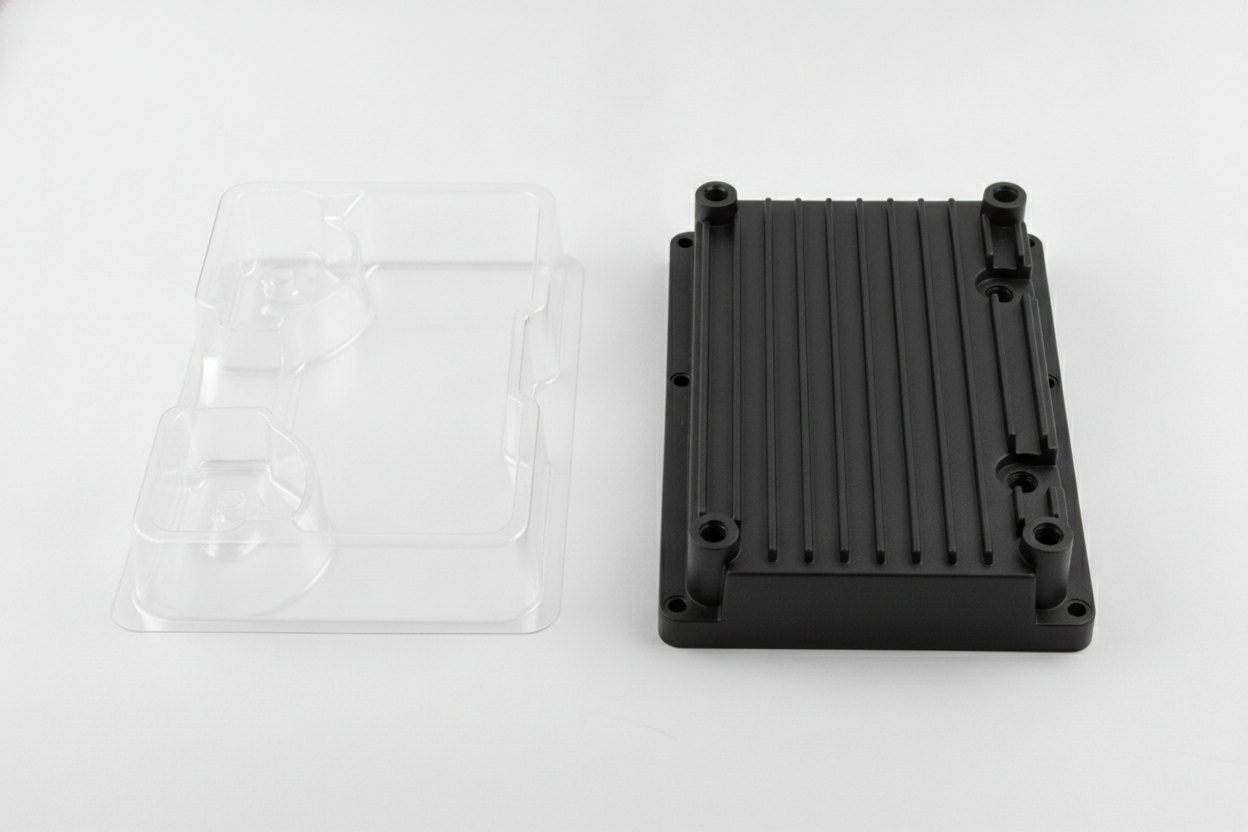
Thermoforming shapes a heated plastic sheet over a single-sided mold, while injection molding injects molten plastic pellets into a closed two-sided mold. Thermoforming has low tooling costs and suits large parts and lower volumes. Injection molding has higher tooling costs but the lowest cost per part at high volumes, with far more detail and tighter tolerances. This guide compares the two manufacturing processes point by point and shows how to choose.
What is thermoforming?
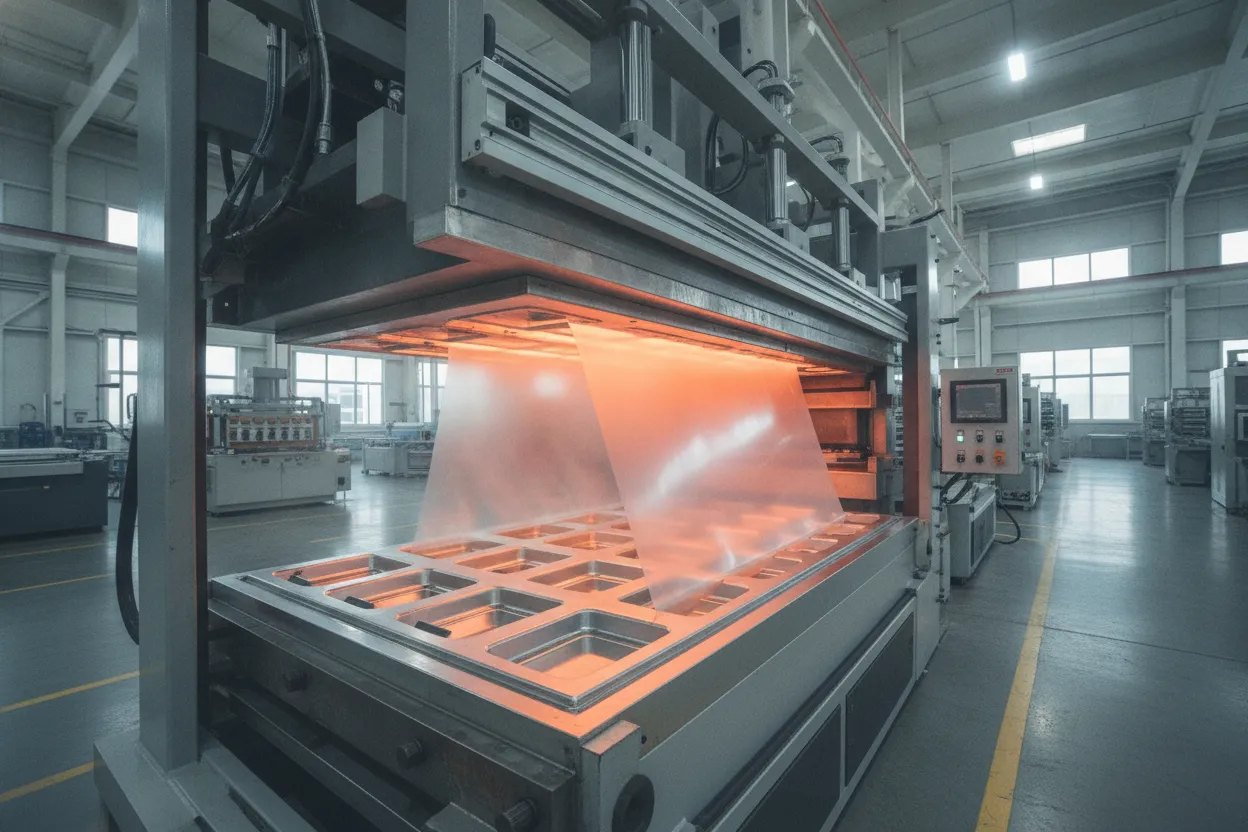
Thermoforming starts with a flat plastic sheet. The sheet is heated until soft, then pulled or pushed against a mold and cooled. The formed part is trimmed from the remaining sheet. There are three main thermoforming methods.
- Vacuum forming. A vacuum pulls the heated sheet onto the mold. It is the simplest and cheapest method, with moderate detail.
- Pressure forming. Air pressure pushes the sheet into the mold as well. It gives sharper detail and textures on the mold side, approaching the look of a molded part.
- Twin-sheet forming. Two sheets are formed and fused together to make a hollow, rigid part.
Thermoforming is also split by sheet thickness. Thin-gauge thermoforming makes packaging such as trays and clamshells. Heavy-gauge thermoforming makes durable parts such as equipment covers, panels and vehicle interior parts.
What is injection molding?
In injection molding, plastic pellets are melted and injected under high pressure into a mold cavity formed by two steel or aluminum halves. The plastic cools, the mold opens and the part is ejected. Because the mold defines every surface of the part, the injection molding process produces intricate parts with ribs, bosses, snap fits, threads and controlled wall thickness, shot after shot.
Thermoforming vs injection molding: comparison table
| Factor | Termoformado | Moldeo por inyección |
|---|---|---|
| Starting material | Plastic sheet | Plastic pellets |
| Moho | Single-sided, often aluminum | Two-sided, steel or aluminum |
| Coste de los utillajes | Bajo | Alta |
| Tooling lead time | Breve | Longer |
| Cost per part at low volume | Inferior | Más alto |
| Cost per part at high volume | Más alto | Mínimo |
| El mejor volumen | Hundreds to a few thousand per year | De miles a millones |
| Tamaño de la pieza | Very large parts are practical | Large parts need large, costly molds |
| Detail | One side controlled; limited features | Both sides controlled; intricate features |
| Grosor de la pared | Varies as the sheet stretches | Controlled by the mold |
| Tolerancias | Looser | Tighter |
| Material waste | Trim scrap from the sheet | Very little; runners can be reground |
| Operaciones secundarias | Trimming always required | Usually none |
| Cambios de diseño | Cheaper to modify the tool | More expensive once steel is cut |
Tooling costs and lead time
Tooling is where the two processes differ most. A thermoforming mold is a single-sided tool that sees low pressure, so it can be made from aluminum, composite or even wood for prototypes. It is quick to build and cheap to change.
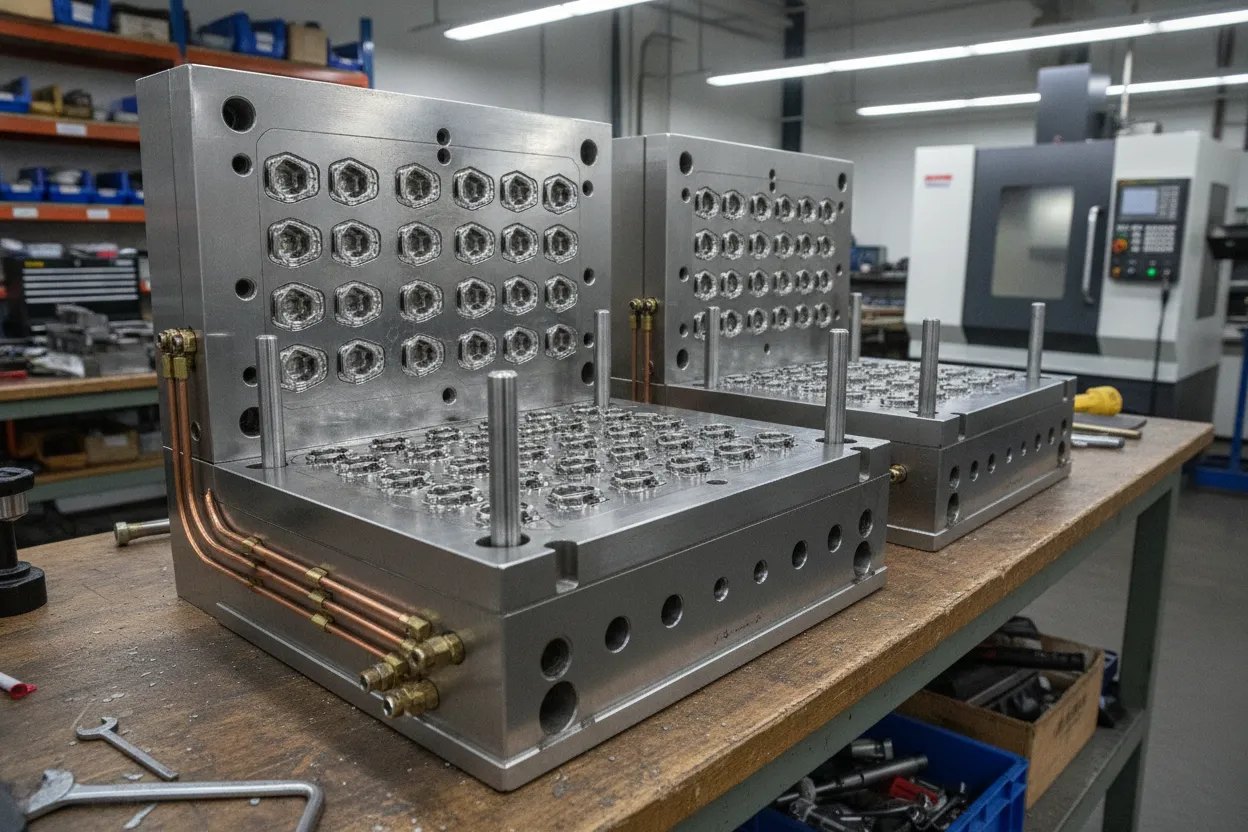
An injection mold has two precisely matched halves that must resist high pressure and temperature for many thousands of cycles. It often includes slides, lifters, cooling circuits and an ejection system. That makes it several times more expensive and slower to build. The gap narrows with prototype injection molds, which use simpler construction for limited runs.
Cost per part and production volume
The choice usually comes down to volume.
- At low volumes, tooling cost dominates. Thermoforming wins because the mold is cheap.
- At high volumes, cycle time and material cost dominate. Injection molding wins because cycles are fast, multi-cavity molds make several parts per shot and there is almost no waste.
- In between, there is a crossover point. For many parts it falls somewhere in the low thousands of units per year. Large, simple parts push the crossover higher. Small, detailed parts push it lower.
The only reliable way to find the crossover for your part is to compare quotes for both, including tooling spread over the planned production runs.
Part size, geometry and detail
Thermoforming handles large parts easily. A panel a meter or two across is routine, and the tooling cost stays manageable. The limitations are geometric. Only one side of the part touches the mold, so the other side is less defined. The sheet thins as it stretches into deep draws and corners. Features such as ribs, bosses and mounting points cannot be formed in; they are bonded or fastened on afterward.
Injection molding controls both sides of the part. Ribs, bosses, clips, living hinges, threads and fine textures are molded in one shot, and wall thickness is what the mold says it is. Small and medium parts with complex geometry are where it is strongest. Very large parts are possible but need large presses and expensive molds.
Materiales
Both processes use thermoplastics, but in different forms.
| Termoformado | Moldeo por inyección | |
|---|---|---|
| Materiales habituales | ABS, HIPS, PETG, PVC, polycarbonate, HDPE, acrylic | ABS, PC, PP, PE, nylon, POM, PMMA, PEEK and many more |
| Range of grades | Limited to what is available as sheet | Very wide, including filled and reinforced grades |
| Glass-filled materials | Raro | Común |
| Color and finish | Sheet color, caps and textures; often painted | Molded-in color and texture |
If your part needs a glass-filled, high-temperature or specialty engineering resin, injection molding is usually the only option.
Quality, tolerances and finish
Injection molded parts are more consistent. Dimensions are set by the mold on all sides, so tolerances are tighter and parts are repeatable. Typical molded tolerances are around ±0.1 mm on small dimensions. Thermoformed parts depend on how the sheet stretches and on trimming accuracy, so tolerances are looser, especially on the side that does not touch the mold. Pressure forming improves appearance on the mold side and can look close to a molded part.
Pros and cons at a glance
Thermoforming advantages
- Low tooling cost and short lead time
- Economical for large parts
- Cheap and quick design changes
- Good for low and medium volumes
Thermoforming disadvantages
- Mayor coste por pieza en la producción en serie
- Limited detail; features on one side only
- Uneven wall thickness
- Trim scrap and secondary trimming
- Fewer material choices
Injection molding advantages
- Lowest cost per part in high-volume production
- Intricate parts with molded-in features
- Tight tolerances and repeatability
- Very wide material range
- Little waste and little finishing
Injection molding disadvantages
- High tooling cost
- Longer lead time before first parts
- Design changes are expensive after tooling
- Large parts need large, costly molds
How to choose between thermoforming and injection molding
- Annual volume. Hundreds to a few thousand: look at thermoforming first. Many thousands and up: look at injection molding first.
- Part size. Large panels and covers favor thermoforming. Small and medium parts favor injection molding.
- Detail. If the part needs ribs, bosses, clips or threads, choose injection molding.
- Tolerancias. Tight fits with other components favor injection molding.
- Material. Engineering and filled resins point to injection molding.
- Time to first parts. If you need parts in a few weeks and volume is low, thermoforming is faster to tool.
- Design stability. If the design may still change, low-cost tooling limits the risk.
When neither is the best fit
For very small quantities, other processes can beat both. Vacuum casting makes tens of polyurethane parts from a silicone mold. CNC machining makes precise plastic parts with no tooling. 3D printing suits one-off concept models. Prototype injection molding bridges the gap between these and full production tooling.
Which process do we offer?
Tuowei Precision provides plastic injection molding, injection mold tooling, overmolding and insert molding, along with vacuum casting, CNC machining and 3D printing for earlier stages. Thermoforming is not one of our services. If your comparison points to injection molding, send your design and we will return a quote with DFM feedback within 24 hours.
A quick decision example
Imagine a project for an equipment cover about 800 mm wide. At 300 units a year, the thermoforming process is the natural choice: the mold is less expensive, lead times are short and the final product needs only trimming. If the same application grew to 20,000 units a year, the picture changes. Compared to injection molding, each thermoformed cover costs more to make and trim, so the higher tooling cost of a mold is paid back over the production run. Depending on the design, a single part with molded-in bosses can also replace several bonded pieces.
Injection molding is ideal when volume is high, the part is detailed and consistency matters. Thermoforming is ideal when the part is large, volume is modest or the design is still moving.