専門的な機械加工ソリューションが必要ですか?私たちTuowei Protoのチームは、あなたのすべての製造のニーズを支援するためにここにいる。現在進行中または今後のプロジェクトのお見積もりについては、今すぐご連絡ください!
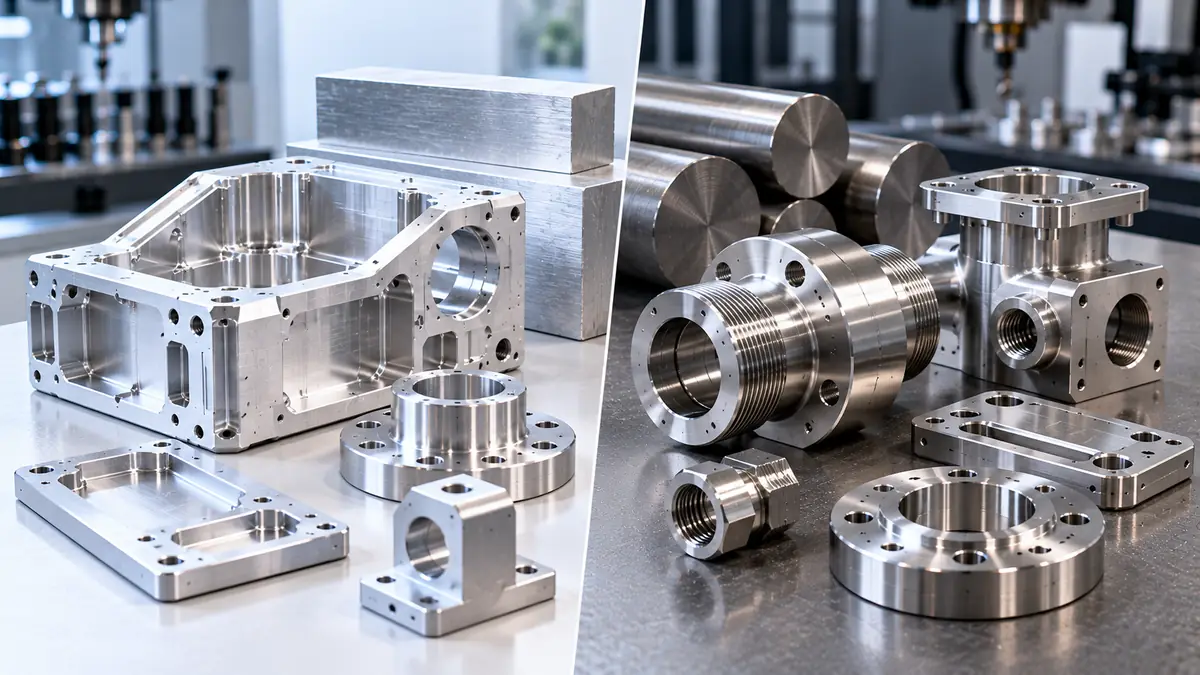
Most material decisions for machined parts get made on one property. Usually that is corrosion resistance or price, and the rest gets discovered when the first batch arrives. That is how a bracket ends up three times heavier than it needed to be, or an outdoor enclosure starts to pit. Aluminum vs stainless steel for CNC machined parts is a decision with several variables, and it is worth settling before the drawing is released.
Short answer: Choose aluminum, usually 6061-T6, when weight, cost and lead time drive the part and it works indoors or in mild conditions. Choose stainless steel, usually 304 or 316L, when the part faces chlorides, sterilization, sustained heat, sliding wear or high loads in a small envelope. Aluminum machines faster and costs less. Stainless survives harsher service.
This guide compares the two on the properties that change the part and the quote. It then covers what most comparisons skip: what switching material does to tolerances, threads, finishing, and the move from prototype to production.
Here is how aluminum vs stainless steel compares on the numbers that most often decide a CNC part.
| プロパティ | 6061-T6 aluminum | 304 stainless (annealed) |
| Density | 2.70 g/cm³ (0.098 lb/in³) | 8.00 g/cm³ (0.289 lb/in³) |
| 降伏強度 | 276 MPa (40 ksi), typical | 205 MPa (30 ksi), minimum |
| Tensile strength | 310 MPa (45 ksi), typical | 515 MPa (75 ksi), minimum |
| Elastic modulus | 69 GPa (10 Msi) | 193 GPa (28 Msi) |
| 熱伝導率 | 167 W/m·K | 16.2 W/m·K |
| Thermal expansion | 23.6 µm/m·°C | 17.3 µm/m·°C |
| Electrical conductivity | about 43% IACS | about 2.5% IACS |
| Machinability | 素晴らしい | Fair; work hardens |
| 耐食性 | Good indoors; anodize for harsh service | Very good; 316L for chlorides |
| 部品単価 | 下へ | より高い |
These are typical handbook values for these tempers. Temper, stock form and supplier all move the numbers, so confirm critical values against the mill certificate for your material.
It depends on which strength you mean, and the answer surprises people.
Yield strength is the stress at which a part starts to deform permanently. On that measure, annealed 304 is actually lower than 6061-T6. Stainless pulls ahead on ultimate tensile strength, hardness and wear resistance. It also wins decisively on stiffness. Its elastic modulus, the resistance to bending under load, is about 2.8 times higher, so a stainless plate deflects far less than an aluminum plate of the same thickness. When you need raw strength, 17-4 PH in the H900 condition reaches a minimum yield of about 1,170 MPa (170 ksi).
Aluminum’s advantage is strength per unit of weight. 7075-T6 reaches roughly 572 MPa (83 ksi) tensile at under 2.9 g/cm³, which is why it shows up in robot arms, drone frames and anything with a motor that has to accelerate the part.
One detail is easy to miss. Divide stiffness by density and the two materials come out almost level. So on “stiff and light”, aluminum versus stainless is close to a draw. Stainless helps when the part must stay stiff within a fixed size, and aluminum helps when mass is the constraint.
Yes, by a wide margin. That margin explains most of the price gap between aluminum and stainless steel parts.
Aluminum is soft, breaks into short chips and carries heat away from the cutting edge about ten times faster than stainless. Shops can run it at high spindle speeds and heavy feeds with tools that last. Machining stainless steel is a different job:
Shops respond with sharp coated carbide, lower surface speeds, a steady chip load, high-pressure coolant and rigid fixturing. All of that adds machine time. On most quotes, machine time drives CNC machining cost far more than the bar stock does.
There is one exception worth knowing. 303 stainless contains at least 0.15% sulfur, which breaks chips and makes it noticeably easier to machine than 304. It is common for high-volume CNC旋盤加工 of fittings and shafts. The trade-off is that 303 welds poorly and handles chlorides worse than 304. For a broader ranking of metals and plastics, see our guide to CNC machining materials by machinability.
<!– IN-CONTENT IMAGE: corrosion-anodized-vs-passivated.webp | ALT: Anodized 6061 aluminum part beside a passivated 316L stainless steel part after salt exposure –>
Stainless steel resists corrosion because it contains at least 10.5% chromium. The chromium forms a thin passive film that repairs itself when scratched. 304 handles most indoor, food and atmospheric service. Chlorides from seawater, road salt or cleaning chemicals cause pitting in 304, and 316 stainless steel adds 2 to 3% molybdenum to resist it.
Machining can embed free iron from tooling into the stainless surface, which leaves rust spots later. Passivation per ASTM A967/A967M removes that contamination and should be called out on the drawing for any stainless part going into wet service.
Aluminum forms its own oxide layer, which is adequate indoors. For outdoor, wash-down or marine exposure, it needs anodizing or a conversion coating.
Mixing the two needs care. When aluminum and stainless steel parts touch in the presence of moisture, the aluminum corrodes preferentially. NASA’s corrosion protection standard for flight hardware, NASA-STD-6012A, requires dissimilar-metal assemblies like this to be evaluated for galvanic corrosion and protected. The usual fixes are nylon washers, sealant or coated fasteners.
On heat, aluminum alloys lose a large share of their strength at temperatures that are routine for stainless. If a part runs hot for long periods, design from elevated-temperature data rather than room-temperature data. On conductivity, the table settles it: for heat sinks, bus bars and EMI enclosures, aluminum is the practical choice.
Settling the aluminum or stainless steel question is only half the decision. “Stainless steel” alone on a drawing invites the shop to pick whatever grade suits its stock, so always specify the alloy and condition.
| グレード | Best for | Watch for |
| 6061-T6 aluminum | Brackets, housings, fixtures, heat sinks | Needs a finish for harsh environments |
| 7075-T6 aluminum | Light, high-load structural parts | Poor weldability; less corrosion-resistant than 6061 |
| 303 stainless | High-volume turned fittings and shafts | Poor for welding; weaker in chlorides than 304 |
| 304 stainless | Food equipment, general enclosures | Pits in chlorides; work hardens |
| 316L stainless | Marine, chemical, medical parts | Slower to machine than 304 |
| 17-4 PH stainless | Shafts, pins, high-load parts | Heat treatment adds a step and lead time |
6061 aluminum is the default for most jobs and anodizes evenly. Extruded bar is commonly supplied to ASTM B221, so cite the spec with the alloy and temper. See our aluminum CNC machining page for stock and finish options. If you are deciding between the two common austenitic grades, our 304 vs 316 stainless steel comparison goes deeper.
Changing the material on a drawing without reviewing the drawing is one of the most common sources of first-article rejections.
Aluminum expands about 36% more per degree than 304. A 150 mm aluminum part that warms by 5 °C between the machine and the inspection room grows about 0.018 mm. The same stainless part grows about 0.013 mm. On a ±0.01 mm feature, that growth can use up most of the tolerance band. For tight work, say so on the drawing: inspect at 20 °C.
Stainless fasteners in stainless tapped holes can gall, meaning the threads cold-weld and seize during assembly. Anti-seize, coated fasteners or a mixed fastener grade prevent it. Aluminum has the opposite problem: tapped threads wear out when a screw goes in and out repeatedly, so specify helical thread inserts wherever that happens in service or maintenance.
Hard anodizing (Type III) typically builds about 0.05 mm (0.002 in), and roughly half of that grows outward from the original surface. Bores, press fits and threads need masking or a pre-finish machining size. Passivation removes almost no material, so stainless dimensions stay essentially where they were machined.
Prototyping in 6061 aluminum and then moving to stainless for production is common and often sensible. The aluminum parts are faster and cheaper to make, and the aluminum vs stainless steel differences only show up later, in ways a prototype can hide.
It helps to be clear about what that prototype proves. Geometry, fit and assembly sequence transfer well. Mass does not: the stainless part weighs nearly three times as much. Stiffness does not either, since the stainless part is about 2.8 times stiffer, which shifts natural frequencies in moving assemblies. Cost does not transfer at all. Deep narrow pockets and thin walls that were cheap in 6061 can multiply cycle time in 316L.
Our position is to run at least one iteration in the production material before releasing the design, or to get a DFM review in stainless before the prototype order. Our ラピッドプロトタイピングサービス can quote both materials side by side from one drawing.
Is aluminum cheaper to CNC machine than stainless steel? Usually, yes. Aluminum bar stock generally costs less, but the bigger lever on CNC machining cost is machine time. Aluminum runs at much higher speeds and feeds with longer tool life, so the same geometry spends less time on the machine. The gap narrows for simple turned parts in 303.
Can stainless steel be CNC machined to tight tolerances? Yes. Stainless holds tight tolerances well because it is stiff and dimensionally stable. Machining stainless steel to tight limits is about process control. Sharp tooling, steady chip load and good coolant prevent work hardening and heat distortion. Expect longer cycle times than aluminum for the same tolerance.
Can aluminum and stainless steel parts be used in the same assembly? Yes, with isolation. Where the two metals touch and moisture is present, galvanic corrosion attacks the aluminum. Anodize or conversion-coat the aluminum, and separate the metals with nylon washers, sealant or coated fasteners. Dry indoor assemblies carry much lower risk.
Which is better for medical device parts, aluminum or stainless steel? For anything that touches patients or goes through autoclave sterilization, stainless steel is the usual choice, most often 316L or 17-4 PH. Aluminum works for housings, carts and fixtures that never see sterilization. Biocompatibility requirements depend on the device, so confirm them with your regulatory team.
Should I choose 304 or 316 stainless for a machined part? Choose 304 for indoor, food-processing and general-purpose parts, where it costs less and machines slightly easier. Choose 316 or 316L when the part meets seawater, road salt, chlorinated cleaners or body fluids. Its molybdenum content resists the pitting that attacks 304 in those environments.
For most indoor, weight-sensitive or cost-driven parts, 6061-T6 aluminum is the better default, because it machines quickly, quotes low and finishes easily. When the part faces chlorides, sterilization, sustained heat or heavy sliding wear, go straight to stainless steel, and in most of those cases 316L rather than 304.
Either way, the final choice for aluminum vs stainless steel for CNC machined parts should come from the service conditions, not the property that first comes to mind. Specify the exact grade, the finish and the inspection temperature on the drawing.
If you want a second opinion, send your drawing to エリート・モールド・テック. Our engineers review material, tolerances and finishing as part of every CNC machining service quote, from single prototypes through production runs.

Written by Andy, Manufacturing Engineer at TUOWEI Precision. Andy specializes in CNC machining, precision manufacturing, and production engineering, with hands-on experience supporting projects from rapid prototyping through full-scale production. He works closely with engineering and manufacturing teams to evaluate materials, tolerances, machining processes, and design manufacturability. His articles provide practical, technically informed insights to help engineers and buyers make better manufacturing decisions, optimize production efficiency, and achieve consistent part quality. Explore TUOWEI Precision’s CNC machining and custom manufacturing solutions for your next project.
From rapid prototypes to scalable production, Tuowei Precision delivers reliable CNC machining with accuracy and consistency at every step. Start your project today.
Tuowei精密の実際のCNC加工、業界動向、生産洞察力を常に更新しますが、より良い生産の意思決定を行うことができるようにインストールされています。.