
Tuowei Precision provides CNC machining for robotics companies that need accurate, repeatable parts. We machine arm links, joint and gearbox housings, actuator parts, shafts, flanges, grippers and sensor brackets on more than 130 three-, four- and five-axis CNC machines, routinely holding ±0.01 mm on custom robot parts and ±0.005 mm on critical features.
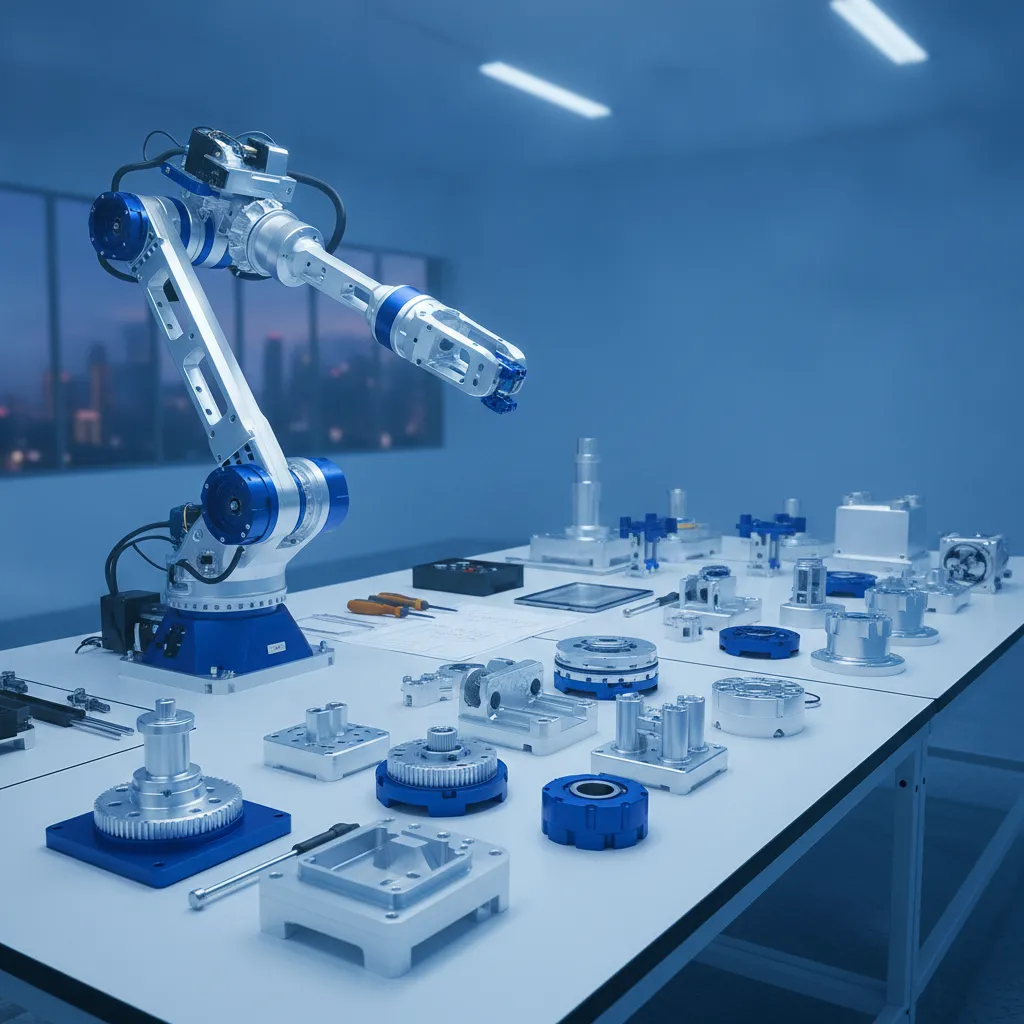
Robots depend on accuracy. Every joint stacks small errors from its housing, bearings and gearbox, and those errors add up at the end effector. Computer numerical control (CNC) machining gives robotics engineers the dimensional accuracy, surface finish and repeatability that cast, plastic molded or 3D printed parts cannot match on their own. The advantages of CNC come from the machine tool itself: a rigid spindle, accurate axes and a programme that repeats every machining operation exactly.
CNC machining also suits the way robotics companies work. There is no mold or die, so the same machining process makes five prototype parts this week and five hundred production parts next quarter. Additive manufacturing is still useful for covers and complex ducts, but load-bearing parts belong on a CNC machine. Design changes mean a new programme, not a new mold.
Mecanizado CNC de 5 ejes reaches multiple sides of a joint housing or link in one setup, so bores and faces stay aligned. It is the best process for complex housings, organic link shapes and humanoid limb parts.
Plates, brackets, motor mounts and gripper bodies are cut efficiently on a 3- or 4-axis mill; multi-axis machining handles the rest, and the right cutting tool for each alloy keeps surfaces clean.
Shafts, pins, bushings, output flanges and spacers are produced on a CNC lathe by Torneado CNC. Swiss-type turning machines make long, slender and very small parts, such as humanoid finger joints and precision pins, straight and accurate.
Anodizing, black oxide, electroless nickel, bead blasting and powder coating protect parts and give a consistent look across the robot.
| Pieza | Material habitual | Critical features |
|---|---|---|
| Arm links | Aluminum 6061-T6, 7075-T6 | Stiffness, weight, bore alignment |
| Joint and gearbox housings | Aluminum, titanium | Bearing bores, concentricity, flatness |
| Actuator housings and output flanges | Aluminum, steel | Bolt patterns, bearing fits |
| Shafts and pins | 4140, 17-4 stainless steel | Diameter, roundness, surface finish |
| End effectors and grippers | Aluminum, POM | Light weight, wear resistance |
| Sensor and camera brackets | Aluminio | Position and angle of mounting faces |
| Humanoid limb and hand parts | Aluminum, titanium | Thin walls, small precise features |
For arm-specific components, see our robot arm manufacturing página.
We routinely machine parts for robotic arms to ±0.01 mm, and critical features down to ±0.005 mm. Reamed or bored holes typically hold ±0.01 mm and turned shaft diameters ±0.01 mm, with positional tolerances from ±0.01 mm. CMM verification is standard on tight-tolerance work, and full inspection reports are provided when needed.
Tolerance every feature tightly and the price goes up without any gain in robot performance. Hold the bearing seats, gearbox interfaces and bolt patterns tight, and leave covers and clearance pockets at standard tolerance.
Humanoid robots need many compact joints, each with an actuator housing, bearing seats and an output flange, inside a light body. CNC machining of humanoid robotic parts means thin walls, deep pockets and tight bearing fits in aluminum and titanium, often in small batches that change between design rounds. Our 5-axis and Swiss-type machines handle both the large limb parts and the tiny finger and wrist components.
Robots do not only use CNC parts; they also run CNC machine tools. In machine tending, a collaborative robot or industrial robots handle material handling, loading and unloading, which keeps spindles busy and improves productivity. Some shops even use a CNC robot to mill or weld large parts. This kind of robotic automation is changing manufacturing processes in machine shops, as robotics and automation link machine control systems with the robot. For robotics buyers, it means a supplier with stable, documented processes can deliver repeatable parts at scale.
Rapid CNC machining for prototype parts starts at 3–7 days, and production batches typically ship in 5–10 business days. General capabilities are on our Servicios de mecanizado CNC página.