Poisson’s ratio (ν) is the amount a material narrows sideways when it is stretched, divided by the amount it lengthens. In formula form, ν = −ε_transverse / ε_axial. Most metals fall between 0.25 and 0.35, which means a bar stretched by 1% gets about 0.3% thinner. Rubber approaches 0.5, cork is close to 0, and a few engineered “auxetic” materials even go negative.
The value matters whenever a part is loaded in more than one direction. In real assemblies, that is most of the time.
The concept comes from the strength of materials, the branch of mechanics that studies deformation in solid bodies under load. In mechanical engineering, the ratio is a basic input for stress analysis, and its value shapes the behavior of materials when forces act in more than one direction at once.
Pull on a rubber band and it gets thinner as it gets longer. Metals do the same. You just cannot see it, because in a steel bar the change in diameter is measured in thousandths of a millimeter even when the bar is loaded close to its yield point. This sideways response is called the Poisson effect, after the French mathematician Siméon Denis Poisson.
Two strains are involved:
Under tension, the axial strain is positive and the transverse strain is negative. The minus sign in the formula makes the ratio a positive number for ordinary materials.
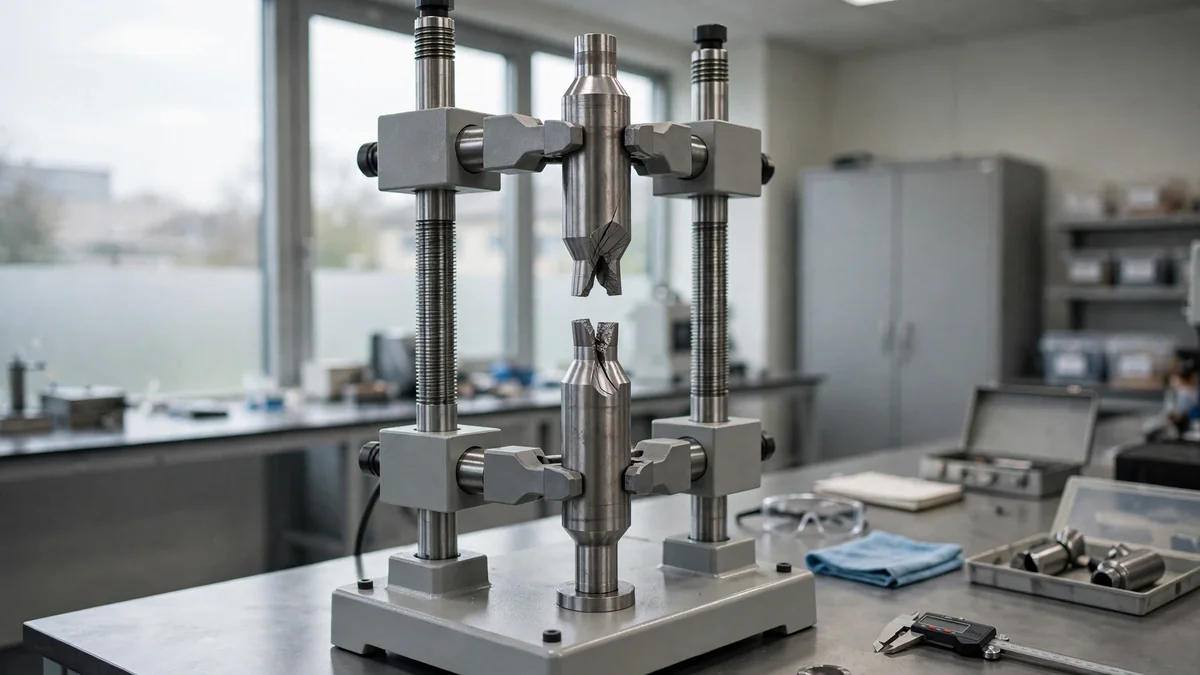
Engineers define the ratio from a simple uniaxial test, pulling a specimen along one axis and measuring how much it narrows sideways. The result is defined as the ratio of transverse strain to axial strain, with a minus sign to keep the value positive. A lateral strain gauge on the side of the specimen records the sideways change, which is usually far smaller than the length change.

ν = −ε_transverse / ε_axial
Worked example. A steel test bar has a 10.000 mm diameter and a 50 mm gauge length. Under load, the gauge length grows by 0.050 mm and the diameter shrinks by 0.0029 mm.
A result of 0.29 is typical for carbon steel. Look at how small the diameter change is: under three microns. Measuring it accurately is the hard part of any test, a point the ASTM standard makes directly in its notes on transverse strain error.
The number tells you how a material trades volume under load:
For isotropic materials, theory limits the ratio to between −1 and 0.5.
Civil engineering uses the same idea for concrete and soil, where the value affects how a foundation settles and how a retaining wall pushes back. In physics terms, the number links volume change to shape change, and a material that keeps its volume (ν = 0.5) narrows in each sideways direction by half as much as it lengthens.
Typical room-temperature values are below. They are guide figures for design and analysis, not certified data. Check the supplier’s data sheet for any safety-critical calculation.
| المواد | Typical ν |
|---|---|
| الفولاذ الكربوني | 0.27 to 0.30 |
| الفولاذ المقاوم للصدأ 304 / 316 | 0.27 to 0.30 |
| Aluminum alloys (6061, 7075) | 0.33 |
| Titanium Ti-6Al-4V | 0.31 to 0.34 |
| النحاس | 0.33 to 0.34 |
| نحاس | 0.33 to 0.35 |
| Gray cast iron | 0.21 to 0.26 |
| Lead | about 0.43 |
| زجاج | 0.20 to 0.25 |
| الخرسانة | 0.10 to 0.20 |
| ABS | about 0.35 |
| بولي كربونات | about 0.37 |
| بيك | about 0.38 to 0.40 |
| Natural rubber | 0.49 to 0.50 |
| Cork | close to 0 |
Metals cluster tightly. That is why many hand calculations simply use 0.3 for steel and 0.33 for aluminum without losing meaningful accuracy, while plastics run higher and shift more with temperature, moisture and fiber content, so their values deserve a second look before any fit or seal calculation is signed off.
For an isotropic material, three elastic constants are tied together:
E = 2G(1 + ν)
E is معامل يونغ and G is the shear modulus. Know any two and the third follows. NIST’s report on elastic moduli data (NISTIR 6853) uses the same relationship, written as ν = E / 2G − 1.
Example: aluminum with E = 68.9 GPa and ν = 0.33 gives G ≈ 25.9 GPa. For a full breakdown of shear behavior, read our guide to shear modulus and material rigidity.
A related link is the bulk modulus, K = E / [3(1 − 2ν)]. As ν approaches 0.5, the bulk modulus heads toward infinity. That is the mathematical way of saying rubber is very hard to compress in all directions, even though it is easy to stretch.
The modulus of elasticity ties the three constants together, so a designer who knows any two can work out the third. For safety-critical parts, the factor that matters most is not the ratio alone but the performance of the whole structure under real loads, including temperature and moisture.
The common method for structural materials is ASTM E132, Standard Test Method for Poisson’s Ratio at Room Temperature. A flat specimen is pulled in tension while two extensometers or strain gauges record axial and transverse strain at the same time.
Three practical rules come out of that method:
Ultrasonic testing is quicker. It works out the elastic constants from how fast longitudinal and shear sound waves travel through the material, which makes it useful for finished parts that cannot be cut into test specimens.
Ignoring the Poisson effect causes real problems, mostly in fits and seals:
A practical warning from the shop floor: plastics such as PEEK and acetal have higher ratios and lower stiffness than metals. A thin plastic sleeve clamped too hard during turning bulges, gets machined round, then springs back oval when released. Light clamping, soft jaws and finishing passes avoid most of that. Our التصنيع الآلي الدقيق team plans fixturing around these effects on tight-tolerance parts.
One honest limit: the tabulated values assume isotropic material. Rolled plate, extrusions, composites and 3D printed parts can show different ratios in different directions. For those, test data in the right orientation beats any handbook number.
The effect also changes length: a bar pulled longitudinally gets longer, and the sideways narrowing is a decrease in diameter that must be allowed for in tight fits. When a seal or a press fit is designed around these numbers, the result holds up in service instead of leaking or loosening.
A ratio of 0.3 means the material contracts sideways by 30% of the strain it experiences along the load. Stretch a bar by 1% and its width shrinks by 0.3%. That value is typical for steel and many other metals, and it is the default used in most hand calculations.
A ratio of 0.5 means the material keeps a constant volume when deformed, so any stretch is fully balanced by narrowing. Rubber and other elastomers come very close to this. Such materials are nearly incompressible, which is why seal grooves must leave room for them to move sideways.
Cork is the best-known material with a ratio close to zero. When compressed along one axis, it barely expands sideways. That behavior makes it easy to push into a bottle neck without bulging. Some engineered foams and lattice structures are also designed to have near-zero values.
Yes. Materials with a negative ratio are called auxetic. They become wider when stretched and thinner when compressed. Most are engineered foams, fabrics or 3D printed lattices with re-entrant cell shapes. Theory allows isotropic materials to range from −1 to 0.5, but ordinary metals and plastics are always positive.
Measure strain in two directions during a tensile test. Divide the change in width by the original width to get transverse strain, and divide the change in length by the original length to get axial strain. The ratio is the negative of transverse strain divided by axial strain.
It signifies how much a material narrows sideways when it is stretched along one axis. A value near 0.3 is typical for metals, near 0.5 means the material keeps its volume like rubber, and near 0 means it barely narrows at all like cork. Engineers use it to predict shape changes in loaded parts.
Gray cast iron is about 0.21 to 0.26, which is lower than steel at 0.27 to 0.30. The lower value reflects the graphite flakes in the iron, which reduce sideways movement under load. Use the data sheet value for the exact grade, because the ratio shifts with composition and heat treatment.
The ratio describes shape change: how much a material narrows sideways when stretched. Young’s modulus describes stiffness: how much it stretches under load. The two are linked by the formula E = 2G(1 + ν), so knowing the ratio and the shear modulus gives the modulus, and the three constants always agree.
This ratio explains how a part changes shape sideways when loaded along one axis. Use the typical values above for early calculations, connect them to Young’s and shear modulus when you need a third constant, and rely on test data for anisotropic or safety-critical parts. Pay closest attention in press fits, seals and thin-walled components.
Need parts where fits and deflection matter? Browse our المواد, explore خدمات التصنيع الآلي باستخدام الحاسب الآلي الرقمي, or upload a drawing for a free instant quote from دقة تووي.