هل تحتاج إلى حلول تصنيع آلية متخصصة؟ فريقنا في Tuowei Proto موجود هنا لمساعدتك في جميع احتياجات التصنيع الخاصة بك. تواصل معنا اليوم للحصول على عرض أسعار لمشاريعك الجارية أو القادمة!
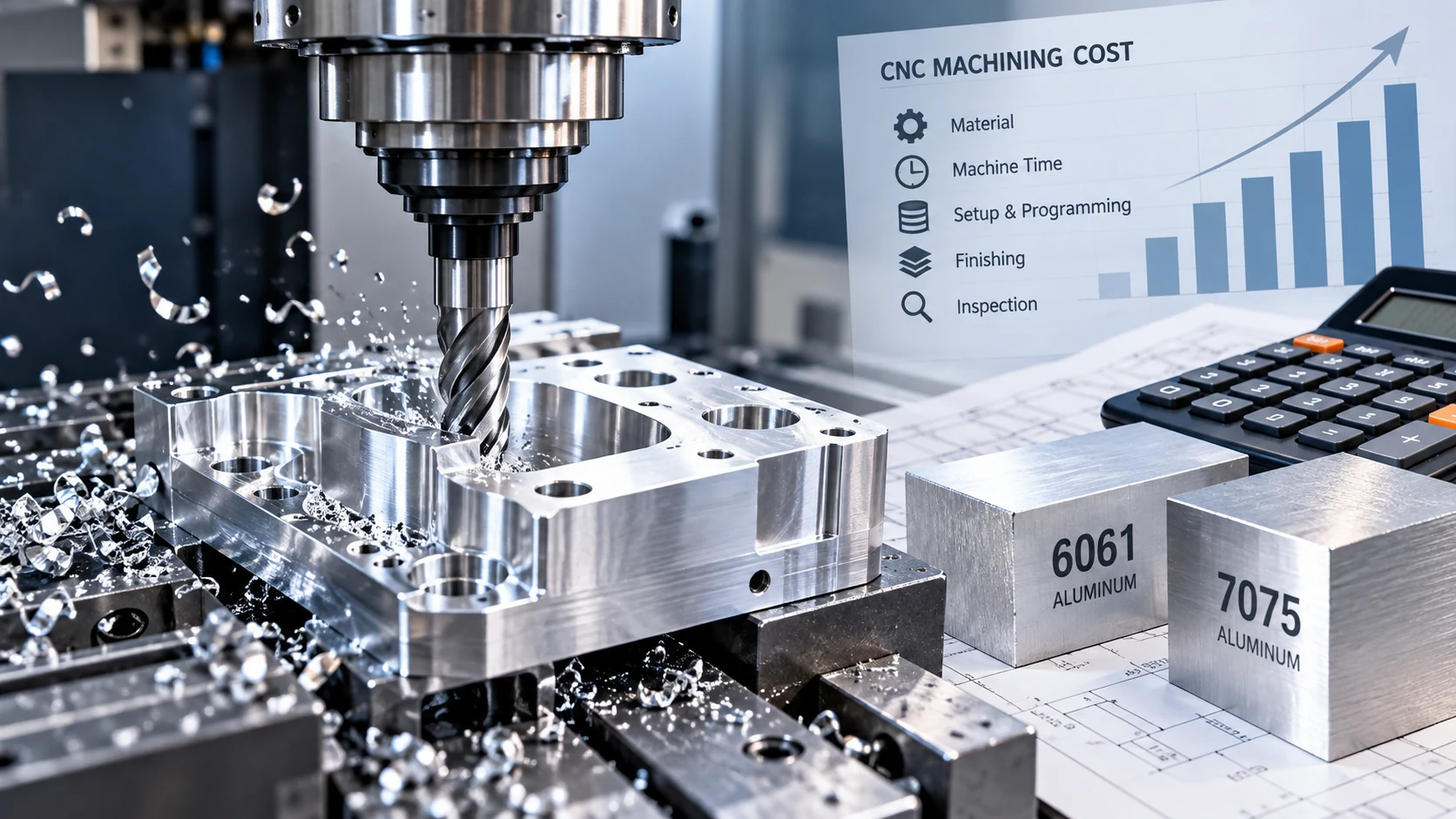
Aluminum CNC machining cost is driven mostly by time, not metal. Every quote adds up the same pieces: material, machine hours, one-time programming and setup, finishing, and inspection. The fixed items are then spread across your order quantity, which is why one 6061 bracket can cost several hundred dollars as a prototype and under $30 each at 500 pieces.
Short answer: The price of a machined aluminum part equals material, plus cycle time multiplied by the shop’s hourly rate, plus setup and programming divided by quantity, plus finishing and inspection. Cycle time and quantity move the number most. Alloy choice matters less than most buyers expect, unless you move to 7075 or a very large billet.
This guide walks through each line of a quote, shows a worked example at four quantities, and covers the costs US buyers often leave out: duties, freight, and how long a price holds when metal markets move.
Most shops, including our team at Tuowei Precision’s CNC machining service, build a quote from the same formula:
Price per part = material + (cycle time × hourly rate) + (programming and setup ÷ quantity) + finishing + inspection
Overhead and margin are usually folded into the hourly rate rather than listed on their own. The table below shows what sets each line and how it behaves as your order grows.
| خط التكلفة | What sets it | What happens as quantity rises |
| المواد | Alloy, temper and stock size, not finished size | Stays roughly fixed per part, with small bulk savings |
| Machine time | Cycle time multiplied by the machine’s hourly rate | Fixed per part, but can drop with tuned toolpaths and multi-part fixtures |
| Programming and setup | CAM (computer-aided manufacturing) programming, fixture design, number of setups | One-time charge divided across the lot |
| التشطيب | Process type, lot charges, masking | Lot charge divides across parts; per-part handling stays |
| الفحص | First article checks, CMM (coordinate measuring machine) reports, sampling plan | First article is one-time; ongoing sampling scales with volume |
Two of these lines are per-part costs. Three are mostly per-order costs.
Keep that split in mind, because it explains almost every price difference you will see between a prototype order and a production order of the same part.
You pay for the stock the shop cuts from, not the finished part. A bracket that weighs 250 g after machining might start as a 624 g bar of 6061. More than half of what you bought leaves the machine as chips.
Even so, the metal is rarely what drives the cost of machining aluminum. At an assumed CNC machining hourly rate of $60, every minute of spindle time adds $1.00 to the price. An 18 minute cycle is $18 of machine time, which is nearly three times the $6.24 of material in the worked example further down this page.
What stretches cycle time is mostly geometry. Small cutters remove material slowly. Deep features force long-reach tools and lighter passes. Tight tolerances need extra finishing passes and in-process measurement, and every tool change adds a few seconds that repeat on every single part in the order.
The CNC machining hourly rate itself varies with machine type, region and how loaded the shop is. Treat any published range as a starting point rather than a price. Two quotes can show the same rate and still land far apart because one programmer found a faster toolpath.
Sometimes. A 5-axis machine carries a higher hourly rate than a 3-axis mill, but it can reach four or five faces of a part in one clamping. Each setup you remove saves fixturing time, a new set of work offsets, and a chance for features on different faces to drift out of position relative to each other.
Our view: if a part needs features on four or more faces, ask for a 5-axis quote next to the 3-axis one and compare the totals, not the rates. For a flat plate or a simple bracket with features on one or two sides, a 3-axis machine will almost always win. You can see how we split work between machine types on our CNC milling services page.
Alloy choice shifts the material line of your aluminum machining cost and, less often, the machine line. Both 6061-T6 and 7075-T6 machine well in their heat-treated tempers, so the gap in a CNC aluminum quote usually comes from what the stock costs and how easy it is to find in the size you need.
| سبيكة | Where it makes sense | Effect on the quote |
| 6061-T6 | Brackets, housings, fixtures, general parts | The usual baseline; widely stocked in bar and plate |
| 7075-T6 / T651 | High-strength structural and aerospace parts | Higher material cost; T651 plate is stress relieved, which helps flatness |
| 6063-T5 | Extruded profiles that need light machining | Lower cost when an extrusion gets close to the final shape |
| 2024-T3 | Fatigue-loaded parts | Higher material cost; weaker corrosion resistance, so it often needs a coating |
| 5052 | Sheet-based parts, marine hardware | Softer and gummier to cut; more common in sheet metal than in machining |
| MIC-6 | Flat plates, fixtures, inspection bases | Cast tooling plate that stays flat after machining; priced above 6061 plate |
Our position: 6061-T6 is the right default for most parts. Move to 7075-T651 aluminum when a load calculation says you need the strength, not because the part looks structural.
On thin-walled parts, residual stress in plate can make the part move after roughing. Stress-relieved tempers or a rough, rest and finish sequence may add a step, and that step shows up in the price.
The example below uses assumed inputs to show how CNC machining cost per part behaves as quantity rises. These are not quoted prices, and your supplier’s rates will differ, but the shape of the curve holds for almost any machined aluminum part.
Assumptions for a 6061-T6 bracket:
| الكمية | المواد | Machine time | Setup share | التشطيب | الفحص | Price per part | Order total |
| 1 | $6.24 | $18.00 | $180.00 | $122.50 | $60.00 | $386.74 | $386.74 |
| 10 | $6.24 | $18.00 | $18.00 | $14.50 | $6.00 | $62.74 | $627.40 |
| 100 | $6.24 | $18.00 | $1.80 | $3.70 | $0.60 | $30.34 | $3,034.00 |
| 500 | $6.24 | $18.00 | $0.36 | $2.74 | $0.12 | $27.46 | $13,730.00 |
At one piece, setup is about 47% of the price and machine time is under 5%. At 500 pieces, machine time is about 66% and setup barely registers. That flip is why the biggest savings on small orders come from ordering smarter, while the biggest savings on production orders come from designing a faster part.
Real quotes often fall faster than this table, because at volume a shop can load several parts per fixture and tune the program. They can also fall slower if your drawing calls for 100% inspection. For low-volume and production runs, our precision machining team quotes quantity breaks side by side so you can see where the curve flattens.
Most of the aluminum CNC pricing you can influence is set on the drawing before a shop ever sees it. These features show up again and again in expensive RFQs (requests for quote):
On machined aluminum parts, finishing is often quoted as a separate line, and it is where many budget surprises start. Anodizing is a batch process with a lot charge, so ten parts can cost almost as much to anodize as fifty.
The Type II and Type III designations come from MIL-A-8625. Type III hardcoat costs more than Type II, and part of the coating grows outward from the surface, so bores, fits and threads need a size allowance or masking. Masking is manual work and it is priced that way.
If a surface must stay conductive for grounding, chromate conversion to MIL-DTL-5541 is usually cheaper than anodizing and masking around it. Bead blasting before anodizing gives an even matte look, but it is another step with its own handling cost. Tuowei offers anodizing, bead blasting, chromate conversion coating and powder coating, so finishing can be quoted with the machining instead of sourced separately.
Inspection scales with what you ask for. A standard dimensional check is part of normal production. A full CMM report, a first article inspection in AS9102 format for aerospace components, or 100% inspection of every feature each add real hours, so ask only for the documentation your customer actually requires.
A common mistake is specifying a finish without thinking through what it touches. The drawing calls for black anodize on the whole part, nobody notices that the tapped holes and a bearing bore are included, and the problem only surfaces when parts fail assembly.
A price per part from an overseas supplier is not your landed cost. Freight, customs brokerage and duties all sit on top, and for aluminum the duty line has changed quickly.
وفقاً ل USGS Mineral Commodity Summaries 2026, the United States imposed a 25% tariff under Section 232 of the Trade Expansion Act on aluminum and aluminum derivative products in March 2025, raised it to 50% for most countries in June, and in August added more than 400 aluminum-related tariff codes, with the duty applied to the aluminum content of those products. Whether a specific machined part falls under one of those codes depends on its Harmonized Tariff Schedule (HTS) classification. These rules changed several times in one year. Confirm the current rate with your customs broker before you place an order.
The same USGS report estimates that the average annual US market price for aluminum rose 39% in 2025 compared with 2024. When metal moves that much, ask how long the material line on your quote is valid and whether the price is EXW (Ex Works) or DDP (Delivered Duty Paid). A DDP price includes duties and delivery; an EXW price leaves both to you.
A quote is only as accurate as the package behind it. Missing information gets priced as risk, and risk is always rounded up. Send:
When you compare quotes, line them up by cost line, not by the bottom number. One supplier may include programming in the unit price while another lists it as a one-time NRE (non-recurring engineering) charge. One may include anodizing lot charges and inspection reports; another may add them later.
A lower CNC machining cost per part means little if the same order carries a larger setup fee, pricier freight terms or a shorter material validity.
These changes rarely affect function and usually show up directly in the price:
The first three items usually have the largest effect, because they cut cycle time on every part, not just the first one. Material and finishing changes help too, but they rarely reduce CNC machining cost as much as a faster program does.
How much each change is worth depends on your volume. On a 10-piece prototype, loosening tolerances saves little because setup dominates. On a 5,000-piece run at $1 per minute of spindle time, shaving two minutes off the cycle is worth $10,000.
The most reliable way to control aluminum CNC machining cost is to decide early which features really need precision and which ones only need to exist. Once those choices are on the drawing, cycle time sets the running cost and quantity decides how much setup each part carries.
If you have a part ready to price, send the STEP file and drawing to دقة تووي. Our engineers will review it and send back a line-by-line quote at the quantities you ask for, with DFM feedback on anything that adds machine time without adding function.
Q: How much does it cost to CNC machine an aluminum part?
A: It depends on cycle time, setups and quantity far more than on the metal. In our worked example, the same 6061 bracket prices at about $387 as a single prototype and about $27 each at 500 pieces. A quote from your actual CAD file is the only reliable number.
Q: Is aluminum cheaper to machine than steel?
A: Usually, yes. Aluminum alloys such as 6061 cut at higher speeds with less tool wear than most steels, so cycle times are shorter and tooling lasts longer. The real gap depends on the grade, the geometry and the tolerances, so compare quotes for your specific part.
Q: Does anodizing add a lot to the price per part?
A: It can on small orders. Anodizing runs in batches with a lot charge, so ten parts share most of that charge between them. Type III hardcoat costs more than Type II, and masking threads or bores adds manual labor that is priced per part.
Q: Is 5-axis machining more expensive than 3-axis?
A: The hourly rate is higher, but the total is not always. A 5-axis machine can reach several faces in one setup, which removes fixtures and repositioning. For parts with features on four or more sides it is often cheaper overall; for flat parts, 3-axis usually wins.
Q: Why do prototypes cost so much more than production parts?
A: Programming, fixturing, setup and first article inspection are paid once per order. On a single prototype, the whole amount lands on one part. On a production run, the same charges spread across hundreds of parts, so the price per part falls sharply.

بقلم آندي، مهندس تصنيع في شركة TUOWEI Precision. يتخصص آندي في التصنيع باستخدام الحاسب الآلي (CNC) والتصنيع الدقيق وهندسة الإنتاج، ويتمتع بخبرة عملية في دعم المشاريع بدءًا من النماذج الأولية السريعة وصولًا إلى الإنتاج على نطاق واسع. وهو يعمل عن كثب مع فرق الهندسة والتصنيع لتقييم المواد والتفاوتات المسموح بها وعمليات التصنيع وقابلية التصميم للتصنيع. تقدم مقالاته رؤى عملية ومستندة إلى المعرفة التقنية لمساعدة المهندسين والمشترين على اتخاذ قرارات تصنيع أفضل، وتحسين كفاءة الإنتاج، وتحقيق جودة متسقة للأجزاء. اكتشف حلول التصنيع باستخدام الحاسب الآلي (CNC) والتصنيع المخصص التي تقدمها TUOWEI Precision لمشروعك القادم.
بدءًا من النماذج الأولية السريعة وصولاً إلى الإنتاج القابل للتوسع، تقدم شركة Tuowei Precision خدمات تصنيع موثوقة باستخدام الحاسب الآلي (CNC) تتسم بالدقة والاتساق في كل خطوة. ابدأ مشروعك اليوم.
ابق على اطلاع دائم على الماكينات بنظام التحكم الرقمي الحقيقي، واتجاهات الصناعة، ورؤى الإنتاج في Tuowei Precision، ولكن تم تثبيتها لتمكينك من اتخاذ قرارات إنتاج أفضل.