
- What Is Binder Jetting 3D Printing?
- How Does Binder Jetting Work?
- Binder Jetting at a Glance
- What Materials Can Binder Jetting Print?
- Binder Jetting vs Other 3D Printing Technologies
- Advantages of Binder Jetting
- Limitations of Binder Jetting
- Design Guidelines for Binder Jetting
- التطبيقات الشائعة
- When to Choose Binder Jetting
- Cost and Production Volume
- How Binder Jetting Compares on Metal Properties
- الأسئلة الشائعة
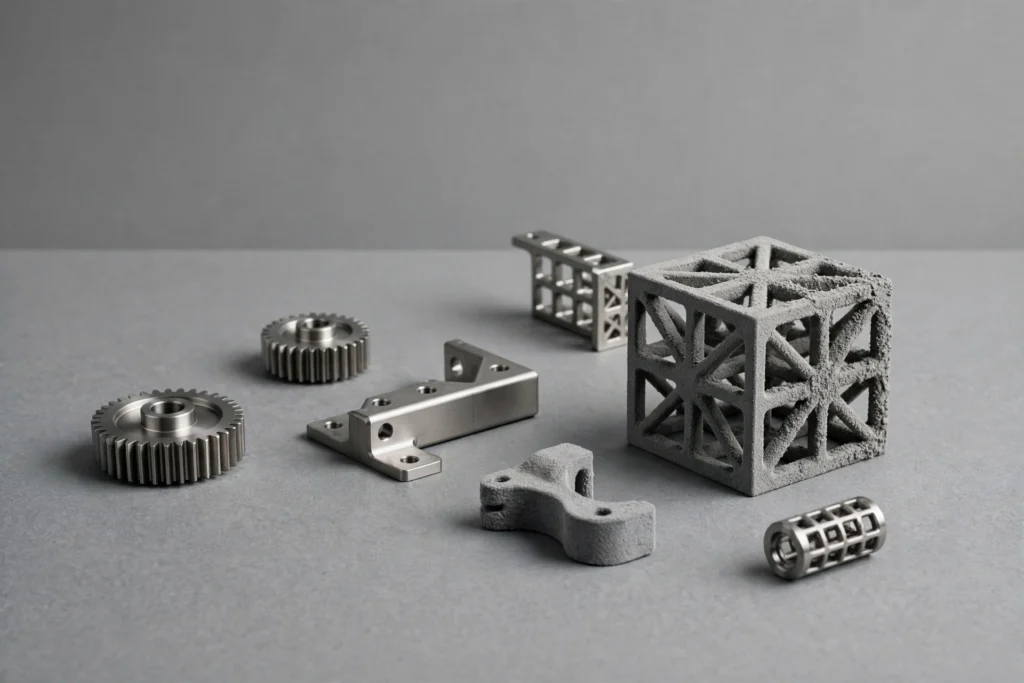
What Is Binder Jetting 3D Printing? #
Binder jetting is a 3D printing process that builds parts by spreading a thin layer of powder and jetting a liquid binder onto it, one layer at a time. The binder acts like a glue, joining the powder particles only where the part should be. This guide explains how the process works, and it sits alongside our introduction to التصنيع المضاف, which covers the wider family of 3D printing technologies.
Where Binder Jetting Came From #
The technology was developed at the Massachusetts Institute of Technology in the 1990s, and the first commercial machines appeared soon after. Today it is used for metal parts, sand casting molds, ceramics, and full color models.
Why It Stands Out #
Binder jetting is best known for three strengths: large build volumes, no support structures, and fast production of many parts at once. Its main weakness is that printed parts are fragile until a second step, usually sintering or infiltration, gives them final strength.
How Does Binder Jetting Work? #
The Printing Cycle #
The printing process has four repeating steps. A recoating blade or roller spreads a thin layer of powder across the build platform. A printhead then moves over the powder bed and jets droplets of liquid binder onto the areas that form the part, much like an inkjet printer jets ink onto paper.
Once a layer is complete, the build platform moves down by one layer height, and a fresh layer of powder is spread on top. The cycle repeats until the whole part is built. The unbound powder around the part stays in place and supports it, so no extra support structures are needed.
Removing the Part #
After printing, the part is left in the powder bed to cure and gain handling strength. It is then removed, and loose powder is cleared away with compressed air or a brush. At this stage the part is called a green part, and it is brittle and porous.
What Happens After Printing? #
The green part almost always needs post processing. Metal parts are sintered in a high temperature furnace, which burns out the binder and fuses the metal particles together. Other metal parts are infiltrated with bronze, which fills the pores by capillary action. Full color models are infiltrated with acrylic and coated to improve color and strength.
Sand casting molds and cores are the main exception. They are usually ready to use straight after printing, with no sintering step, and the mold is broken away after casting.
Sintering vs Infiltration #
Sintering produces denser parts, around 97 percent dense, with better mechanical properties. The trade off is shrinkage of about 20 percent, which the machine software compensates for by printing the part oversize. Non uniform shrinkage can still cause distortion.
Infiltration produces parts around 90 percent dense, with lower shrinkage of about 1 to 3 percent. The bronze filler lowers the maximum service temperature, so infiltrated parts suit decorative and low load uses more than high stress ones. Hot isostatic pressing, known as HIP, can close remaining pores when performance is critical.
Densification in Binder Jetting #
Densification is the step that turns a porous green part into a solid metal part. Sintering densifies by heating the part until the metal particles fuse, reaching about 97 percent density. Infiltration densifies by filling the pores with molten bronze, reaching about 90 percent density. Hot isostatic pressing can densify further by closing the last pores under heat and pressure.
Binder Jetting at a Glance #
| الميزة | القيمة النموذجية |
|---|---|
| Layer height, full color models | 100 microns |
| Layer height, metal parts | 50 microns |
| Layer height, sand molds | 200 to 400 microns |
| Build volume, large sand machines | Up to 2200 x 1200 x 600 mm |
| Build volume, metal machines | Up to 800 x 500 x 400 mm |
| الهياكل الداعمة | None needed |
| Bonding temperature | درجة حرارة الغرفة |
| Typical surface roughness, metal | Ra 6 microns, Ra 3 microns after bead blasting |
| Sintered metal density | About 97 percent |
| Infiltrated metal density | About 90 percent |
The room temperature bonding is a key point. Because the powder is never melted during printing, there is no warping from heat. This is also why binder jetting machines can have such large build volumes.
What Materials Can Binder Jetting Print? #
| مجموعة المواد | Examples | الاستخدام النموذجي |
|---|---|---|
| الفولاذ المقاوم للصدأ | 316L, 17-4PH | Functional metal parts, tooling |
| Other metals | Tool steel, copper, titanium, Inconel | Industrial parts, heat resistant parts |
| Sand and silica | Foundry sand | Casting molds and cores |
| Ceramics | Alumina, silica | Filters, kiln parts, prototypes |
| Polymers | PMMA, sandstone powder | Full color models, visual prototypes |
| Full color mixes | Sandstone with colored ink | Figurines, maps, architectural models |
Metal powders are the fastest growing group, driven by automotive, aerospace, and medical work. Stainless steel 316L is the most common metal. Copper and tool steel are also available on newer systems.
Full color printing uses a second printhead that jets colored ink alongside the binder. The inks mix like a desktop inkjet printer, so a wide range of colors is possible. Even after coating, full color parts stay brittle and are not suited to functional use.
Binder Jetting vs Other 3D Printing Technologies #
| العامل | Binder jetting | SLS | SLA | MJF | DMLS/SLM |
|---|---|---|---|---|---|
| How parts are formed | Binder glues powder | Laser sinters powder | Light cures resin | Fusing agent plus heat | Laser melts powder |
| الهياكل الداعمة | لا يوجد | لا يوجد | Required | لا يوجد | Required |
| المواد الشائعة | Metal, sand, ceramic, color | Nylon and plastics | راتنج | Nylon and plastics | معدن |
| حجم البناء | كبير جدًا | كبير | صغيرة إلى متوسطة | متوسط | صغيرة إلى متوسطة |
| تشطيب السطح | Ra 6 microns | Rough, grainy | Very smooth | Smooth | Ra 12 to 16 microns |
| Metal part strength | Good after sintering | لا ينطبق | لا ينطبق | لا ينطبق | الأعلى |
| الأفضل لـ | Batch metal parts, molds, color models | Functional plastic parts | Detailed visual models | Production plastic parts | High performance metal parts |
| Relative speed | Fast, whole bed at once | متوسط | متوسط | سريع | بطيء |
Binder Jetting vs SLS and SLA #
Compared with الطباعة ثلاثية الأبعاد SLS, binder jetting shares the no support advantage and the powder bed approach, but it adds metals, ceramics, and full color. Compared with الطباعة ثلاثية الأبعاد SLA, it gives stronger functional parts but rougher surfaces and no transparent resins.
Binder Jetting vs MJF and Laser Metal Printing #
Compared with MJF 3D printing, binder jetting covers a wider material range, while MJF is faster and more consistent for production nylon parts. Compared with laser metal printing, binder jetting is cheaper and faster per part, but its metal parts are weaker and less dense.
Binder Jetting vs Material Jetting #
Material jetting and binder jetting both jet material onto a bed, but they work in opposite ways. Material jetting jets the build material itself and cures each droplet with UV light, which gives smooth, detailed resin parts. Binder jetting jets only a glue onto a powder bed, so it can print metal, sand, and ceramics. Choose material jetting for fine visual detail and binder jetting for metal parts, molds, or color models.
| Binder jetting | Material jetting | |
|---|---|---|
| How parts are formed | Binder glues powder in a bed | Droplets of resin cured by UV light |
| المواد الشائعة | Metal, sand, ceramic, color | راتنج البوليمر الضوئي |
| الأفضل لـ | Batch metal parts, molds, color models | Detailed visual models |
For background on the plastic processes, see our guides to الطباعة ثلاثية الأبعاد FDM و... خدمات الطباعة ثلاثية الأبعاد الصفحة.
Advantages of Binder Jetting #
No Supports, Complex Shapes #
Binder jetting needs no support structures, because the loose powder supports every overhang and cavity. This allows complex shapes, internal channels, and lattice structures that would be hard to print any other way, with no support marks left on the part.
Fast at Batch Scale #
The process is fast at batch scale. The printhead covers the whole bed in each pass, so printing fifty small parts takes little longer than printing one. Combined with large build volumes, this makes binder jetting a real option for low to medium batch production rather than one off prototypes only.
Room Temperature, Wide Materials #
Because bonding happens at room temperature, parts do not warp from heat, and residual stress is low. The same feature allows a wide material range, from sand and ceramics to stainless steel, on the same basic process. Full color printing is also possible, which most other industrial processes cannot offer.
Limitations of Binder Jetting #
Fragile Green Parts and Shrinkage #
Green parts are fragile and porous, so every metal part needs a furnace step before use. Sintering shrinks parts by about 20 percent, and shrinkage is not always uniform, which makes tight tolerances harder to hold than in machining. Infiltration avoids most shrinkage but leaves a mixed metal structure.
Surface Finish and Porosity #
Surface finish is rougher than resin printing and about Ra 6 microns for metal parts, though bead blasting can bring this to about Ra 3 microns. Internal porosity also lowers fatigue strength and elongation at break, so binder jetting is not the first choice for highly stressed parts such as turbine blades or load bearing implants.
Size and Handling Limits #
The process also has practical limits. Metal parts are usually kept below about 50 mm in recommended length where accuracy matters most, and thin walls can break during depowdering. Powder handling needs care too, since fine metal powder must be stored and recycled under controlled conditions.
Design Guidelines for Binder Jetting #
| إرشادات إرشادية | Recommendation |
|---|---|
| Minimum wall thickness | Keep walls thick enough to survive depowdering; check with the machine operator for the material |
| Holes and channels | Design holes larger than the minimum printable size so loose powder can be removed |
| Shrinkage | Allow for sintering shrinkage of about 20 percent, or 1 to 3 percent for infiltrated parts |
| Flat surfaces | Avoid large flat areas facing the furnace plate, which can warp during sintering |
| Batch layout | Fill the build volume with many parts to spread cost, known as bin packing |
| Unsupported areas | Avoid long unsupported spans that can sag while the part is soft in the furnace |
Check wall thickness and hole sizes with the machine operator before finalizing a design, since accuracy varies with geometry.
التطبيقات الشائعة #
Sand Casting Molds and Cores #
Sand casting is the oldest large scale use. Foundries print molds and cores directly from CAD data, which cuts pattern making time from weeks to days. Complex cores that would be impossible to mold by hand become routine, and the mold is simply broken away after the metal is cast.
Metal Parts #
Metal parts are the growing use. Automotive brackets, jewelry, dental parts, and industrial tooling are all printed in binder jetting today. The process suits small, complex metal parts made in batches of tens to hundreds, where machining would waste material or take too long.
Full Color Models #
Full color models serve architecture, education, and product design. Topographical maps, figurines, and concept models print in full color at low cost, and no painting step is needed. Medical models for surgical planning are another visual use, where color helps show different tissue types.
When to Choose Binder Jetting #
| الوضع | Choose binder jetting? |
|---|---|
| Batch of small metal parts | Yes, one of the best options |
| Large sand casting mold or core | Yes, the standard use |
| Full color visual model | Yes, low cost and no painting |
| Complex shape with internal channels | Yes, no supports needed |
| Single high strength metal part | No, consider DMLS/SLM or التصنيع الآلي باستخدام الحاسب الآلي |
| Tight tolerance below 0.1 mm | No, consider machining after printing |
| Large flat metal part | Caution, sintering distortion risk |
| Functional plastic part | No, consider SLS or MJF instead |
The decision usually comes down to volume and stress. If you need many small metal parts and the loads are moderate, binder jetting is hard to beat on cost and speed. If you need one part that must survive high stress or fatigue, a laser melted or machined part is safer.
Cost and Production Volume #
Binder jetting is up to ten times more economical than laser metal printing for suitable parts (Hubs), mainly because the machines are faster and the powder is cheaper to process. This is a typical comparison for suitable parts, not a guarantee for every part or geometry. The saving grows with batch size, since the printhead covers the whole bed whether it holds one part or one hundred.
It suits low to medium volumes, roughly tens to hundreds of parts. Stainless steel is the most affordable metal option, while titanium and Inconel cost more in powder and furnace time. Sand molds are the cheapest application of all, because the material is inexpensive and no furnace step is needed.
How Binder Jetting Compares on Metal Properties #
The table below compares stainless steel parts made by binder jetting with parts made by laser melting. Sintered binder jetting parts reach about half the yield strength of laser melted parts, while infiltrated parts trade elongation for a modest strength gain.
| الممتلكات | Binder jetting 316, sintered | Binder jetting 316, bronze infiltrated | DMLS/SLM 316L |
|---|---|---|---|
| قوة الخضوع | 214 MPa | 283 MPa | 470 MPa |
| الاستطالة عند الاستراحة | 34 percent | 14.5 percent | 40 percent |
| معامل المرونة | 165 GPa | 135 GPa | 180 GPa |
These values are typical published figures for stainless steel, not guarantees for every geometry. Real results depend on powder quality, furnace settings, and part orientation.
الأسئلة الشائعة #
What is binder jetting 3D printing? #
Binder jetting is an additive manufacturing process that builds parts by spreading a thin layer of powder and jetting a liquid binder onto it, layer by layer. The binder glues the powder particles together into a green part. The part is then cured, depowdered, and sintered or infiltrated to reach its final strength and density.
What materials can binder jetting print? #
Binder jetting prints stainless steel, tool steel, copper, titanium, and other metals, plus sand, silica, ceramics, and polymers. Full color models use sandstone or PMMA powder with colored ink. Stainless steel 316L is the most common metal, while sand molds are the most common non metal use.
Is binder jetting strong enough for functional parts? #
Yes, for moderate loads. Sintered metal parts reach about 97 percent density, with properties close to metal injection molded parts. They suit brackets, tooling, and housings. For high stress, fatigue critical, or safety critical parts, laser melted metal or CNC machined parts are safer choices.
How accurate is binder jetting? #
Accuracy varies with geometry and post processing. Small parts shrink about 0.8 to 2 percent after infiltration, larger parts about 3 percent, and sintered parts about 20 percent. Software compensates for average shrinkage, but non uniform shrinkage can cause distortion, so tight tolerances need machining after printing.
What is binder jetting used for? #
Binder jetting is used for sand casting molds and cores, small batches of metal parts, and full color visual models. Foundries print molds directly from CAD data, while automotive and medical makers print brackets, dental parts, and tooling. It suits tens to hundreds of parts where machining would waste material or take too long.


