
Tuowei Precision supports robot arm manufacturing by making the precision parts inside the arm: links, joint housings, gearbox and motor mounts, wrist components, flanges and end effector frames. We work with builders of industrial robots, collaborative robots, SCARA robots and research arms, from first prototypes to production batches.
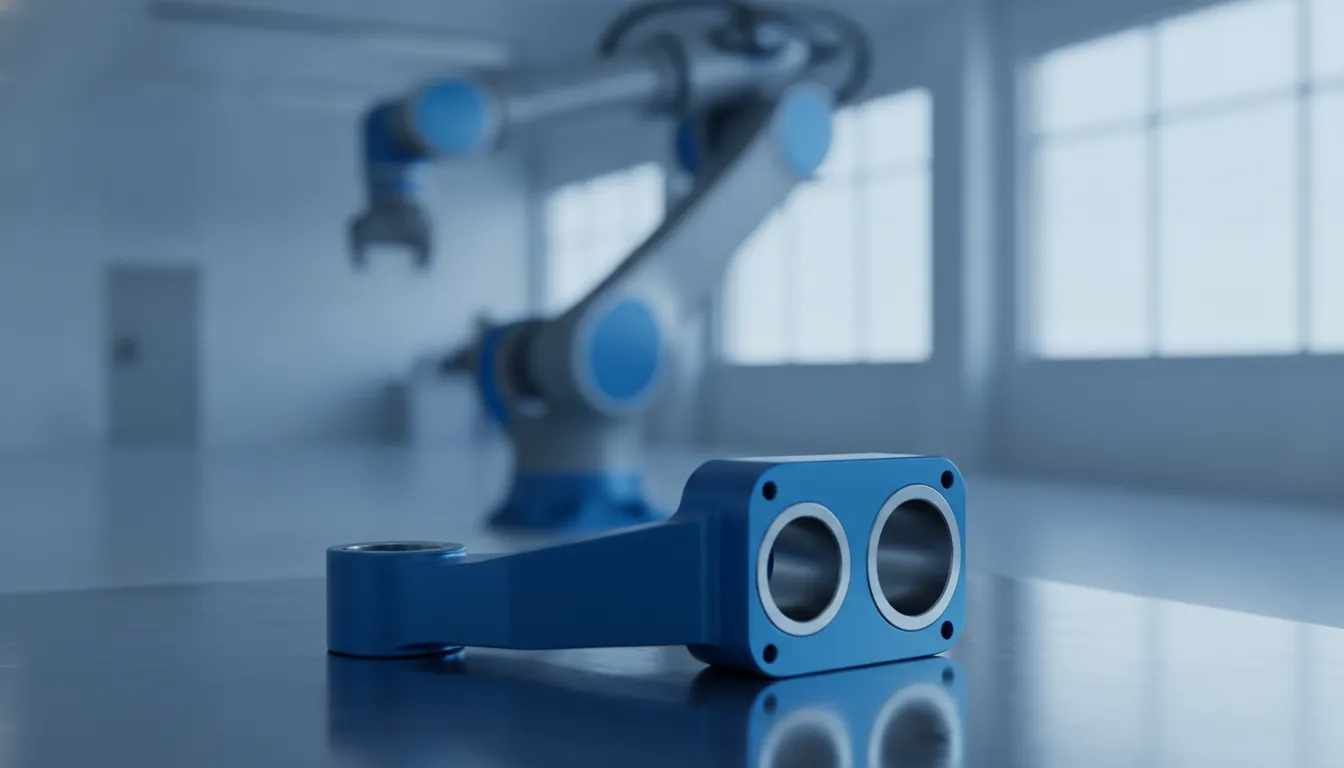
A robotic arm works like a human arm: a base, a shoulder, an elbow and a wrist, connected by joints that each add a degree of freedom. Most industrial robotic arms have six axes. Each joint has a motor or actuator, a gearbox (often a harmonic or cycloidal reducer), bearings, an encoder and a housing that holds them in line. At the end of the arm, an end effector such as a gripper, welding torch or vacuum tool does the work.
We do not build complete robots. We manufacture the mechanical components that robotic arm makers assemble into robotic systems, and we focus on the features that decide arm performance: bearing bores, gearbox mounting faces, link stiffness and weight.
| Arm type | 典型用途 | Key parts we make |
|---|---|---|
| Articulated robot (6-axis) | Welding, painting, material handling, machine tending | Base, shoulder and elbow housings, long links, wrist parts |
| Collaborative robot (cobot) | Assembly and packaging next to people | Rounded joint housings, lightweight links, flanges |
| SCARA robot (selective compliance assembly robot arm) | Fast assembly and pick and place | Arm plates, ball-screw spline mounts, covers |
| Delta | High-speed picking | Rod end fittings, base plates, motor mounts |
| Cartesian / gantry with linear axes | Large work areas, palletizing | Linear axis carriages, plates, brackets |
Links carry the load between joints. They need high stiffness for low weight, so most are machined from 6061-T6 or 7075-T6 aluminum with pockets and ribs. Stiff, light links improve repeatability and let the arm carry more payload for the same motors.
Joint housings hold the motor, reducer and bearings in perfect alignment. Bore position, concentricity and flatness of mounting faces decide gear life and accuracy, so we machine critical features in one setup on 5-axis machines and verify them by CMM.
Wrist housings and output flanges need tight bolt patterns and flat faces so tools mount the same way every time.
Gripper bodies, fingers, tool changers and vacuum manifolds, often in aluminum or POM for low weight and wear resistance.
Heavy bases from machined plate or castings, sheet metal and molded covers, and cable guides that protect the wiring through every joint.
All of these are made with our CNC machining for robotics capability, and enclosures and frames with sheet metal fabrication for robotics.
Repeatability is the headline spec of any industrial robot, next to payload and reach. A small error at the shoulder grows at the tool tip, because it is multiplied by the length of the arm. Misaligned bores also overload bearings and reducers, which shortens their life. That is why we hold ±0.01 mm on robotic components routinely and down to ±0.005 mm on critical features, with CMM verification standard on tight-tolerance work.
See the full list on our robotics manufacturing 页面。.
Our parts go into robotic arms used to weld, paint, assemble, tend machines, palletize, pack and inspect, in automotive plants, electronics factories, warehouses and labs. Industrial automation with robot cells raises productivity because a robot can run the same programme shift after shift. Leading brands such as FANUC, ABB, KUKA and Universal Robots set the benchmark, and a growing number of new arm makers are adding sensors and artificial intelligence to make arms easier to automate. Robots in the automotive manufacturing industry need rigid parts for heavy payloads; cobots for electronics assembly need light, smooth housings; lab and medical robots need clean finishes and small, precise components.
New arm designs start with a few sets of parts for testing. Our robotics prototyping service delivers functional parts from 3–7 days. When the design is frozen, we move to production batches on the same programmes and fixtures, so the hundredth arm matches the first. Standard lead times for robotic parts are 5–10 business days.