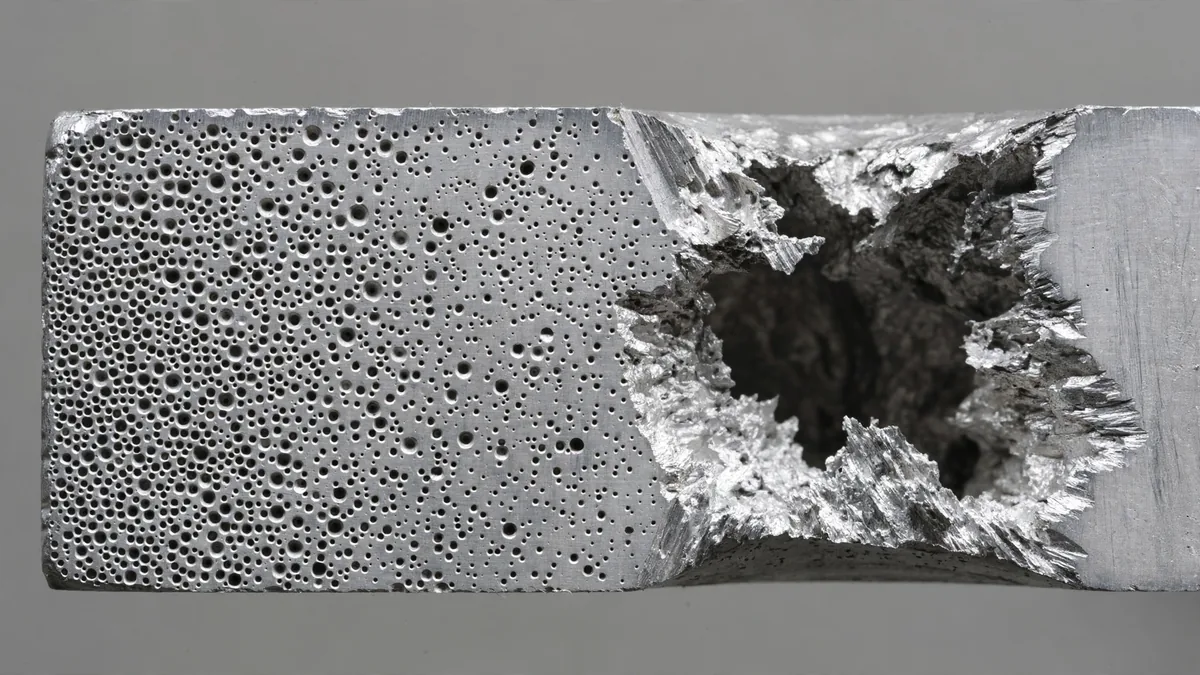
Casting defects are flaws that form in a metal casting during pouring, filling or solidification, such as porosity, shrinkage cavities, cold shuts, misruns, inclusions, hot tears and dimensional errors. Most trace back to five root causes: gas, solidification shrinkage, poor metal flow, mold or core problems, and contaminated metal. Each casting defect has a known fix.
إجابة سريعة: The most common defects are gas porosity and shrinkage porosity. Gas porosity gives smooth, round holes and is fixed by degassing the melt, venting the mold and controlling moisture. Shrinkage gives jagged, branching cavities in thick sections and is fixed with better risers, chills and more uniform wall thickness. Misruns and cold shuts mean the metal was too cold or flowed too slowly.
Telling these casting flaws apart matters, because the wrong diagnosis leads to the wrong fix. Adding a riser will not cure gas porosity, and degassing will not cure shrinkage. This guide shows how to identify each defect, what causes it, and how to stop it coming back.
| Defect | What it looks like | Main cause | تصحيح |
|---|---|---|---|
| Gas porosity | Smooth, round holes, often near the top surface | Dissolved hydrogen or trapped air | Degas melt, vent mold, dry sand and tools |
| Blowholes | Larger smooth cavities, often below the surface | Steam or gas from mold or cores | Lower moisture, improve permeability and venting |
| Pinholes | Tiny holes clustered near the surface | Hydrogen pickup, damp mold | Degas, dry materials, control pouring temperature |
| Shrinkage cavity | Jagged, rough internal void at thick sections | Volume loss on solidification, no feed metal | Correct risers, chills, uniform walls |
| Shrinkage porosity | Sponge-like network of fine voids | Poor feeding in the mushy zone | Directional solidification, risers |
| Sink (surface shrinkage) | Depression on a heavy section surface | Feeding failure near the surface | Riser or chill at the hot spot |
| Misrun | Casting incomplete; thin areas not filled | Metal too cold or too slow | Raise pour temperature, faster fill, thicker walls |
| Cold shut | Visible line or seam where two flows met | Metal fronts too cold to fuse | Hotter metal, better gating, fewer flow meetings |
| Hot tear | Ragged crack in a hot spot or corner | Restrained contraction while still weak | Fillets, collapsible cores, uniform cooling |
| Cold crack | Clean, straight crack | Residual stress after cooling | Slower cooling, stress relief, design changes |
| Slag or dross inclusion | Irregular non-metallic pockets | Oxides or slag poured with the metal | Skim, filter, bottom-pour, quiet filling |
| Sand inclusion | Embedded sand grains | Mold erosion or loose sand | Stronger mold, smoother gating, clean cavity |
| Mold shift | Step or offset at the parting line | Cope and drag misaligned | Proper pins, flask and pattern alignment |
| Core shift | Uneven wall thickness around a cored hole | Core moved or floated | Better core prints and chaplets |
| Flash (fins) | Thin metal web at the parting line | Gap between mold halves | Clamp properly, maintain die faces |
| Swell | Enlarged, bulged area | Soft mold yields under metal pressure | Ram harder, stronger sand |
| Metal penetration | Rough, sand-encrusted surface | Metal soaks into coarse sand | Finer sand, mold coatings, lower temperature |
| Warpage | Part out of shape after cooling | Uneven cooling and residual stress | Uniform walls, fixtures, stress relief |
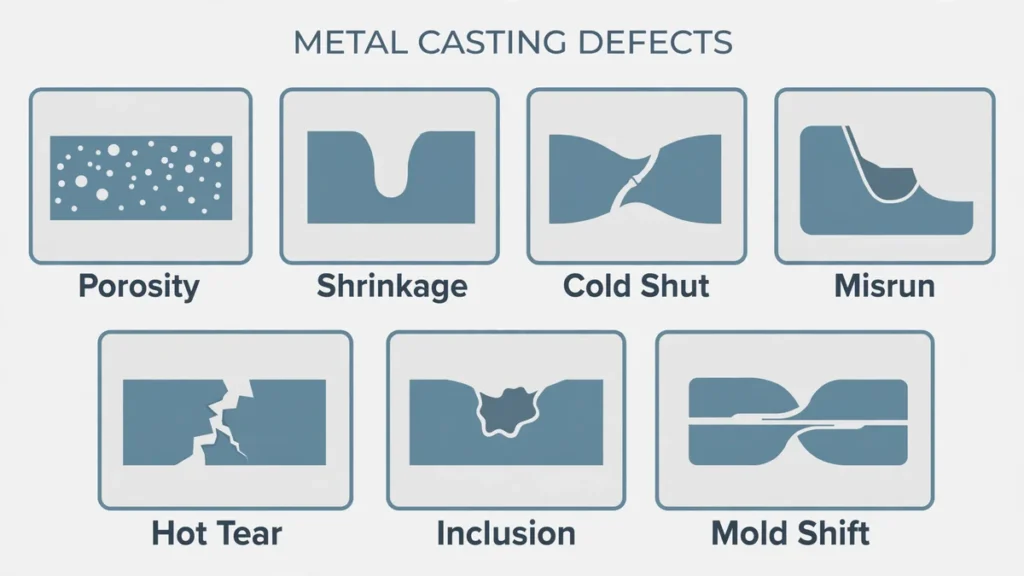
Most published lists group defects in castings by appearance. Grouping the types of casting defects by root cause is more useful on the shop floor, because one corrective action usually fixes the whole group.
Gas-related flaws form when gas cannot escape before the metal freezes. There are two sources.
Dissolved gas. Molten aluminum absorbs hydrogen from moisture in the air, wet tools, damp charge material and combustion products. Liquid aluminum holds far more hydrogen than solid aluminum, so as the metal freezes, the excess comes out of solution as small, round bubbles. That is why aluminum castings are especially prone to gas porosity, and why degassing with an inert gas (rotary degassing with argon or nitrogen) and a reduced pressure test of the melt are standard practice in good aluminum foundries.
Entrapped gas. Air or steam gets trapped when the mold fills turbulently or cannot vent. In sand casting, moisture in green sand turns to steam and forms blowholes if the sand has low permeability. In high-pressure die casting, air trapped in the die cavity is the main cause of porosity.
How to identify this casting defect: gas pores have smooth, shiny walls and are usually round. They often sit in the upper part of the casting, where bubbles rise.
Remedies:
– Degas the melt and keep pouring temperature only as high as needed.
– Preheat and dry ladles, tools and charge material.
– Control sand moisture and increase permeability; add vents at high points.
– Use smooth, non-turbulent gating and filters.
– In die casting, add overflows and vents, or use vacuum-assisted die casting.
Nearly all metals shrink as they change from liquid to solid. If liquid metal cannot flow in to replace that lost volume, a cavity forms. Shrinkage defects appear at the last place to freeze, which is usually the thickest section or a junction where walls meet.
How to tell it from gas porosity: shrinkage voids are jagged and dendritic, not smooth and round. They sit at hot spots, not at the top of the casting. This is the most important distinction in diagnosing metal casting defects, and the most common reason foundry defects get the wrong fix.
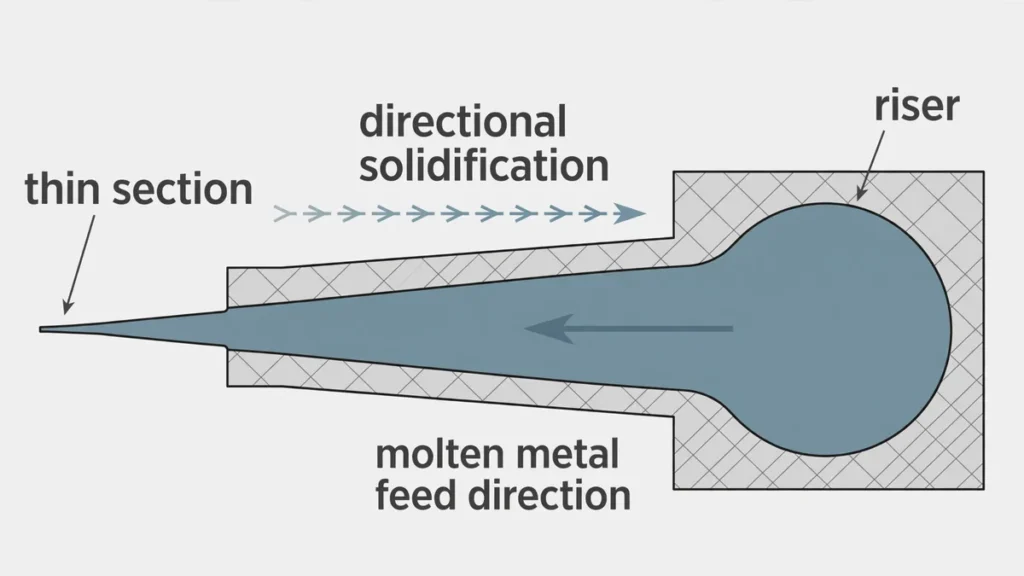
Remedies: design for directional solidification, so the casting freezes from the thin sections toward a riser that freezes last. Size risers correctly, add chills to speed cooling at isolated heavy sections, use exothermic or insulating sleeves, and keep wall thickness as uniform as the design allows.
Riser sizing and Chvorinov’s rule. Solidification time rises with the casting’s volume-to-surface-area ratio (its modulus). Chvorinov’s rule expresses this as t = B × (V/A)², where B is a mold constant. A riser must solidify after the section it feeds, so foundries size it with a modulus about 1.2 times that of the section. Simulation software now does this routinely, but the principle explains why thick sections shrink and thin ones do not.
Misrun: the metal freezes before the mold is full, leaving thin sections or edges incomplete.
Cold shut: two streams of metal meet but are too cold to fuse completely. The result is a visible line or seam, sometimes a weak plane that cracks under load.
The difference is simple. A misrun is an unfilled area; a cold shut is a filled area with an internal weak joint. Both of these casting problems come from the same causes: pouring temperature too low, filling too slow, sections too thin for the alloy, poor gating, or interrupted pouring.
Remedies: raise pouring temperature within limits (too hot adds gas pickup and shrinkage), increase gate size or filling speed, redesign gating so streams meet less often, increase thin wall sections, and avoid stopping and restarting the pour.
Hot tears form near the end of solidification, when the metal is still weak but has started to contract. If a mold or core resists that contraction, the casting tears. Hot tears look ragged and oxidized and usually appear at sharp corners or junctions between thick and thin sections.
Cold cracks are a later casting defect that forms after the casting has solidified, from residual stress during cooling, shakeout or handling. They look clean and straight.
Remedies: add generous fillets at internal corners, avoid abrupt section changes, use collapsible cores and less rigid molds, control cooling rate, and stress-relieve heavy or complex castings.
Inclusions are non-metallic particles trapped in the casting, and they are among the hardest casting flaws to see without X-ray:
Remedies: skim the melt, use ceramic filters, design gating with a sprue well and runner extension to catch the first dirty metal, keep fill velocity low, and make the mold strong enough not to erode.
These come from the tooling rather than the metal: mold shift, core shift, flash, swell, metal penetration, cuts and washes (erosion by flowing metal), scabs and rat tails (sand surface expanding and buckling), and drops (sand falling from the cope). These casting problems are most common in sand casting and are fixed with better mold strength, alignment, core support and sand control.
Each process has its own typical faults, so the defect you see also hints at where to look.
| العملية | Most common defects | لماذا |
|---|---|---|
| الصب بالرمل | Blowholes, sand inclusions, metal penetration, mold shift, swell, scabs | Moisture and sand strength drive most problems |
| High-pressure die casting | Gas porosity, shrinkage porosity, cold shuts, flow lines, flash, soldering, blisters | Very fast filling traps air; steel dies wear |
| Investment casting | Shrinkage, ceramic inclusions, misruns in thin sections, shell cracks | Thin walls and ceramic shell |
| Permanent mold (gravity) | Cold shuts, misruns, shrinkage | Metal die chills metal quickly |
| Centrifugal casting | Segregation, banding, inclusions near the bore | Density differences under rotation |
Most sand casting defects relate to the mold itself. Green sand that is too wet causes blowholes and pinholes; sand rammed too softly causes swell and penetration; poor permeability traps gas. Measuring moisture, compactability and permeability every shift prevents most of them.
Die casting defects come mainly from speed and heat. Metal is injected in milliseconds, so air in the cavity has very little time to escape, which is why porosity is the leading defect. Other die casting defects include:
Porosity is also why many high-pressure die castings are not heat-treated or welded: the trapped gas expands and blisters the surface. If a part needs that, plan for vacuum die casting or a different process early. Our guide to what die casting is covers the process and its limits, and our aluminum die casting page lists the alloys we run.
Aluminum is the most common die casting and sand casting alloy, and it has its own casting problems. It picks up hydrogen easily, so gas porosity is a more common casting defect than in steel or zinc. It forms a tough oxide skin within seconds, and turbulent pouring folds that skin into the metal as oxide films that cause leaks and early fatigue cracks. Some alloys, especially those with long freezing ranges, are also prone to hot tearing. Good aluminum practice therefore means rotary degassing, filtering, gentle bottom-up filling and alloy selection matched to the part’s wall thickness.
| الطريقة | Finds | الملاحظات |
|---|---|---|
| Visual inspection | Surface defects: cold shuts, misruns, flash, cracks, sinks | First and cheapest check |
| Dimensional inspection (CMM, gauges) | Mold shift, warpage, wrong size | Compared with drawing tolerances |
| Dye penetrant (PT) | Fine surface cracks and porosity | Non-ferrous and ferrous metals |
| Magnetic particle (MT) | Surface and near-surface cracks | Ferromagnetic metals only |
| Radiography (X-ray) and CT | Internal porosity, shrinkage, inclusions | CT gives 3D void size and location |
| Ultrasonic testing (UT) | Internal voids in thicker sections | Hard on rough, complex shapes |
| Pressure or leak testing | Leak paths through porosity | Essential for fluid-carrying parts |
| Sectioning and metallography | Microstructure, micro-porosity | Destructive; used for qualification |
Acceptance levels for internal defects are usually specified against reference radiographs. ASTM E446 covers steel castings up to 2 inches thick, ASTM E155 covers aluminum and magnesium castings, and ASTM E505 covers aluminum and magnesium die castings. Specify the standard and severity level for each casting defect type on the drawing, or acceptance becomes a matter of opinion.
Some defective castings can be saved, depending on the defect, location and customer specification.
Repair does not fix the cause of casting problems, and repaired defective castings still need re-inspection. If the same casting defect shows up in more than a few percent of parts, change the process instead of paying for repairs on every batch.
The cheapest fix for defects in castings happens before the pattern is made. Most casting defects and remedies discussions focus on the foundry, and most guides to metal casting defects stop there, but part design causes many problems.
Many of these rules mirror plastic part design; our guide to عيوب القولبة بالحقن shows the same sink and flow problems in plastics.
Porosity is the most common, in two forms. Gas porosity comes from dissolved hydrogen or trapped air and forms smooth, round holes. Shrinkage porosity comes from poor feeding as the metal solidifies and forms jagged voids at thick sections. Identifying which type you have is the first step to fixing it.
A misrun is a casting that is not completely filled because the metal froze too early. A cold shut is a casting that did fill, but two metal streams met too cold to fuse, leaving a seam or weak plane. Both are caused by low pouring temperature, slow filling or thin sections.
Degas the melt with argon or nitrogen, keep tools, ladles and charge material dry, and avoid overheating the metal. Design gating for smooth, low-turbulence filling, add vents and overflows, and use filters. In die casting, vacuum assistance reduces trapped air. Shrinkage porosity also needs correct risers or uniform walls.
Surface defects are found by visual inspection, dye penetrant or magnetic particle testing. Internal defects such as porosity, shrinkage and inclusions need X-ray radiography, CT scanning or ultrasonic testing. Pressure testing finds leak paths. Acceptance is usually judged against reference radiograph standards such as ASTM E446 or ASTM E505.
Often, yes. Small, isolated pores away from machined or sealing surfaces may be acceptable under the specified radiographic level. Interconnected porosity in pressure parts can be sealed by vacuum impregnation. Porosity in highly stressed areas, sealing faces or parts needing heat treatment or welding usually means rejection.
No casting process is free of casting flaws, so match the process to the part. Sand casting is flexible for large, low-volume parts but needs careful sand control. High-pressure die casting gives thin walls and high volume but traps air. Investment casting gives fine detail at higher cost. For prototypes and short runs of plastic parts, الصب بالتفريغ avoids many of these metal-specific problems entirely.
The pattern that works: identify the defect correctly, fix the root cause in the process or design, then confirm with inspection to a stated standard. We produce aluminum and zinc parts with our die casting service, including machining of cast surfaces through our CNC machining services. To discuss a part or a defect problem, طلب عرض أسعار أو قم بزيارة دقة تووي.
المصادر ومزيد من القراءة
– ASTM International, reference radiograph standards E446, E155 and E505: astm.org
– American Foundry Society, technical resources on casting quality: afsinc.org
Defect causes and remedies are general guidance. Acceptance levels, repair methods and process limits depend on the alloy, process and customer specification, so confirm them with your foundry and quality requirements.