是的。TUOWEI Precision 提供快速原型设计服务,以便在投入批量生产之前验证设计。原型设计可进行设计测试、及早发现问题并进行具有成本效益的调整,从而确保更顺利地过渡到全面生产。这一步骤有助于优化性能、降低风险,并确保生产就绪的部件。.
Expert plastic injection molding solutions for custom prototypes and production parts. From concept to completion, TOUWEI delivers high-quality molded components with rapid turnaround times.
Injection molding is one of the most efficient and cost-effective methods for manufacturing plastic parts at scale. The process involves injecting molten plastic into a precision-engineered mold, where it cools and solidifies into the desired shape. This cycle repeats rapidly, producing hundreds or thousands of identical components with consistent quality. Because the same mold is used for every run, costs per unit decrease significantly, making it an ideal solution for large-volume production. Compared to CNC machining or 3D printing, injection molding offers unmatched flexibility in materials, colors, finishes, and surface textures—perfect for both functional and aesthetic applications.

The plastic injection molding process requires three key elements: an injection molding machine, raw plastic material, and a high-quality mold tool. The raw material is melted inside the machine and then injected into the mold cavity, typically made from hardened steel or aluminum where it cools and solidifies into the final part. This repeatable process ensures high efficiency, low waste, and consistent output across every cycle.
Our engineers use your CAD data to create precision mold tooling using CNC machining and other advanced techniques. Once the initial parts are molded, we provide sample runs for validation and fine-tuning before moving into full-scale production. From small medical components to large, complex parts for automotive and aerospace applications, our team ensures that every product is manufactured with accuracy, speed, and reliability.

TUOWEI Precision makes it simple to move from rapid prototypes to full-scale production with high-quality, cost-effective plastic parts delivered in just days. Backed by expert engineering support, we offer comprehensive solutions including precision mold tooling, overmolding, and insert molding. Partnering with TUOWEI means faster lead times, consistent quality, and the flexibility to scale production while keeping costs competitive.
We deliver aluminum and steel molds, achieving 0.0008 in tolerances with free mold flow analysis provided.
Our overmolding process bonds plastics to substrates, creating durable, integrated products with strength, flexibility, and customizable finishes.
Insert molding combines plastics with pre-placed inserts, eliminating fasteners while enhancing strength, efficiency, and overall part performance.
TUOWEI Precision delivers advanced injection molding solutions with tight tolerances. Our capabilities guarantee consistent, high-quality production with efficiency and reliability for projects across diverse industries.
| Plastic Injection Molding Service | Tolerance |
|---|---|
| Standard Plastic Injection Molding | ±0.005" (±0.127 mm) |
| High-Precision Plastic Molding | ±0.001" (±0.025 mm) |
| Plastic Molding for Large Parts | ±0.010" (±0.254 mm) |
| Plastic Molding with Thin Walls | ±0.005" (±0.127 mm) |
| High-Volume Plastic Molding | ±0.003" (±0.076 mm) |
TUOWEI Precision ensures reliable injection molding tolerances, delivering consistent accuracy and quality for every project.
| Design Element | Guideline |
|---|---|
| Wall Thickness | Uniform thickness of 1.5 mm to 3 mm is recommended. |
| Radii and Corners | Minimum radius of 0.5 mm for internal corners. |
| Draft Angles | Draft angle of 1° to 2° is recommended on vertical walls to ensure smooth part ejection. |
| Undercuts | Use side actions or lifters to accommodate undercuts. Proper mold design is necessary for parts with undercuts. |
| Tolerances | Standard tolerance of ±0.1 mm. For tighter tolerances (±0.01 mm). |
| Text and Logos | Minimum engraving depth of 0.1 mm and width of 0.5 mm. |
| Holes and Features | Minimum hole diameter of 1.5 mm. For holes larger than 5 mm. |
| Parting Line and Gate | Gates should be placed to minimize defects, and parting lines should be positioned in non-visible areas. |
| Material Selection | Choose appropriate materials such as ABS, polycarbonate, or nylon. |
Following are the surface finishing techniques used to enhance the appearance and functionality of molded parts:
Polishing removes imperfections and burrs from the surface, providing a smooth, glossy finish on the molded parts.
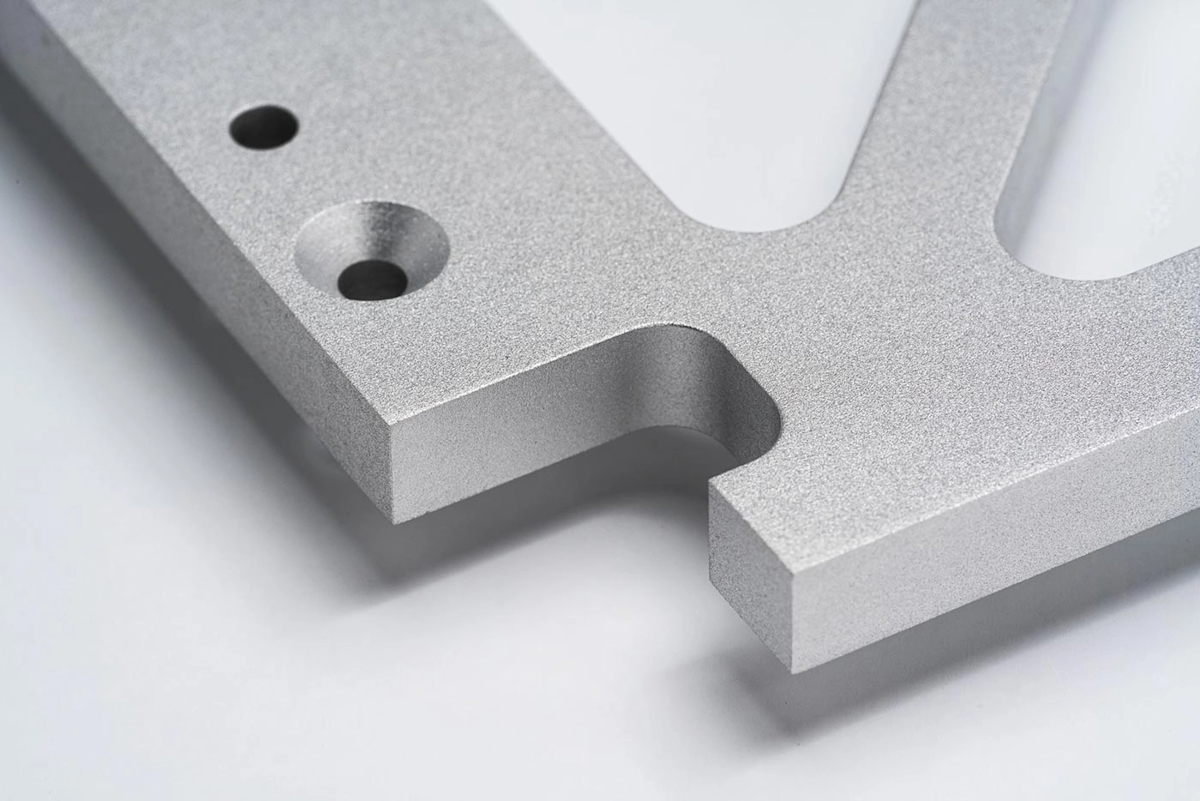
Bead blasting creates a consistent matte surface finish that helps mask any mold lines or imperfections on quick-turn parts.
Texturing adds visual appeal and grip to the surface of the part, commonly used for quick-turn consumer goods with tactile requirements.
Laser engraving is used for precise marking or part identification, allowing for high-speed production without compromising quality.
Vibratory finishing is used to smooth rough edges and surfaces, ensuring quick-turn molded parts meet both aesthetic and functional standards.
Electroplating applies a thin metal coating, enhancing the part’s appearance, wear resistance, and corrosion protection.
Engineers and leading manufacturers trust TUOWEI for fast iterations and durable, high-performance parts. Whether for prototyping or full-scale production, our extensive material selection ensures precision, strength, and reliability for any CNC machining project.
General-purpose ABS
High-Impact ABS
Flame Retardant ABS
Medical ABS
Low-Density Polyethylene (LDPE)
High-Density Polyethylene (HDPE)
Linear Low-Density Polyethylene (LLDPE)
General-purpose PS
High-Impact PS
Crystal PS
Rigid PVC
Flexible PVC, CPVC
High-Impact PVC
Nylon 6
Nylon 6/6
Glass-Filled Nylon
Heat-Resistant Nylon
Homopolymer POM
Copolymer POM
Glass-Filled POM
Styrenic Block Copolymers (SBC)
Thermoplastic Vulcanizates (TPV)
Thermoplastic Polyurethane (TPU)
PET
PET-G (glycol-modified)
PET-High Crystallinity (HCPET)
Rigid PU
Flexible PU
TPU (Thermoplastic Polyurethane)
Noryl (PPO blended with polystyrene)
High-Temperature PPO
With Tuowei Precision’s CNC milling service, you’re not just investing in advanced machinery. You’re gaining the assurance of flawless precision, commitment to strict timelines, and the expertise of skilled professionals dedicated to meeting your needs.
Tuowei Precision’s ISO-certified CNC machining guarantees exceptional accuracy and quality. Every part is crafted for perfect fit and flawless performance, with rigorous quality control at each stage.
Stay on schedule with Tuowei Precision. Our state-of-the-art equipment and local workshops deliver rapid production to meet your tight deadlines.
Rely on our team for comprehensive CNC machining support. Our experts are available to optimize design efficiency and ensure top-quality results at every step.
At TUOWEI Precision, quality is at the core of every project. From design to production, our cross-functional reviews and rigorous checks ensure superior results, delivering up to a 90% first-pass yield on all plastic molded parts.
Mold and Pre-Production Inspection
We start with precision mold design and thorough pre-production reviews. Our engineers carefully evaluate geometry, material flow, and cooling systems to ensure seamless processing. Trial runs are conducted to confirm mold performance, guaranteeing stability and consistency before full-scale production.
In-Process Quality Control
During manufacturing, strict monitoring ensures reliability at every stage. Key injection parameters—including temperature, pressure, and speed—are maintained within defined limits. Regular dimensional and visual checks help detect deviations early, reducing waste and ensuring consistent product quality.
Final Inspection
Before delivery, all parts undergo comprehensive final inspection. Our team evaluates dimensions, surface quality, and physical performance using advanced tools such as CMMs and colorimeters. This ensures every component meets both customer requirements and TUOWEI’s strict internal standards.
APPLICATIONS
Injection molding is a highly efficient process used to manufacture a wide range of products, from automotive components to medical devices. It delivers consistent, high-quality parts with tight tolerances at a low cost per unit, making it the preferred choice for mass production across industries.
Advantages
Injection molding is a highly efficient process used to manufacture a wide range of products, from automotive components to medical devices. It delivers consistent, high-quality parts with tight tolerances at a low cost per unit, making it the preferred choice for mass production across industries.
从详细的原型到大批量生产,TUOWEI 是您值得信赖的精密 CNC 加工合作伙伴。今天就联系我们,迈出简化、高质量制造解决方案的第一步。.
Injection molding includes a range of specialized methods, each designed to suit different materials, geometries, and production goals, making it possible to manufacture anything from micro-scale components to large, intricate parts with precision and efficiency.
This is the most common process, where molten plastic is injected into a metal mold to form high-precision parts. It’s ideal for mass-producing identical items quickly and cost-effectively.
Advantage: Excellent for high-volume production with consistent quality.
Limitation: High upfront tooling costs make it less economical for small runs.
Overmolding combines two or more materials in one part by molding a secondary material over a base component. Often used for ergonomic grips, soft-touch surfaces, or sealing functions.
Advantage: Enhances product functionality and aesthetics without extra assembly.
Limitation: Requires complex mold design and careful material compatibility checks.
In this process, pre-made inserts (like metal parts) are placed into the mold, and plastic is molded around them. Common in electronics and automotive applications.
Advantage: Strong bonding between components and reduced assembly steps.
Limitation: Manual placement of inserts can slow production if automation is not used.
Gas is injected into the molten plastic inside the mold to create hollow sections, reducing weight and material use. Often used for large, thick-walled parts.
Advantage: Produces lightweight yet strong components with minimal warping.
Limitation: Higher equipment and process complexity compared to standard molding.
This method manufactures extremely small and precise components, often under 1 gram in weight. Widely used in medical devices, electronics, and micro-mechanics.
Advantage: Unmatched precision for tiny, intricate designs.
Limitation: Specialized machinery and expertise are required, increasing costs.
Injection molding can present hurdles such as defects, material inconsistencies, and dimensional variances, these challenges are overcome through advanced engineering, precise mold design, and rigorous quality control, ensuring flawless results from the first shot to the millionth.
The Challenge: Warping occurs when different sections of a molded part cool at different rates, causing bending or twisting. This can compromise part fit and function, especially in high-precision industries like automotive or medical.
TUOWEI’s Solution: We use advanced mold temperature control systems and uniform cooling channel designs to ensure even cooling, along with material selection strategies to reduce shrinkage rates.
The Challenge: Sink marks small depressions on the surface happen when thicker sections cool unevenly, leading to cosmetic and structural defects.
TUOWEI’s Solution: Our engineers optimize part geometry in the design phase, adjust packing pressure profiles, and use simulation software to predict and eliminate sink mark risks before production.
The Challenge: Flash refers to excess material seeping out at mold parting lines, which requires post-processing and increases production costs.
TUOWEI’s Solution: We maintain precision tooling with tolerances as tight as ±0.005 mm, perform regular mold maintenance, and use clamping force calibration to prevent material leakage.
The Challenge: Short shots occur when molten material doesn’t completely fill the mold cavity, resulting in missing sections or weak spots in the final part.
TUOWEI’s Solution: We optimize injection pressure, gate design, and melt temperature, combined with real-time monitoring systems to ensure complete mold filling every cycle.
The Challenge: Overheating, excessive residence time, or poor mixing can degrade materials, causing brittleness, discoloration, or reduced performance.
TUOWEI’s Solution: Our automated material handling and drying systems control moisture and temperature precisely, while our color masterbatch blending ensures consistent aesthetics across large production runs.
无论您是创建小批量定制零件,还是扩大规模进行大批量生产,拓威 Proto 服务都能为您提供所需的灵活性。.
数控快速原型加工是创建工程或生产原型的完美选择,这些原型在外观和功能上都与最终产品非常相似。在拓维,我们提供即时报价和快速交付,为您提供精确、高质量的 CNC 加工原型,以满足您的需求。.
小批量数控加工通常是新兴产品从原型设计到批量生产之间的桥梁。有了拓威,这一过程变得更加简单、高效和经济,使您能够在保持高质量标准的同时迅速扩大生产规模。.
数控生产加工是高效生产千件或更多零件的最佳解决方案。拓威利用多样化的材料选择、自动化和多轴加工能力,实现了大批量生产,具有公差小、尺寸精度高、可靠性高和周转时间短等特点。.
了解拓威团队的专业技巧、行业趋势和精密制造见解,保持领先地位。阅读我们的最新博客,获取有价值的知识,了解我们如何塑造数控生产的未来。.
在大规模生产之前,我能否获得原型部件?
是的。TUOWEI Precision 提供快速原型设计服务,以便在投入批量生产之前验证设计。原型设计可进行设计测试、及早发现问题并进行具有成本效益的调整,从而确保更顺利地过渡到全面生产。这一步骤有助于优化性能、降低风险,并确保生产就绪的部件。.
注塑成型的成本是多少?
价格取决于零件尺寸、模具复杂程度、模腔数量、所选材料和加工要求。每个项目都是独一无二的,因此 TUOWEI Precision 可根据您的规格要求提供定制报价。这种透明的方式可确保您预先了解成本。上传您的 CAD 文件和要求,我们的团队将为您提供详细的估价。.
什么是最小订购量?
TUOWEI Precision 的注塑成型服务没有最低订单要求。无论您需要的是一个原型还是数千件产品,我们都能为您提供同样的质量承诺。由于规模经济,大订单可节省成本,使批量生产的单价更实惠。.
注塑成型零件的典型公差是多少?
TUOWEI Precision 在一般公差方面遵守 ISO 2768-c 标准,确保部件生产的一致性和可靠性。对于需要更严格规格的项目,我们会根据每个客户的需求提供更严格的公差。这种灵活性保证了零件的精确装配和正常功能,并满足航空航天、汽车、电子和医疗设备等行业的苛刻要求。.
注塑成型的 4 个阶段是什么?
注塑成型是一个系统化的过程,有四个关键步骤可确保生产出高质量、高精度的塑料零件:锁模:牢牢夹住两半模具,防止注塑过程中发生泄漏 注塑:熔融塑料在高压下注入模腔,以实现完全填充。.
冷却顶出:顶出:凝固后,部件从模具中顶出,循环再次开始。.